FREE OF
- Added Sugars
- Artificial Sweeteners
- Artificial Colors
- Artificial Flavors
- Chew Fillers
Your Cart
Choose the formula built for what you want to support.
Choose Your System32 science-backed healthspan actives for longevity and comfort. Selected for quality, bioavailability, and biological purpose.

Park et al. showed oral astaxanthin is absorbed dose-dependently in dogs and cats, with substantial localization in leukocyte mitochondria. That makes it a rare two-species antioxidant anchor.

Blueberry is not positioned as a concentrated extract. It adds whole-fruit polyphenol character and supports the phytonutrient base alongside spirulina, resveratrol, and quercetin.

CoQ10 sits inside the electron transport chain and also acts as a lipid-phase antioxidant. Its role is mechanistic and nutritional, not a stand-alone performance claim.

Dogs and cats synthesize vitamin C endogenously, so this is intentionally modest. Its role is network support, especially alongside vitamin E and other redox-active nutrients.

Reduced L-glutathione is paired with riboflavin and vitamin B6, cofactors connected to glutathione recycling and amino-acid metabolism. The point is system support, not a single heroic antioxidant.

Whey protein isolate contributes amino-acid support and palatability. It is not a primary protein source; its role is to support the formula's glutathione and food-matrix architecture.

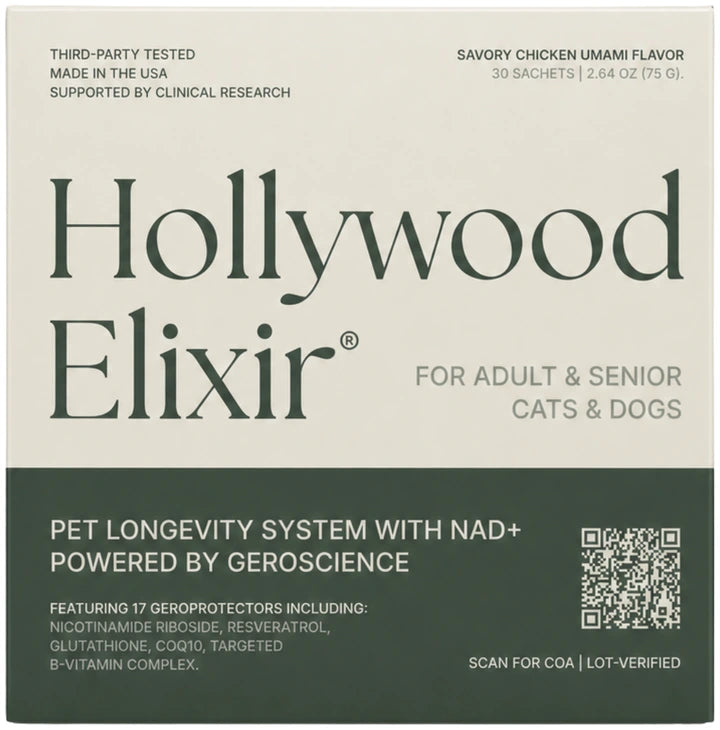
NAD+ biology is strong in aging research, and human data show NR can raise NAD+ levels.
Companion-animal evidence is emerging, so this sits in a translational layer.

Quercetin absorption has been characterized in dogs. The dihydrate 95% form is included as a flavonoid companion to resveratrol, vitamin C, and the immune-balance system.

Reishi has canine research in immune-cell and antibody-response contexts. This 35% polysaccharide extract is positioned as a mushroom complement to yeast beta-glucan.

Trans-resveratrol has been fed orally in published dog and cat studies and is used here as one polyphenol node in the formula's redox and aging-biology network.

Spirulina is used as a food-matrix phytonutrient base. Canine studies associate it with antioxidant capacity and immune support, but the page should keep the claim at structure-function level.

The 1,3/1,6 yeast form has oral canine research on immune-response and skin-condition markers. Hollywood Elixir uses it as an immune-balance anchor without extending dog findings to cats.

Cobalamin status can matter more with age and digestive variability. This methylcobalamin source supplies a direct B12 form within the broader energy and nervous-system support system.

Vitamin E is an essential nutrient for dogs and cats. In antioxidant systems, it works in the lipid phase and can be supported by vitamin C recycling.

Pyridoxal-5-phosphate is the metabolically active B6 form. It supports more than one hundred enzyme reactions and helps integrate protein metabolism with the glutathione support system.

As FAD, riboflavin powers enzymes involved in energy production and glutathione reductase, the enzyme that helps regenerate reduced glutathione inside the antioxidant network.

Niacin is a classical NAD+ substrate. Dogs and cats both need it, and cats have limited conversion from tryptophan, making dietary niacin especially foundational.
No ingredients found for this filter.

MSM is placed in the translational layer because its role is best understood as part of a broader sulfur, connective-tissue, and structural maintenance system.

L-Carnitine is not a cosmetic active by itself; it supports the wider repair-and-turnover logic of the formula alongside protein, zinc, and lipid inputs.

Zinc is one of the formula’s direct pet-relevance inputs because canine skin and coat literature repeatedly ties zinc status to barrier and keratinized tissue health.

Hyaluronic acid sits at the hydration layer, translating connective-tissue and dermal hydration biology into a daily pet formula context.

Omega 7 supports the lipid architecture logic of the formula, complementing omega 3-6-9 and ceramides rather than duplicating them.

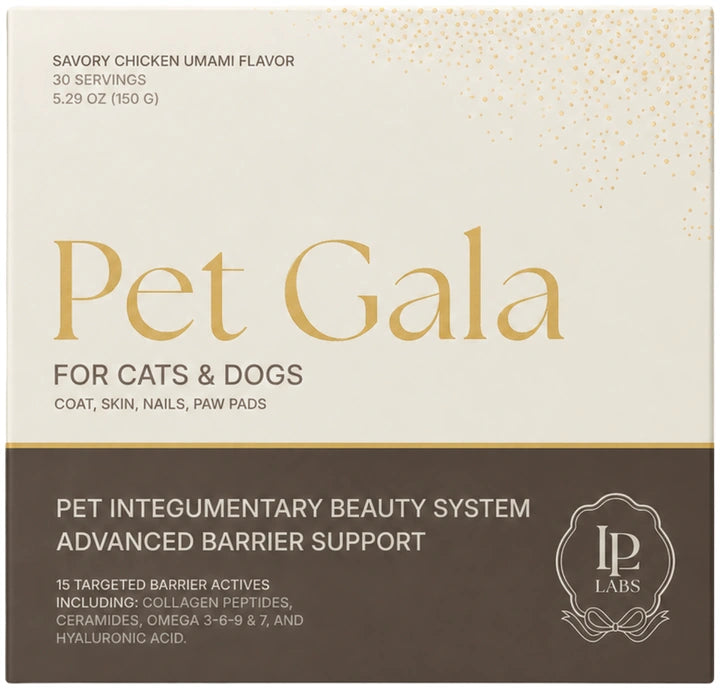
Omega fatty acids anchor the lipid-barrier side of Pet Gala, with canine coat-quality and skin-barrier literature forming a direct evidence layer.

Gelatin sits in the foundational layer: not a standalone claim, but part of the protein-and-matrix architecture that supports skin and coat maintenance.

Pet Gala uses collagen peptides as part of a wider structural matrix system alongside gelatin, bone broth, hyaluronic acid, silica, and zinc.

Ceramides are the barrier-first anchor of Pet Gala, informed by canine skin-barrier research and supported by the formula’s broader lipid system.

Silica is mapped as translational biology: it supports the structural framework around collagen, keratin, and matrix maintenance.

Bone broth contributes to the formula’s structural nutrition logic without replacing complete and balanced daily food.

Biotin belongs in the foundational nutrition layer: useful for skin, coat, and nail biology, but not a substitute for complete nutrition or veterinary diagnosis.

Hydrolyzed whey complements collagen and gelatin by broadening the amino-acid profile behind coat protein and epidermal renewal support.
No ingredients found for this filter.


Most supplements target one area at a time.
The Pampered System is designed differently — supporting internal health, visible vitality, and everyday comfort together, as a coordinated whole.
You’re covering the systems that shape how your pet feels, functions, and shows up—day after day.
Not more products. Just a more complete approach.