MSM for Dogs

What MSM can offer, what dog studies found, and how to choose a daily product

By La Petite Labs Editorial 14 min read

Woman cuddling a golden retriever and a collie beside a Pet Gala box and a food bowl
Pet Gala™ Daily skin & coat system · adult & senior dogs Starting at $56/month 

MSM for Dogs

What MSM can offer, what dog studies found, and how to choose a daily product

During inflammation, immune cells release chemical messages that help organize the response. MSM, a sulfur-containing compound, reduced this activity in mouse-cell experiments. 1

In dogs with arthritis, an MSM-containing chew showed no clear gait advantage, while a complete joint diet improved some owner ratings. Both combined MSM with other ingredients. 2 3 Pet Gala includes MSM in a skin-and-coat formula. 12 The choice starts with what you want to add: a particular joint preparation, or MSM alongside ingredients selected for skin and coat.

An MSM-containing chew showed no significant gait advantage; a small joint-diet trial improved some owner ratings. Visible coat benefit was unproven in poodles. 2 3 6 The amount in the whole daily portion matters, along with the accompanying ingredients, food acceptance and any medicines.

What MSM is

MSM stands for methylsulfonylmethane. 1

The short entry “MSM” identifies an ingredient, while the full product name identifies what you would give. Two preparations can share that entry and still contain very different combinations. Check the ingredients alongside it before treating one product as a substitute for another.

Woman cuddling a golden retriever and a fluffy white dog while holding a Pet Gala box beside a food bowl

How MSM changed inflammatory signals in the laboratory

An immune cell can respond by activating genes: instructions for making proteins, including chemical messages involved in inflammation. A protein called NF-κB helps activate those genes once it reaches the nucleus, where the instructions are held. An inhibitor normally keeps it outside.

In mouse cells challenged with a bacterial component, MSM reduced the inhibitor’s breakdown. More of that restraint remained, less NF-κB entered the nucleus, and production of inflammatory substances fell. 1

Woman holding a Pet Gala box beside a curly-coated brown dog outdoors

The 2023 joint-chew trial

A 2023 trial compared several treatments in dogs with hip osteoarthritis. Its MSM chew also contained glucosamine, chondroitin and avocado/soybean unsaponifiables; 16 of the 75 dogs analyzed received that blend.

A force plate measured how much weight the most affected hindlimb took during a controlled trot. The blend showed no significant advantage over placebo over six weeks. 2

Woman cuddling a Dalmatian while holding a Pet Gala box

A newer joint diet improved some owner ratings

Ten small-breed dogs with osteoarthritis ate both a control food and a lower-energy joint diet containing MSM, omega-3s and other ingredients.

Owners rated stiffness, function, gait and quality of life. The overall orthopedic-index score and its quality-of-life part improved; separate pain-questionnaire and veterinary scores did not differ significantly. Weight fell more. 3

Each dog had eight weeks on joint food and four on control, without a washout or objective gait assessment. This whole-diet finding does not isolate MSM.

Cream-colored dog resting on a person's lap beside a Pet Gala box and a food bowl

When getting up or walking becomes harder

A slower rise from bed or a newly shortened walk is worth describing to your veterinarian. A short video can show a change that is less obvious during an appointment. Pain can be overlooked when altered movement is attributed to age. 4

The plan may include medicines, weight management, rehabilitation and changes at home. A nonslip route across a smooth floor, for example, addresses footing. 4 Bring the supplement you are considering into that conversation with its full label, so it can be assessed alongside the care your dog needs.

In mouse immune cells, MSM reduced the release of inflammatory substances.

Sulfur does not make MSM dietary protein

Food protein supplies amino acids, the smaller molecules used to build the body’s proteins. Dogs need methionine, a sulfur-containing amino acid, in their diet. 5 MSM is a different molecule. 1 Its sulfur content does not make a serving interchangeable with protein or methionine.

Keep complete food as the nutritional foundation. The optional addition is a separate choice; the word “sulfur” on a supplement is not evidence that the main diet is lacking it.

For the actual protein ingredients, the hydrolyzed whey guide explains processing and milk-source distinctions. The marine collagen guide separates fish-derived peptides from the collagen in skin and the protein in hair.

Hand lifting a sachet from an open Pet Gala box beside a dog's long golden coat

What the poodle coat study found

Thirty-two adult poodles received a control diet, added MSM, added myo-inositol or both, with eight dogs per group. Hair length and overall observer coat scores did not differ significantly.

There was a microscopic finding: the outer hair scales were thinner in the myo-inositol and combination groups than in controls. MSM alone did not show that difference. 6 Faster growth or a visibly better coat was not demonstrated.

Woman leaning toward a golden retriever in a kitchen while holding a Pet Gala box

Itching and hair loss need their own explanation

Hair growth responds to nutrition, hormones, illness, medicines and the environment. 7 Persistent itching or hair loss deserves an assessment of its cause; appearance alone cannot tell you which ingredient to add.

Be especially careful during a veterinary elimination diet. That trial deliberately controls what the dog eats, and supplements or flavored medicines can introduce ingredients that interfere with it. 8 Agree on any addition with the clinician running the trial before putting it in the bowl.

Man cuddling two dogs while holding a Pet Gala box

Why MSM is included in Pet Gala

Skin has several needs at once. Dietary protein supplies amino acids for making tissue. 5 Skin’s outer lipid barrier helps limit water loss. 7 Hyaluronic acid, or HA, forms part of the water-rich material around cells. 9

Pet Gala combines MSM with protein ingredients, ceramides, fatty-acid ingredients and HA. 12 The recipe pairs nutrition for skin structure and moisture with a compound studied for reducing inflammatory activity in mouse cells. 1 For someone seeking those ingredients together, it provides that skin-and-coat combination in one powder.

The research has not demonstrated the finished Pet Gala formula’s effects or shown that its ingredients work better together. The Pet Gala ingredient guide shows the composition. For the companion hydration ingredient, the HA for dogs guide explains its properties and the oral research.

How much MSM should a dog receive?

The canine trials do not establish a universal effective MSM-only dose. The chew’s amount was set by glucosamine content; the joint diet listed MSM per quantity of food energy. 2 3

Neither provides a serving for a different bottle or sachet. Follow the applicable product directions and the plan agreed for your dog. 10 If the portion is unclear, resolve it before giving the product. A research concentration cannot fill in missing feeding instructions.

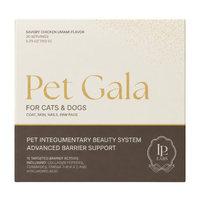
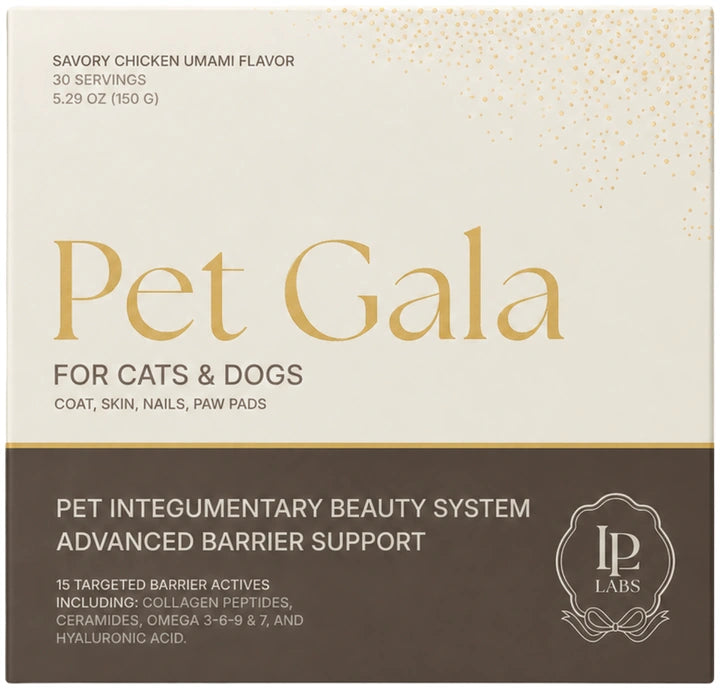
A standard Pet Gala sachet contains 100 mg MSM within 2.5 g of powder.

Woman in a white coat sitting with a pug while holding a Pet Gala box

DVM Voice: Clinical Vignette of When Skin Changes Point Deeper Than the Surface

Case contributed by Sarah Calvin, DVM

Rosey, a 10-year-old Shih Tzu, was brought in after two weeks of paw redness and head shaking. Her owner had also noticed lower energy, thinning abdominal hair, and mild generalized itchiness over the previous few months.

Examination showed inflammation in the ears, skin folds, and paws. Testing confirmed mixed yeast and bacterial infections, while parasites and fungal disease were ruled out. Because Rosey’s skin changes appeared alongside reduced energy and coat thinning, her veterinarian performed a broader workup, which revealed hypothyroidism as a likely underlying contributor.

Her care required a staged approach: treating the infections, addressing the thyroid imbalance, and then restoring the skin barrier through diet, bathing support, paw care, and omega-3 supplementation.

Six months later, Rosey’s owner reported a thicker coat, fewer tangles, less breakage, no itch, and restored energy.

Clinical takeaway: Rosey’s case shows why skin and coat changes should not be treated as cosmetic alone. Healthy skin depends on immune balance, endocrine health, nutrition, barrier integrity, and daily support for resilient coat growth.

Single-case vignette. Not generalizable. Veterinary diagnosis and oversight are essential for itching, redness, ear irritation, hair thinning, recurrent infections, or suspected endocrine disease.

Explore Pet Gala Research →
Woman smiling beside a chocolate-brown dog while holding a Pet Gala box

What is inside the portion you give?

A standard 2.5 g Pet Gala sachet contains 100 mg MSM. The sachet weight includes every ingredient. Half, one and two sachets therefore contain 50, 100 and 200 mg MSM, respectively. 11

These are portion calculations, not established MSM treatment doses.

Hand petting a brown dog beside a Pet Gala box and a bowl of food

Powder, chew, capsule or liquid?

Picture how the selected portion will reach your dog. A counted chew or capsule provides a unit; a powder or liquid needs the measure specified for that product. Choose units you can give accurately and a format your dog accepts.

To compare effectiveness, look for a study of the actual preparations being compared. The shape of a chew or the word “liquid” cannot supply that evidence.

A human product has its own full ingredient list and directions. Matching the name “MSM” does not make it a canine substitute. Have the complete label checked before using it.

German shepherd raising a paw beside a Pet Gala box on a small table

Keep the meal workable

Mix the selected Pet Gala serving into usual food and serve immediately. 11 A partly eaten meal leaves the amount taken uncertain.

Repeated refusal is a reason to reconsider the addition or its format. Easy measurement saves little effort if breakfast becomes a daily struggle. Discuss repeated refusal with your veterinarian or pharmacist.

Do not double a later dose to make up for a missed one. 10

Side effects and a suspected reaction

Possible effects include digestive upset, diarrhea, appetite loss, tiredness or restlessness. Stop the supplement for unusual changes and contact your veterinarian; call promptly for suspected overdose. Bring the product, estimated amount, dog’s weight and symptoms. 10

If the product contains several ingredients, a reaction does not identify MSM as the cause. Keep the packaging available: the complete mixture is what your dog received.

Medicines, life stages and overlapping products

Ask your veterinarian about combining MSM with nonsteroidal anti-inflammatory drugs (NSAIDs), often used for pain, or anticoagulants. Avoid MSM during pregnancy or nursing, and in dogs allergic to it. 10

With kidney or liver disease, effects may last longer; review use beforehand and bring every medicine and supplement label. 10

Pet Gala contains MSM; its puppy directions call for veterinary guidance. 11 Two differently named products may duplicate ingredients. Review the proposed addition alongside existing care, and keep prescribed pain treatment in place unless the treating veterinarian changes it.

Man leaning toward a golden retriever while holding a Pet Gala box beside a food bowl

When to review the result

The trials provide no reliable MSM-only timetable. 2 3 Agree on a review point that fits the reason for trying the product.

Choose one familiar activity, such as getting up from the usual bed, and take a short starting video. Revisit it with your veterinarian. 4 A few notes about changes in food, exercise or medicines give that comparison context; you do not need to turn daily care into an experiment.

At review, include whether the portion is eaten, whether it is tolerated and whether continuing feels worthwhile. A worsening problem needs attention when it happens, rather than waiting for the planned date.

Brown-and-white dog raising a paw beside a Pet Gala box held in a person's hand

Compare the daily portion and the documentation

Compare the amount in the portion you would actually give, then work out how many days the package lasts. For a hypothetical 30-unit package, one unit a day lasts 30 days; two last 15. Divide its price by those usable days to compare daily cost. These are arithmetic examples, not serving directions.

For a purity claim, ask which preparation and batch the testing describes. A trademark or a large front-label number cannot answer that. Testing the contents and testing a clinical benefit are different tasks: a document confirming what is in the powder is not a dog trial showing what it does.

Choosing MSM for joints or coat

For joint discomfort, bring the intended supplement and its full label to the pain-care discussion. Your veterinarian can assess how it fits the treatment, food and daily movement plan.

If you want MSM together with Pet Gala’s skin-and-coat ingredients, explore Pet Gala for the formula and current serving directions. 11 Compare the full portion with what your dog already receives before adding another product.

For a cat in the same household, the MSM for cats guide covers the separate feline study and feeding context.

Doubling a Pet Gala portion doubles the other ingredients along with its MSM.

Educational content only. This material is not a substitute for veterinary advice. Always consult your veterinarian about your dog’s specific needs. These statements have not been evaluated by the Food and Drug Administration. Products mentioned are not intended to diagnose, treat, cure, or prevent any disease.

Glossary

MSM: Methylsulfonylmethane, a sulfur-containing compound.

NF-κB: A protein involved in switching on inflammatory genes.

Amino acid: A small molecule used to build proteins.

Cuticle: The outer layer of a hair shaft, made of overlapping scales.

Whole-product serving: The portion of the complete formula, including all its ingredients.

Related Reading

References

Numbered references identify the sources used for specific claims. Read the study design, species and evidence boundaries alongside each finding.

  1. Yoon Hee Kim et al. The Anti-inflammatory Effects of Methylsulfonylmethane on Lipopolysaccharide-Induced Inflammatory Responses in Murine Macrophages. 2009· DOI 10.1248/bpb.32.651Species/context: Mouse immune cellsEvidence boundary: Mouse-cell experiments examined the inflammatory response and NF-κB activity.↩ 1 · ↩ 2 · ↩ 3 · ↩ 4 · ↩ 5
  2. Naruepon Kampa et al. Study of the effectiveness of glucosamine and chondroitin sulfate, marine based fatty acid compounds (PCSO-524 and EAB-277), and carprofen for the treatment of dogs with hip osteoarthritis: A prospective, block-randomized, double-blinded, placebo-controlled clinical trial. 2023· DOI 10.3389/fvets.2023.1033188Species/context: Dogs with hip osteoarthritisEvidence boundary: Six-week comparison of oral treatments, including a four-ingredient MSM chew.↩ 1 · ↩ 2 · ↩ 3 · ↩ 4 · ↩ 5
  3. Dohkyung Lee et al. Clinical Effects of a Prescription Joint Diet in Small-Breed Dogs with Osteoarthritis. 2026· DOI 10.17555/jvc.2026.43.2.94Species/context: Small-breed dogs with osteoarthritisEvidence boundary: A ten-dog crossover tested a complete joint diet, including MSM.↩ 1 · ↩ 2 · ↩ 3 · ↩ 4 · ↩ 5
  4. American Animal Hospital Association. Pain Management — 2023 AAHA Senior Care Guidelines for Dogs and Cats. 2023 guidelines; page 2022Species/context: Senior dogs and catsEvidence boundary: Guidance on recognizing pain, reviewing movement and combining treatments with changes at home.↩ 1 · ↩ 2 · ↩ 3
  5. Sherry Lynn Sanderson. Nutritional Requirements of Small Animals. Updated 2024Species/context: Dogs and catsEvidence boundary: Veterinary nutrition reference explaining dietary protein and essential amino acids.↩ 1 · ↩ 2
  6. Jie Zhang et al. Dietary Supplementation with Methylsulfonylmethane and Myo-Inosito Supports Hair Quality and Fecal Microbiome in Poodles. 2024· DOI 10.3390/ani14243643Species/context: Adult poodlesEvidence boundary: Four diets compared MSM, myo-inositol, both or neither; visible coat scores did not differ.↩ 1 · ↩ 2
  7. Karen A. Moriello. The Integumentary System in Animals. Updated 2025Species/context: Animal skinEvidence boundary: Veterinary account of the skin barrier, supporting tissues and factors influencing hair growth.↩ 1 · ↩ 2
  8. Cherie M. Pucheu-Haston. Cutaneous Food Allergy in Animals. Updated 2025Species/context: Dogs and cats; food allergyEvidence boundary: Explains diagnostic diet restrictions, including supplements and flavored medicines.↩
  9. Melanie Simpson et al. Hyaluronan — Essentials of Glycobiology, 4th edition, Chapter 16. 2022· DOI 10.1101/glycobiology.4e.16Species/context: Animal biochemistryEvidence boundary: Explains hyaluronan’s physical roles in water-rich tissues.↩
  10. Alison Hamilton et al. Methylsulfonylmethane (MSM). Updated 2026Species/context: Pets; veterinary guidanceEvidence boundary: Administration and precautions.↩ 1 · ↩ 2 · ↩ 3 · ↩ 4 · ↩ 5
  11. La Petite Labs. Pet Gala™ Barrier System — current supplement facts and routine. n.d.Species/context: Dogs and cats; product specificationsEvidence boundary: Manufacturer panel and routine for the complete Pet Gala formula.↩ 1 · ↩ 2 · ↩ 3 · ↩ 4
  12. La Petite Labs. Pet Gala Ingredients: Skin, Coat, and Beauty Actives. n.d.Species/context: Pet Gala; ingredient specificationsEvidence boundary: Manufacturer composition guide identifying the ingredients combined in Pet Gala.↩ 1 · ↩ 2

FAQ

What is MSM, and how is it thought to work?

MSM means methylsulfonylmethane. In mouse immune cells, it reduced inflammatory signaling. It is distinct from dietary protein and does not replace the amino acids a dog needs from food.

Does MSM help dogs with arthritis?

An MSM-containing chew showed no significant gait advantage over placebo. A complete diet improved some owner ratings; separate pain and veterinary scores did not differ significantly. Neither trial isolated MSM.

Can MSM improve coat growth or relieve itching?

The poodle trial found no significant advantage in hair length or overall coat scores. Its microscopic hair-scale finding involved myo-inositol-containing groups, not MSM alone. It did not establish itch relief. Persistent itching or hair loss needs its own assessment.

How much MSM should I give, and how much is in Pet Gala?

The canine trials do not establish a universal effective MSM-only dose. Pet Gala declares 100 mg MSM per standard 2.5 g sachet. Use the product’s directions.

What side effects should I watch for?

Possible signs include digestive upset, diarrhea, appetite loss, tiredness or restlessness. Stop and contact your veterinarian for an unusual change; call promptly for a suspected overdose.

Can MSM be used with medicines, and who should avoid it?

Check anti-inflammatory pain medicines and anticoagulants with your veterinarian. Avoid MSM during pregnancy or nursing and with an MSM allergy. Disclose all medicines and supplements.

Is powder better than a chew or a human capsule?

Choose a portion you can measure accurately and a format your dog will take. Neither the shape nor the MSM name establishes better effectiveness. A human product’s full ingredients and serving need checking before it can be considered for a dog.

How long does MSM take to work in dogs?

There is no reliable MSM-only timetable from the canine trials. Agree on a review point for the product and purpose, using a familiar activity and a short starting observation. Check meal acceptance and tolerance too, and seek advice sooner if the problem worsens.

Black-and-white dog between a bowl of food and a Pet Gala box held in a person's hands

Discover LPL-01: How This Fits Into a Complete Canine Integumentary Support System

Skin, coat, and nails aren’t cosmetic features. They’re the visible surface of deeper biological systems—barrier function, hydration balance, structural protein turnover, and lipid integrity—working in concert.

When these systems fall out of sync, it shows: dull coat, shedding, dryness, brittleness, sensitivity.

This article explores one piece of that puzzle. If you want to understand how true coat quality and skin resilience are built—and what actually moves the needle—you need to zoom out.

Start with the underlying science:

Keep exploring

What would you like to understand next?

Search practical guides about skin, coat, barrier health, ingredients, and daily care for dogs.