Dog Life Stages Explained
Modern veterinary and longevity frameworks describe a dog's life in five broad stages: puppy, young adult, mature adult, senior, and advanced senior. The boundaries are approximate and depend on size — small dogs tend to mature earlier and age more slowly, while large and giant breeds compress their life stages into a faster arc. The value of the framework is not in the dates; it's in the shift in what to pay attention to.
Puppy vs Adult vs Senior Dogs
Puppies are building structure, immunity, and behavior at the same time, and most of that work happens during deep sleep. Adult dogs settle into a steady rhythm where consistency outweighs novelty. Seniors enter a slower, more deliberate phase where recovery and rest become more meaningful, and small daily supports begin to compound. Each transition is gradual, biologically coherent, and worthy of awareness — not concern.
When Is a Dog Considered a Senior?
Senior status depends largely on size, because larger dogs age faster.
- Small dogs (under 20 lb): generally considered senior around age 8.
- Medium dogs (20–50 lb): generally considered senior around age 7.
- Large dogs (50–90 lb): generally considered senior around age 6.
- Giant dogs (90+ lb): generally considered senior as early as age 5.
Senior status is not a verdict — it's a signal to think proactively about recovery, mobility, cognition, and the daily inputs that shape the next phase.
How Dogs Change With Age
The most consistent shifts are not dramatic — they are quiet. Recovery times lengthen. Sleep deepens. Activity windows shorten while preference becomes more specific. Skin, coat, and lean muscle require more attention. None of this is decline; it is the body using its resources more deliberately. Owners who watch the pattern, rather than any single moment, see the picture most clearly.
Large Dogs vs Small Dogs Aging
Small dogs tend to live longer than large dogs — sometimes meaningfully longer. Researchers attribute this to faster early growth, higher metabolic load, and accelerated cellular wear in larger breeds. A 7-year-old Great Dane is, in many ways, biologically older than a 7-year-old Chihuahua. That's why size matters when interpreting age and choosing how to support a dog at each stage.
Senior Dog Wellness Priorities
In the senior years, the most useful frame is not treating age — it's supporting the body where it is. The priorities that consistently matter:
- Cellular energy and recovery — the foundation of every other system
- Cognition and mental engagement — gentle daily novelty and connection
- Mobility and lean muscle — daily movement tuned to the dog, not the calendar
- Skin, coat, and barrier integrity — quietly important as the body's first line of resilience
- Hydration and nutrient density — quality matters more than quantity now
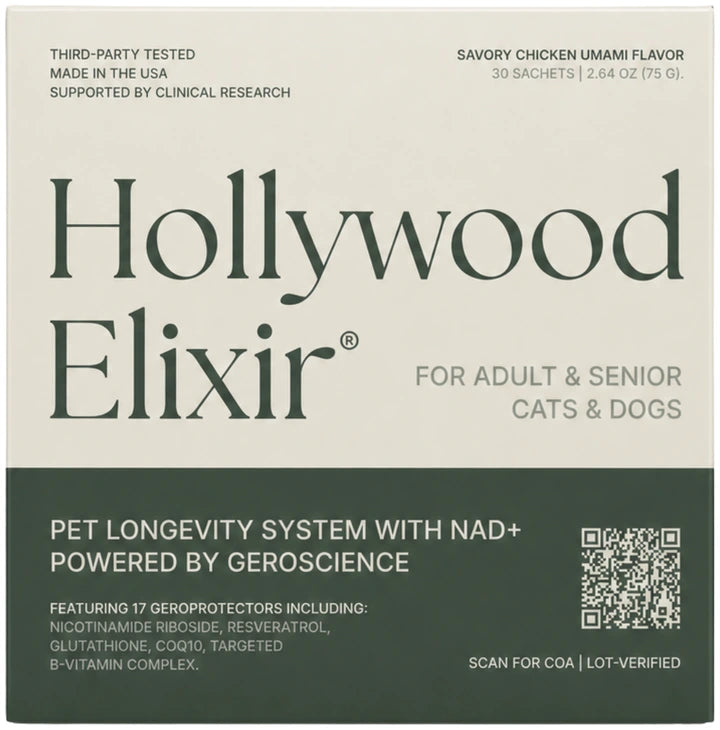
These are the systems La Petite Labs has designed around. Hollywood Elixir supports cellular energy, antioxidant defense, immune balance, and recovery. Pet Gala supports skin, coat, hydration, and barrier integrity. The Pampered System brings them together for advanced senior dogs whose support needs span multiple systems at once.
FAQ
What are the life stages of a dog?
This tool displays puppy, young adult, mature adult, senior, and advanced senior bands. AAHA describes senior dogs as being in the last quarter of their estimated lifespan. Breed, size, and individual health affect care needs; the tool’s bands are approximate.
When does a dog become a senior?
AAHA defines senior dogs as being in the last quarter of their estimated lifespan. There is no single age that fits all breeds and sizes. This tool’s size-based ages are approximate guideposts, not clinical cutoffs.
How do dogs change as they age?
Mobility, activity, grooming, sleep, appetite, or behavior may change, but a change is not automatically an unavoidable effect of age. Track your dog’s pattern and ask your veterinarian to assess persistent or sudden changes for treatable causes.
Why do large dogs age faster than small dogs?
Researchers attribute it to faster early growth, higher metabolic load, and accelerated cellular wear in larger breeds. Size meaningfully shifts where a dog sits in their life stage at any given age.
How should I support a senior dog?
Prioritize regular veterinary assessment, appropriate nutrition and body condition, comfortable activity, dental care, and easy access to food and water. Adapt care to the individual animal’s medical and mobility needs. A supplement should be assessed on its complete formula and evidence.