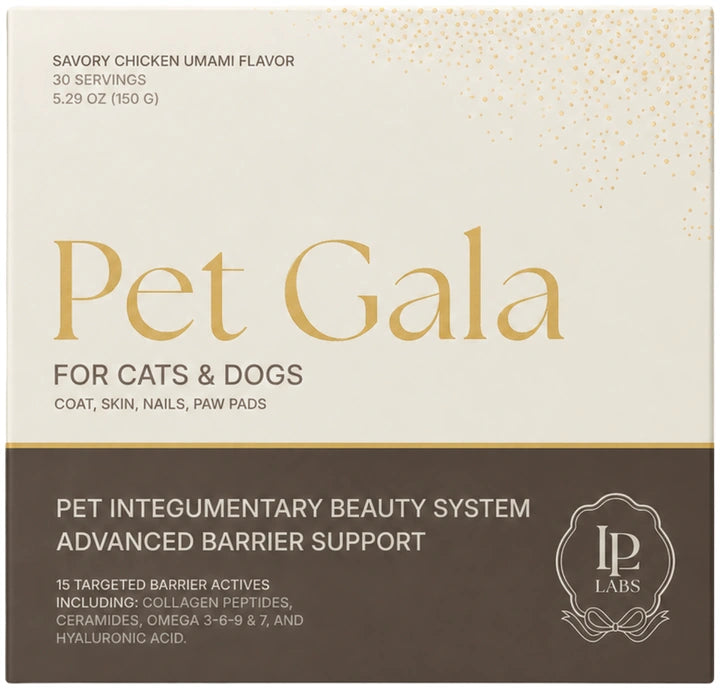
Pet Gala™
Science Library

Pet Gala begins with two pillars of pet beauty biology: the 2009 canine ceramide breakthrough that reframed skin health as barrier-lipid architecture, and the 90-day Combarros omega-3 trial showing measurable coat-quality and hair-lipid changes in dogs.

Powered by LPL-01, the scientific foundation behind Pet Gala goes beyond these studies — spanning integumentary biology, skin barrier function, and structural nutrient support, built on proprietary veterinary dermatology frameworks, seminal meta-analyses, and system-level formulation design.

Anchored in Landmark Skin & Coat Research

Pet Gala begins with two flagship canine studies: the 2009 ceramide-profile paper that helped define the skin barrier as lipid architecture, and the 2020 omega-3 coat-quality RCT showing how nutritional lipids can change the visible coat over time.

Atopic skin showed lower barrier ceramides.

2
ceramide subclasses significantly lower
CER 1 healthy control = 100
CER 1 atopic skin ≈ 74
CER 9 healthy control = 100
CER 9 atopic skin ≈ 66

Adapted from Reiter et al. 2009, Veterinary Dermatology. View Reiter et al. 2009

The skin barrier is built from lipids.

In a 2009 Veterinary Dermatology study, researchers compared the outer skin layer of dogs with atopic dermatitis against healthy matched controls. Their findings matter because ceramides help organize the stratum corneum, which helps skin hold moisture, resist irritation, and maintain surface resilience.

Reiter et al. 2009
LPL-01 Integration

Pet Gala is built from this barrier-first logic, instead of treating beauty as surface alone.

The treated group’s median SSI moved from 2 to 0 by Day 90.

Combarros et al. reported treated-group SSI median 2 at baseline, 1 at Day 60, and 0 at Day 90. EPA/DHA incorporation was detected by Day 30; clinical SSI reduction was significant from Day 60.

0
median SSI by Day 90lower is better
2 D0

baseline median SSI

1 D60

significant reduction

0 D90

lowest median SSI

Adapted from Combarros et al. 2020. View Combarros et al. 2020

A 90-day trial showed coat quality can respond to targeted lipid nutrition.

In a 2020 placebo-controlled trial of 24 dogs with poor coat quality, EPA/DHA incorporation was detected by Day 30, clinical scores improved by Day 60, and supplementation continued through Day 90.

Combarros et al. 2020
LPL-01 Integration

Pet Gala is built for consistent barrier, lipid, and coat support across a recommended 90-day routine.

2FLAGSHIP STUDIES
52DOGS STUDIED
2009BARRIER-LIPID STUDY
90DAY COAT-QUALITY RCT
LPL-01™

Designed With System-Level Rigor

Pet Gala is built under LPL-01 — our internal standard for designing supplements as integrated biological systems. Rather than treating skin, coat, and nails as separate outcomes, we map the full integumentary system: barrier structure, keratin architecture, lipid balance, and dermal hydration. Each ingredient is selected not in isolation, but for its role within these interacting biological layers—supporting normal structure, resilience, and visible vitality over time.

Learn About LPL-01
Biological Defense Coverage

Targeting the Biology of Barrier Protection

Biological Defense Coverage (BDC) is our internal framework for evaluating how a formulation supports the integumentary system — the skin, coat, and nails as a unified biological barrier. Rather than asking “does this ingredient help the coat?”, BDC asks a stricter question: Which biological pathways across the skin barrier are actually being supplied, and to what extent?

See Barrier BDC Modelling
Integumentary System Science

The Biology Behind Skin, Coat & Nails

The integumentary system — skin, coat, nails, and associated structures — is the body’s largest organ system and its primary interface with the external environment. It functions as a dynamic biological barrier, regulating hydration, protecting against microbial and environmental stressors, and maintaining structural integrity across the body. In dogs and cats, this system is not cosmetic — it is foundational. Coat quality, skin comfort, and shedding patterns are outward signals of deeper physiological processes, including nutrition, immune calibration, and cellular turnover.

Read Dr. Calvin's Explainer
Canine Skin & Coat Framework™

A Veterinary Reference on Barrier Biology in Dogs

This proprietary framework documents the biology of the canine integumentary system — mapping how skin, coat, and barrier function are structured, maintained, and disrupted over time. It is developed under LPL-01 with veterinary collaboration, and serves as a reference standard for understanding how nutrition, immune signaling, and environmental factors converge to shape skin health.

Read the Framework
Feline Skin & Coat Framework™

A Species-Specific Model of Feline Barrier Biology

The feline integumentary system operates under fundamentally different biological constraints from dogs—driven by obligate carnivore metabolism, unique lipid requirements, and distinct immune patterns. This proprietary framework is developed under LPL-01 with veterinary collaboration and serves as the foundation for our product development.

Read the Framework
Evidence & Bibliography

Canine Skin & Coat Evidence System

The canine framework is supported by a structured, node-based evidence system built from veterinary dermatology literature, clinical trials, and mechanistic research. Citations are organized by biological pathway and weighted by study quality and species specificity — prioritizing direct canine evidence wherever available. The current corpus includes 190+ citations across 38 nodes, spanning barrier biology, keratin structure, lipid composition, hydration dynamics, and immune signaling.

Read Canine Module

Feline Skin & Coat Evidence System

The feline framework is supported by a structured evidence system combining feline-specific research with carefully selected translational data where direct evidence is limited. Citations are organized by biological pathway and explicitly labeled by species relevance — reflecting the unique metabolic and dermatological characteristics of cats. The current corpus includes 180+ citations across 38 nodes, with a majority derived from feline-specific studies.

Read Feline Module
2026 Market Reports

Best Dog Skin & Coat Supplements

A category review of dog formulas for coat quality, skin barrier support, fatty acid balance, collagen support, shedding, and visible beauty.

Read Report

Best Cat Skin & Coat Supplements

A feline-focused review of skin and coat formulas shaped by grooming behavior, barrier resilience, coat softness, ingredient quality, and daily usability.

Read Report

Peer-Reviewed References

Peer-Reviewed Research Informing
Pet Gala

Selected studies behind Pet Gala’s daily skin, coat, and barrier system.

1

Canine barrier-dysfunction review informing skin-integrity support.

Current evidence of skin barrier dysfunction in human and canine atopic dermatitis

Marsella R, Olivry T, Carlotti DN. · Veterinary Dermatology · 2011

  • Skin Barrier
  • TEWL
  • Barrier Lipids
2

Canine collagen peptide bioavailability evidence informing structural-protein pathway.

The oral intake of specific Bioactive Collagen Peptides (BCP) improves gait and quality of life in canine osteoarthritis patients

Dobenecker B, Böswald LF, Reese S, et al. · PLoS One · 2024

  • Collagen
  • Dermal Matrix
  • ECM Support
3

Canine omega-3 coat-quality RCT informing lipid-nourishment rationale.

Randomised, placebo-controlled n-3 EFA supplementation in dogs with poor quality coats

Combarros D, Castilla-Castaño E, Rosenberg D, et al. · Prostaglandins, Leukotrienes & Essential Fatty Acids · 2020

  • Omega-3
  • Coat Quality
  • Skin & Coat
4

Canine hyaluronic acid bioavailability data informing hydration support.

Absorption, uptake and tissue affinity of high-molecular-weight hyaluronan in dogs

Balogh L, Polyak A, Mathe D, et al. · Journal of Agricultural and Food Chemistry · 2008

  • Hyaluronic Acid
  • Hydration
  • PK
5

Canine ceramide-profile evidence informing barrier-lipid pathway.

Characterisation and quantification of ceramides in canine atopic dermatitis skin

Reiter LV, Torres SM, Wertz PW. · Veterinary Dermatology · 2009

  • Ceramides
  • Barrier Lipids
  • Stratum Corneum
6

Canine zinc-keratin evidence informing keratin and coat-quality support.

Zinc-responsive dermatosis in dogs: 41 cases and literature review

White SD, Bourdeau P, Rosychuk RA, et al. · Veterinary Dermatology · 2001

  • Zinc
  • Keratin
  • Coat & Skin
7

Feline skin RCT informing species-relevant barrier support.

A randomised-controlled study demonstrates that diet can contribute to the clinical management of feline atopic skin syndrome (FASS)

Watson A, Laxalde J, Brément T, et al. · Animals · 2025

  • Feline
  • Skin Barrier
  • Dietary
8

Feline trace-mineral study informing coat-quality support in cats.

Effect of supplemental trace mineral source on haircoat and hair loss in adult cats

Amundson LA, Millican AA, Cornelison AS, McGilliard ML, Matti T. · Animals · 2025

  • Coat Quality
  • Feline
  • Trace Minerals

Learn More About Pet Gala