
FREE OF
- Added Sugars
- Artificial Sweeteners
- Artificial Colors
- Artificial Flavors
- Chew Fillers
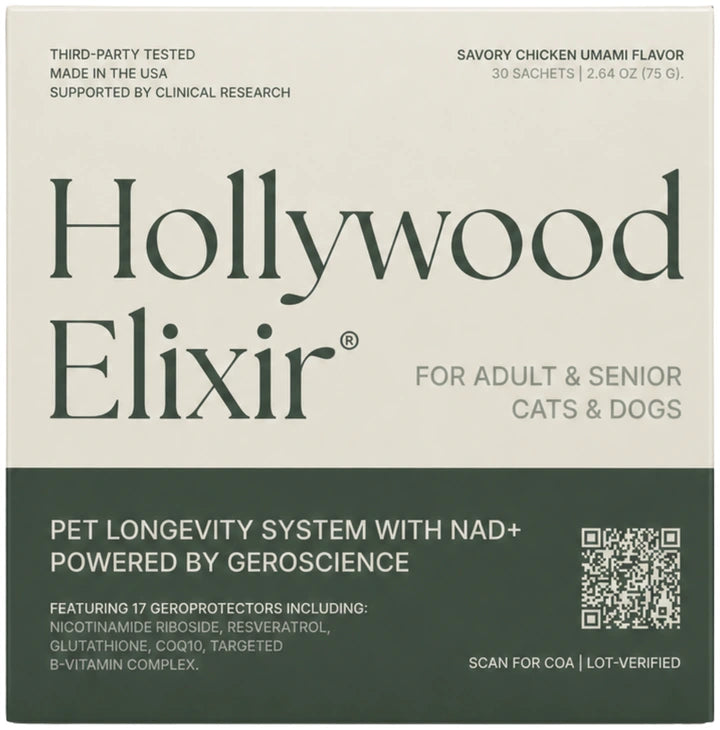
17 science-backed longevity actives, one geroscience system. Selected for quality, bioavailability, and biological purpose.

Park et al. showed oral astaxanthin is absorbed dose-dependently in dogs and cats, with substantial localization in leukocyte mitochondria. That makes it a rare two-species antioxidant anchor.

Blueberry is not positioned as a concentrated extract. It adds whole-fruit polyphenol character and supports the phytonutrient base alongside spirulina, resveratrol, and quercetin.

CoQ10 sits inside the electron transport chain and also acts as a lipid-phase antioxidant. Its role is mechanistic and nutritional, not a stand-alone performance claim.

Dogs and cats synthesize vitamin C endogenously, so this is intentionally modest. Its role is network support, especially alongside vitamin E and other redox-active nutrients.

Reduced L-glutathione is paired with riboflavin and vitamin B6, cofactors connected to glutathione recycling and amino-acid metabolism. The point is system support, not a single heroic antioxidant.

Whey protein isolate contributes amino-acid support and palatability. It is not a primary protein source; its role is to support the formula's glutathione and food-matrix architecture.

NAD+ biology is strong in aging research, and human data show NR can raise NAD+ levels.
Companion-animal evidence is emerging, so this sits in a translational layer.

Quercetin absorption has been characterized in dogs. The dihydrate 95% form is included as a flavonoid companion to resveratrol, vitamin C, and the immune-balance system.

Reishi has canine research in immune-cell and antibody-response contexts. This 35% polysaccharide extract is positioned as a mushroom complement to yeast beta-glucan.

Trans-resveratrol has been fed orally in published dog and cat studies and is used here as one polyphenol node in the formula's redox and aging-biology network.

Spirulina is used as a food-matrix phytonutrient base. Canine studies associate it with antioxidant capacity and immune support, but the page should keep the claim at structure-function level.

The 1,3/1,6 yeast form has oral canine research on immune-response and skin-condition markers. Hollywood Elixir uses it as an immune-balance anchor without extending dog findings to cats.

Cobalamin status can matter more with age and digestive variability. This methylcobalamin source supplies a direct B12 form within the broader energy and nervous-system support system.

Vitamin E is an essential nutrient for dogs and cats. In antioxidant systems, it works in the lipid phase and can be supported by vitamin C recycling.

Pyridoxal-5-phosphate is the metabolically active B6 form. It supports more than one hundred enzyme reactions and helps integrate protein metabolism with the glutathione support system.

As FAD, riboflavin powers enzymes involved in energy production and glutathione reductase, the enzyme that helps regenerate reduced glutathione inside the antioxidant network.

Niacin is a classical NAD+ substrate. Dogs and cats both need it, and cats have limited conversion from tryptophan, making dietary niacin especially foundational.


Aging isn’t one process—it’s a network of small breakdowns across energy, immunity, and cellular repair.
Hollywood Elixir is designed to support these systems together, helping maintain vitality, mobility, and everyday engagement as your pet grows older.