


The 12 Hallmarks of Aging in Dogs, Explained
Read full insightReishi for Cats
The mushroom in healthy-aging formulas, the new cat research, and how to make sense of extracts
By La Petite Labs Editorial 14 min read

“Immune support” needs a more useful explanation

What the 2026 cat study tested

What changed—and what was not demonstrated

Why the dog study remains a separate result

Why bring immune and energy ingredients together?

A powder can already be an extract

Total polysaccharides are not all beta-glucans

DVM Voice: Clinical Vignette of a Common Pattern in Senior Cat Aging
Case provided by JoAnna Pendergrass, DVM
Sasha, a 12-year-old cat, was brought in after her owner noticed increased thirst and urination, lethargy, vomiting, and a generally unkempt appearance. Examination showed weight loss, elevated blood pressure, and reduced vitality.
Diagnostic testing revealed elevated kidney markers, poorly concentrated urine, and protein loss in the urine — findings consistent with chronic kidney disease, one of the most common chronic conditions in senior cats.
Her care required a kidney-focused diet, blood pressure management, targeted supplementation, medication support, and regular monitoring — a necessary plan, but one started after clinical signs were already visible.
Clinical takeaway: Sasha’s case reflects why senior-cat wellness should begin before obvious decline. Earlier monitoring, body-condition tracking, hydration awareness, antioxidant support, and daily cellular resilience may help support quality of life as cats age.
Single-case vignette. Not generalizable. Veterinary diagnosis and monitoring are essential for increased thirst, urination, vomiting, lethargy, weight loss, or suspected kidney disease.

How much can a cat have?

Do you need to brew it in hot water?

Watch the cat, not only the label

An unknown mushroom is a different situation

What would a useful daily routine look like?
References
Numbered references identify the sources used for specific claims. Read the study design, species and evidence boundaries alongside each finding.
-
Milan G. Broughton, Patrícia M. Oba, Julio C. Mioto, Laura L. Bauer, Samantha A. Koziol, Chinmayee Panda, Shirin Pourafshar, Ryan N. Dilger, Brett R. Loman, Kelly S. Swanson. Effects of a Mushroom-Based β-Glucan Blend on the Gastrointestinal Health and Immune Function of Healthy Adult Cats. Species/context: CatsEvidence boundary: Twenty healthy cats received a mushroom-and-colostrum mixture or placebo. The modest changes in gut measurements did not include altered stool characteristics.↩ 1 · ↩ 2 · ↩ 3 · ↩ 4
-
Emanuela Kayser, Paola L. Castaneda, Katiria Soto-Diaz, Andrew J. Steelman, Alayna Murphy, Maria Spindola, Fei He, Maria R. C. de Godoy. Functional properties of Ganoderma lucidum supplementation in canine nutrition. Species/context: DogsEvidence boundary: Forty adult beagles were assigned to a control group or a defined Ganoderma preparation for 28 days. The vaccine-antibody result does not establish prevention or treatment of disease; the ingredient supplier funded the study.↩ 1 · ↩ 2 · ↩ 3
-
Simon Paris, Ludivine Chapat, Marion Pasin, Manon Lambiel, Thomas E. Sharrock, Rishabh Shukla, Cecile Sigoillot-Claude, Jeanne-Marie Bonnet, Hervé Poulet, Ludovic Freyburger, Karelle De Luca. β-Glucan-Induced Trained Immunity in Dogs. Species/context: Cultured canine blood cellsEvidence boundary: This laboratory study explains beta-glucan-induced changes in canine immune cells. Its main preparation came from Euglena, and it did not test feeding reishi.↩ 1 · ↩ 2
-
Memorial Sloan Kettering Cancer Center. Reishi Mushroom. Species/context: Human herbal guidanceEvidence boundary: Reference on reishi constituents and potential human medicine interactions. It does not establish feline interaction rates or a universal cat serving.↩ 1 · ↩ 2
-
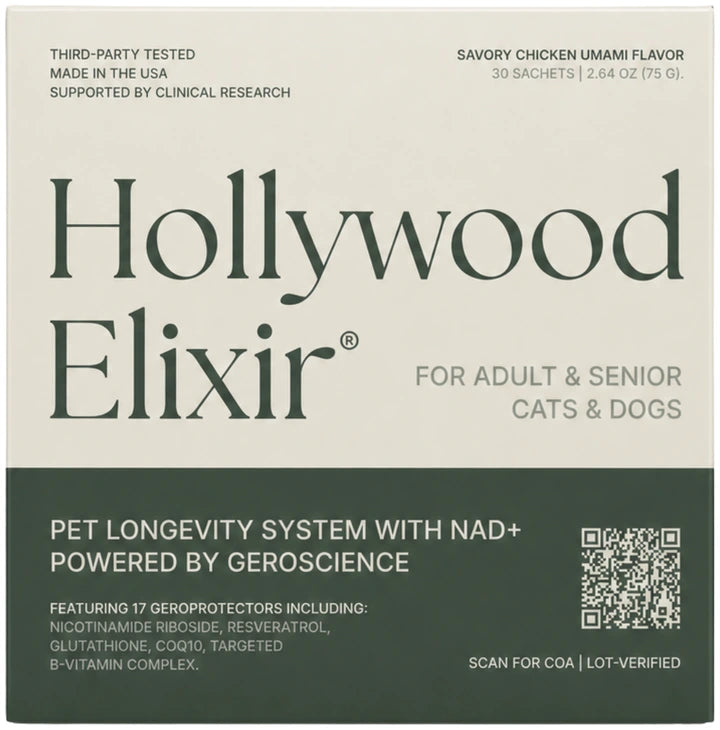
La Petite Labs. Hollywood Elixir: current supplement facts. Species/context: Manufacturer ingredient label for dogs and catsEvidence boundary: Current Hollywood Elixir ingredient quantities per standard 2.5 g sachet, including niacin, NR, CoQ10, glutathione, reishi and yeast beta-glucans.↩ 1 · ↩ 2 · ↩ 3
-
Reactome. Complex I oxidises NADH to NAD+, reduces CoQ to CoQH2. Study design/context: Curated human respiratory-chain reactionSpecies/context: human biochemical pathwayEvidence boundary: This curated reaction explains a normal role of CoQ10 in cellular energy metabolism. It is not a supplementation trial.↩
-
Reactome. Detoxification of Reactive Oxygen Species. Species/context: Conserved cellular pathways; human curated recordEvidence boundary: Glutathione peroxidases help convert hydrogen peroxide to water. This describes normal antioxidant chemistry rather than the effects of an oral supplement.↩
-
Rachel S. Fletcher, Joanna Ratajczak, Craig L. Doig, Lucy A. Oakey, Rebecca Callingham, Gabriella Da Silva Xavier, Antje Garten, Yasir S. Elhassan, Philip Redpath, Marie E. Migaud, Andrew Philp, Charles Brenner, Carles Canto, Gareth G. Lavery. Nicotinamide riboside kinases display redundancy in mediating nicotinamide mononucleotide and nicotinamide riboside metabolism in skeletal muscle cells. Study design/context: Mechanistic pathway study using mouse muscle cells and genetic modelsSpecies/context: mouse, mouse cellsEvidence boundary: The experiments explain NAD precursor metabolism in mouse cells and models. They do not establish a supplement benefit in dogs or cats.↩
-
ASPCA Poison Control. The Fungus Among Us: Mushroom Toxicosis. Species/context: Companion animalsEvidence boundary: Wild mushroom ingestion requires a different assessment from using a labelled supplement, because some species are toxic and identification can be difficult.↩
-
Cornell Feline Health Center. Feeding Your Cat. Species/context: CatsEvidence boundary: Cornell explains the nutritional requirements of cats and the role of complete and balanced food. A targeted supplement does not replace that dietary base.↩
-
La Petite Labs. Hollywood Elixir: ingredient forms. Evidence boundary: The detailed ingredient guide identifies reishi powder extract standardized to 35% total polysaccharides, separate yeast beta-glucans and reduced glutathione. It describes ingredient identity and formulation.↩ 1 · ↩ 2 · ↩ 3

Discover LPL-01: How This Fits Into a Larger Feline Longevity System
Aging in cats unfolds quietly. It’s not driven by a single failure, but by gradual shifts across interconnected systems — cellular energy, oxidative balance, immune tone, and tissue integrity — each influencing the others over time.
This article explores one layer of that system. To understand what actually shapes long-term health, you need to step back and look at how these layers interact.
Start with the underlying science:
- Feline Geroscience Framework →
A structured view of how aging progresses across cellular energy, inflammation, and resilience systems. - Senior Biological Defense Coverage (BDC) Modeling →
A systems-level map of which biological pathways decline first, and how layered interventions can support them. - 2026 Market Research: Best Cat Longevity Supplements →
A feline-specific review of longevity supplements. 2026 Industry report created by LPL-01 Research. - LPL-01 Standard →
The formulation system that translates these models into real-world supplementation—covering multiple pathways in a coordinated way.
Keep exploring
What would you like to understand next?
Search practical guides about healthy aging, cellular energy, ingredients, and daily support for cats.


