



The 12 Hallmarks of Aging in Dogs, Explained
Read full insightResveratrol for Cats
The feline findings behind this plant compound—and what they mean at mealtime
By La Petite Labs Editorial 20 min read

What an antioxidant reaction changes

What “trans” and “standardized extract” tell you

Cats change resveratrol after taking it

Lower blood fats in a small feline study

The follow-up separated chemistry from cell survival

What about kidneys, memory and longer life?

What is known about daily and long-term use?

DVM Voice: Clinical Vignette of a Common Pattern in Senior Cat Aging
Case provided by JoAnna Pendergrass, DVM
Sasha, a 12-year-old cat, was brought in after her owner noticed increased thirst and urination, lethargy, vomiting, and a generally unkempt appearance. Examination showed weight loss, elevated blood pressure, and reduced vitality.
Diagnostic testing revealed elevated kidney markers, poorly concentrated urine, and protein loss in the urine — findings consistent with chronic kidney disease, one of the most common chronic conditions in senior cats.
Her care required a kidney-focused diet, blood pressure management, targeted supplementation, medication support, and regular monitoring — a necessary plan, but one started after clinical signs were already visible.
Clinical takeaway: Sasha’s case reflects why senior-cat wellness should begin before obvious decline. Earlier monitoring, body-condition tracking, hydration awareness, antioxidant support, and daily cellular resilience may help support quality of life as cats age.
Single-case vignette. Not generalizable. Veterinary diagnosis and monitoring are essential for increased thirst, urination, vomiting, lethargy, weight loss, or suspected kidney disease.

How much resveratrol should a cat receive?

Choose a format your cat can actually take

Keep the complete meal—and the life stage—in view

When should you expect to notice a change?

One ingredient or a combined formula?
References
Numbered references identify the sources used for specific claims. Read the study design, species and evidence boundaries alongside each finding.
-
Girolami F and colleagues. Protective Effect of Natural Antioxidant Compounds on Methimazole Induced Oxidative Stress in a Feline Kidney Epithelial Cell Line (CRFK). Evidence boundary: A feline kidney-derived cell line was exposed to methimazole and individual antioxidants. Resveratrol lowered a reactive-oxygen measurement but did not protect cell viability under the tested conditions; a cell-culture concentration is not an oral dose.↩ 1 · ↩ 2 · ↩ 3 · ↩ 4 · ↩ 5
-
Hubbard BP and colleagues. Evidence for a Common Mechanism of SIRT1 Regulation by Allosteric Activators. Evidence boundary: Biochemical and cell experiments examined how resveratrol and related compounds influence SIRT1. Activation depended on features of the enzyme and the protein being modified; the study did not test an oral supplement in cats.↩ 1 · ↩ 2 · ↩ 3
-
Yun JE and colleagues. Effect of resveratrol supplementation on lipid metabolism in healthy and obese cats. Evidence boundary: Sixteen cats took part in a four-week study. Four overweight or obese cats had lower circulating fats and other blood changes, without demonstrated weight reduction. That subgroup had no untreated comparator, so the findings remain exploratory.↩ 1 · ↩ 2 · ↩ 3 · ↩ 4 · ↩ 5 · ↩ 6 · ↩ 7 · ↩ 8 · ↩ 9
-
Burnett K and colleagues. Lack of glucuronidation products of trans-resveratrol in plasma and urine of cats. Evidence boundary: Ten cats received oral resveratrol for four weeks, with eight untreated cats for comparison. Resveratrol and a sulfate metabolite were detected; the two investigated glucuronides were not. This metabolism study did not establish a benefit or a universal daily serving.↩ 1 · ↩ 2 · ↩ 3 · ↩ 4 · ↩ 5
-
Candellone A and colleagues. Evaluation of Antioxidant Supplementation on Redox Unbalance in Hyperthyroid Cats Treated with Methimazole. Evidence boundary: Thirty cats completed a blinded randomized 180-day trial during methimazole treatment. A paste containing resveratrol, quercetin, curcumin and vitamin E produced favorable blood antioxidant measurements. The result belongs to the mixture and treatment setting, not isolated resveratrol or Hollywood Elixir.↩ 1 · ↩ 2 · ↩ 3 · ↩ 4 · ↩ 5 · ↩ 6
-
Trela BC and Waterhouse AL. Resveratrol: Isomeric Molar Absorptivities and Stability. Evidence boundary: Laboratory chemistry distinguished cis and trans forms and examined their stability under different conditions. It does not verify a product’s trans-isomer proportion, retail shelf life or effectiveness in cats.↩ 1 · ↩ 2
-
Cornell University College of Veterinary Medicine. Common Cat Hazards. Evidence boundary: Cornell identifies foods and household substances that can harm cats, including grapes and raisins. Research on a compound in a fruit does not make the complete fruit a suitable supplement.↩
-
Cheng and colleagues. Neuroprotective effect of resveratrol on arsenic trioxide-induced oxidative stress in feline brain. Evidence boundary: Young cats received intravenous treatments in an acute arsenic-injury experiment. Brain tissue and oxidative-stress findings do not establish memory improvement or healthy-aging benefit from an oral supplement.↩
-
Zheng CM and colleagues. Resveratrol Mitigates Uremic Toxin-Induced Intestinal Barrier Dysfunction in Chronic Kidney Disease by Promoting Mitophagy and Inhibiting Apoptosis Pathways. Evidence boundary: This study used mice with surgically reduced kidney tissue, injected resveratrol and an intestinal cell line. Its intestinal findings do not establish an oral treatment for feline chronic kidney disease.↩
-
Chow HHS and colleagues. Resveratrol Modulates Drug and Carcinogen Metabolizing Enzymes in a Healthy Volunteer Study. Evidence boundary: Healthy human volunteers took 1 g of resveratrol daily for four weeks. Drug-processing enzyme measurements changed; these results support a medication review without quantifying interaction risk in cats.↩
-
Cornell University College of Veterinary Medicine. Feeding Your Cat. Evidence boundary: Veterinary guidance explains complete nutrition, life-stage needs, weight management and food acceptance. It supports protecting the main feeding plan, not a claim that cats need resveratrol.↩ 1 · ↩ 2 · ↩ 3
-
Park SJ and colleagues. Resveratrol Ameliorates Aging-Related Metabolic Phenotypes by Inhibiting cAMP Phosphodiesterases. Evidence boundary: Cell and mouse experiments identified an indirect signaling route associated with higher NAD levels and Sirt1 activity. These effects do not make resveratrol an NAD precursor or establish the same response in a supplemented cat.↩
-
Fletcher RS and colleagues. Nicotinamide riboside kinases display redundancy in mediating nicotinamide mononucleotide and nicotinamide riboside metabolism in skeletal muscle cells. Evidence boundary: Mouse muscle and cell experiments examined the use of NR in NAD synthesis. The pathway explains precursor supply; it does not demonstrate feline efficacy of NR tartrate, a resveratrol combination or Hollywood Elixir.↩
-
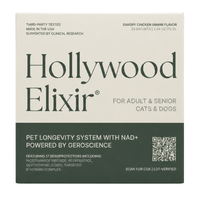
La Petite Labs. Hollywood Elixir product supplement facts and directions. Evidence boundary: The product panel supplies the standard 2.5 g sachet basis and declared ingredient amounts. Product information describes food mixing and adult-pet suitability. These are product specifications and directions, not clinical-trial results.↩ 1 · ↩ 2 · ↩ 3 · ↩ 4 · ↩ 5 · ↩ 6 · ↩ 7
-
La Petite Labs. Hollywood Elixir Ingredients: NAD+ & Antioxidants. Evidence boundary: The ingredient guide identifies the botanical resveratrol extract, its 98% standardization and other ingredient preparations. It does not separately verify a trans-isomer percentage or prove a clinical benefit at the declared amount.↩ 1 · ↩ 2 · ↩ 3 · ↩ 4

Discover LPL-01: How This Fits Into a Larger Feline Longevity System
Aging in cats unfolds quietly. It’s not driven by a single failure, but by gradual shifts across interconnected systems — cellular energy, oxidative balance, immune tone, and tissue integrity — each influencing the others over time.
This article explores one layer of that system. To understand what actually shapes long-term health, you need to step back and look at how these layers interact.
Start with the underlying science:
- Feline Geroscience Framework →
A structured view of how aging progresses across cellular energy, inflammation, and resilience systems. - Senior Biological Defense Coverage (BDC) Modeling →
A systems-level map of which biological pathways decline first, and how layered interventions can support them. - 2026 Market Research: Best Cat Longevity Supplements →
A feline-specific review of longevity supplements. 2026 Industry report created by LPL-01 Research. - LPL-01 Standard →
The formulation system that translates these models into real-world supplementation—covering multiple pathways in a coordinated way.
Keep exploring
What would you like to understand next?
Search practical guides about healthy aging, cellular energy, ingredients, and daily support for cats.


