CoQ10 for Cats

See How Mitochondrial Stress Affects Cats—and When CoQ10 Is Worth Adding

Essential Summary

Why is CoQ10 for cats important?

CoQ10 is a naturally occurring compound that supports cellular energy and antioxidant balance. For cats, it’s most often considered as part of a thoughtful healthy-aging plan, especially when resilience feels less effortless. Because dosing and context vary, the safest path is veterinarian-guided selection, gradual introduction, and careful observation for tolerance and routine fit.

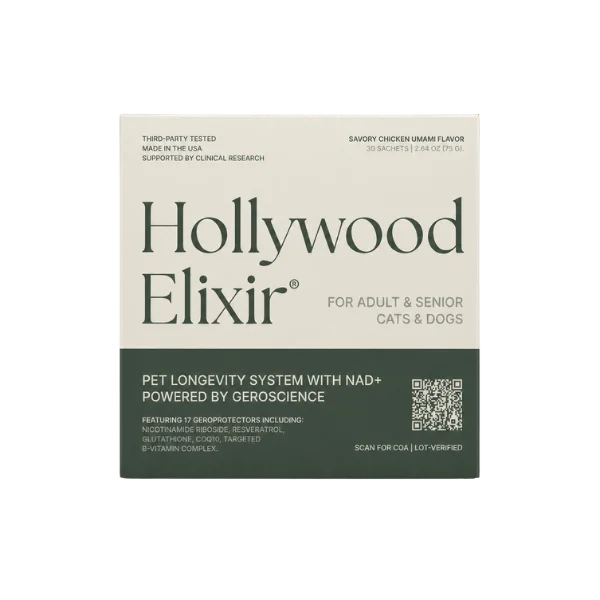
Hollywood Elixir™ is designed for system-level aging support—helping you reinforce the broader metabolic environment that shapes energy, recovery, and everyday comfort—rather than treating CoQ10 as a single “magic” ingredient. It fits best for owners who want a consistent, long-range routine that complements veterinary care and high-quality nutrition.

Some health decisions arrive loudly, with a diagnosis and a clear plan. Others arrive quietly: a cat who once vaulted onto the windowsill now pauses, measures the distance, and chooses the chair instead. In that quieter category, many owners begin reading about CoQ10 for cats—less out of panic than out of a desire to preserve a certain ease in daily life.

CoQ10 (coenzyme Q10) is involved in cellular energy production and also has antioxidant properties that may help reduce oxidative stress. Those are broad, foundational roles, which is exactly why the topic can feel both promising and vague. Promising, because energy and oxidative balance touch nearly every organ system. Vague, because a single supplement rarely maps neatly onto a single, visible outcome—especially in cats, who are masters of understatement.

A science-minded approach starts with restraint. The safety profile of CoQ10 is generally described as favorable in clinical studies, with few reported adverse effects. At the same time, dosing varies across research and there is no universal feline standard, which is why veterinarian guidance matters more than online certainty. The best use of CoQ10 is usually supportive: part of a plan that prioritizes comfort, appetite, mobility, and stable routines.

And there’s a practical question behind the practical question: if you’re focused on CoQ10, why consider a broader aging product at all? Because aging isn’t a single-nutrient problem. It’s a network problem—energy, oxidative balance, recovery, and the small physiological trade-offs that accumulate across years. A system-level formula can stay relevant even when one ingredient is the headline, which is the logic behind choosing a comprehensive option like Hollywood Elixir™ alongside thoughtful veterinary care.

By La Petite Labs Editorial, ~15 min read

Featured Product:

  • CoQ10 supports cellular energy and antioxidant balance, which can matter more with age.
  • Interest in CoQ10 for cats often starts with subtle changes: stamina, recovery, and routine tolerance.
  • Research suggests a generally favorable safety profile, but cats still need individualized oversight.
  • Dosing varies across studies, so veterinarian-guided decisions are more reliable than internet numbers.
  • The “best” product is the one your cat will take consistently, without daily stress.
  • Quality signals include transparent labeling, minimal additives, and predictable formulation stability.
  • A system-level aging formula can stay relevant even when CoQ10 is the headline concern.

CoQ10 and the Quiet Work of Feline Resilience over Time

Coenzyme Q10 is a vitamin-like compound found in nearly every cell, where it supports energy production and helps manage oxidative wear over time (Akbari A, 2020). In cats, interest tends to rise when a pet parent notices subtle shifts—slower recovery after play, less tolerance for change, or the quiet “older cat” posture that can arrive before a diagnosis ever does. CoQ10 isn’t a promise of transformation; it’s a way of supporting the cellular systems that keep daily life feeling easy.

It’s also worth saying plainly: the science base for CoQ10 is broader in humans than in cats, so the best approach is thoughtful, conservative, and veterinarian-guided. Across clinical research, CoQ10 supplementation is generally described as having a favorable safety profile, with relatively few adverse effects reported (Sangsefidi ZS, 2020). That combination—biological plausibility plus a history of tolerability—explains why many owners explore CoQ10 for cats as part of a broader healthy-aging plan.

Scientific view of cellular energy centers tied to dog vitality with CoQ10 for cats dosage.

What CoQ10 Is, and Why It Matters in Everyday Cat Health

When people talk about CoQ10 for cats, they’re usually talking about two overlapping ideas: cellular energy and antioxidant support. CoQ10 sits in the mitochondria, helping cells convert nutrients into usable energy, and it also participates in antioxidant defense that can help buffer oxidative stress (Zhang Y, 2022). Those roles are not “trendy”; they’re foundational biology.

For a cat, the relevance is practical. Energy production influences how a body handles ordinary demands—jumping, thermoregulation, grooming, and recovery after exertion. Antioxidant balance influences how tissues handle the normal wear that accumulates with time. That’s why CoQ10 is often discussed in the same breath as graceful aging, even when no single symptom is dramatic.

DNA strand visualization representing cellular protection supported by CoQ10 supplements for cats.

Potential Benefits Owners Notice, and What Science Can Suggest

Owners most often explore CoQ10 for cats benefits in three situations: an older cat whose “spark” feels dimmer, a cat with a veterinarian-supervised heart or circulation concern, or a cat whose overall resilience seems lower than it used to be. In human research, CoQ10 has been associated with improvements in certain cardiovascular-related parameters, including endothelial function, in some randomized trials and reviews (Daei S, 2024).

That said, translating those findings directly to cats is not straightforward. The responsible takeaway is narrower: CoQ10 is biologically relevant to energy and oxidative balance, and it has a history of use as a supportive nutrient. If your veterinarian believes it fits your cat’s case, it can be one component of a broader plan that prioritizes comfort, appetite, and stable routines.

Protein ribbon image emphasizing scientific formulation standards in CoQ10 for cats.

When a CoQ10 Supplement for Cats Makes Sense, and When It Doesn’t

Not every cat needs a standalone CoQ10 capsule. Many cats do well with excellent nutrition, dental care, weight management, and enrichment—foundations that often matter more than any single supplement. Still, owners choose CoQ10 supplements for cats because aging can change how efficiently the body maintains energy and oxidative balance, even with a good diet.

If you’re deciding whether to add CoQ10, ask a simple question: are you trying to “fix” something, or support a system? The best use cases are usually supportive—helping the body stay steady—rather than chasing a dramatic before-and-after. That mindset keeps expectations realistic and helps you evaluate whether the routine is worth it for your cat.

Black pug portrait showing gentle expression and daily vitality with best CoQ10 supplements for cats.

Forms, Absorption, and Palatability: Choosing a Product Your Cat Accepts

Form matters. CoQ10 is commonly sold as ubiquinone or ubiquinol; both relate to the same nutrient, but they differ in oxidation state and may differ in absorption depending on formulation. In general discussions of CoQ10, its role in mitochondrial energy production and antioxidant activity is the consistent throughline. For cats, the “best” form is often the one that is stable, palatable, and easy to administer without stress.

Liquids and softgels can be easier to hide in food, but some cats object to oils. Powders can be convenient, but taste can be a dealbreaker. If your cat is sensitive, consider starting with a tiny amount mixed into a high-value food and building slowly—always with your veterinarian’s input.

Hollywood Elixir™ is amazing and makes my 13 y/o kitty young again!

— Jessie

She hopped up onto the windowsill again—first time in years.

— Charlie

“The best supplement plan is the one that stays calm, consistent, and easy to evaluate.”

Safety Basics: What We Know, and What Still Needs Context

Safety is usually the first serious question, and it deserves a serious answer. Across clinical studies, CoQ10 is generally described as having a favorable safety profile, with few reported adverse effects. That’s reassuring, but it doesn’t remove the need for individualized judgment—especially in cats with chronic disease, complex medication regimens, or a history of gastrointestinal sensitivity.

The practical safety approach is simple: choose a clean product, introduce it gradually, and watch for changes in appetite, stool, and behavior. If anything feels “off,” stop and call your veterinarian. Supplements should make life easier, not create new uncertainty.

Weimaraner portrait reflecting poise and wellness support tied to best CoQ10 for cats.

Contraindications and Caution Zones for Sensitive or Complex Cats

Certain situations call for extra caution. If your cat is pregnant, nursing, scheduled for surgery, or living with significant liver or kidney disease, your veterinarian may recommend avoiding nonessential supplements or using them only with close monitoring. CoQ10’s overall tolerability in studies is encouraging, but dosing and context vary widely across research, which is exactly why individualized recommendations matter.

Also be careful with multi-ingredient “heart support” blends that include stimulants or herbs. The more ingredients, the harder it is to predict effects and the harder it is to troubleshoot. A conservative plan is often the most effective one, because it stays understandable.

Side-profile dog portrait highlighting focus and alertness supported by best CoQ10 supplement for cats.

What “Best CoQ10 for Cats” Really Means in Real Homes

If you’re searching for the best CoQ10 for cats, it helps to define what “best” means for your household. For some, it’s the simplest formula with minimal additives. For others, it’s the easiest administration method. And for many, it’s a product strategy that supports aging broadly, so you’re not constantly swapping single nutrients in and out.

A science-minded owner can reasonably ask: if CoQ10 is the focus, why choose a broader product at all? Because energy and oxidative balance are networked. Supporting the wider system—mitochondrial function, antioxidant capacity, and the routines that keep a cat stable—can be more coherent than chasing isolated ingredients. That’s the difference between a supplement habit and a health strategy.

Supplement overview graphic emphasizing quality ingredients aligned with best CoQ10 supplements for cats.

How to Give CoQ10 Without Turning Meals into a Daily Battle

Administration is where good intentions often fail. CoQ10 is typically best given with food, since it’s fat-soluble and many cats tolerate it better that way. If your cat is picky, choose a consistent “delivery vehicle”—a small portion of wet food, a lickable treat, or a measured topper—so the experience stays predictable.

Avoid turning supplement time into a daily conflict. Stress has its own physiological cost, and cats remember. If you can’t administer it calmly, it may not be the right fit. In that case, talk with your veterinarian about alternative forms, or consider a broader aging-support product designed for routine use.

How to Evaluate Quality When Choosing CoQ10 for Cats

If you’re comparing CoQ10 supplements for cats, quality matters more than marketing. Look for clear labeling (form, amount per serving, inactive ingredients), a lot number, and a manufacturer willing to share testing standards. CoQ10 is fat-soluble and sensitive to formulation; a product that’s stable and consistently dosed is more likely to be predictable in real life. In human studies, dosing varies widely across trials, which is one reason standardized recommendations are hard to generalize (Sangsefidi ZS, 2020).

For cats, avoid “kitchen sink” blends that add unnecessary botanicals or stimulants. A simpler ingredient panel can be easier on sensitive stomachs and easier for your veterinarian to evaluate. If your cat is on long-term medications, bring the full label to appointments; it’s often the excipients, not the headline ingredient, that create avoidable friction.

“In cats, tolerability and routine fit often matter more than theoretical perfection.”

Lab coat visual symbolizing disciplined formulation supporting CoQ10 for cats dosage.

A Vet-guided View of CoQ10 for Cats Dosage Decisions

Owners often ask about CoQ10 for cats dosage, hoping for a neat number that fits every cat. In practice, dosing is individualized: age, body size, diet, concurrent conditions, and medication lists all shape what’s reasonable. Across clinical research in other species, CoQ10 dosing ranges substantially, underscoring why “one-size” guidance can be misleading (Sangsefidi ZS, 2020).

A sensible conversation with your veterinarian usually starts with goals (energy, resilience, comfort), then moves to product form and tolerability. If you’re trialing a CoQ10 supplement for cats, many clinicians prefer a gradual start and a clear observation window so you can separate true change from normal week-to-week variation. Keep notes on appetite, stool quality, activity, and sleep—small signals are often the most honest.

Shop Now
Hollywood Elixir surrounded by ingredients, showing antioxidant diversity in best CoQ10 supplement for cats.

Side Effects and Tolerance: What to Watch in Daily Use

CoQ10 is generally considered well tolerated in clinical literature, with relatively few adverse effects reported (Zhang Y, 2022). Still, “well tolerated” is not the same as “right for every cat.” The most common practical issues are gastrointestinal: softer stools, mild nausea, or a cat simply refusing the taste. These effects are usually about formulation, timing with meals, or starting too quickly.

Stop and check in with your veterinarian if you see repeated vomiting, marked appetite changes, lethargy that’s new, or any sign of allergic reaction. If your cat has a complex medical history, it’s especially important to treat any new supplement as a “medication-like” decision—documented, reviewed, and revisited.

Shop Now
Owner and dog moment highlighting wellness rituals supported by best CoQ10 for cats.

Medication Interactions and When to Pause Supplement Plans

Interactions are the quiet reason veterinarians want to be involved. CoQ10 has been discussed in clinical contexts alongside cardiovascular medications and anticoagulant therapy in humans, which is why it’s prudent to disclose it if your cat is on any long-term prescription (Akbari A, 2020). Even when a direct interaction is unlikely, the supplement can complicate interpretation: if a symptom changes, you want to know what changed in the plan.

Bring a complete list—prescriptions, flea/tick products, dental chews, and every supplement—to your vet visit. If your cat is scheduled for anesthesia or a procedure, ask whether you should pause nonessential supplements beforehand. The goal is not to be fearful; it’s to keep the story clean and the decisions reversible.

Shop Now

Age, Lifestyle, and When CoQ10 Fits a Cat’s Routine

Aging is where CoQ10 for cats benefits are most often discussed, because cellular energy and oxidative balance tend to feel less “automatic” with time (Zhang Y, 2022). That doesn’t mean CoQ10 is only for seniors. Middle-aged cats—especially those who are indoor-only, less active, or carrying extra weight—may be the ones whose owners notice early drift in stamina and recovery.

For kittens and young adults, the bar is higher: if everything is thriving, supplementation may add complexity without clear upside. Where it can make sense is when a veterinarian is building a long-range plan for resilience—diet, dental health, mobility support, and carefully chosen supplements that don’t compete with each other. CoQ10, when used, should sit inside that larger architecture.

Cats Versus Dogs: Why the Same Supplement Feels Different

Cats are not small dogs, and supplement habits don’t always translate. Taste sensitivity is higher, feeding patterns are different, and cats can be less forgiving of oils, powders, or strong odors. That’s why “best CoQ10 for cats” often means “the one your cat will reliably take,” not the one with the loudest label.

From a physiology standpoint, CoQ10’s core role—supporting cellular energy and antioxidant function—is conserved across species (Akbari A, 2020). But the practical decision is feline: choose a form that fits your cat’s routine, minimizes stress, and doesn’t turn meals into negotiations. Consistency is what makes any gentle, supportive strategy worth attempting.

Benchmark graphic emphasizing formulation depth and rigor behind CoQ10 for cats dosage.

Timeline and Expectations: Measuring Subtle Changes Without Guesswork

If you’re trying to decide whether a CoQ10 supplement for cats is “working,” set expectations that match the ingredient. CoQ10 is not a stimulant; changes, if they appear, tend to be subtle—more willingness to play, steadier energy across the day, or a calmer recovery after activity. In broader research, CoQ10 has been studied for outcomes like fatigue and perceived energy, with variable results across trials (Tsai IC, 2022).

Give the trial a defined window, and avoid changing three other things at the same time. If you adjust diet, litter, and supplements in one week, you won’t know what mattered. A simple log can be surprisingly clarifying: appetite, grooming, play initiation, and sleep location. The goal is not perfection; it’s a clean signal.

Shop Now
Packaging reveal image highlighting brand care aligned with best CoQ10 for cats.

Beyond a Single Nutrient: Supporting the Whole Aging Network

Many owners arrive at CoQ10 through a single nutrient lens, then realize the deeper question is aging itself: how to support the network that keeps a cat steady over years. Oxidative stress and energy production are not isolated topics; they touch appetite, mobility, cognition, and cardiovascular comfort in indirect ways. A supplement can be useful, but it’s rarely the whole story.

This is where system-level products earn their place. Even if a cat’s diet contains some CoQ10, supporting the broader metabolic environment—mitochondrial function, antioxidant capacity, and healthy aging routines—can still matter. The most compelling approach is layered: veterinary care, nutrition, enrichment, and a formulation designed to support aging as a whole rather than chasing one ingredient.

Shop Now

A Calm Decision Framework for Long-term Supplement Choices

Choosing the best CoQ10 supplement for cats is less about finding a miracle and more about choosing a plan you can sustain. Start with your veterinarian’s view of your cat’s health priorities, then select a product with transparent labeling and a form your cat accepts. Track outcomes quietly, and be willing to stop if the trade-offs outweigh the upside.

If you want a science-minded reason to still choose a comprehensive aging product even when focusing on CoQ10, it’s this: aging is networked. A system-level formula can support multiple, interlocking aspects of resilience—energy, oxidative balance, and everyday comfort—without pretending any single nutrient is the entire answer. That’s the most honest frame for long-term care.

“Healthy aging is a network: energy, recovery, and oxidative balance move together.”

Educational content only. This material is not a substitute for veterinary advice. Always consult your veterinarian about your cat’s specific needs. These statements have not been evaluated by the Food and Drug Administration. Products mentioned are not intended to diagnose, treat, cure, or prevent any disease.

Glossary

  • CoQ10 (Coenzyme Q10): A naturally occurring compound involved in cellular energy production and antioxidant defense.
  • Mitochondria: Cell structures that convert nutrients into usable energy; often discussed in aging and stamina.
  • Oxidative Stress: An imbalance between oxidants and antioxidants that can contribute to cellular wear over time.
  • Antioxidant: A substance that helps neutralize reactive molecules; part of the body’s protective balance.
  • Ubiquinone: A common supplemental form of CoQ10; formulation and stability can affect real-world use.
  • Ubiquinol: A reduced form of CoQ10; sometimes chosen for absorption considerations depending on product design.
  • Bioavailability: How much of a nutrient is absorbed and becomes available for use; influenced by form and food.
  • Tolerability: How comfortably a cat can take a product over time, including taste acceptance and GI response.
  • Formulation: The full product design, including active ingredient form, oils, flavorings, and stabilizers.

Related Reading

References

Sangsefidi ZS. The effect of coenzyme Q10 supplementation on oxidative stress: A systematic review and meta-analysis of randomized controlled clinical trials.. PubMed. 2020. https://pubmed.ncbi.nlm.nih.gov/32328242/

Akbari A. Coenzyme Q10 supplementation and oxidative stress parameters: a systematic review and meta-analysis of clinical trials.. PubMed. 2020. https://pubmed.ncbi.nlm.nih.gov/32583356/

Daei S. Effect of Coenzyme Q10 Supplementation on Vascular Endothelial Function: A Systematic Review and Meta-Analysis of Randomized Controlled Trials.. PubMed. 2024. https://pubmed.ncbi.nlm.nih.gov/38630421/

Zhang Y. Discovering the Potential Value of Coenzyme Q10 in Oxidative Stress: Enlightenment From a Synthesis of Clinical Evidence Based on Various Population.. PubMed. 2022. https://pubmed.ncbi.nlm.nih.gov/35910386/

Tsai IC. Effectiveness of Coenzyme Q10 Supplementation for Reducing Fatigue: A Systematic Review and Meta-Analysis of Randomized Controlled Trials.. PubMed. 2022. https://pubmed.ncbi.nlm.nih.gov/36091835/

Kovacic S. Effects of coenzyme Q10 supplementation on myopathy in statin-treated patients: a systematic review and meta-analysis.. PubMed. 2025. https://pubmed.ncbi.nlm.nih.gov/41158831/

Jorat MV. The effects of coenzyme Q10 supplementation on biomarkers of inflammation and oxidative stress in among coronary artery disease: a systematic review and meta-analysis of randomized controlled trials.. PubMed. 2019. https://pubmed.ncbi.nlm.nih.gov/30758695/

Dai. Effects of Coenzyme Q10 Supplementation on Biomarkers of Oxidative Stress in Adults: A GRADE-Assessed Systematic Review and Updated Meta-Analysis of Randomized Controlled Trials. 2022. https://www.mdpi.com/2076-3921/11/7/1360

Patiño-Cardona. Effect of Coenzyme Q10 Supplementation on Lipid and Glycaemic Profiles: An Umbrella Review. 2024. https://www.mdpi.com/2308-3425/11/12/377

Hidaka T. Safety assessment of coenzyme Q10 (CoQ10).. PubMed. 2008. https://pubmed.ncbi.nlm.nih.gov/19096117/

Shade. Liposomes as Advanced Delivery Systems for Nutraceuticals.. 2016. https://www.frontiersin.org/journals/nutrition/articles/10.3389/fnut.2025.1605033/abstract

Bilgiç B. Investigation of Trace and Macro Element Contents in Commercial Cat Foods.. PubMed Central. 2025. https://pmc.ncbi.nlm.nih.gov/articles/PMC11633335/

Summers S. Evaluation of iron, copper and zinc concentrations in commercial foods formulated for healthy cats.. PubMed Central. 2022. https://pmc.ncbi.nlm.nih.gov/articles/PMC10812249/

FAQ

What is CoQ10, and why do cats have it?

CoQ10 (coenzyme Q10) is a naturally occurring compound found in cells, where it supports energy production and helps manage oxidative stress. Cats make and use it as part of normal physiology, not as something “extra.”

Supplementing is sometimes considered when an owner wants to support healthy aging, especially if a cat seems less resilient than before. For broader, system-level support beyond a single nutrient, consider Hollywood Elixir™.

Why are owners interested in coq10 for cats lately?

Most interest comes from a familiar moment: a cat is still “fine,” but energy, recovery, or adaptability feels subtly different. CoQ10 is tied to cellular energy and antioxidant balance, which are common themes in healthy-aging conversations.

Because feline-specific data is limited, many owners prefer a conservative, veterinarian-guided approach that supports the whole aging picture rather than chasing one ingredient. A system-minded option to discuss is Hollywood Elixir™.

How does CoQ10 work inside a cat’s body?

CoQ10 participates in mitochondrial energy production and also functions in antioxidant defense. In plain terms, it helps cells do their daily work while buffering some of the oxidative wear that accumulates over time.

That’s why it’s usually framed as supportive, not dramatic. If you prefer a broader approach that supports multiple parts of the aging network, you can look at Hollywood Elixir™.

Is CoQ10 safe for cats to take daily?

In clinical literature, CoQ10 is generally described as having a favorable safety profile with few reported adverse effects. For cats, daily use still depends on the individual: health status, medications, and how sensitive the stomach is.

Daily routines should feel easy and tolerable; if they create stress or GI upset, the plan may need adjustment. For a daily, system-level aging routine to discuss with your vet, consider Hollywood Elixir™.

What side effects might CoQ10 cause in some cats?

The most common issues owners report with supplements are digestive: softer stools, mild nausea, or food refusal. CoQ10 is generally well tolerated in studies, with few side effects reported overall, but individual cats can still react to formulation, oils, or flavorings.

If vomiting, appetite loss, or lethargy appears, stop and call your veterinarian. For a gentler, broader aging-support approach that prioritizes routine fit, consider Hollywood Elixir™.

What is a sensible coq10 for cats dosage approach?

The safest approach is veterinarian-guided, because dosing varies widely across studies and contexts. Cats differ in size, diet, health history, and medication use, so a single internet number is rarely a good fit.

Many vets prefer starting low, watching tolerance, and adjusting only with a clear goal and observation window. If you want a broader daily routine that supports aging systems beyond one nutrient, consider Hollywood Elixir™.

Can CoQ10 interact with my cat’s medications?

Potential interactions depend on the medication list and the cat’s condition. CoQ10 is discussed in clinical contexts alongside cardiovascular and anticoagulant therapies in humans, so it’s wise to disclose it to your veterinarian.

Even when interactions are unlikely, adding supplements can complicate interpretation of new symptoms. For a product strategy meant to complement veterinary care and keep routines consistent, consider Hollywood Elixir™.

Is CoQ10 better for senior cats than younger cats?

It’s most commonly considered for older cats because energy production and oxidative balance can feel less effortless with age. For younger cats who are thriving, supplementation may add complexity without clear benefit.

For seniors, the goal is usually steadiness: appetite, comfort, and resilience. If you want a broader aging-support routine rather than a single-ingredient focus, consider Hollywood Elixir™.

Do certain breeds or sizes need different CoQ10 plans?

Breed is usually less important than the individual cat’s size, diet, and medical context. Because CoQ10 dosing varies across studies and there’s no universal feline standard, veterinarians typically individualize recommendations rather than using breed rules.

If your cat is very small, very large, or medically complex, that’s even more reason to avoid generic dosing advice. For a consistent, system-level aging routine to discuss, consider Hollywood Elixir™.

Is coq10 for cats the same idea as for dogs?

The underlying biology—supporting cellular energy and antioxidant balance—is similar across mammals. But cats differ in taste preferences, feeding patterns, and tolerance for certain formulations, so the practical plan often looks different.

A dog-friendly softgel or flavored oil may be a nonstarter for a cat. If you want a cat-appropriate, broader aging-support option that fits routine life, consider Hollywood Elixir™.

How long does it take to notice changes with CoQ10?

If changes appear, they’re usually subtle and gradual—more stable energy, better tolerance for activity, or steadier day-to-day behavior. In broader research, CoQ10 outcomes can be variable across trials, which is a reminder to set measured expectations(Tsai IC, 2022).

A defined trial window and a simple log can help you judge whether it’s worth continuing. For a long-range, system-level aging routine that doesn’t hinge on one signal, considerHollywood Elixir™.

What should I look for in the best coq10 for cats?

Prioritize transparency and tolerability: clear labeling, minimal unnecessary additives, and a form your cat will accept consistently. CoQ10’s benefits depend on regular use, and regular use depends on a low-friction routine.

Also consider whether you want a single-ingredient product or a broader aging-support strategy that addresses multiple systems at once. A system-level option to explore is Hollywood Elixir™.

Should I choose ubiquinol or ubiquinone for my cat?

Both forms relate to the same nutrient, and real-world differences often come down to formulation quality and whether your cat tolerates the product. The core rationale remains CoQ10’s role in energy production and antioxidant support.

If your cat is older or medically complex, ask your veterinarian which form and delivery method best fits the bigger plan. For a broader aging-support approach that isn’t dependent on one form choice, consider Hollywood Elixir™.

Can I give CoQ10 with food, or on empty stomach?

Many owners give CoQ10 with food because it’s fat-soluble and tends to be easier on the stomach that way. For cats, “easier” often matters more than “optimal,” because routine acceptance is the limiting factor.

If your cat has a sensitive stomach, start with a small amount mixed into a familiar food and keep the rest of the day unchanged. For a daily routine designed to fit seamlessly into feeding, consider Hollywood Elixir™.

Are coq10 supplements for cats helpful for heart support?

CoQ10 has been studied in cardiovascular contexts in humans, including measures related to endothelial function, with some positive findings in reviews(Daei S, 2024). That doesn’t translate into a promise for cats, but it helps explain why vets sometimes consider it as supportive care.

If your cat has a known heart condition, supplementation should be coordinated with your veterinarian so it doesn’t distract from proven monitoring and medications. For broader aging-system support that complements veterinary care, considerHollywood Elixir™.

When should I avoid giving CoQ10 to my cat?

Avoid or pause nonessential supplements when your veterinarian advises it—such as around surgery, during pregnancy or nursing, or when a cat is medically unstable. While CoQ10 is generally well tolerated in studies, the right decision depends on context and monitoring capacity.

If your cat is on multiple prescriptions, disclose everything before adding new supplements. For a carefully designed, routine-friendly aging approach to discuss with your vet, consider Hollywood Elixir™.

How do I choose the best coq10 supplements for cats quality?

Look for manufacturing transparency: clear amounts per serving, minimal fillers, a lot number, and a company that can speak to testing and stability. Since dosing varies across research and products, consistency is a practical form of safety.

Also consider whether the product’s form matches your cat’s preferences; the best label is useless if your cat refuses it. For a system-level aging product designed for routine use, consider Hollywood Elixir™.

Can CoQ10 support energy in cats that seem tired?

CoQ10 is closely tied to cellular energy production, which is why it’s often discussed when owners notice lower stamina. In broader research, CoQ10 has been studied for fatigue-related outcomes with mixed results across trials(Tsai IC, 2022).

If your cat seems newly tired, a veterinary exam matters first to rule out treatable causes. For gentle, system-level support that fits into a long-range routine, considerHollywood Elixir™.

Is coq10 for cats useful alongside other antioxidants?

It can be, but stacking antioxidants isn’t automatically better. CoQ10 participates in antioxidant defense and oxidative balance, yet the overall plan should be coherent: diet quality, inflammation control, and avoiding unnecessary ingredient overlap.

If your cat already takes multiple supplements, ask your veterinarian to review the full list for redundancy and tolerability. For a more integrated, system-level approach, consider Hollywood Elixir™.

When should I call my vet after starting CoQ10?

Call if you see repeated vomiting, appetite loss, diarrhea that persists, marked lethargy, or any sudden behavior change. Even with a generally favorable safety profile reported in studies, cats can be sensitive to formulation details and timing.

Also call if your cat has a chronic condition and you’re unsure whether the supplement complicates monitoring. For a routine-friendly aging support option to discuss with your veterinarian, consider Hollywood Elixir™.

How do I decide between a CoQ10-only product and a blend?

A single-ingredient product can be easier to evaluate and troubleshoot. A blend can make sense when it’s designed to support aging as a network—energy, oxidative balance, and resilience—without forcing you to juggle multiple bottles.

If your goal is long-range consistency, a well-designed system-level formula may be the more realistic choice for daily life. A product built for that broader context is Hollywood Elixir™.

5K+ Happy Pet Parents

Excellent 4.8

CoQ10 for Cats | Why Thousands of Pet Parents Trust Hollywood Elixir™

"My go-to nutrient-dense topper. Packed with 16 powerful anti-aging actives and superfoods!"

Chanelle & Gnocchi

"We go on runs pretty often; he use to get tired halfway through, but lately, he's been keeping up without any problem."

Cami & Clifford

"He seems more happy overall. I've also noticed he has more energy which makes our walks and playtime so much more fun."

Olga & Jordan

"I want her to live forever. She hasn't had an ear infection since!"

Madison & Azula

"My go-to nutrient-dense topper. Packed with 16 powerful anti-aging actives and superfoods!"

Chanelle & Gnocchi

"We go on runs pretty often; he use to get tired halfway through, but lately, he's been keeping up without any problem."

Cami & Clifford

"He seems more happy overall. I've also noticed he has more energy which makes our walks and playtime so much more fun."

Olga & Jordan

"I want her to live forever. She hasn't had an ear infection since!"

Madison & Azula

"My go-to nutrient-dense topper. Packed with 16 powerful anti-aging actives and superfoods!"

Chanelle & Gnocchi

"We go on runs pretty often; he use to get tired halfway through, but lately, he's been keeping up without any problem."

Cami & Clifford

"He seems more happy overall. I've also noticed he has more energy which makes our walks and playtime so much more fun."

Olga & Jordan

"I want her to live forever. She hasn't had an ear infection since!"

Madison & Azula

"My go-to nutrient-dense topper. Packed with 16 powerful anti-aging actives and superfoods!"

Chanelle & Gnocchi

"We go on runs pretty often; he use to get tired halfway through, but lately, he's been keeping up without any problem."

Cami & Clifford

"He seems more happy overall. I've also noticed he has more energy which makes our walks and playtime so much more fun."

Olga & Jordan

"I want her to live forever. She hasn't had an ear infection since!"

Madison & Azula

SHOP NOW