Why the NAD+ story needs to go beyond precursors
A dog follows a scent uphill. A cat calculates a jump and lands on a windowsill. Muscles contract, nerves fire and cells turn food into the energy that pays for both. NAD+ helps keep that chemistry running.
Much of the popular NAD+ story stops at replenishment: NAD+ falls with age, take a precursor, make more NAD+. That has drawn attention to nicotinamide riboside, or NR, and nicotinamide mononucleotide, or NMN. Both can supply material for NAD synthesis. Neither, by itself, describes everything a cell must do with that material.
A cell needs to make NAD+, regenerate it after electron transfer, deliver it to the right compartments and replace what repair and signalling enzymes consume. A cell may contain more NAD yet still struggle to regenerate NAD+ from NADH, move it into mitochondria or replace what repair enzymes consume.
NAD+ stands for nicotinamide adenine dinucleotide. Its reach explains the scientific interest: it participates in the reactions that extract energy from food, and it is consumed by enzymes that help cells respond to DNA damage and regulate metabolism. The related NADPH system supplies electrons for antioxidant recycling. These connections bring NAD biology into research on muscle performance, brain and nerve function, metabolic health, inflammation and the ability of tissues to withstand stress.1
- Energy for movement and organ function
- NAD+ accepts electrons as cells break down fuel. In mitochondria, the resulting NADH passes electrons into machinery that helps make ATP, the energy currency used for muscle contraction, nerve signalling and countless other jobs.
- Repair of everyday DNA damage
- Normal metabolism and environmental exposures can damage DNA. Enzymes in the PARP family use NAD+ to attach molecular signals that help organise a cell’s response to that damage. Repair therefore creates a continuing need to replenish NAD.
- Control of fuel use and responses to stress
- Sirtuins consume NAD+ while modifying proteins that regulate metabolism and cellular maintenance. Researchers investigate whether changing NAD availability can influence these processes, especially when tissues are under metabolic or age-related stress.
- Antioxidant recycling
- NADPH, a related cofactor, supplies the reducing power used to restore antioxidants such as glutathione after they have been oxidised. This helps cells continue managing reactive molecules instead of exhausting their antioxidant supply.
- Nerve maintenance and immune activity
- Nerve cells depend on energy production and tightly controlled NAD breakdown. Immune cells also change how they make and consume NAD when activated. That is why NAD research reaches well beyond tiredness into nerve injury, inflammation and tissue resilience.
Researchers have tested some of these possibilities directly. In aged mice, NR improved aspects of muscle stem-cell function and regeneration after injury.2 In a trial of 25 postmenopausal women with prediabetes, NMN improved muscle insulin sensitivity, a measure of how effectively muscle responds to insulin.3 These experiments connect NAD research to specific functions—repairing muscle or handling glucose—rather than treating a higher NAD+ reading as the benefit itself.
The NADome is the collection of NAD-related molecules: precursors, NAD+ and NADH, related cofactors, intermediates and breakdown products. NADomics is their measurement and study.4 Together, they let researchers follow what enters the system, what gets used and what leaves it.
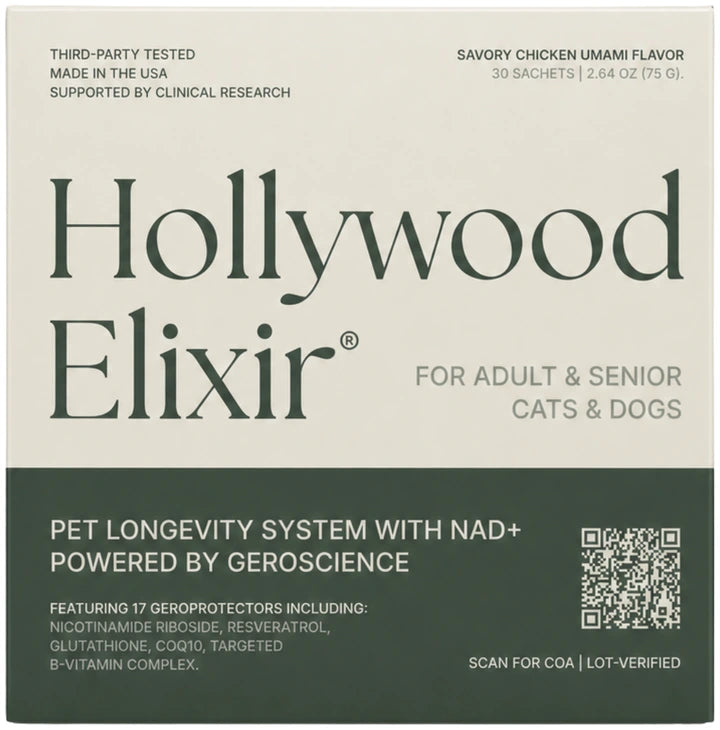
At La Petite Labs, we apply that research to formulation. Hollywood Elixir® starts with NR, then pairs it with ingredients selected for the processes connected to NAD use: CoQ10 and riboflavin for electron-transfer machinery, glutathione and antioxidant nutrients for redox biology, and polyphenols investigated in NAD consumption and metabolic signalling.
Our NAD+ for dogs and NAD+ for cats guides cover the species-specific introduction. Here, we follow the cellular system that informs Hollywood Elixir®.
Inputs, circulation, demand and waste
A cell continually takes in raw materials, exchanges electrons, recovers used molecular parts and clears what it cannot reuse. Four connected processes make the NADome easier to follow.
A working map of the NADome
Inputs
NR, NMN and other precursors supply building blocks for NAD+. Different enzymes process each starting material.
NR · NMN · niacin forms · tryptophan*Circulation
NAD+ accepts electrons and becomes NADH; releasing those electrons regenerates NAD+. Separately, salvage recovers nicotinamide released during NAD consumption and rebuilds it into NAD+.
Electron transfer · nicotinamide salvageDemand
Fuel metabolism cycles NAD+ and NADH. DNA-repair and signalling enzymes consume NAD+, so cells must replace what they use.
Energy production · repair · signallingWaste
Some nicotinamide leaves the salvage route. Cells convert it into methylated compounds and other breakdown products that can be cleared in urine.
Methyl-nicotinamide · pyridones · clearance“Circulation” means chemical cycling, not free movement of NAD through the bloodstream. *Dogs can use tryptophan to make NAD precursors; cats cannot convert enough to meet their niacin needs.
The amount of NAD present and the rate at which it is replaced are different measurements. A bath can hold the same water level with the tap and drain barely open or with both flowing rapidly. Likewise, two cells can contain the same amount of NAD while one makes and breaks down much more of it per hour.
This matters when interpreting a supplement experiment. An unchanged NAD concentration could conceal faster synthesis matched by faster consumption. A higher concentration could reflect slower breakdown rather than faster synthesis. Isotope-tracing experiments label incoming molecules and follow them over time to distinguish those possibilities.5 Measuring concentration tells you how much is there; tracing tells you how quickly it is being made and used.

Inputs: how NR, NMN and other precursors become NAD+
Cells build NAD+ from several starting materials. Niacin forms enter through vitamin B3 pathways. Tryptophan, an amino acid released when dietary protein is digested, can enter a longer synthesis route. NR and NMN enter nearer the final steps.
NR is converted to NMN by NR kinases. NMN is then converted to NAD+ by enzymes called NMNATs. The discovery of the NR-kinase pathway in 2004 gave researchers a defined route to investigate: a nutritional molecule, an enzyme that processes it and a measurable NAD product.6
NMN is one reaction closer to NAD+ once it is inside the relevant cell. But an oral supplement starts in the digestive tract, outside those cells. Absorption, conversion by other tissues and entry across cell membranes all come before the final intracellular reaction.
That membrane step gives researchers a concrete reason to investigate NR. NR is a nucleoside that can enter cells through nucleoside transporters.7 NMN carries a phosphate group and, in studied cell systems, is first converted outside the cell to NR before uptake. The cell then adds the phosphate back through NR kinase.8 In those systems, NR provides the form used for entry even when the starting material is NMN. One fewer reaction inside a cell does not necessarily mean a shorter route from the digestive tract into that cell.
Oral tracing studies added another complication: precursor material can be converted into nicotinamide before reaching peripheral tissues.5 Counting arrows on a pathway diagram cannot tell you how much of a dose reaches muscle, which chemical form arrives there or what the tissue does with it. Those require absorption and tissue measurements. Our guides to NR for dogs and NMN for dogs examine the individual precursors in more detail.
Nicotinamide, often shortened to NAM, enters the salvage route through the enzyme NAMPT. Nicotinic acid enters the Preiss–Handler pathway, passing through NaMN and NAAD. Similar names conceal different chemical structures, enzymes and routes into NAD synthesis.
Dogs
Dietary tryptophan can supply NAD building blocks.
Dogs can convert some tryptophan into NAD precursors through the kynurenine pathway. This connects protein nutrition to NAD synthesis, although much tryptophan is used for other purposes and the pathway has several branches.
For the evidence on supplemental precursors in cats, see NR for cats and NMN for cats.
Circulation: regenerating NAD+ after it carries electrons
NAD+ picks up electrons during fuel metabolism and becomes NADH. To keep those reactions running, NADH must release the electrons and become NAD+ again. The cofactor can then repeat the job.
Inside mitochondria, NADH donates electrons to Complex I, the first large protein assembly in one route through the respiratory chain. Electrons pass through its cofactors into the CoQ pool and onward along the chain. That flow helps create the proton gradient used to make ATP.
Making more NAD and regenerating NAD+ from NADH solve different problems. Adding precursor can increase the material available for synthesis. It does not, on its own, guarantee that the respiratory chain can accept electrons quickly enough. When electron transfer is restricted, NADH can accumulate and less NAD+ remains available for reactions that need its electron-accepting form.
This is why researchers distinguish total NAD(H)—NAD+ plus NADH—from the NAD+/NADH ratio. The total measures the combined pool. The ratio describes how that pool is divided between the two forms. If NADH rises while NAD+ falls, the total can stay unchanged even though less NAD+ is available to accept electrons during fuel breakdown.11
Hollywood Elixir® includes CoQ10 and riboflavin, or vitamin B2, alongside NR because electron transport requires more than NADH. CoQ carries electrons between respiratory-chain complexes. B2 is used to make FMN and FAD, cofactors used by metabolic enzymes; FMN participates in the first electron-transfer steps within Complex I.1213 We pair the precursor with nutrients used by the machinery that takes electrons from NADH and passes them onward.
NAD must reach the mitochondria that need it
A whole-cell NAD measurement mixes together material from compartments with different jobs. NAD in the nucleus helps supply enzymes involved in DNA damage responses and gene regulation. Mitochondrial NAD participates in fuel oxidation. The cytosol has its own NAD-dependent reactions, including steps in glycolysis.14
The inner mitochondrial membrane separates the mitochondrial supply from the surrounding cell. In 2020, researchers identified SLC25A51, a protein that transports NAD+ across that membrane. Disrupting the transporter lowered mitochondrial NAD and impaired respiration.15
NAD outside a mitochondrion cannot do the work of NAD inside it. Availability depends on transport as well as synthesis. Measuring the whole cell can therefore hide a shortage in the compartment where energy production is being studied.
The same issue applies at the scale of an animal. Blood, muscle and brain contain different cells with different metabolic demands. A blood NAD increase establishes a change in the blood sample. To know whether muscle mitochondria gained NAD or produced ATP more effectively, researchers have to measure muscle and mitochondrial function.

Demand: DNA repair and signalling consume NAD+
During electron transfer, NAD+ and NADH cycle without the molecule being permanently spent. Other reactions split NAD+ apart. The cell then has to rebuild the supply.
PARPs use NAD+ to add ADP-ribose signals to proteins, helping coordinate responses to DNA damage. Sirtuins consume NAD+ while removing chemical groups from proteins and changing their activity. CD38 breaks down NAD and participates in calcium signalling and immune biology. These enzymes do useful work; eliminating all consumption would interfere with normal cell function.
Demand can nevertheless become excessive or change with age and inflammation. In an ageing-mouse study, CD38 expression and activity rose in several tissues. Mice lacking CD38 were protected against the same NAD decline and associated mitochondrial changes.16 This showed that falling NAD can result from increased destruction, not simply inadequate precursor supply.
Quercetin, included in Hollywood Elixir®, inhibited CD38 in enzyme and cell experiments.17 That finding links it to the enzyme consuming NAD, rather than to the supply of new precursor. This research on NAD breakdown is one reason we include quercetin.
Resveratrol connects to a different regulatory route. In cell and mouse experiments, it affected signalling through cAMP and AMPK, with downstream changes involving NAD metabolism and SIRT1-associated activity.18 AMPK helps coordinate cellular responses to energy availability. This research informs resveratrol’s place in the formula; it should not be read as a direct switch that turns on every sirtuin.
NaMN can restrain an enzyme that destroys NAD in injured nerves
Long nerve fibres need a supply of NAD to remain functional. During certain forms of injury, an enzyme called SARM1 activates and rapidly breaks NAD down, contributing to degeneration of the damaged fibre.
Researchers found that NaMN, a molecule formed on the nicotinic-acid route to NAD, can bind a control site on SARM1 and inhibit its activation in experimental neuronal systems.19 NaMN therefore has two relevant properties: enzymes can use it to make NAD, and it can influence an enzyme that destroys NAD.
This is why measuring related metabolites can reveal more than measuring NAD+ alone. Two samples with the same NAD+ concentration could contain different amounts of a molecule that regulates NAD breakdown. The nerve experiments concern SARM1 regulation; they do not establish nerve protection from dietary niacin.
Waste: recycling nicotinamide or clearing it
When NAD-consuming enzymes release nicotinamide, cells can reuse it. NAMPT converts nicotinamide into NMN, and NMNAT completes the return to NAD+. This NAD salvage pathway conserves material already inside the body.
Alternatively, the enzyme NNMT transfers a methyl group from a donor called SAM onto nicotinamide. The product, methyl-nicotinamide or MeNAM, is no longer following the usual salvage route back to NAD+. It can be converted into pyridones and cleared in urine.
NADomics studies often measure MeNAM and pyridones after precursor supplementation.20 Higher levels show that these products accumulated. That could reflect faster formation or slower removal; tracer studies and timed urine measurements help distinguish the two. To find out how much material first passed through NAD-dependent reactions or reached a particular tissue, researchers need precursor tracing and tissue measurements alongside the breakdown products.
“Waste” describes material leaving this recycling route, not a judgement that every breakdown product is useless or harmful. Raising the precursor dose may send more material into clearance without producing a proportional change in tissue NAD or function. Measuring the outputs helps researchers detect that possibility instead of assuming every additional milligram remains available to cells.
NADPH supplies the electrons that recycle glutathione
NAD kinases add a phosphate group to create the related NADP system. Its reduced form, NADPH, supplies electrons for making molecules and maintaining antioxidant defences.
Consider glutathione. Cells use reduced glutathione to help neutralise peroxides. In the process, glutathione becomes oxidised. The enzyme glutathione reductase uses electrons from NADPH to restore the reduced form so it can work again. That enzyme also uses FAD, a cofactor made from vitamin B2.21
Glutathione supply, NADPH availability and the enzyme that connects them are therefore linked. An antioxidant molecule must either be replenished or regenerated after use; its presence alone does not explain how long the defence can continue. Research tracing NADPH production shows that cells generate and manage this reducing power through several metabolic routes.22
Hollywood Elixir® combines glutathione with riboflavin because they participate in that same recycling process: glutathione helps handle peroxides; B2 supplies the FAD cofactor used by glutathione reductase; NADPH supplies the electrons in the cell. Vitamin C, vitamin E and astaxanthin contribute additional antioxidant chemistry.
A NAD+ measurement cannot reveal whether glutathione was successfully recycled. A study addressing that question would also examine NADPH/NADP+, reduced and oxidised glutathione, and a measure of oxidative damage or antioxidant function. Our guides to NAD, NADH, NADP and NADPH in dogs and the same cofactors in cats separate their roles in more detail.
How we use NADome research to formulate Hollywood Elixir®
We formulate around what happens before, during and after NAD is used. Findings from NADomics show why precursor exposure, the NAD+/NADH balance and breakdown products need to be considered separately. Pathway research identifies the enzymes and cofactors connecting those measurements to energy production, antioxidant recycling and signalling.
That is how we apply the NADome to Hollywood Elixir®. NR supplies precursor material. CoQ10 and B2 connect the formula to the machinery that transfers electrons. Glutathione and antioxidant nutrients address the chemistry of oxidation and reduction. Quercetin and resveratrol are selected in part for research on NAD-consuming enzymes and metabolic regulation. Each selection has a stated biological job; adding several precursors would not cover the same set of processes.
| Cellular process | Ingredients | Why we include them |
|---|---|---|
| Building NAD | Nicotinamide riboside; niacin | NR enters through NR kinase and NMN. Niacin provides additional vitamin B3 nutrition used in NAD metabolism. |
| Transferring electrons | CoQ10; riboflavin (B2) | CoQ carries electrons along the respiratory chain. B2 supplies FMN and FAD cofactors used by electron-transfer enzymes. |
| Maintaining antioxidant chemistry | Glutathione; B2; vitamins C and E; astaxanthin | Glutathione participates in peroxide defence. Its recycling enzyme uses B2-derived FAD and electrons from NADPH. The other ingredients add distinct antioxidant functions. |
| Regulating NAD breakdown | Quercetin | In enzyme and cell experiments, quercetin inhibited CD38, an enzyme that consumes NAD. |
| Metabolic regulation | Resveratrol | Experimental research connects it to AMPK and sirtuin-associated signalling, which regulate responses to cellular energy availability. |
The broader formula also contains vitamins B6 and B12, beta glucans, reishi mushroom, spirulina, blueberry powder and whey protein isolate. NAD biology guides a central part of the design; the product also serves broader healthy-aging nutritional goals for adult and senior dogs and cats.
The Hollywood Elixir ingredient breakdown lists the complete live formula. The Hollywood Elixir research page connects individual ingredients and formulation choices to the supporting literature.
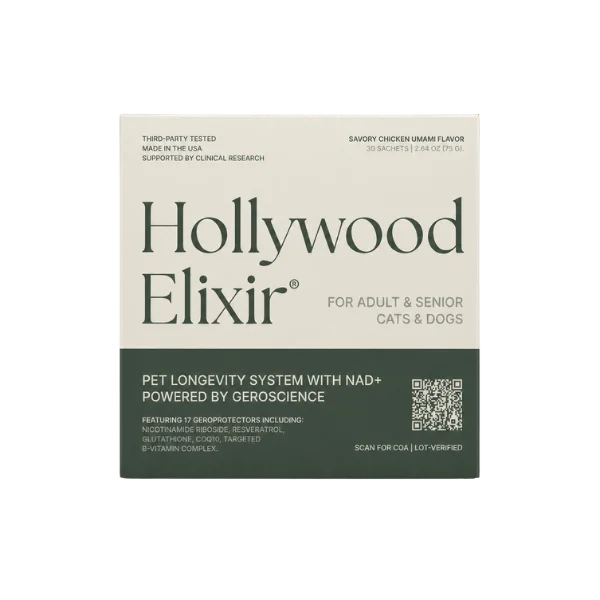
Hollywood Elixir® Longevity System with NAD+
From $63/box
NADomics: measuring supply, use and clearance together
NADomics measures a set of related molecules in the same sample. Researchers commonly use liquid chromatography–mass spectrometry, or LC–MS: chromatography separates the compounds, and mass spectrometry identifies and quantifies them.
A panel can include precursors such as NR and NMN, NAD+ and NADH, NADP+ and NADPH, intermediates such as NAAD, and clearance products such as MeNAM and pyridones. Collection and handling matter because some of these molecules change or degrade before analysis; a warm sample left too long can report the handling process as well as the original biology.11
- Did the NAD pool get larger?
- Measure NAD+ and NADH, then calculate their combined amount. This distinguishes an increase in total NAD(H) from a shift between its two forms.
- Did electron handling change?
- Examine NAD+/NADH and NADPH/NADP+ in the relevant sample. These ratios describe different redox systems; neither is a universal score in which a higher number is always better.
- Did clearance products accumulate?
- Measure MeNAM and pyridones alongside precursors and NAD. Higher concentrations can reflect increased formation or reduced removal. Timed urine measurements and tracing help determine which occurred.
- Did synthesis or breakdown speed up?
- Use labelled molecules or suitable repeated measurements over time. A single concentration cannot distinguish rapid production matched by rapid use from slow production matched by slow use.
- Did the animal benefit?
- Measure the intended function separately: for example, mitochondrial respiration, muscle performance or a defined cognitive outcome. A metabolite change alone cannot supply that result.
A human NR trial illustrates why the distinction is useful. Twelve older men received NR in a randomised crossover study. Blood NAD+ rose, but muscle NAD+ did not increase significantly. Muscle NAAD and methylated nicotinamide products increased, while the measured mitochondrial bioenergetics did not improve.23
Measuring blood NAD+ alone would have missed the different response in muscle. Measuring only muscle NAD+ would have missed the changes in related metabolites. Measuring the metabolites without mitochondrial function would have left the question of improved energy production unanswered.
For Hollywood Elixir®, the decisive comparison would hold NR exposure constant: the complete formula versus NR alone, with an appropriate control. NADomics could show whether the additional ingredients alter precursor handling, redox balance or clearance. Functional measurements in dogs or cats would then show whether those differences benefit the animal. The formulation rationale described here has not yet been established through a finished-product NADomics trial.
Dogs and cats: measure the species and tissue that matter
The claim that NAD+ falls with age is well established in some experimental tissues, but it is not a universal description of every sample from every older animal.
In a 2025 observational study of toy poodles and retrievers, researchers found no significant relationship between chronological age and whole-blood NAD+.24 An earlier study of cultured canine skin fibroblasts found that NAD+ and NADH appeared to increase with age in that cell model, even as other measures, including glutathione and ATP, declined.25
The second finding is especially instructive: a cell can contain more measured NAD while showing less of an energy molecule or an antioxidant. NAD abundance does not describe all the processes needed for cell function. Neither study tells us what happened in every muscle or neuron of the dogs from which the samples came.
For a dog study aimed at physical performance, relevant outcomes might include muscle function alongside the biochemical measurements. A feline study must account for cats’ dietary niacin dependence, their own precursor handling and outcomes measured in cats. The existing canine NAD+ evidence and feline NAD+ evidence should be read with those differences in mind.
NADomics helps researchers identify which processes changed and choose the next measurement. It does not make a blood NAD result a diagnosis of an individual pet or establish one ideal concentration for every dog and cat.
From cellular chemistry to the daily bowl
A precursor supplies material. Electron-transfer enzymes use the resulting cofactors. Repair and signalling reactions consume NAD, salvage rebuilds it, and clearance removes some of the leftovers. The animal depends on those processes working together, every day.
Hollywood Elixir® is designed around those connections. NR is paired with CoQ10 and B2 because NADH hands electrons to machinery that uses them. Glutathione is paired with nutrients involved in antioxidant chemistry and recycling. Quercetin and resveratrol bring specific research on NAD consumption and metabolic regulation into the ingredient selection.
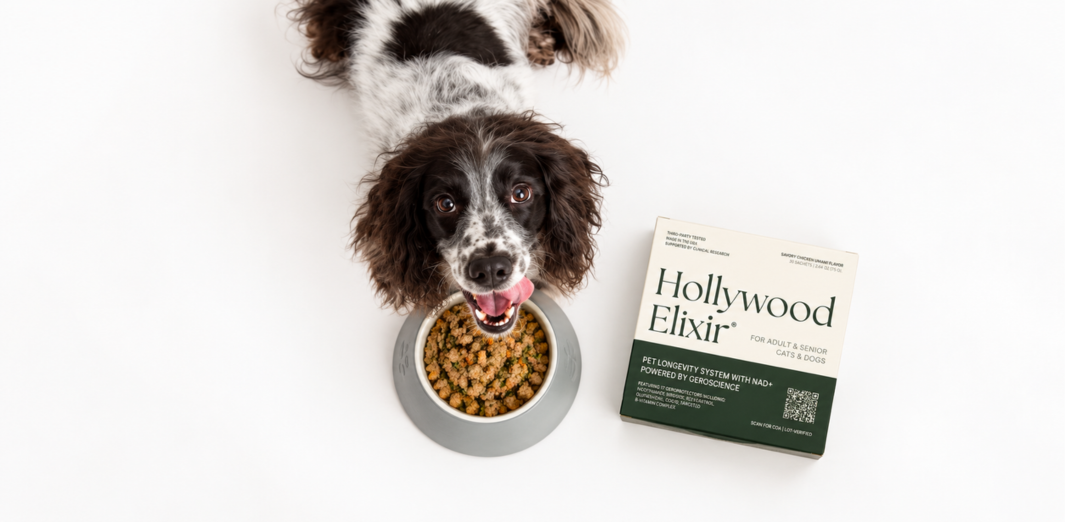
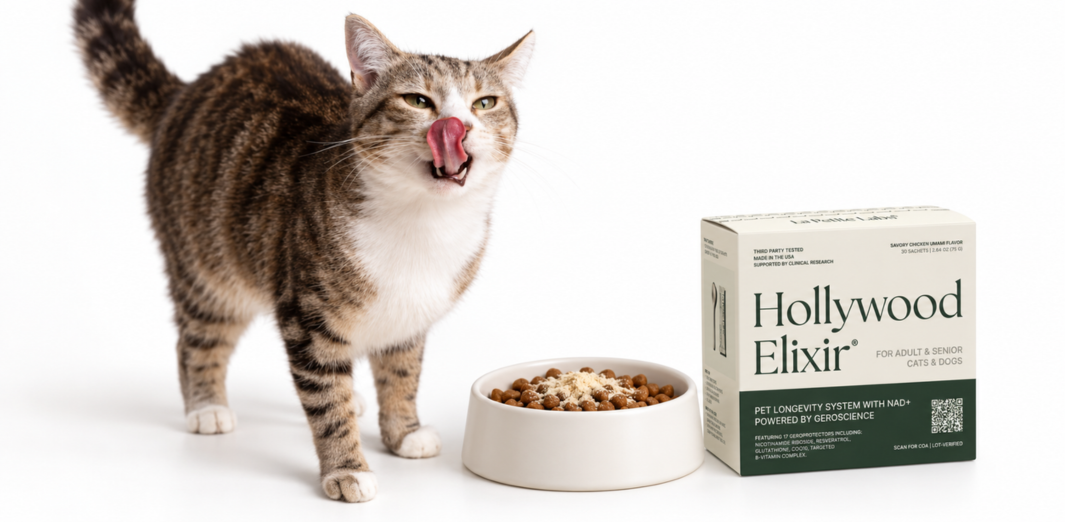
For adult and senior dogs and cats, those choices arrive as a daily powder mixed into their usual food. Follow the current product directions for your pet’s serving. A complete and balanced diet, appropriate activity and veterinary care remain the foundation.
The ingredient list follows the reactions: precursor supply, electron transfer, antioxidant recycling and regulation of NAD breakdown. That is how the NADome shapes Hollywood Elixir®.