NAD+ for Cats

How NAD+ helps your cat’s cells turn food into usable energy, and where supplements fit

By La Petite Labs Editorial 19 min read

Woman cuddling an orange-and-white cat and a silver tabby while holding a Hollywood Elixir box
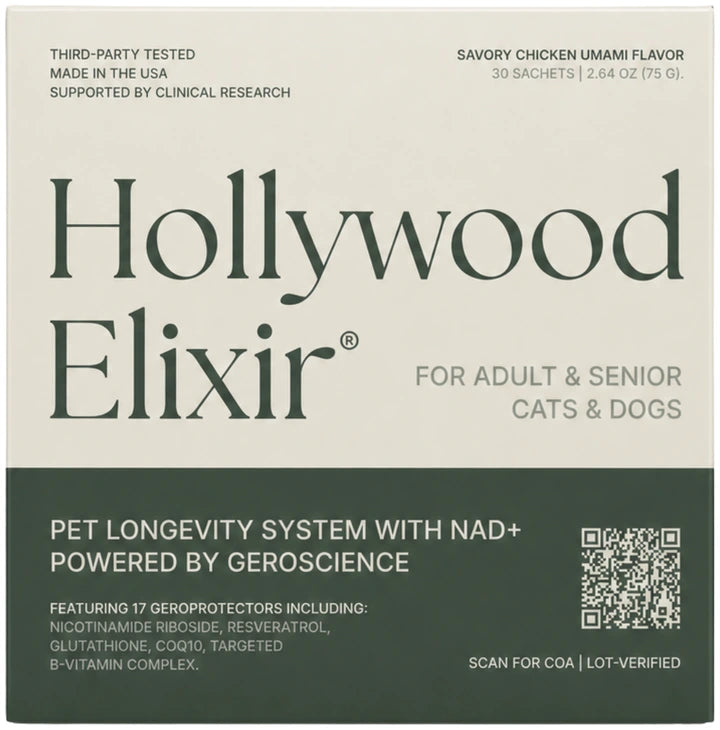
Hollywood Elixir® Daily longevity system · adult & senior cats Starting at $63/month 

NAD+ helps your cat’s cells turn nutrients from food into usable energy. Cells also use it in maintenance work, including responses to DNA damage. These everyday jobs explain why NAD+ has become a focus of healthy-aging research.

Nicotinamide riboside, or NR, is an ingredient cells can use to make NAD+. Understanding that connection helps make sense of a label—and of what researchers have, and have not, learned about supporting this system in cats.

NAD+ is a coenzyme: a small molecule that helps enzymes carry out chemical reactions. It participates in energy production and is consumed in other cellular processes, so cells continually reuse and replenish it. NR, nicotinamide (NAM) and nicotinamide mononucleotide (NMN) are different compounds involved in making NAD+. 1 5

Feline research has identified changes in related metabolism in cats with heart disease. It has not yet supplied a clear answer to the question many owners are asking: will an NAD-oriented supplement help my cat feel or function better? This guide connects the biology with the practical choice, from a formula’s actual ingredients to the food your cat will eat.

How NAD+ Helps Cells Use Food

Food supplies energy, but cells need a way to make that energy available for their work. As nutrients are broken down, NAD+ accepts electrons and becomes NADH. Those electrons can feed into reactions in mitochondria that help produce ATP, the molecule that powers much of a cell’s activity. NAD+ then becomes available to take part again. 5

The initials stand for nicotinamide adenine dinucleotide. Calling it a coenzyme describes its role: it helps enzymes carry out reactions. NAD+ is involved in the chemistry that makes food useful to a cell; the calories still come from the food.

Its work extends beyond energy production. Enzymes called PARPs use NAD+ during responses to DNA damage, while sirtuins use it in regulating cellular processes. These reactions consume NAD+, creating an ongoing need to make more. 1 4

Woman kneeling with two long-haired tabby cats while holding a Hollywood Elixir box beside a food bowl

How Cells Replenish NAD+

Cells have pathways for making NAD+ and recovering materials they can use again. A precursor enters that process as starting material. NR is one such precursor; NAM and NMN are others. 1

This is why a supplement described as “NAD+ support” may list nicotinamide riboside among its ingredients. The product is supplying a precursor to the molecule the cells use. NADH, meanwhile, is the related form involved in electron transfer, rather than another name for NR.

Read the full ingredient name when comparing products or research. NR, NAM and NMN connect to the same system, but a study of one does not describe all three. Our nicotinamide riboside for cats guide takes a closer look at NR itself.

Woman exercising beside a tabby cat, with a Hollywood Elixir box and food bowl on a small table

The Feline Connection: Niacin in the Diet

Cats do not efficiently convert the amino acid tryptophan into enough niacin to meet their needs. Niacin is therefore an essential part of their diet. 6

That does not mean cats cannot make NAD+. Classic experiments found the relevant enzymes in feline tissues, but also showed how much of the material coming from tryptophan could be diverted into another pathway. The limitation concerns a source of starting material, rather than an absence of NAD-making machinery. 6

This helps separate two ideas that can become tangled in supplement discussions. Supplying an essential nutrient through an appropriate complete food is established nutrition. Whether extra NR offers an additional benefit asks a further question about supplementation. A cat’s need for dietary niacin does not, by itself, answer it.

Orange-and-white cat reaching toward a woman holding a Hollywood Elixir box while sitting in a chair

What Researchers Found in Cats With Heart Disease

A study of 83 cats gives NAD-related metabolism a concrete feline context. Researchers compared blood samples from healthy controls with samples from cats at different stages of hypertrophic cardiomyopathy, a disease in which the heart muscle thickens. They looked across many metabolites—the small molecules present as the body’s chemistry proceeds. 2

Among the findings, serum nicotinamide was lower in two groups with preclinical disease than in controls. Nicotinamide is NAM, a precursor involved in NAD synthesis. Its concentration in blood is a different measurement from NAD+ inside heart cells.

The study helps identify metabolic changes associated with feline heart disease. It did not give the cats NR, NAM or NAD+, so it cannot tell us whether adding one would correct those changes or improve their health. Nor does a comparison involving heart disease establish the normal course of NAD+ levels as healthy cats age. 2

Gray-haired man holding a Hollywood Elixir box while two cats rest beside him in an armchair

What Human NR Studies Add

Human research helps explain why NR has attracted interest as an oral ingredient. Trammell and colleagues studied NR in humans and mice. In one human experiment, they measured increases in NAD+ in blood cells after people took NR. This supports the precursor connection under the conditions studied. 3

Another trial examined muscle in older men. NR changed NAD-related metabolites there, without improving the measured mitochondrial bioenergetics—the energy-producing function of the mitochondria. 4

Together, these findings make the distinction between reaching a biochemical target and changing function easier to see. They also leave the feline question open: how a particular formulation affects a cat depends on more than what it did in a human experiment. A human research dose is not a serving instruction for a pet.

NAD+ helps your cat’s cells turn nutrients from food into usable energy.

NAD+ and Healthy Aging in Cats

You can be interested in healthy aging while your cat is still doing well. NAD+ is relevant because the processes it participates in—using energy and maintaining cells—continue throughout life.

The research reviewed here does not establish a birthday at which a healthy cat needs an NAD+ precursor, or an age-by-age chart that tells an owner how much to give. It also has not established that supplementing NAD-related ingredients extends cats’ lives.

A proactive choice can still have a clear purpose. Begin with what the formula supplies, why you are considering it and how it fits the existing care plan.

Tabby cat looking up at a Hollywood Elixir sachet held above it, with the product box on a small table

Can NAD+ Support Everyday Energy or Cognition?

“Energy” can mean two different things in this discussion. In a cell, it refers to chemical reactions and molecules such as ATP. At home, it may mean whether a cat comes over to play, climbs to a favorite perch or stays interested in the household. The biology makes a connection worth investigating; it does not tell us that giving a precursor will change those behaviors.

The studies discussed here have not demonstrated that NAD+ or NR treats feline cognitive dysfunction, or established a predictable improvement in play, grooming or jumping. A cognition finding from dogs given a different combination cannot supply that answer for cats.

For an owner, the starting point is the particular change. A cat who has stopped jumping and a cat who seems disoriented present different concerns, even if both are described as “slowing down.” Their care begins with understanding what has changed.

Hand gently petting an orange-and-white cat beside a food bowl and Hollywood Elixir box

Notice the Details of a Changed Routine

A favorite sleeping spot is useful context. Is your cat still choosing it, reaching it by a different route, or avoiding the jump altogether? At mealtimes, does your cat approach the bowl but leave it, eat less, or seek more food than before?

These observations give a veterinarian something specific to investigate. Senior-cat guidance emphasizes changes in mobility, eating, grooming, elimination and behavior, which may be easier to recognize at home than during an appointment. 7

Write down when a change began and, for movement, take a short video if you can. These details are information about your cat’s daily life, not a home test for low NAD+. They can make the discussion about supplements more useful by placing it alongside the concern that prompted it.

Man holding a Hollywood Elixir box beside a black cat, an orange tabby and a food bowl

What a Supplement Adds to a Complete Diet

A food’s “complete and balanced” statement means it is intended to provide the required nutrients for the stated life stage. A longevity powder has a different role. It adds its own ingredients to the diet. Do not assume it makes an incomplete homemade recipe nutritionally complete. 8

Start by listing what is already being given. An NR-containing formula adds a precursor. A blend containing CoQ10 or glutathione may also overlap with another supplement on the shelf. Different product names can hide that overlap.

The decision becomes clearer when you can see the actual ingredients and amounts together. A combined powder may simplify the routine for someone considering several ingredients, but the complete food remains the nutritional foundation.

Hollywood Elixir’s ingredient breakdown lists the ingredients and amounts in our blend.

What to Bring to a Veterinary Review

Body weight is only part of a senior-cat assessment. A cat can lose muscle without a correspondingly obvious change on the scale. Veterinary guidance therefore treats muscle condition and body condition as separate assessments. 7

Bring your observations and the current food, supplement and medicine labels to the review. Together with an examination, that history helps put a question about “more energy” into the context of the cat’s overall health.

NAD+ is the molecule cells use. NR is one of the ingredients they can use to make it.

Silver tabby sitting beside a food bowl and a Hollywood Elixir box held in a person's hand

DVM Voice: Clinical Vignette of a Common Pattern in Senior Cat Aging

Case provided by JoAnna Pendergrass, DVM

Sasha, a 12-year-old cat, was brought in after her owner noticed increased thirst and urination, lethargy, vomiting, and a generally unkempt appearance. Examination showed weight loss, elevated blood pressure, and reduced vitality.

Diagnostic testing revealed elevated kidney markers, poorly concentrated urine, and protein loss in the urine — findings consistent with chronic kidney disease, one of the most common chronic conditions in senior cats.

Her care required a kidney-focused diet, blood pressure management, targeted supplementation, medication support, and regular monitoring — a necessary plan, but one started after clinical signs were already visible.

Clinical takeaway: Sasha’s case reflects why senior-cat wellness should begin before obvious decline. Earlier monitoring, body-condition tracking, hydration awareness, antioxidant support, and daily cellular resilience may help support quality of life as cats age.

Single-case vignette. Not generalizable. Veterinary diagnosis and monitoring are essential for increased thirst, urination, vomiting, lethargy, weight loss, or suspected kidney disease.

Explore Hollywood Elixir Research →
Woman holding a Hollywood Elixir box toward a brown cat perched on the back of a sofa

A Powder Has to Work at Mealtimes

A supplement routine depends on what your cat actually consumes. A measured portion stirred into a full bowl does not establish how much was taken if half the meal is left behind. Food acceptance is therefore part of the product decision, rather than an inconvenience to deal with afterward.

Check whether the product is meant to be mixed with food and follow its directions. If the directions allow it, offering the product with a small portion first can make it easier to see whether that portion was eaten before serving the rest. Do not mix a new powder into the only available food and assume hunger will solve the problem.

If your cat refuses the altered food, return to the familiar food and seek guidance. Contact your veterinarian promptly if your cat is not eating. 9 Preserving a supplement routine should never come at the expense of eating.

Woman leaning toward a fluffy orange cat beside a Hollywood Elixir box and green food bowl

Serving Sizes and Life Stages

A scoop is a volume, not a universal amount of NR. Two powders can have different concentrations and different directions for cats of the same weight. Human capsules and experimental doses introduce still other differences.

Use the current directions for the exact pet product and check its intended life stage. Hollywood Elixir is intended for adult dogs and cats; a kitten’s nutritional needs and suitability for additional ingredients need their own assessment.

The sources in this guide do not establish a general therapeutic NR dose for cats. If a label does not make the serving or ingredient amount clear, obtain that information before trying to calculate a dose from another product.

Tabby cat licking its nose beside a food bowl and Hollywood Elixir box

Compare the Cost of the Daily Routine

Compare the cost per day using the label-directed amount for your cat. A hypothetical $60 container holding 30 daily servings costs $2 a day. At the same price, a container holding 60 daily servings costs $1 a day. The number of sachets or scoops alone does not tell you how many daily servings there are. These examples are not Hollywood Elixir’s price or serving guidance.

Use the actual price, the directions for your cat and any storage requirements when comparing formats. A large container is poor value if the food is repeatedly refused or the product cannot be used within its stated storage period.

What Is Known About Safety?

The studies discussed here do not establish long-term feline safety for an NAD-oriented supplement or settle how every ingredient in a blend interacts with medicines. Safety is a question about the whole formulation, the amount and the cat receiving it.

A cat with kidney, liver or heart disease, a cat on a prescription diet, or one receiving several medicines needs an individual review. The heart-disease study above did not test supplementation as a treatment.

If appetite loss, vomiting, diarrhea, unusual lethargy or another concerning change follows a new product, contact your veterinarian with its name, serving and the timing of the change. Those observations do not identify the cause on their own, but they help the veterinarian decide what to do next.

Read a Testing Report for What It Shows

A product’s evidence can include several different kinds of information. The label describes the formulation and directions. A laboratory report can address the identity, amount or contaminants actually tested in the sampled material. A clinical study asks what happened when a defined intervention was given to a defined population.

For a testing report, match the product and batch where supplied, then read the named tests and results. Testing for heavy metals does not automatically verify every ingredient amount. A certificate for an ingredient does not necessarily describe the finished blend.

These documents serve a useful purpose when their scope is clear. They help you understand what is in a product and what was checked, while the clinical research addresses a different part of the decision.

La Petite Labs’ quality and testing standards describe our ingredient and batch verification approach.

Tabby cat sitting at a table with a food bowl and Hollywood Elixir box

Where Hollywood Elixir Fits

Hollywood Elixir is La Petite Labs’ daily longevity powder for adult dogs and cats. It combines NR with reduced glutathione, CoQ10 and other antioxidant ingredients, packaged in sachets.

The ingredients have distinct roles. NR supplies starting material for making NAD+. 1 Reduced glutathione helps an antioxidant enzyme break down hydrogen peroxide. 10 CoQ10 carries electrons within mitochondria as part of energy production. 11

That explains the rationale for bringing an NAD+ precursor, antioxidant support and a mitochondrial cofactor into one formulation. For an owner considering those ingredients together, a single powder may make the daily routine easier to organize. The amounts and any overlap with existing products still matter.

The Hollywood Elixir product information provides the complete formulation and current directions. The studies in this guide explain the scientific background; they did not test the finished Hollywood Elixir formula in cats.

The Hollywood Elixir research library explains the broader research and frameworks informing our formulation.

Woman cuddling a silver tabby and a cream-colored cat while holding a Hollywood Elixir box

What to Watch After You Start

Choose a few observations you can actually keep up with: how much food is eaten, whether the product is accepted, stool changes and the particular activity you wanted to follow. Keep the descriptions simple enough that another person caring for your cat can follow them.

Write down other changes during the same period, including food, medicines and the household routine. A better week is easier to interpret when you know what else happened that week.

The research does not provide a reliable deadline for a visible response to feline NAD+ support. Agree on a review point appropriate to the purpose and product. The record can help decide whether the routine is tolerated, practical and worth continuing; it cannot by itself prove that the supplement caused an improvement.

Keep the Routine Specific to Your Cat

In a home with several cats, a supplement plan also needs a feeding plan. A shared bowl can make it difficult to know which cat consumed a measured serving. Work out how the intended cat will receive the product without disrupting the others’ food.

NAD+ biology explains why a precursor might be considered. The next step is to evaluate one product for your cat, with a specific reason for using it and a practical way to review it.

Hollywood Elixir brings NR, reduced glutathione and CoQ10 together in one daily powder.

Educational content only. This material is not a substitute for veterinary advice. Always consult your veterinarian about your cat’s specific needs. These statements have not been evaluated by the Food and Drug Administration. Products mentioned are not intended to diagnose, treat, cure, or prevent any disease.

Glossary

NAD+: Nicotinamide adenine dinucleotide, a coenzyme involved in using energy and in other cellular reactions.

NADH: The related form NAD+ becomes when it accepts electrons during metabolism.

ATP: Adenosine triphosphate, a molecule that supplies energy for much of a cell’s work.

Precursor: A starting material used to make another molecule. NR, NAM and NMN are distinct compounds involved in making NAD+.

NR: Nicotinamide riboside. NAM: Nicotinamide. NMN: Nicotinamide mononucleotide.

Metabolite: A small molecule involved in or produced by metabolism.

Biomarker: A measurable biological feature, such as the concentration of a molecule in blood.

Clinical outcome: A measured aspect of health or function in the population being studied.

Related Reading

References

Numbered references identify the sources used for specific claims. Read the study design, species and evidence boundaries alongside each finding.

  1. Ratajczak J, Joffraud M, Trammell SA, et al. NRK1 controls nicotinamide mononucleotide and nicotinamide riboside metabolism in mammalian cells. Nature communications · 2016· DOI 10.1038/ncomms13103Study design/context: Mechanistic studySpecies/context: mouse, mammalian cellsEvidence boundary: Experimental pathway work; not canine or feline absorption, dosing, or clinical efficacy.↩ 1 · ↩ 2 · ↩ 3 · ↩ 4
  2. Li Q, Homilius M, Achilles E, et al. Metabolic abnormalities and reprogramming in cats with naturally occurring hypertrophic cardiomyopathy. ESC heart failure · 2025· DOI 10.1002/ehf2.15135Study design/context: Observational metabolomics comparisonSpecies/context: catEvidence boundary: Observational serum-metabolite comparison; nicotinamide was lower in preclinical B1/B2 groups. No NAD-precursor supplementation or heart-tissue NAD measurement.↩ 1 · ↩ 2
  3. Trammell SA, Schmidt MS, Weidemann BJ, et al. Nicotinamide riboside is uniquely and orally bioavailable in mice and humans. Nature communications · 2016· DOI 10.1038/ncomms12948Study design/context: Pharmacokinetic studySpecies/context: human, mouseEvidence boundary: Human and mouse NAD-related biomarkers; not clinical benefit or a dose for pets.↩
  4. Elhassan YS, Kluckova K, Fletcher RS, et al. Nicotinamide Riboside Augments the Aged Human Skeletal Muscle NAD+ Metabolome and Induces Transcriptomic and Anti-inflammatory Signatures. Cell reports · 2019· DOI 10.1016/j.celrep.2019.07.043Study design/context: Randomized placebo-controlled crossover trialSpecies/context: humanEvidence boundary: Older men; muscle NAD-related metabolites changed without improved mitochondrial bioenergetics. Not pet outcome evidence.↩ 1 · ↩ 2
  5. Kory N, Uit de Bos J, van der Rijt S, et al. MCART1/SLC25A51 is required for mitochondrial NAD transport. Science advances · 2020· DOI 10.1126/sciadv.abe5310Study design/context: Mechanistic studySpecies/context: human cellsEvidence boundary: Intracellular NAD transport and ATP-related cell biology; no feline oral supplement trial.↩ 1 · ↩ 2
  6. Ikeda M, Tsuji H, Nakamura S, Ichiyama A, Nishizuka Y, Hayaishi O. Studies on the biosynthesis of nicotinamide adenine dinucleotide. II. A role of picolinic carboxylase in the biosynthesis of nicotinamide adenine dinucleotide from tryptophan in mammals. Journal of Biological Chemistry · 1965· DOI 10.1016/S0021-9258(18)97589-7Study design/context: Comparative biochemical enzyme experimentsSpecies/context: cat, ratEvidence boundary: Feline tissue enzyme activity and niacin nutrition; not NR dosing or clinical supplement efficacy.↩ 1 · ↩ 2
  7. Ray M, Carney HC, Boynton B, Quimby J, Robertson S, St Denis K, Tuzio H, Wright B. 2021 AAFP Feline Senior Care Guidelines. Journal of Feline Medicine and Surgery · 2021· DOI 10.1177/1098612X211021538Study design/context: Clinical practice guidanceSpecies/context: catEvidence boundary: Clinical assessment and practical care; not an NAD supplement trial.↩ 1 · ↩ 2
  8. U.S. Food and Drug Administration. “Complete and Balanced” Pet Food. U.S. Food and Drug AdministrationStudy design/context: Official guidanceSpecies/context: dogs, catsEvidence boundary: Nutritional adequacy labeling; does not establish whether an NAD+ supplement benefits cats.↩
  9. Cornell Feline Health Center. Anorexia. Cornell University College of Veterinary MedicineStudy design/context: Veterinary owner guidanceSpecies/context: catEvidence boundary: Prompt attention to loss of appetite; not NR-specific tolerability or a product-feeding protocol.↩
  10. G C Mills. Hemoglobin catabolism. I. Glutathione peroxidase, an erythrocyte enzyme which protects hemoglobin from oxidative breakdown. Journal of Biological Chemistry · 1957· PMID 13491573Study design/context: Biochemical mechanism experimentEvidence boundary: Biochemical erythrocyte experiment; no feline oral product effect inferred.↩
  11. Cristina Cerqua, Alberto Casarin, Fabien Pierrel, Luis Vazquez Fonseca, Giampiero Viola, Leonardo Salviati, Eva Trevisson. Vitamin K2 cannot substitute Coenzyme Q10 as electron carrier in the mitochondrial respiratory chain of mammalian cells. Scientific Reports · 2019· DOI 10.1038/s41598-019-43014-yStudy design/context: Cell experimentsSpecies/context: human cells, yeastEvidence boundary: Human-cell/yeast experiments; cellular electron transport, not feline oral supplement benefit.↩

FAQ

What is NAD, and why do cat owners discuss it?

NAD+ is a coenzyme involved in cellular energy metabolism and enzyme activity. Its importance in cells does not establish that additional NAD-oriented supplementation improves feline energy, cognition, or lifespan.

Is NAD safe for cats when used as a supplement?

The studies cited in this guide do not establish long-term feline safety or a general therapeutic dose for NAD+ precursors. Review the specific product and the cat’s medical history with a veterinarian.

Should kittens or young cats ever use NAD support?

The cited evidence does not establish a routine need for NAD+ precursor supplements in kittens or healthy young cats. Discuss any proposed supplement with your veterinarian and keep an appropriate complete diet central to care.

Do senior cats benefit more from NAD-related support?

The reviewed studies do not establish that senior cats benefit more from NAD-related supplementation. Changes in sleep, mobility, appetite, or behavior should be assessed for medical causes rather than attributed to low NAD+.

What’s the difference between NAD+, NADH, and precursors?

NAD+ and NADH are the oxidized and reduced forms of a cellular coenzyme. Precursors, including NR, NAM, and NMN, enter related metabolic pathways. They are distinct ingredients, and safety findings for one do not establish equivalent safety for another in cats.

Does NAD support replace a high-quality diet for cats?

No. A supplement should not replace a complete diet appropriate for the cat’s life stage and health. Discuss poor appetite, weight change, or prescription-diet questions with your veterinarian before adding products.

What does current research say about NAD use overall?

The cited feline metabolomics study compared cats with heart disease and controls; it did not test supplementation. Human NR experiments supply indirect biochemical context. Neither establishes a feline benefit, dose, or predictable response timeline.

When should I call my veterinarian about NAD supplementation?

Seek advice before starting if your cat has chronic disease, takes medication, or is on a prescription diet. Contact your veterinarian for appetite loss, vomiting, diarrhea, unusual lethargy, or sudden behavior changes after adding any new product.

Orange-and-white cat beside a Hollywood Elixir box held in a person's hand

Discover LPL-01: How This Fits Into a Larger Feline Longevity System

Aging in cats unfolds quietly. It’s not driven by a single failure, but by gradual shifts across interconnected systems — cellular energy, oxidative balance, immune tone, and tissue integrity — each influencing the others over time.

This article explores one layer of that system. To understand what actually shapes long-term health, you need to step back and look at how these layers interact.

Start with the underlying science:

Keep exploring

What would you like to understand next?

Search practical guides about healthy aging, cellular energy, ingredients, and daily support for cats.