Mitochondrial Support for Cats

Learn Why Energy and Cognition Fade and What Can Protect Cellular Output

Essential Summary

Why is mitochondrial support for cats important?

Mitochondrial support for cats is about protecting the cellular capacity that powers everyday life—movement, appetite, and resilience over time. The strongest approach combines a complete feline diet, steady routines, and gentle antioxidant and energy-network support. For many cats, the goal is not a sudden change, but a quieter kind of durability.

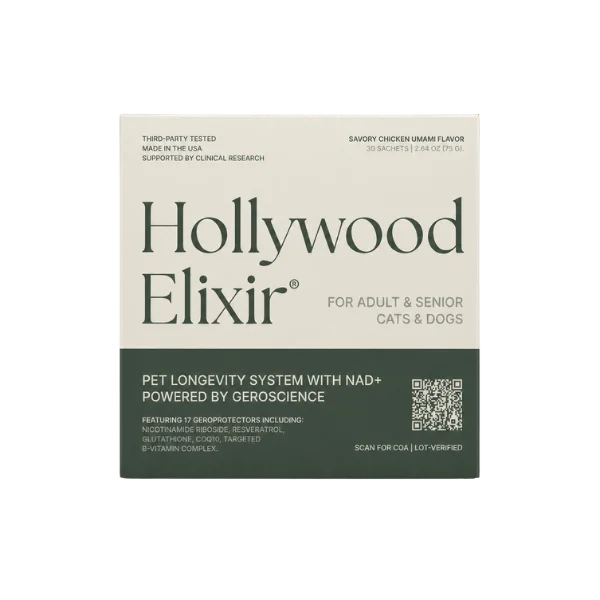
Hollywood Elixir™ is designed as system-level support for aging cats—reinforcing cellular energy steadiness and oxidative balance without treating disease. It fits best for owners who want a consistent daily ritual that complements a high-quality diet, rather than chasing single-ingredient fixes.

Most cats don’t announce that they’re running low on energy. They simply edit their lives: fewer sprints down the hallway, longer pauses before a jump, a preference for the warmest chair over the highest perch. For many owners, that quiet shift is what leads them to mitochondrial support for cats—an attempt to protect the cellular work that keeps a cat’s everyday life feeling easy.

Mitochondria are where cells convert nutrients into usable energy, and that process is shaped by the realities of feline biology. Cats depend on specific amino acids to support normal energy production, and deficiencies can contribute to reduced energy levels. At the same time, energy production naturally creates oxidative byproducts, which is why antioxidant balance becomes more relevant as cats age or face chronic stress.

This page is written for owners who want a clear, science-minded view without turning their home into a lab. You’ll see why diet and routine still matter, what a mitochondrial support supplement for cats can reasonably do, and how to choose among mitochondrial support products for cats without being pulled into exaggerated promises.

A careful reader might ask: if nutrition is so foundational, why choose a supplement at all? The answer is that aging is not a single-nutrient problem. Even with a strong diet, cats can benefit from system-level support that reinforces energy steadiness and oxidative balance in a form that’s easy to use consistently. That’s the role a product like Hollywood Elixir™ is meant to play: not a replacement for food, but a daily layer that supports the broader network behind vitality.

By La Petite Labs Editorial, ~15 min read

Featured Product:

  • Mitochondrial support is best understood as preserving normal daily capacity, not chasing a dramatic “boost.”
  • In cats, diet quality and consistency matter because their energy systems depend on specific amino acids and reliable intake.
  • Oxidative balance is a practical focus: supporting the body’s defenses can reduce cellular “friction” over time.
  • Evaluate supplements by coherence: feline-appropriate formulation, clear directions, and palatability you can sustain.
  • Track outcomes as steadiness—appetite, play, grooming, and recovery—rather than expecting an immediate personality shift.
  • If your cat has chronic disease or takes medications, add new products slowly and with veterinary guidance.
  • A product can still be worth choosing even with a good diet when it supports the broader aging network, not just one nutrient.

Why Cellular Energy Quietly Shapes a Cat’s Daily Vitality

Mitochondria are the small, tireless structures inside cells that convert fuel into usable energy. In cats, that work shows up as steadier vitality, resilient muscles, and the quiet ability to adapt to stress over time. When people search for mitochondrial support for cats, they’re often noticing subtle shifts: slower recovery after play, less interest in jumping, or a general “older” feel that doesn’t fit the calendar.

Because cats are obligate carnivores, their energy systems are shaped by amino acids and other nutrients that must be consistently supplied. When key amino acids are insufficient, energy production can suffer and overall vigor may fade (Sun M, 2024). That’s one reason “support” is broader than a single ingredient: it’s about helping the whole cellular network stay well supplied and well defended.

The best mitochondrial support for cats is rarely a dramatic intervention (see: CoQ10 for Cats). It’s a steady, system-level approach: high-quality food, thoughtful antioxidants, and a supplement strategy that respects feline sensitivity while reinforcing the body’s own maintenance rhythms.

Cellular energy graphic representing oxidative balance supported by mitochondrial support products for cats.

What Mitochondria Do for Movement, Appetite, and Recovery

Energy is not just a personality trait. It’s biology, and it’s expensive. Every jump to a windowsill and every fast turn in a hallway depends on cells producing energy efficiently, then managing the byproducts of that work. Over time, oxidative stress can add friction to that system, especially in older cats (Hill AS, 2005).

This is where mitochondrial support for cats becomes a practical idea rather than a buzzword. You’re supporting the cellular “engine room” so normal activity feels easier to sustain. The goal isn’t to change who your cat is; it’s to protect the capacity they already have.

Owners often notice the difference in small ways: a steadier appetite, more willingness to move, and fewer “off” days that seem to come from nowhere.

DNA strand illustration representing antioxidant support pathways in mitochondrial support supplement for cats.

Why Cats Need a Feline-specific Approach to Energy Support

Cats are not small dogs, and mitochondrial support should respect that. Their metabolism is built around animal protein, and they rely on specific amino acids to maintain normal function. When amino acid intake is inadequate, mitochondrial function and energy can be impaired.

That’s why the first “supplement” is often a diet audit: is the food complete and appropriate for life stage, and is the cat actually eating enough of it? A perfect label doesn’t matter if the bowl stays half full.

Once the basics are stable, a mitochondrial support supplement for cats can make sense as a second layer—especially when the goal is longevity and day-to-day steadiness rather than a quick fix.

Protein structure illustration showing biological precision behind mitochondrial support for cats health.

When Low Energy Isn’t a Supplement Problem at All

Not all “energy” problems are mitochondrial problems. Pain, dental disease, thyroid changes, anemia, and kidney issues can all look like low energy. If your cat has a sudden change in activity, appetite, breathing, or grooming, it’s worth a veterinary visit before you assume the answer is a supplement.

Still, mitochondrial support for cats health can be a reasonable part of a broader wellness plan once major issues are addressed. Think of it as supporting the baseline: helping cells meet everyday demands with less strain, especially as cats age.

The best plans are calm and measurable: you’re watching comfort, appetite, play, and recovery—not chasing a dramatic “before and after.”

Pug portrait highlighting companionship and steady support from mitochondrial support for cats.

Diet Consistency: the Underestimated Lever for Cellular Resilience

Food quality influences mitochondrial function in more than one way. Nutrient composition matters, but so does the microbiological quality of what a cat consumes (Prantil LR, 2016). A diet that is theoretically ideal but poorly tolerated—or inconsistently stored—can create stress that undermines the goal.

For owners pursuing natural mitochondrial support for cats, the most effective move is often improving consistency: same feeding times, stable brand rotation, and careful transitions. Cats are conservative eaters, and their bodies tend to reward predictability.

If you’re adding a supplement, introduce one change at a time (see: Anti-aging Supplements for Cats). That way, you can tell what’s helping—and what’s simply new.

Hollywood Elixir™ is amazing and makes my 13 y/o kitty young again!

— Jessie

She hopped up onto the windowsill again—first time in years.

— Charlie

“The most meaningful energy boost is often fewer low days, not a sudden spike.”

Oxidative Balance as a Gentle, Long-horizon Strategy

Oxidative stress is a normal part of life: energy production creates reactive byproducts, and the body uses antioxidants to keep them in check. When that balance tilts, cells can feel the strain. In feline research contexts, dietary antioxidant supplementation has been explored for its potential to mitigate oxidative stress under specific challenges (Hill AS, 2005).

For everyday owners, the point isn’t to treat a toxin exposure. It’s to recognize that antioxidant support is one of the more plausible, system-level ways to support mitochondria over time—especially in older cats or cats under chronic stress.

A well-designed supplement can help cover this “maintenance” role without turning wellness into a chemistry project (related: The Best Antioxidant Supplements for Cats).

Weimaraner image reflecting strength and companionship supported by mitochondrial support supplement for cats.

Amino Acids, Protein Quality, and the Nonnegotiables for Cats

Protein isn’t just about muscle; it’s also about cellular energy competence. Cats have specific amino acid needs that support metabolic processes tied to energy production. When those needs aren’t met—because of picky eating, illness, or poor diet fit—energy can drop in a way that looks like “slowing down.”

Methionine is one example of an essential amino acid with defined minimum requirements in adult cats (Pezzali JG, 2024). Owners don’t need to calculate amino acids at home, but it’s a reminder that feline nutrition has hard edges: you can’t improvise indefinitely without consequences.

The best mitochondrial support for cats often begins with ensuring the diet is truly complete, then using supplements to support the broader aging network rather than patching a single gap (see: NAD+ for Cats).

Canine side view symbolizing quiet confidence supported through mitochondrial support supplements for cats.

Making Supplements Work in Real Homes with Real Cats

If you’re considering mitochondrial support supplements for cats, the most important practical question is: will your cat take it every day? Consistency is the hidden ingredient. A modest formula used reliably often outperforms an ambitious one that triggers food refusal.

Introduce changes slowly, keep the feeding environment calm, and avoid stacking multiple new products at once. If you see vomiting, diarrhea, or appetite loss, stop the new supplement and check in with your veterinarian—especially for seniors or cats with chronic conditions.

The right product should feel like it belongs in your routine, not like a daily negotiation.

Ingredient showcase image explaining core components and support from mitochondrial support products for cats.

What to Track When You’re Evaluating Results

Owners sometimes expect mitochondrial support for cats to produce a visible “energy spike.” That’s not the most realistic benchmark. Mitochondrial support is better judged by steadiness: fewer low days, more consistent interest in normal activities, and a calmer recovery after exertion.

Because diet composition can influence mitochondrial function, changes in food can confound what you attribute to a supplement. If you want to evaluate fairly, keep the rest of the routine stable for several weeks and track a few simple signals: appetite, play, grooming, and willingness to jump.

If nothing changes, that’s also useful information. Not every cat needs the same layer of support at the same time.

How to Compare Mitochondrial Support Products Without Getting Distracted

If you’re comparing mitochondrial support products for cats, look for a design that makes sense as a whole. Cats don’t benefit from a “kitchen sink” label if the formula ignores palatability, dosing practicality, or ingredient compatibility. A good product reads like a coherent plan: energy support, antioxidant coverage, and gentle daily consistency.

Quality signals matter. Transparent sourcing, stability-aware packaging, and clear instructions are not marketing flourishes; they’re part of whether a supplement can be used reliably. Diet composition can also influence mitochondrial function, so a supplement should fit alongside the cat’s existing food rather than fight it (Prantil LR, 2016).

Finally, avoid products that promise outcomes that sound like medicine. The goal is support: helping the cat maintain normal energy and cellular resilience, not “fixing” a diagnosis.

“For cats, consistency is a biological advantage—diet, routine, and what they’ll actually accept.”

Close-up clinical uniform showing research-driven formulation behind best mitochondrial support supplements for cats.

Do Cats with Great Diets Still Benefit from Added Support

A common question is whether mitochondrial support supplements for cats are “necessary” if a cat eats a complete diet. Many cats do well on balanced foods, but real life is messier: appetite changes, selective eating, stress, and aging can all narrow nutritional margins. Even when nutrients are present, the body still has to manage oxidative load and day-to-day cellular wear.

Antioxidant supplementation has been explored in feline contexts as a way to mitigate oxidative stress under specific challenges (Hill AS, 2005). While that doesn’t mean every cat needs extra antioxidants, it supports the broader idea that oxidative balance is a meaningful lever for mitochondrial steadiness.

The most defensible reason to choose a supplement is not to replace food, but to reinforce the system that food feeds—especially when the goal is graceful aging rather than short-term change.

Shop Now
Supplement with whole-food visuals emphasizing quality sourcing for best mitochondrial support for cats.

NAD+ Conversations, Translated into Practical Daily Choices

Owners often ask about “NAD+ support” in the same breath as mitochondrial support for cats. NAD+ is involved in cellular energy handling and maintenance, and it tends to be discussed in longevity conversations. For pet owners, the practical takeaway is simpler: support the conditions that allow cells to do their work with less strain—steady nutrition, oxidative balance, and consistent routines.

Because cats have distinct dietary requirements, foundational amino acids remain central to energy production. Deficiencies can impair energy levels and cellular function (Sun M, 2024). That’s why a “NAD+ angle” should never distract from basics like protein quality, appetite protection, and a formula that a cat will actually accept.

A supplement earns its place when it supports the broader network—rather than chasing a single lab-sounding target.

Shop Now
Owner and dog moment highlighting wellness rituals supported by mitochondrial support products for cats.

Natural Foundations That Keep Energy Steady over Time

Natural mitochondrial support for cats starts with the unglamorous: food safety, freshness, and consistency. Even well-formulated diets can vary in composition, and those differences can influence mitochondrial function and energy handling (Prantil LR, 2016). For cats with sensitive digestion, the “best” plan is often the one that stays stable week to week.

Hydration is another quiet factor. Cells do not run well when the body is chronically under-hydrated, and many cats live on the edge of that line. Wet food, water fountains, and multiple bowls can be a more meaningful energy intervention than a new powder.

If you add a supplement, keep the rest of the routine calm. Mitochondrial support is cumulative; it benefits from repetition, not constant tinkering.

Shop Now

When Kidney Considerations Change the Supplement Conversation

Some cats who need mitochondrial support for cats health are also managing kidney concerns. In that context, owners may hear about phosphorus control and intestinal phosphate binders. One such binder, Lantharenol, has been evaluated in cats and was reported as well-tolerated in the study context (Schmidt BH, 2012).

This matters because cellular energy and overall vitality are not isolated from organ health. Still, supplements aimed at mitochondrial support are not substitutes for a kidney plan. If your cat has kidney disease, any new supplement should be discussed with your veterinarian to avoid unintended nutrient imbalances or conflicts with prescribed strategies.

The safest approach is to treat mitochondrial support as a supportive layer—added carefully, monitored quietly, and adjusted only with a clear reason.

Ingredients People Ask About, and What They Can’t Promise

When people look for the best mitochondrial support supplements for cats, they often focus on a short list of familiar ingredients. CoQ10 and L-carnitine are frequently discussed in relation to mitochondrial function, and research in a toxicology model suggests they may help protect against mitochondrial dysfunction under certain exposures (Lee, 2025).

That does not mean every cat should receive high-dose versions of these compounds, or that they are appropriate for every medical situation. It does support a broader principle: mitochondrial support is often about buffering stressors and supporting normal cellular performance, not forcing a dramatic change.

If you’re choosing a mitochondrial support supplement for cats, prioritize feline-appropriate formulation, clear use directions, and a track record of gentle daily use.

Supplement comparison highlighting clean formulation advantages for mitochondrial support products for cats.

Aging Cats: Supporting Capacity Without Chasing a Personality Change

Aging is the most common reason owners explore mitochondrial support for cats. The shift is rarely sudden. It’s a gradual narrowing: shorter play sessions, longer naps, and a body that seems less forgiving after minor stress. Supporting mitochondria is one way to support the “background” work of aging—energy production, cellular housekeeping, and resilience.

Diet remains the anchor. Cats require specific amino acids that are crucial for energy production, and deficiencies can reduce energy levels (Sun M, 2024). In older cats, appetite and digestion can change, making consistency and palatability more important than theoretical perfection.

The most useful mindset is not “anti-aging,” but “pro-function”: preserving normal daily capacity in a way that feels calm and sustainable.

Shop Now
Unboxing visual symbolizing thoughtful design aligned with mitochondrial support for cats.

Safety, Tolerance, and the Art of Introducing Anything New

Safety is part of what makes a supplement truly supportive. Cats can be sensitive to certain ingredients, flavors, and carrier oils, and they may refuse products that smell “off.” Start with the smallest practical amount per label directions, introduce it slowly, and watch for appetite changes, vomiting, or stool changes.

If your cat takes medications or has a chronic condition, ask your veterinarian before adding mitochondrial support supplements for cats. This is especially important when the goal is long-term use, where small tolerability issues can become persistent.

A good product should make safe use easy: clear instructions, conservative positioning, and a formula designed for daily life rather than occasional experimentation.

Shop Now

A Clear Reason to Choose a System-level Daily Formula

The honest reason a careful, science-minded owner still chooses a mitochondrial support product is not because food is “bad” or because one molecule is missing. It’s because aging is a systems problem. Even with a strong diet, cats still face oxidative load, appetite variability, and the slow accumulation of cellular wear.

The best mitochondrial support for cats is the approach you can keep doing: a stable diet, hydration, gentle movement, and a supplement that supports the broader network—energy handling, antioxidant balance, and overall cellular steadiness—without making medical promises (related: Antioxidants for Cats).

Think of it as a quiet vote for durability: less about chasing a result, more about supporting the conditions that let your cat stay themselves across the years.

“System-level support earns its place when it complements a good diet, not competes with it.”

Educational content only. This material is not a substitute for veterinary advice. Always consult your veterinarian about your cat’s specific needs. These statements have not been evaluated by the Food and Drug Administration. Products mentioned are not intended to diagnose, treat, cure, or prevent any disease.

Glossary

  • Mitochondria: Structures inside cells that convert nutrients into usable energy.
  • Cellular Energy: The usable energy cells produce to power movement, organ function, and repair.
  • Oxidative Stress: An imbalance where reactive byproducts outpace the body’s antioxidant defenses.
  • Antioxidants: Compounds that help neutralize reactive molecules and support normal cellular balance.
  • Amino Acids: Building blocks of protein; cats require specific ones to maintain normal function.
  • Methionine: An essential amino acid with defined minimum needs in adult cats (Pezzali JG, 2024).
  • CoQ10: A compound commonly discussed in relation to mitochondrial function and energy handling.
  • L-Carnitine: A nutrient-like compound associated with fat utilization and cellular energy support.
  • Palatability: How appealing a food or supplement is to a cat, influencing consistent daily use.

Related Reading

References

Prantil LR. Nutritional analysis and microbiological evaluation of commercially available enteral diets for cats.. PubMed. 2016. https://pubmed.ncbi.nlm.nih.gov/26317493/

Sun M. Considerations on amino acid patterns in the natural felid diet: a review.. PubMed Central. 2024. https://pmc.ncbi.nlm.nih.gov/articles/PMC11603590/

Tal. Dietary imbalances in a large breed puppy, leading to compression fractures, vitamin D deficiency, and suspected nutritional secondary hyperparathyroidism.. Nature. 2018. https://www.nature.com/articles/s41598-019-49087-z

Schmidt BH. Tolerability and efficacy of the intestinal phosphate binder Lantharenol® in cats.. PubMed. 2012. https://pubmed.ncbi.nlm.nih.gov/22305206/

Hill AS. Effects of dietary antioxidant supplementation before and after oral acetaminophen challenge in cats.. PubMed. 2005. https://pubmed.ncbi.nlm.nih.gov/15757115/

Lee. Protective effects of CoQ10 and L-carnitine against antidepressant-induced mitochondrial dysfunction and teratogenicity in chicken embryos. 2025. https://www.sciencedirect.com/science/article/pii/S0753332225000769

Boccanegra. Safety issues and harmful pharmacological interactions of nutritional supplements in Duchenne muscular dystrophy: considerations for Standard of Care and emerging virus outbreaks. 2020. https://www.sciencedirect.com/science/article/abs/pii/S1043661820312251

Pezzali JG. Minimum methionine requirement in adult cats as determined by indicator amino acid oxidation.. PubMed. 2024. https://pubmed.ncbi.nlm.nih.gov/38092464/

Summers S. Evaluation of iron, copper and zinc concentrations in commercial foods formulated for healthy cats.. PubMed Central. 2022. https://pmc.ncbi.nlm.nih.gov/articles/PMC10812249/

Ahmed. Bioaccumulation of heavy metals in some commercially important fishes from a tropical river estuary suggests higher potential health risk in children than adults.. Nature. 2019. https://www.nature.com/articles/s41598-021-00467-4

FAQ

What does mitochondrial support for cats mean in everyday terms?

In everyday terms, it means supporting the cellular “power stations” that help your cat turn food into usable energy. Owners usually notice this as steadier vitality, more consistent play, and fewer low days.

It’s not a promise of transformation; it’s a way to support normal function as cats age. Many owners choose a system-level option like Hollywood Elixir™.

Why do owners look into mitochondrial support for cats?

Most owners start looking when they notice subtle changes: slower recovery after activity, less jumping, or a general “older” feel. These can have many causes, so a vet check is wise if changes are sudden.

When the goal is gentle, long-term support, a daily formula that reinforces energy steadiness and oxidative balance can fit well, such as Hollywood Elixir™.

How is mitochondrial support for cats different from stimulants?

Stimulants push behavior temporarily; mitochondrial support is about supporting normal cellular energy handling over time. The goal is steadiness, not a spike.

If you’re choosing a supplement, look for calm, daily compatibility rather than “instant energy” language. A system-oriented option many owners consider is Hollywood Elixir™.

Is mitochondrial support for cats safe for daily use?

Daily use can be appropriate, but safety depends on the specific formula, your cat’s health status, and what else they take. Introduce any new supplement slowly and watch appetite, vomiting, and stool quality.

If your cat has chronic disease or takes medications, confirm fit with your veterinarian first. For a daily, system-level approach, many owners choose Hollywood Elixir™.

When should I avoid mitochondrial support supplements for cats?

Avoid starting a new supplement during acute illness, right after a medication change, or when your cat is not eating normally. Those are times when it’s harder to interpret side effects and easier to create food aversion.

For cats with complex medical histories, the safest path is vet-guided selection and slow introduction. If you want a gentle, routine-friendly option, consider Hollywood Elixir™.

How quickly can mitochondrial support for cats show changes?

Some owners notice small shifts within a few weeks, but the more realistic expectation is gradual steadiness over time. Look for consistent appetite, willingness to move, and fewer “off” days rather than a sudden burst of energy.

Keep diet and routine stable while you evaluate, so you can attribute changes more clearly. A consistent daily option is Hollywood Elixir™.

What are common side effects of mitochondrial support products for cats?

The most common issues are digestive: soft stool, vomiting, or reduced appetite, often tied to flavor, oils, or introducing too much too fast. Some cats also refuse food if a new smell is mixed in.

Stop the new product if symptoms appear and check in with your veterinarian if they persist. For a formula designed for gentle daily use, many owners look to Hollywood Elixir™.

Can mitochondrial support for cats interact with medications?

It can, depending on ingredients and the medication. Interactions are not always obvious, and cats with kidney, thyroid, or heart conditions may be on regimens where small changes matter.

Bring the full supplement label to your veterinarian and introduce only one new product at a time. If you want a system-level approach that’s meant to complement routine care, consider Hollywood Elixir™.

Is mitochondrial support for cats useful for senior cats?

Senior cats are a common fit because aging can narrow energy reserves and increase sensitivity to stress. The goal is usually comfort and steadiness: normal movement, stable appetite, and a calmer recovery after activity.

Because seniors may have other conditions, choose conservative formulas and vet-guided use. A daily option many owners use for graceful aging is Hollywood Elixir™.

Do kittens need mitochondrial support supplements for cats?

Most kittens do best with a complete, life-stage-appropriate diet and a stable routine. If a kitten seems unusually tired, the priority is a veterinary evaluation rather than adding supplements.

When supplements are considered for young cats, they should be chosen cautiously and with professional guidance. For owners focused on long-term, system-level support as cats mature, Hollywood Elixir™ is often used as part of an adult wellness routine.

Are there breed differences in mitochondrial support needs?

Breed can influence body size, activity patterns, and risk for certain conditions, but most “support” decisions come down to the individual cat: age, diet tolerance, and baseline energy.

Rather than buying for a breed label, choose a product that’s feline-appropriate and easy to use consistently. A system-level option many owners consider is Hollywood Elixir™.

Is mitochondrial support for cats the same as for dogs?

The concept is similar, but cats have distinct dietary requirements and sensitivities, so you should not assume a dog product is appropriate. Feline formulas should respect palatability, dosing practicality, and ingredient choices suited to cats.

If you’re choosing a cat-specific approach for long-term use, a product designed with feline aging in mind is a better fit, such as Hollywood Elixir™.

What should I look for in the best mitochondrial support for cats?

Look for coherence: a formula that supports energy steadiness and antioxidant balance, with clear directions and ingredients your cat will tolerate. Avoid labels that promise medical outcomes or rely on hype.

Also consider practical quality signals like transparency, stability, and customer support. For a system-level approach built around daily use, many owners choose Hollywood Elixir™.

How do I give a mitochondrial support supplement for cats?

Most cats do best when supplements are introduced slowly and paired with a familiar food. Mix thoroughly, start with a small amount per label guidance, and keep the feeding environment calm to reduce refusal.

If your cat is sensitive, consider offering the supplement separately in a small “test bite” first. A routine-friendly option designed for daily use is Hollywood Elixir™.

Can I combine multiple mitochondrial support supplements for cats?

Combining products can increase the risk of overlap, digestive upset, or unintended ingredient interactions. It also makes it harder to tell what’s helping and what’s causing side effects.

If you want to layer support, do it one change at a time and keep your veterinarian in the loop for cats with medical conditions. Many owners prefer one comprehensive daily option, such as Hollywood Elixir™, rather than stacking several bottles.

Does diet matter if I use mitochondrial support products for cats?

Diet still matters because it supplies the raw materials for energy production, and diet composition can influence mitochondrial function. A supplement can’t compensate for a diet your cat won’t eat or tolerate.

The best results usually come from pairing a stable, complete diet with a supplement that supports the broader aging network. Many owners pair their feeding routine with Hollywood Elixir™ for that reason.

What research areas relate to mitochondrial support supplements for cats?

Relevant research areas include feline amino acid requirements for energy production and the role of oxidative stress and antioxidant support. Cats rely on specific amino acids, and deficiencies can impair energy levels.

This doesn’t translate into a single “magic” ingredient, but it supports a system-level approach to daily resilience. Many owners choose that style of support with Hollywood Elixir™.

When should I call my vet about low energy?

Call your vet if low energy is sudden, paired with not eating, hiding, breathing changes, vomiting, diarrhea, or weight loss. Those signs can indicate pain or illness that needs medical attention, not supplementation.

Once serious causes are ruled out, supportive routines may be appropriate. For a gentle daily layer that complements veterinary care, consider Hollywood Elixir™.

How do I choose between the best mitochondrial support supplements for cats?

Start with your goal: steadier energy, aging support, or general resilience. Then choose a product that matches your cat’s reality—taste preferences, digestion, and your ability to use it consistently.

Avoid formulas that feel like a chemistry set unless your veterinarian is directing it. Many owners prefer a single, system-level daily option like Hollywood Elixir™ to keep the routine simple.

Does mitochondrial support for cats help with longevity goals?

Longevity is influenced by many factors, and no supplement can promise a longer life. What mitochondrial support can do is align with longevity-minded care: supporting normal cellular energy, antioxidant balance, and day-to-day resilience.

If your goal is “more good days” rather than a dramatic change, a consistent daily formula can be a reasonable part of the plan. Many owners choose Hollywood Elixir™ for that kind of long-horizon support.

What is a simple decision framework for mitochondrial support for cats?

First, rule out medical causes of fatigue with your veterinarian if anything feels abrupt or concerning. Second, stabilize basics: complete diet, hydration, and a low-stress routine. Third, add one supplement at a time and track a few signals for several weeks.

If you want a single, system-level layer that fits a daily rhythm, many owners start with Hollywood Elixir™.

5K+ Happy Pet Parents

Excellent 4.8

Mitochondrial Support for Cats | Why Thousands of Pet Parents Trust Hollywood Elixir™

"My go-to nutrient-dense topper. Packed with 16 powerful anti-aging actives and superfoods!"

Chanelle & Gnocchi

"We go on runs pretty often; he use to get tired halfway through, but lately, he's been keeping up without any problem."

Cami & Clifford

"He seems more happy overall. I've also noticed he has more energy which makes our walks and playtime so much more fun."

Olga & Jordan

"I want her to live forever. She hasn't had an ear infection since!"

Madison & Azula

"My go-to nutrient-dense topper. Packed with 16 powerful anti-aging actives and superfoods!"

Chanelle & Gnocchi

"We go on runs pretty often; he use to get tired halfway through, but lately, he's been keeping up without any problem."

Cami & Clifford

"He seems more happy overall. I've also noticed he has more energy which makes our walks and playtime so much more fun."

Olga & Jordan

"I want her to live forever. She hasn't had an ear infection since!"

Madison & Azula

"My go-to nutrient-dense topper. Packed with 16 powerful anti-aging actives and superfoods!"

Chanelle & Gnocchi

"We go on runs pretty often; he use to get tired halfway through, but lately, he's been keeping up without any problem."

Cami & Clifford

"He seems more happy overall. I've also noticed he has more energy which makes our walks and playtime so much more fun."

Olga & Jordan

"I want her to live forever. She hasn't had an ear infection since!"

Madison & Azula

"My go-to nutrient-dense topper. Packed with 16 powerful anti-aging actives and superfoods!"

Chanelle & Gnocchi

"We go on runs pretty often; he use to get tired halfway through, but lately, he's been keeping up without any problem."

Cami & Clifford

"He seems more happy overall. I've also noticed he has more energy which makes our walks and playtime so much more fun."

Olga & Jordan

"I want her to live forever. She hasn't had an ear infection since!"

Madison & Azula

SHOP NOW