


The 12 Hallmarks of Aging in Dogs, Explained
Read full insightAnti-Aging Supplements for Cats
What drives aging and which ingredients protect function
By La Petite Labs Editorial 15 min read

A Triage Map: Which Aging Changes Point to Which Type of Support

Joint and Mobility Support: When It Matters and Where to Learn More

Benefits Worth Caring About, and Claims Worth Ignoring

Diet First, Then Support: Where Supplements Fit In

Administration Realities: the Best Product Is the One Taken

Cats Are Not Small Dogs: Why Feline Formulation Matters

Digestive Comfort and Absorption Changes with Age

DVM Voice: Clinical Vignette of a Common Pattern in Senior Cat Aging
Case provided by JoAnna Pendergrass, DVM
Sasha, a 12-year-old cat, was brought in after her owner noticed increased thirst and urination, lethargy, vomiting, and a generally unkempt appearance. Examination showed weight loss, elevated blood pressure, and reduced vitality.
Diagnostic testing revealed elevated kidney markers, poorly concentrated urine, and protein loss in the urine — findings consistent with chronic kidney disease, one of the most common chronic conditions in senior cats.
Her care required a kidney-focused diet, blood pressure management, targeted supplementation, medication support, and regular monitoring — a necessary plan, but one started after clinical signs were already visible.
Clinical takeaway: Sasha’s case reflects why senior-cat wellness should begin before obvious decline. Earlier monitoring, body-condition tracking, hydration awareness, antioxidant support, and daily cellular resilience may help support quality of life as cats age.
Single-case vignette. Not generalizable. Veterinary diagnosis and monitoring are essential for increased thirst, urination, vomiting, lethargy, weight loss, or suspected kidney disease.

Quality Signals That Separate Serious Formulas from Noise

Hydration Habits, Wet Food, and Supplement Fit

Muscle, Mobility, and the Practical Meaning of Vitality

Timeline Expectations: Subtle Changes, Not Sudden Transformations

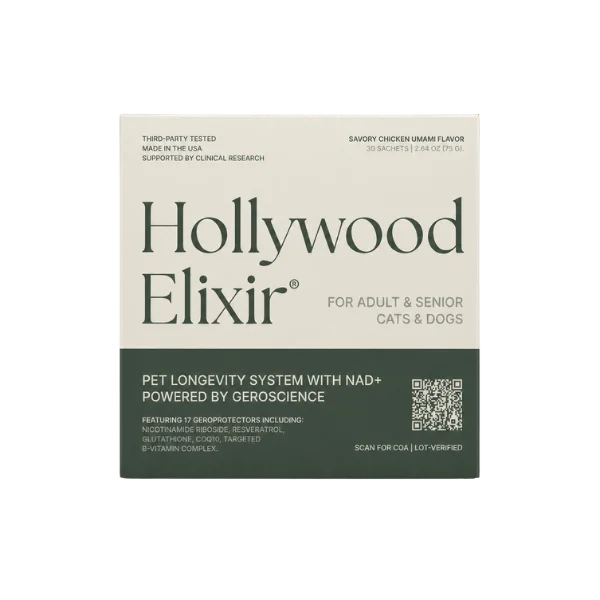
What to Look for in a Senior Cat Supplement (and Where Hollywood Elixir Fits)
References
Numbered references identify the sources used for specific claims. Read the study design, species and evidence boundaries alongside each finding.
-
Grant CE, Shoveller AK, Blois S, et al. Dietary intake of amino acids and vitamins compared to NRC requirements in obese cats undergoing energy restriction for weight loss. Study design/context: not-stated-in-titleSpecies/context: catEvidence boundary: The species/context tag is inferred only from the source title; the actual study population and claim-level relevance still depend on the full methods and outcomes.↩ 1 · ↩ 2
-
Hutchinson D, Freeman LM. Focus on nutrition--Optimal nutrition for older cats. Study design/context: not-stated-in-titleSpecies/context: catEvidence boundary: The species/context tag is inferred only from the source title; the actual study population and claim-level relevance still depend on the full methods and outcomes.↩ 1 · ↩ 2 · ↩ 3
-
Schauf S, Stockman J, Haydock R, et al. Healthy Ageing Is Associated with Preserved or Enhanced Nutrient and Mineral Apparent Digestibility in Dogs and Cats Fed Commercially Relevant Extruded Diets. Study design/context: not-stated-in-titleSpecies/context: dog, catEvidence boundary: The species/context tag is inferred only from the source title; the actual study population and claim-level relevance still depend on the full methods and outcomes.↩ 1 · ↩ 2 · ↩ 3
-
Summers SC, Stockman J, Larsen JA, et al. Evaluation of nutrient content and caloric density in commercially available foods formulated for senior cats. Study design/context: not-stated-in-titleSpecies/context: catEvidence boundary: The species/context tag is inferred only from the source title; the actual study population and claim-level relevance still depend on the full methods and outcomes.↩ 1 · ↩ 2 · ↩ 3
-
Laflamme D, Gunn-Moore D. Nutrition of aging cats. Study design/context: not-stated-in-titleSpecies/context: catEvidence boundary: The species/context tag is inferred only from the source title; the actual study population and claim-level relevance still depend on the full methods and outcomes.↩ 1 · ↩ 2
-
Laflamme DP. Nutrition for aging cats and dogs and the importance of body condition. Study design/context: not-stated-in-titleSpecies/context: dog, catEvidence boundary: The species/context tag is inferred only from the source title; the actual study population and claim-level relevance still depend on the full methods and outcomes.↩ 1 · ↩ 2
-
Stockman J. Nutrition and Aging in Dogs and Cats. Study design/context: not-stated-in-titleSpecies/context: dog, catEvidence boundary: The species/context tag is inferred only from the source title; the actual study population and claim-level relevance still depend on the full methods and outcomes.↩ 1 · ↩ 2 · ↩ 3
-
Protopopov VA, Sekunov AV, Toropova TV, et al. Influence of a diet with potential geroprotectors on blood biochemistry and aging-associated markers in domestic cats: a pilot study. Study design/context: not-stated-in-titleSpecies/context: catEvidence boundary: The species/context tag is inferred only from the source title; the actual study population and claim-level relevance still depend on the full methods and outcomes.↩ 1 · ↩ 2
Further reading
These sources provide additional context but are not mapped to a numbered claim above.
- Shahverdian A, Jafari M. Dietary Supplement Safety in Older Adults: A Review of Published Case Reports.(2025).
- Fahey GC Jr, Campion M, Collings GF, et al. The art of establishing mineral tolerances of dogs and cats.(2024).
- Summers S, Stockman J, Larsen JA. Evaluation of iron, copper and zinc concentrations in commercial foods formulated for healthy cats.(2022).
- Zafalon RVA, Perini MP, Vendramini THA, et al. Vitamin-mineral supplements do not guarantee the minimum recommendations and may imply risks of mercury poisoning in dogs and cats.(2021).
- A. S. Shafiuddin Ahmed, Sharmin Sultana, Ahasan Habib, et al. Bioaccumulation of heavy metals in some commercially important fishes from a tropical river estuary suggests higher potential health risk in children than adults(2019).

Discover LPL-01: How This Fits Into a Larger Feline Longevity System
Aging in cats unfolds quietly. It’s not driven by a single failure, but by gradual shifts across interconnected systems — cellular energy, oxidative balance, immune tone, and tissue integrity — each influencing the others over time.
This article explores one layer of that system. To understand what actually shapes long-term health, you need to step back and look at how these layers interact.
Start with the underlying science:
- Feline Geroscience Framework →
A structured view of how aging progresses across cellular energy, inflammation, and resilience systems. - Senior Biological Defense Coverage (BDC) Modeling →
A systems-level map of which biological pathways decline first, and how layered interventions can support them. - 2026 Market Research: Best Cat Longevity Supplements →
A feline-specific review of longevity supplements. 2026 Industry report created by LPL-01 Research. - LPL-01 Standard →
The formulation system that translates these models into real-world supplementation—covering multiple pathways in a coordinated way.
Keep exploring
What would you like to understand next?
Search practical guides about healthy aging, cellular energy, ingredients, and daily support for cats.


