
Biological Age vs. Chronological Age in Cats

Why some cats age faster, and the signs that reveal true age

By La Petite Labs Editorial 15 min read

Two cats with the same birthday can age at very different speeds, and the calendar is the part that misleads you. Chronological age is just time since birth; biological age is how worn or resilient the body’s systems actually are—what your cat can still do comfortably day to day: move, groom, play, eat, and bounce back from small stressors. That bounce-back is physiologic reserve, the buffer that lets a cat absorb a new routine, a cold week, or a minor illness without losing ground.

As reserve narrows, ordinary challenges cost more and recovery slows, even when nothing looks dramatic. That is why grooming gaps, shorter play, or a softer body with sharper bones can signal faster aging before a vet visit does. Below is a practical map of the domains that shift first—mobility, coat and grooming, cognition, and body condition—so you can read patterns as changes in underlying capacity, then act early.

  • Function changes before the calendar does—grooming, play stamina, and body condition can shift while a cat still seems “not that old.”
  • Grooming gaps usually mean reduced reach, discomfort, dental pain, or lower stamina—not just a messy coat.
  • Body-condition drift is a loud quiet sign: fat gain with muscle loss, or unexplained weight loss, tracks with faster aging.
  • A two-week log beats memory—weight, grooming coverage, play minutes, and water/urine cues give your vet something to act on.
  • Common mistakes speed decline: crash-dieting, changing several variables at once, and high-dose single nutrients without guidance.
  • Some signs aren’t aging at all—rapid weight loss, repeated vomiting, breathing changes, or sudden loss of jumping need prompt care.

Aging Domains: What Changes First (And What It Usually Means)

Early aging signals often cluster by domain, and the domain can hint at which “reserve” is thinning.

Coat and grooming: A coat that looks duller, clumped, or unevenly maintained can reflect reduced flexibility, lower stamina for self-care, or decreased comfort with repetitive movements. It can also indicate that the cat’s daily maintenance budget is tighter than it used to be.

Play and activity tolerance: Shorter play sessions, fewer jumps, or longer recovery after activity often point to reduced endurance and musculoskeletal confidence. The key is comparing to baseline behavior—what was normal for your cat six months ago may be different now.

Appetite, weight, and body condition score: Subtle shifts in body condition score (BCS) can signal changes in metabolism, muscle maintenance, or how efficiently a cat uses calories. Weight alone can miss this; body shape and muscle feel matter. (see our Cat Body Condition Calculator →)

Litter box patterns: Changes in posture, frequency, or “near misses” can reflect mobility limits, stress, or altered routines rather than a single isolated issue.

Sleep and daily rhythm: More daytime sleeping or less interest in interaction can be normal variation, but consistent drift from baseline behavior can indicate reduced resilience across multiple systems.

Taken together, these domains help frame biological age as a whole-body capacity story, not a single symptom story.

Why Grooming Is a 'Functional Age' Signal (Mobility, Mouth, Mood)

Grooming is a useful window into functional age because it requires coordination, comfort, and energy—several systems working smoothly at once. When grooming declines, it can reflect a shift in biological age even if the cat’s chronological age hasn’t changed much in your mind.

Mobility and flexibility: Reaching the lower back, hips, and tail base demands spinal and joint range of motion. If bending, twisting, or balancing is harder, cats may focus on “easy” areas and leave others unfinished.

Dental discomfort: Grooming involves frequent licking and jaw movement. Mouth sensitivity can make grooming feel unpleasant, shortening sessions or changing technique.

Skin/coat condition: If the skin is irritated or the coat is harder to maintain, grooming can become less effective, creating a feedback loop where the coat mats or looks greasy despite effort.

Mood and stress: Cats under chronic stress may groom less (or sometimes overgroom specific areas). Either pattern can signal that coping capacity is changing.

What to track week to week: note which body areas are missed, how long grooming bouts last, whether mats or dandruff are increasing, any changes in odor or coat texture, and how grooming aligns with activity tolerance and baseline behavior. Frameworks that view aging as accumulating small deficits help explain why these shifts can appear gradually (Armstrong, 2025).

Play Stamina as an Early Aging Marker

Play changes are another early window into Biological Age vs. Chronological Age in Cats. A cat may still want interaction but show less stamina: fewer sprints, longer pauses, and quicker disengagement. That can reflect musculoskeletal discomfort, reduced aerobic depth, or a quieter shift in motivation as the nervous system ages. In aging science, biological age is often inferred from function—what the body can still do reliably—rather than the number of birthdays.

A simple home test is to standardize play: same toy, same time, same hallway. Track how long the cat stays engaged before stopping, and whether the stop looks like fatigue, frustration, or pain. If play ends with licking a joint, stretching repeatedly, or hiding, that is a different signal than a calm “done for now.”

Is My Cat Losing Muscle as It Ages?

Body-condition change is often the loudest quiet sign of faster aging. Some cats gain fat while losing muscle—a softer abdomen over a sharper spine—while others lose weight on an unchanged routine. Both matter because biological age tracks how well tissues maintain themselves under ordinary stress. Frailty-style medicine uses accumulated deficits to estimate physiologic vulnerability, the same idea you see when a cat’s body condition stops looking balanced (Darvall, 2018).

Use hands more than eyes: feel ribs, spine, and hips weekly, and notice whether the muscle over the shoulders is thinning. Photograph your cat from above and from the side once a month, in the same spot and light. Small drifts are far easier to catch early than sudden change—and catching them early keeps the next steps gentler.

A Key Misconception About Cat Age Conversions

A common misconception is that a cat’s “human-age conversion” tells the whole story. It does not. Biological Age vs. Chronological Age in Cats is about pace: two 12-year-old cats can have very different overhead for grooming, play, and maintaining lean mass. Epigenetic clocks—built from DNA methylation patterns—show that age signals can be measured, and the broader aging literature recognizes that biological age can diverge from chronological age (Horvath, 2022).

This misconception can delay action: owners may dismiss new stiffness or coat neglect as “normal for 12.” A better approach is to treat new functional change as a prompt to reassess routines, nutrition, and veterinary screening. The goal is not to label a cat as old, but to slow the slide into uneven daily function.

“A cat can look fine while overhead quietly shrinks.”

A Realistic Household Scenario of Faster Aging

CASE VIGNETTE: A 10-year-old indoor cat still greets the family but now stops grooming halfway, leaving a dull strip along the lower back. Play has shifted from full-room chases to two short pounces, then sitting with a tucked posture. The scale shows only a small gain, yet the shoulders feel less muscular, suggesting biological age is advancing faster than the calendar.

In a scenario like this, the most useful next step is structured observation for two weeks rather than guessing a single cause. Note whether changes cluster around jumping, litter box posture, or post-meal behavior. That pattern helps a veterinarian prioritize pain evaluation, dental checks, and screening labs, instead of treating grooming as a purely cosmetic issue.

Owner Checklist: Signs Biological Age Is Advancing

OWNER CHECKLIST: At-home signs that biological age may be outpacing chronological age include (1) new mats or greasy coat along the spine, (2) shorter play bouts with longer recovery, (3) reluctance to jump up but willingness to jump down, (4) a softer belly with sharper back bones, and (5) subtle litter box changes like longer squatting or stepping in waste. These are functional clues, not just “senior quirks.”

Check items at the same time of day to avoid confusing routine variation with decline. If several items appear together, the cat may have less overhead for normal movement and self-care. That cluster is often more meaningful than any single sign, and it supports a faster, more focused veterinary workup.

What to Track so the Vet Can Act

“WHAT TO TRACK” RUBRIC: Track (1) weekly body weight, (2) monthly body condition score notes, (3) a simple muscle condition note over shoulders and spine, (4) play stamina in minutes with the same toy, (5) grooming coverage—especially lower back and hindquarters, and (6) water intake and urine clump size as rough household cues. These markers translate Biological Age vs. Chronological Age in Cats into a timeline a veterinarian can use.

Use a single page or phone note with dates, not memory. Add one short line about context: new food, moving furniture, visitors, or a stressful event. The goal is a clean story of change over time, which is often what separates a manageable early problem from a late, complicated one.

The Most Likely Drivers: Pain and Early Disease

When a cat seems to “age fast,” the most common medical driver is a blend of pain and early [chronic disease](https://lapetitelabs.com/pages/chronic-kidney-disease-in-cats) that quietly drains stamina. Chronic kidney disease is common in older cats and can pull on appetite, hydration, coat quality, and overall vitality, making biological age look older than the birthdate suggests (Grecu, 2025). Because cats compensate so well, the first visible change is often grooming decline or a softer, less balanced body—not obvious illness.

Watch for paired cues rather than single symptoms: mild weight loss plus more drinking, or less play plus a duller coat. Those combinations carry more information than any one sign. When a pattern is present, it is reasonable to book a visit rather than wait for something dramatic.

Epigenetics: Why Age Can Be a Biological State

Mechanistically, biological aging is often described as a gradual shift in cellular cooperation: slower repair, more cellular senescence, and less efficient energy handling. Epigenetic clocks use DNA methylation patterns to estimate age-related change, and cat studies show this approach can work in the species (Raj, 2021). That does not replace clinical assessment, but it supports the idea that “age” is partly a biological state, not only a number.

For households, the practical translation is simple: when grooming, play, and body condition all drift, it is rarely “just behavior.” It is often a sign that the cat’s renewal rate is slipping and daily tasks cost more effort. That is why documentation and early screening matter more than trying to guess a single mechanism at home.

“Grooming, play, and body condition are daily function tests.”

La Petite Labs

DVM Voice: Clinical Vignette of a Common Pattern in Senior Cat Aging

Case provided by JoAnna Pendergrass, DVM

Sasha, a 12-year-old cat, was brought in after her owner noticed increased thirst and urination, lethargy, vomiting, and a generally unkempt appearance. Examination showed weight loss, elevated blood pressure, and reduced vitality.

Diagnostic testing revealed elevated kidney markers, poorly concentrated urine, and protein loss in the urine — findings consistent with chronic kidney disease, one of the most common chronic conditions in senior cats.

Her care required a kidney-focused diet, blood pressure management, targeted supplementation, medication support, and regular monitoring — a necessary plan, but one started after clinical signs were already visible.

Clinical takeaway: Sasha’s case reflects why senior-cat wellness should begin before obvious decline. Earlier monitoring, body-condition tracking, hydration awareness, antioxidant support, and daily cellular resilience may help support quality of life as cats age.

Single-case vignette. Not generalizable. Veterinary diagnosis and monitoring are essential for increased thirst, urination, vomiting, lethargy, weight loss, or suspected kidney disease.

Explore Hollywood Elixir Research →
Epigenetic Clock Signals In Everyday Cat Function - 9

Frailty Thinking for Cats, Without the Jargon

Frailty thinking can be helpful for cats because it treats aging as an accumulation of small, observable deficits. A pilot effort to build a frailty scale for pet cats highlights that measurable items—mobility, body condition, coat, and behavior—can be organized into a practical snapshot of physiologic vulnerability (Colleran, 2025). This aligns with Biological Age vs. Chronological Age in Cats: function tells the story earlier than a crisis does.

Owners can mirror this approach without scoring systems. List the “new normals” in one place: fewer jumps, more sleeping, less grooming reach, and changes in appetite or thirst. Bringing that list to appointments helps the veterinarian see the whole pattern instead of chasing one symptom at a time.

Epigenetic Clock Signals In Everyday Cat Function - 10

How to Prepare for a Focused Vet Visit

VET VISIT PREP: Bring (1) a two-week log of play stamina and grooming gaps, (2) recent weight and photos, and (3) notes on water intake, urine clumps, and stool changes. Ask targeted questions: “Could pain be limiting grooming reach?”, “Which screening labs best match these changes?”, and “What body condition and muscle targets should be used at home?” This keeps the visit focused on biological age signals rather than vague “slowing down.”

Also ask what would change the plan urgently, such as rapid weight loss, vomiting, or sudden hiding. A clear urgency ladder reduces delay when a cat’s overhead drops quickly. It also helps owners avoid overcorrecting with diet changes or supplements before the underlying driver is identified.

Epigenetic Clock Signals In Everyday Cat Function - 11

Common Mistakes That Quietly Speed Decline

“WHAT NOT TO DO”: Do not crash-diet an older cat to chase a slimmer look, because muscle loss can accelerate functional aging. Do not add high-dose single nutrients “for aging” without veterinary review; cats are sensitive to excess vitamin A, and chronic oversupplementation has been linked to skeletal and hepatic changes (Corbee, 2014). Do not assume reduced grooming is laziness, and do not wait for limping—cats often show pain as stillness.

Another common mistake is changing food, litter, and routines all at once, which blurs cause and effect. Make one change at a time and keep notes. If a supplement is considered, it should fit into a broader plan that includes hydration, dental care, mobility support, and appropriate screening.

Grooming Support That Starts with Comfort

Grooming support is often more about comfort and access than about shampoo. If the cat cannot twist, the lower back and hindquarters are the first areas to look neglected, which can be an early mobility signal. Gentle brushing, strategic trimming around problem areas, and reducing static with appropriate tools can keep the coat more balanced while the underlying cause is addressed. This is where “symptom-first triage” helps: the coat change is the clue, not the diagnosis.

Households can set up grooming success: add a non-slip mat, brush after meals when the cat is relaxed, and keep sessions short to avoid overwhelm. If the cat flinches or abruptly leaves, note the body area touched. That detail can point a veterinarian toward dental pain, spinal discomfort, or skin sensitivity.

Play That Matches Stamina and Protects Mobility

Play can be redesigned to match a cat’s current overhead without giving up enrichment. Shorter, more frequent sessions often fit aging cats better than one long session, and “micro-hunts” can preserve engagement while respecting stamina. Use toys that encourage controlled pounces rather than vertical leaps if jumping looks hesitant. The goal is to keep movement and curiosity more balanced, which supports body condition and mood.

Owners can rotate three predictable games: a slow wand lure, a treat puzzle, and a hallway roll. Document which game produces the longest engagement and the smoothest recovery. If a cat plays hard but then hides or pants, that is a sign the session exceeded current overhead and should be gentler next time.

Body Condition: Protect Lean Mass and Hydration

Body-condition work should prioritize lean mass and hydration, not just calories. In older cats, muscle can fade while fat accumulates, and that mix makes biological age look older because movement, grooming reach, and play stamina all cost more effort. A veterinarian can help choose a diet that supports normal kidney function and maintains muscle, especially when screening suggests early disease—and how the body handles energy (cellular redox and mitochondrial function) shapes daily function.

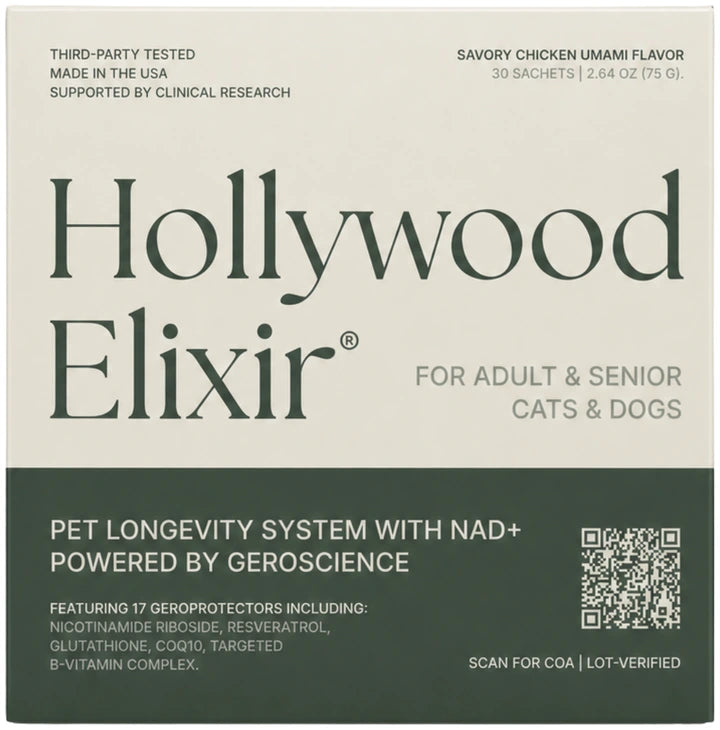
At home, feed with intention: measure portions, skip free-choice grazing if weight is rising, and add movement with food puzzles. If a daily supplement fits the plan, label literacy matters more than buzzwords. Hollywood Elixir is a food-mixed routine for aging cats and dogs with readable amounts—nicotinamide riboside 60 mg and CoQ10 40 mg to support normal cellular energy, antioxidant defenses like glutathione 50 mg, and whey protein isolate 250 mg as light structural nutrition. It supports steady, present good days; it is not a treatment for kidney disease or muscle loss. Ask your vet, then introduce one change at a time.

Where Aging Science Terms Actually Help Owners

Aging-science terms can be useful when they change decisions. Telomeres, DNA damage, and cellular senescence are often discussed as drivers of aging, while epigenetic clocks summarize DNA methylation patterns into an age estimate (Horvath, 2022). For owners, the value is not testing at home; it is understanding why small functional changes deserve attention. Biological Age vs. Chronological Age in Cats becomes actionable when it prompts earlier screening and gentler adjustments.

This page fits into a larger aging cluster: rate of aging, DNA damage, mitochondrial dysfunction, and cellular redox. Those topics explain why a cat may have less stamina and a lower renewal rate even before obvious disease appears. The household job is to notice the first drift and keep routines supportive while the veterinarian checks for treatable contributors.

An Urgency Ladder for When to Act Fast

When should changes feel urgent? Rapid weight loss, refusing food for a day, repeated vomiting, marked increase in drinking/urination, open-mouth breathing, or sudden inability to jump are not “aging.” Those signs suggest a sharp drop in overhead and deserve prompt veterinary attention. Slower changes—less grooming reach, shorter play, gradual body condition drift—still matter, but they fit a scheduled assessment with good documentation.

The most protective plan is early, consistent monitoring paired with targeted vet visits. Keep the tracking rubric, bring photos and notes, and ask for clear next steps. That approach keeps Biological Age vs. Chronological Age in Cats grounded in observable function, not guesswork, and it supports a more balanced aging trajectory.

“Track patterns first; diagnosis becomes gentler when caught early.”

Educational content only. This material is not a substitute for veterinary advice. Always consult your veterinarian about your dog’s specific needs. These statements have not been evaluated by the Food and Drug Administration. Products mentioned are not intended to diagnose, treat, cure, or prevent any disease.

Glossary

  • Biological Age - Functional “age” reflected by stamina, grooming, and body condition.
  • Chronological Age - Time since birth measured in years.
  • Epigenetic Clock - A model that estimates age from DNA methylation patterns.
  • DNA Methylation - Chemical marks on DNA that change with age and environment.
  • Renewal Rate - How quickly tissues maintain and replace themselves in daily life.
  • Body Condition Score (BCS) - A hands-on estimate of body fat and shape.
  • Muscle Condition - A practical assessment of muscle over shoulders, spine, and hips.
  • Frailty - Accumulation of small deficits that increases vulnerability to stress.
  • Cellular Senescence - A state where cells stop dividing and can alter tissue function.
  • Telomeres - Protective chromosome ends that change with cell division and aging.

Related Reading

References

Grecu. Epidemiology of Chronic Kidney Disease (CKD) in Cats: An Analysis of the Factors Involved. 2025. https://www.mdpi.com/2075-1729/15/12/1856

Raj. Epigenetic clock and methylation studies in cats. PubMed. 2021. https://pubmed.ncbi.nlm.nih.gov/34463900/

Horvath. DNA methylation clocks for dogs and humans. PubMed. 2022. https://pubmed.ncbi.nlm.nih.gov/35580182/

Darvall. Frailty indexes in perioperative and critical care: A systematic review. PubMed. 2018. https://pubmed.ncbi.nlm.nih.gov/30153605/

Colleran. A non-randomized pilot study to test the feasibility of developing a frailty scale for pet cats. PubMed Central. 2025. https://pmc.ncbi.nlm.nih.gov/articles/PMC11897749/

Armstrong. Pathophysiology of geriatric diseases in dogs and cats: a foundation for geriatric care. PubMed Central. 2025. https://pmc.ncbi.nlm.nih.gov/articles/PMC12520855/

Corbee. Skeletal and hepatic changes induced by chronic vitamin A supplementation in cats. 2014. https://www.sciencedirect.com/science/article/abs/pii/S1090023314003980

FAQ

What does Biological Age vs. Chronological Age in Cats mean?

Chronological age is the number of years since birth. Biological age reflects how much functional overhead a cat has for daily tasks like grooming, play, and maintaining lean mass.

In cats, biological age often shows up as quieter shifts: shorter play stamina, less grooming reach, and body condition becoming less balanced. Those changes can happen earlier or later than expected for the cat’s birthday.

Why do grooming changes matter for aging assessment?

Grooming is a daily “function test.” When grooming becomes patchy, it can signal discomfort, reduced flexibility, dental pain, skin irritation, or lower stamina rather than simple messiness.

Owners evaluating Biological Age vs. Chronological Age in Cats can use grooming coverage as a practical marker: the lower back and hindquarters are often the first areas missed when twisting becomes harder.

How can play behavior reveal biological aging in cats?

Play is closely tied to stamina, comfort, and motivation. A cat that still wants interaction but stops sooner may be showing reduced overhead rather than disinterest.

Track play with the same toy and time of day. Note minutes engaged, recovery time, and whether stopping is calm or looks like pain (licking a joint, sudden hiding, repeated stretching).

What body condition changes suggest faster aging in cats?

Two common patterns are fat gain with muscle loss, or gradual weight loss despite stable routines. Either can make a cat function “older” because movement and grooming cost more effort.

Hands-on checks help: feel ribs, spine, hips, and shoulder muscle weekly. Photos from above and the side, taken monthly, make slow drift easier to spot than memory alone.

Are epigenetic clocks real for cats?

Yes. Studies in cats have used DNA methylation patterns to estimate age, supporting the concept of an epigenetic clock in the species(Raj, 2021).

These tools are mainly research methods, not routine home tests. For owners, the practical takeaway is that biological age can differ from chronological age, so functional changes deserve attention even when a cat is “not that old.”

Can biological age be different from chronological age?

Yes. Aging biology recognizes that biological age estimates can diverge from chronological age, reflecting different rates of change across individuals(Horvath, 2022).

In cats, that difference is often visible as grooming decline, reduced play stamina, or body condition becoming less balanced. Those cues are more actionable than “cat years” conversions.

What should be tracked at home for aging concerns?

Track weight weekly, body condition notes monthly, and a simple muscle note over shoulders and spine. Add play stamina (minutes engaged) and grooming coverage, especially the lower back.

Also document water intake cues and urine clump size. This turns Biological Age vs. Chronological Age in Cats into a timeline a veterinarian can interpret and act on.

When is a change urgent rather than normal aging?

Urgent signs include rapid weight loss, refusing food for a day, repeated vomiting, open-mouth breathing, marked increase in drinking/urination, or sudden inability to jump.

Slower changes—less grooming reach, shorter play, gradual body condition drift—still matter, but they fit a scheduled visit with good documentation. The key is not waiting for a crisis to confirm a pattern.

How does kidney health relate to aging signs in cats?

Chronic kidney disease is common in older cats and can influence appetite, hydration, coat quality, and overall vitality(Grecu, 2025). Those effects can make biological age look older than the birthdate.

Owners can document paired cues such as subtle weight loss plus increased drinking, or dull coat plus larger urine clumps. Bringing those observations to the veterinarian supports earlier, gentler intervention planning.

Is a frailty score used for cats?

Frailty approaches are being explored for pet cats. A pilot study tested the feasibility of developing a frailty scale, reflecting interest in organizing observable deficits into a practical snapshot(Colleran, 2025).

Owners do not need a formal score to benefit. A short list of “new normals” (grooming gaps, play stamina, jumping changes, body condition drift) can function as a household version of the same idea.

What questions should be asked at the vet visit?

Ask: “Could pain be limiting grooming reach?”, “Which screening labs best match these changes?”, and “What body condition and muscle targets should be tracked at home?”

Also ask what would change the plan urgently, such as rapid weight loss or repeated vomiting. Clear next steps help owners manage Biological Age vs. Chronological Age in Cats with less guesswork between appointments.

What not to do when a cat seems older?

Do not crash-diet an older cat, since muscle loss can worsen function. Do not change food, litter, and routines all at once, which makes patterns harder to interpret.

Avoid high-dose single-nutrient supplementation without veterinary guidance; chronic vitamin A oversupplementation has been associated with skeletal and hepatic changes in cats(Corbee, 2014). Do not assume reduced grooming is laziness—cats often mask discomfort.

Is Hollywood Elixir™ a treatment for aging or disease?

No. Hollywood Elixir™ is not a substitute for veterinary care and should not be viewed as treating, preventing, or curing disease.

It can be considered as part of a daily plan that supports normal cellular function and overall wellness, alongside appropriate diet, hydration, mobility-friendly activity, and screening. Any cat with rapid changes should be evaluated by a veterinarian first.

How soon should owners expect changes after starting a supplement?

For aging-related goals, the most reliable “results” are tracking-based: coat grooming coverage, play stamina, and body condition trends over weeks, not days. Supplements are typically part of a broader routine rather than a quick switch.

If a cat is declining quickly, waiting for a supplement to work can delay needed care. Use documentation to guide decisions, and reassess with a veterinarian if the trend continues.

Can Hollywood Elixir™ be used daily for senior cats?

Daily use can be discussed with a veterinarian, especially for cats with chronic conditions or those taking medications. The goal should be consistent support, not chasing short-term swings. When used, a disclosed aging-support formula fits best alongside stable routines: measured feeding, hydration support, gentler play, and regular weight and body condition checks.

Are there side effects or safety concerns with supplements?

Any supplement can cause individual sensitivity, including digestive upset or food refusal. Cats with chronic disease, especially kidney or liver concerns, should have supplement choices reviewed by a veterinarian.

Avoid stacking multiple products with overlapping vitamins. Chronic oversupplementation of certain nutrients, such as vitamin A, has been associated with skeletal and hepatic changes in cats(Corbee, 2014). When in doubt, simplify and ask for guidance.

Can supplements interact with prescription medications in cats?

Potential interactions depend on the ingredient profile and the medication. Cats on thyroid medication, pain control, or kidney-related prescriptions should have any supplement reviewed before starting.

A practical approach is to bring the label and a list of all foods and treats to the appointment. That supports safer decisions while working through Biological Age vs. Chronological Age in Cats concerns.

How is this different in cats compared with dogs?

Cats often show aging as quieter, more linear functional drift: grooming reach, play stamina, and body condition become less balanced before dramatic symptoms appear. That makes observation and documentation especially valuable.

Because cats mask discomfort, “acting normal” can coexist with meaningful decline. A symptom-first approach keeps the focus on what changed, when it changed, and what else changed alongside it.

What quality signals matter when choosing an aging supplement?

Look for clear labeling, consistent dosing instructions, and a company that can answer sourcing and quality-control questions. Avoid products that promise disease outcomes or dramatic “anti-aging” effects. If considering a disclosed aging-support formula, treat it as one part of a plan that supports normal function, and keep tracking outcomes like grooming coverage and play stamina to judge fit over time.

How should Hollywood Elixir™ be given to picky cats?

For picky cats, consistency and minimal disruption matter. Mix with a small amount of a familiar food topper, then offer the regular meal after acceptance, rather than changing the whole diet at once.

If using Hollywood Elixir™, keep a brief log of appetite and stool quality for the first two weeks. Stop and consult a veterinarian if food refusal or vomiting occurs.

Do biological vs. chronological age differences affect vet screening for cats?

Yes. When biological age looks older than the calendar—less grooming, shorter play, body condition drift—screening often becomes more valuable, even if the cat is not extremely old.

Owners can ask which labs and exams best match the pattern (for example, kidney screening when thirst and weight changes appear). Bringing a two-week log helps the veterinarian choose a more targeted, gentler plan.

What is a simple decision framework for worried owners?

Use three steps: (1) Identify the first change noticed (grooming, play, or body condition), (2) look for a second change in a different category, and (3) start a dated log for two weeks. If changes cluster or accelerate, schedule a veterinary visit.

La Petite Labs

Discover LPL-01: How This Fits Into a Larger Feline Longevity System

Aging in cats unfolds quietly. It’s not driven by a single failure, but by gradual shifts across interconnected systems — cellular energy, oxidative balance, immune tone, and tissue integrity — each influencing the others over time.

This article explores one layer of that system. To understand what actually shapes long-term health, you need to step back and look at how these layers interact.

Start with the underlying science: