


The 12 Hallmarks of Aging in Dogs, Explained
Read full insightNAD+ for Dogs
How NAD+ helps cells turn food into energy, what studies in dogs have found, and what to know before choosing a supplement
By La Petite Labs Editorial 20 min read

Mitochondria and Energy

DNA Repair and Cellular Maintenance

What the Inflammation Study Measured

What the Senior-Dog Cognition Trial Found
Why NAD+ and Antioxidant Ingredients Appear Together

What the Muscle-Disease Experiment Found

NR, NAM and NMN Are Different Compounds

DVM Voice: Clinical Vignette of a Common Pattern in Senior Dog Aging
Case provided by JoAnna Pendergrass, DVM
Rex, a 7-year-old Labrador Retriever, was brought in after his owner noticed he was slower to rise, hesitant on stairs, and less able to play as before. Examination showed stiffness and reduced hip mobility; radiographs confirmed degenerative joint changes.
His care required weight management, veterinary-guided pain control, nutritional support, and rehabilitation — a comprehensive plan, but one started only after visible decline appeared.
Clinical takeaway: Rex’s case reflects the value of proactive aging support: maintaining lean body condition, monitoring mobility early, and supporting cellular resilience, antioxidant defense, and healthy inflammatory balance before decline becomes obvious.
Single-case vignette. Not generalizable. Veterinary oversight is essential for pain, stiffness, or suspected joint disease.

What Can an Owner Conclude From the Research?

What Is Known About Safety?

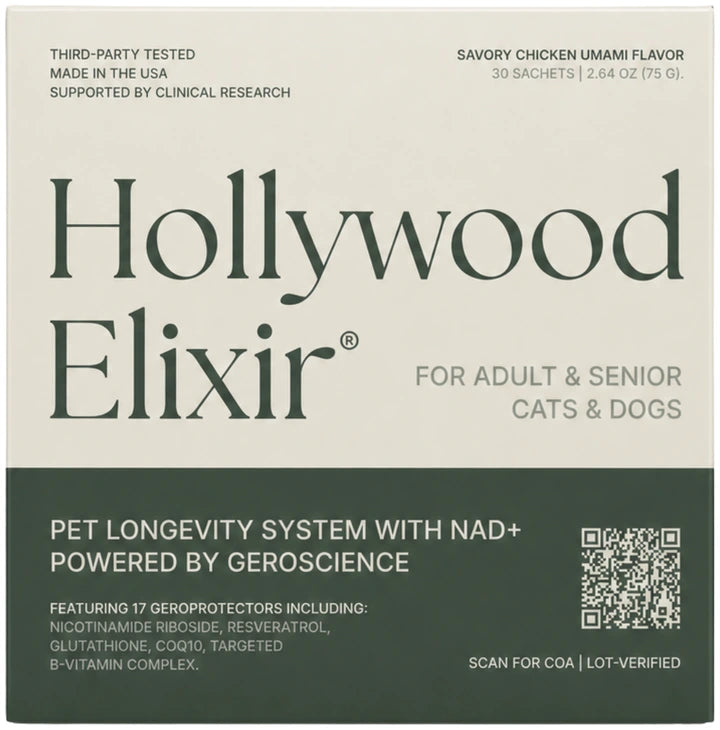
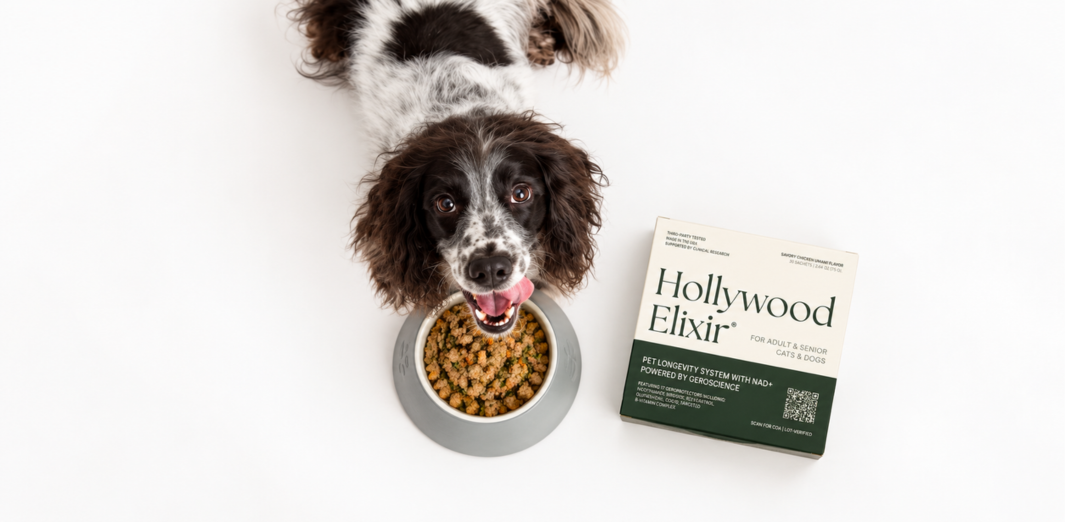
Where Hollywood Elixir Fits

Serving Size, Daily Cost and What Your Dog Will Take

A Record That Is Useful at the Next Review
References
Numbered references identify the sources used for specific claims. Read the study design, species and evidence boundaries alongside each finding.
-
Ratajczak J, Joffraud M, Trammell SA, et al. NRK1 controls nicotinamide mononucleotide and nicotinamide riboside metabolism in mammalian cells. Study design/context: Mechanistic studySpecies/context: mouse, mammalian cellsEvidence boundary: Experimental pathway work; not canine or feline absorption, dosing, or clinical efficacy.↩ 1 · ↩ 2 · ↩ 3 · ↩ 4 · ↩ 5 · ↩ 6
-
Kory N, Uit de Bos J, van der Rijt S, et al. MCART1/SLC25A51 is required for mitochondrial NAD transport. Study design/context: Mechanistic studySpecies/context: human cellsEvidence boundary: Intracellular transport mechanism; no oral precursor trial in dogs or cats.↩ 1 · ↩ 2
-
Simon KE, Russell K, Mondino A, et al. A randomized, controlled clinical trial demonstrates improved owner-assessed cognitive function in senior dogs receiving a senolytic and NAD+ precursor combination. Study design/context: Randomized controlled clinical trialSpecies/context: dogEvidence boundary: Combination-specific owner-assessed cognition result; does not isolate NR or establish efficacy of another formula.↩ 1 · ↩ 2 · ↩ 3 · ↩ 4 · ↩ 5
-
Cardoso D, Barthélémy I, Blot S, et al. Replenishing NAD+ content reduces aspects of striated muscle disease in a dog model of Duchenne muscular dystrophy. Study design/context: Muscular dystrophy disease-model experimentSpecies/context: dogEvidence boundary: Dogs with inherited muscular dystrophy received NAM, not NR. Not healthy senior-dog or feline evidence.↩ 1 · ↩ 2 · ↩ 3 · ↩ 4 · ↩ 5
-
You Y, Gao Y, Wang H, et al. Subacute Toxicity Study of Nicotinamide Mononucleotide via Oral Administration. Study design/context: Subacute oral toxicology studySpecies/context: dog, mouseEvidence boundary: Beagle exposure lasted 14 days and mild creatinine/uric-acid increases were reported. Not NR or long-term efficacy evidence.↩
-
Marinescu AG, Chen J, Holmes HE, et al. Safety Assessment of High-Purity, Synthetic Nicotinamide Riboside (NR-E) in a 90-Day Repeated Dose Oral Toxicity Study, With a 28-Day Recovery Arm. Study design/context: 90-day oral toxicology study with recovery armSpecies/context: ratEvidence boundary: Sprague-Dawley rats, not dogs or cats. Rat toxicology cannot establish long-term pet safety or a pet serving.↩
-
Zeng M, Zhou T, Li Z, et al. Transcriptomic and intervention evidence reveals domestic dogs as a promising model for anti-inflammatory investigation. Study design/context: Exploratory canine biomarker study with separate intervention arms and before-and-after comparisonsSpecies/context: dogEvidence boundary: Small NMN biomarker arm without an untreated placebo group; does not establish NR effects, clinical benefit or lifespan extension.↩ 1 · ↩ 2 · ↩ 3
-
G C Mills. Hemoglobin catabolism. I. Glutathione peroxidase, an erythrocyte enzyme which protects hemoglobin from oxidative breakdown. Study design/context: Biochemical mechanism experimentEvidence boundary: Biochemical erythrocyte experiment; no oral product effect inferred↩
-
Cristina Cerqua, Alberto Casarin, Fabien Pierrel, Luis Vazquez Fonseca, Giampiero Viola, Leonardo Salviati, Eva Trevisson. Vitamin K2 cannot substitute Coenzyme Q10 as electron carrier in the mitochondrial respiratory chain of mammalian cells. Study design/context: Cell experimentsSpecies/context: human cells, yeastEvidence boundary: Human-cell/yeast deficiency experiments; no canine supplement benefit inferred↩
-
U.S. Food and Drug Administration. “Complete and Balanced” Pet Food. Study design/context: Official guidanceSpecies/context: dogs, catsEvidence boundary: Nutritional adequacy labeling; does not establish whether an NAD+ supplement benefits dogs.↩
-
American Animal Hospital Association. Evaluating the Healthy Senior Pet. Study design/context: Official guidanceSpecies/context: dogs, catsEvidence boundary: Professional senior-care guidance about history and observation; not an NAD+ efficacy trial.↩ 1 · ↩ 2

Discover LPL-01: How This Fits Into a Larger Canine Longevity System
Aging in dogs is not driven by a single pathway. It’s the result of interacting biological systems—energy metabolism, oxidative stress, immune signaling, and structural integrity—changing over time.
This article explores one piece of that puzzle. If you want to understand how these pieces connect—and what actually moves the needle—you need to zoom out.
Start with the underlying science:
- Canine Geroscience Framework →
A structured view of how aging progresses across cellular energy, inflammation, and resilience systems. - Senior Biological Defense Coverage (BDC) Modeling →
A systems-level map of which biological pathways decline first, and how layered interventions can support them. - 2026 Market Research: Best Dog Longevity Supplements →
A 2026 industry report and review of leading senior-dog and cellular-aging formulas. - LPL-01 Standard →
The formulation system that translates these models into real-world supplementation—covering multiple pathways in a coordinated way.
Keep exploring
What would you like to understand next?
Search practical guides about healthy aging, cellular energy, ingredients, and daily support for dogs.


