Reishi Mushroom for Dogs

Why reishi appears in immune and healthy-aging supplements

By La Petite Labs Editorial 17 min read

Woman hugging a golden retriever while holding a Hollywood Elixir box
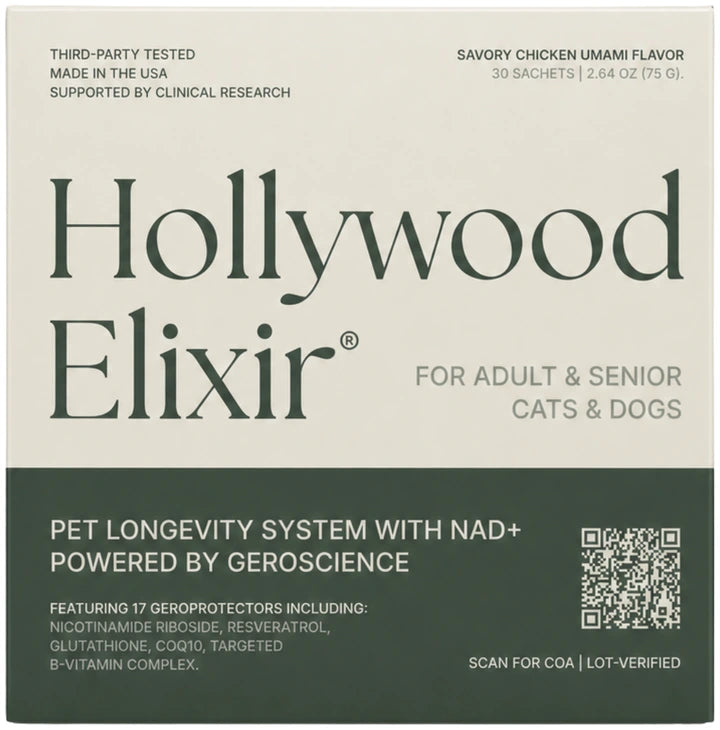
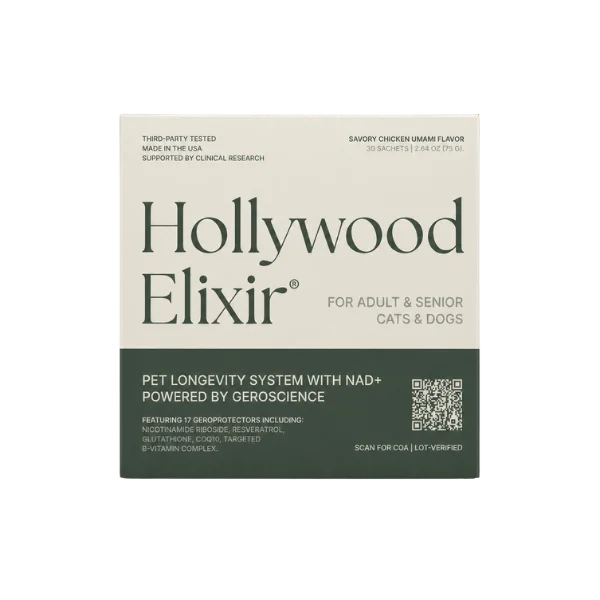
Hollywood Elixir® Daily longevity system · adult & senior dogs Starting at $63/month 

Reishi is a woody mushroom used in supplements for compounds that interact with immune processes. There is direct canine research behind that interest, although it answers a much narrower question than many claims about calming, cancer or longevity.

The preparation matters. A whole mushroom powder, a concentrated extract and a finished supplement can contain very different amounts of the compounds being studied. Hollywood Elixir includes reishi within a measured formula alongside yeast beta-glucan, NR, CoQ10 and glutathione. Here is how those choices connect, and what they mean when you are considering reishi for your dog.

Reishi contains polysaccharides, including beta-glucans, and triterpenes. Direct canine research supports interest in an immune role, but does not establish treatment for cancer, itching or disturbed sleep. Preparations differ, so study amounts cannot be transferred automatically to a different extract or a mixed supplement. Hollywood Elixir declares 25 mg of reishi extract, standardised to 35% polysaccharides, per standard 2.5 g sachet alongside a separate 50 mg yeast beta-glucan ingredient, NR, CoQ10 and glutathione. Follow the actual dog serving directions and review medicines and other supplements when considering the complete formula.

What reishi is

Reishi, often labelled Ganoderma lucidum, is a glossy, woody mushroom. Its texture helps explain why it appears in supplements as a processed powder or extract rather than as an ordinary dinner ingredient. Two groups of compounds attract particular interest: polysaccharides, including beta-glucans, and triterpenes. 1 5

Polysaccharides are long chains of sugars. The way those sugars join together changes what they can do; they are more than a source of sweetness or calories. Triterpenes are a different chemical family. A label describing one group does not tell you how much of the other is present.

Woman holding a Hollywood Elixir box beside a pug, a terrier and a food bowl

Why mushroom sugars interest immune researchers

Immune cells recognise molecular patterns on microbes. Beta-glucans form part of fungal cell walls, and their structures can interact with that recognition machinery. Researchers have studied how exposure changes the way immune cells respond to a later challenge. 2

In one experiment, canine blood cells grown in the laboratory responded differently to bacterial stimuli after exposure to beta-glucans. The main preparation came from Euglena, a different organism; the experiment explains a mechanism of interest, rather than testing oral reishi. 2

An immune cell can react more strongly without an allergy getting better. Recognising microbes and controlling an allergic reaction are different tasks, which is why a claim of “immune support” needs a more specific explanation.

Woman in sportswear holding a Hollywood Elixir box beside a black-and-tan dog outdoors

The controlled reishi study in dogs

In a 2024 study, 40 adult beagles received a control or one of three daily amounts of a Ganoderma preparation for 28 days. The supplied material was specified as at least 70% beta-glucans. Researchers assessed blood, digestion and immune responses. 1

After vaccination, the highest-dose group had a larger increase from baseline in rabies-specific antibodies than the control group. The ingredient supplier funded the study. Unlike a laboratory experiment on isolated cells, this study tested the preparation in dogs that ate it.

Woman holding a Hollywood Elixir box above her forehead beside a Bernese mountain dog outdoors

An antibody response is one part of immunity

Antibodies recognise particular targets. Measuring their response after a vaccine lets researchers ask a more precise question than whether a dog’s “immunity improved.” The reishi study did not test whether supplemented dogs caught fewer infections. Other reported immune-cell changes were trends rather than statistically significant improvements. 1

The distinction matters when choosing a supplement. There is a reason to investigate reishi’s immune role, but a vaccine-antibody result does not establish treatment for cancer, allergies or a dog’s disturbed sleep. Each of those requires evidence addressing the actual condition.

Golden retriever nuzzling a woman holding a Hollywood Elixir box on the grass beside a food bowl

Why Hollywood Elixir contains reishi

Hollywood Elixir includes 25 mg of reishi extract per standard 2.5 g sachet, specified in our ingredient guide as standardised to 35% polysaccharides. It sits alongside a separate 50 mg yeast beta-glucan ingredient. The two entries represent different source materials within the formula’s immune-focused component. 7

We combine those ingredients with NR, CoQ10 and reduced glutathione because the daily formula is built around more than one biological job: immune signalling, cellular energy and antioxidant nutrition. That gives reishi a defined place in Hollywood Elixir, rather than asking one mushroom to explain every aspect of healthy aging.

It is a nutritional rationale for the combination. The beagle experiment tested a different preparation, so it is not a clinical trial of Hollywood Elixir.

Reishi extract and yeast beta-glucan are separate ingredients in Hollywood Elixir.

Polysaccharides and beta-glucans are not the same label claim

“Polysaccharides” is the broader category; beta-glucans are one kind. A percentage for total polysaccharides cannot be read as the same percentage of beta-glucans. Nor does it reveal the amount of reishi’s triterpenes. 1 5

For Hollywood Elixir, the reishi declaration is 25 mg of an extract standardised to 35% polysaccharides. The separately listed yeast beta-glucan comes from Saccharomyces cerevisiae. Do not add the two ingredient weights together and call the result a measured beta-glucan dose. 7

The complete ingredient guide makes these forms visible. Reading the named preparation is more informative than comparing the biggest percentage on two jars.

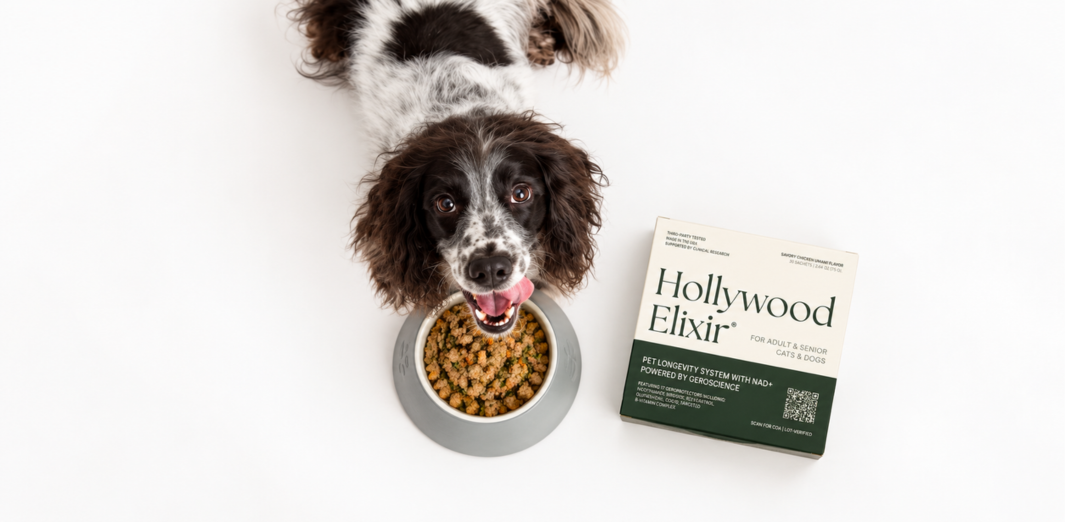
Overhead view of a black-and-white dog beside a food bowl and Hollywood Elixir box

How the formula connects to cellular energy

Food supplies the nutrients a dog’s cells use to make ATP, which powers much of their work. NAD+ and NADH participate in the reactions that transfer energy from those nutrients. NR is a precursor cells can use to make NAD+. Inside mitochondria, CoQ carries electrons along the pathway involved in ATP production. 8 10

Hollywood Elixir contains 60 mg of NR and 40 mg of CoQ10 per standard sachet, alongside its reishi and yeast beta-glucan ingredients. 7 These are distinct roles, which is why the formula’s purpose cannot be reduced to “mushroom support.”

The NAD+ guide for dogs explains the wider system. The NR ingredient guide follows the precursor itself.

Woman smiling beside a golden retriever, a green food bowl and a Hollywood Elixir box

Glutathione supplies a different connection

Energy-producing cells also generate reactive oxygen molecules. Some have useful signalling roles, while excessive or misplaced reactions can damage cellular components. Cells therefore have ways to handle them. Glutathione helps enzymes convert hydrogen peroxide into water. 9

Hollywood Elixir includes 50 mg of reduced glutathione per standard sachet. In the formulation, that gives the antioxidant component an explicit ingredient alongside the NAD+ precursor, electron carrier and immune-focused ingredients. 7

The reason for bringing them together is biological, rather than a claim that the combination has proved superior to reishi alone. Our glutathione guide for dogs explains this chemistry and the oral research.

Man holding a Hollywood Elixir box while sitting on an outdoor sofa with a golden retriever

Reading reishi dosage without borrowing the wrong number

The beagle study used 5, 10 or 15 mg of its particular preparation per kilogram of body weight daily. Those are research amounts. They do not establish a universal dose for whole mushroom powder, a different extract or a multi-ingredient formula. 1

For a product you are considering, identify the preparation and amount per serving, then use its current dog directions and individual veterinary advice. Hollywood Elixir’s standard 2.5 g sachet is the basis for its label amounts; it is not a reason to copy another study’s reishi calculation. 7

Increasing a complete blend to match one research ingredient would also increase its NR, CoQ10, vitamins and other components. The whole serving has to make sense together.

Powder, extract, fruiting body and mycelium

The fruiting body is the visible mushroom; mycelium is the network of fungal filaments that grows through its surroundings. A finished ingredient may be made from either, and processing can select or concentrate different constituents. These descriptions help identify the material, but none alone supplies a clinical result. 1 5

A jar of plain ground mushroom and an extract standardised to a named constituent should not be compared only by their total milligrams. Likewise, the word “extract” does not disclose its composition. Look for the actual preparation, the source material and any measured constituent declared.

Hollywood Elixir identifies its reishi as a standardised extract. That is the relevant description when you compare it with standalone reishi powder. 7

A percentage for total polysaccharides is not a percentage for beta-glucans.

Woman sitting with a beagle in a kitchen while holding a Hollywood Elixir box

DVM Voice: Clinical Vignette of a Common Pattern in Senior Dog Aging

Case provided by JoAnna Pendergrass, DVM

Rex, a 7-year-old Labrador Retriever, was brought in after his owner noticed he was slower to rise, hesitant on stairs, and less able to play as before. Examination showed stiffness and reduced hip mobility; radiographs confirmed degenerative joint changes.

His care required weight management, veterinary-guided pain control, nutritional support, and rehabilitation — a comprehensive plan, but one started only after visible decline appeared.

Clinical takeaway: Rex’s case reflects the value of proactive aging support: maintaining lean body condition, monitoring mobility early, and supporting cellular resilience, antioxidant defense, and healthy inflammatory balance before decline becomes obvious.

Single-case vignette. Not generalizable. Veterinary oversight is essential for pain, stiffness, or suspected joint disease.

Explore Hollywood Elixir Research →
Spotted gray dog beside a Hollywood Elixir box held in a person's hand

What a useful product label lets you compare

Start with the full ingredient name and the preparation. Then find the amount per serving, the serving directions for dogs and the other ingredients in that serving. If a company provides a laboratory report, check which material and lot it covers and which measurements appear in it.

For a mushroom ingredient, a compositional result and a contaminant screen answer different questions. Neither is a clinical efficacy trial. A total-polysaccharide entry also should not be silently relabelled as beta-glucans.

Hollywood Elixir’s formula and serving information gives you the declared amounts for reishi and its companions. Use that as the starting point for deciding whether you want this combination or a separate mushroom product. 7

Golden retriever nuzzling a man holding a Hollywood Elixir box beside a food bowl

Reishi is different from the mushroom in turkey-tail cancer research

The mushroom compound often discussed in canine cancer studies is polysaccharopeptide, or PSP, from Coriolus versicolor—turkey tail. That is a different mushroom and preparation from reishi.

A larger 2022 study analysed 101 dogs with splenic hemangiosarcoma after surgery. Among dogs receiving doxorubicin, adding PSP did not improve survival. Owners had chosen whether to proceed with chemotherapy; only the chemotherapy group was randomly assigned PSP or placebo. 3

This distinction prevents two mistakes: assigning turkey-tail findings to reishi, and treating any mushroom powder as interchangeable with a studied cancer regimen. If cancer is the reason for considering a supplement, the oncologist needs to review the exact product alongside treatment.

Golden spaniel eating from a green bowl beside a Hollywood Elixir box

Reishi for calming, dementia or unsettled nights

An older dog wandering or barking at night presents a very different question from immune nutrition. Canine cognitive dysfunction can change sleep patterns, but pain, other illnesses and loss of vision or hearing can cause overlapping changes. Cornell’s guidance describes assessment and treatment involving the dog’s environment, diet and medicines. 4

The reishi research discussed here does not establish a sedative effect or a treatment for canine dementia. “Calming” on a mushroom label should not be assumed to mean that a dog will sleep through the night.

If sleep has changed, describe what happens to your veterinarian: wandering, distress, toilet needs or difficulty settling. A supplement chosen for general daily nutrition can be discussed within that care, without being mistaken for the answer to a new symptom.

Our guide to a dog pacing at night starts with the signs that need urgent care, then works through common reasons a dog cannot settle.

What about itching or digestion?

Immune activity, allergic itching and bowel function overlap biologically, but they are not interchangeable outcomes. A study has to measure the thing you hope will change. In the controlled reishi experiment, stool scores and visual skin-and-coat assessments did not improve between treatment groups. 1

That makes reishi a different choice from a treatment selected to control a diagnosed allergy or digestive disorder. An owner considering Hollywood Elixir for daily cellular and immune nutrition has a clear formulation to evaluate. An owner trying to stop persistent scratching or diarrhoea needs the cause and care options addressed first.

What the dog trial tells us about safety

The 28-day beagle trial did not report treatment-related clinical illness or adverse blood-test changes. 1 It offers useful short-term information about the tested material, while leaving long-term use and medically complicated dogs less certain.

Whole-product tolerance still matters. Stop a new supplement and contact your veterinarian if vomiting, diarrhoea, appetite loss, unusual tiredness or another concerning change follows it. Have the label and timing available; do not assume an unwanted change means the ingredient is “working.”

Wild mushroom ingestion is a separate situation. Do not use a supplement article to identify a mushroom your dog found outdoors. Seek prompt veterinary or poison-control advice, since identification can be difficult and some species cause serious poisoning. 6

Woman holding a Hollywood Elixir box beside a dapple dachshund and green food bowl on a sofa

Medicines deserve a specific review

Reishi’s human herbal reference at Memorial Sloan Kettering flags potential interactions with blood-thinning medicines and immunosuppressants. Those cautions are not measurements of the risk in dogs, but they are good reasons to discuss reishi with the veterinarian managing those medicines. 5

Bring the full formula and all current medicines and supplements. The clinician can assess why each is being used and whether the proposed addition fits. This is particularly relevant when treatment deliberately changes immune activity or clotting.

Do not change a prescribed medicine to make room for a mushroom supplement. If your dog is receiving cancer treatment, the oncology team should be part of the discussion.

Woman cuddling a brown-and-white spaniel while holding a Hollywood Elixir box

Make the daily serving easy to understand

Hollywood Elixir is designed to be mixed with food. Read the current dog serving directions and measure the complete product accordingly. The label also lists whey protein isolate, chicken flavour, chicken liver powder and other ingredients, so it belongs in any discussion of allergies or a tightly controlled diet. 7

If you already give a mushroom blend or an NAD-related supplement, compare both labels before combining them. Reishi, yeast beta-glucan and antioxidant ingredients can appear in more than one product. A single formula may be the more convenient way to obtain the combination you want, provided it fits your dog’s existing nutrition and care.

Keep the package and follow its storage instructions. Those practical details make the product and amount traceable if a question arises.

Choosing reishi for a reason

Reishi is an ingredient with a plausible immune role and some direct canine research. The strongest reason to understand it is the actual composition and preparation, rather than a promise that it will make a dog calmer, younger or resistant to illness.

In Hollywood Elixir, reishi contributes mushroom polysaccharides alongside a separate yeast beta-glucan ingredient. NR, CoQ10 and reduced glutathione extend the formula into cellular energy and antioxidant nutrition. That is the case for choosing the combination: several defined ingredients with different jobs, offered as one food-mixed daily product. 7 8 9 10

If that purpose fits what you are looking for, explore Hollywood Elixir for your dog and compare the full label with the current routine.

NR helps supply the NAD+ pathway; CoQ10 carries electrons; glutathione helps handle reactive oxygen molecules.

Educational content only. This material is not a substitute for veterinary advice. Always consult your veterinarian about your dog’s specific needs. These statements have not been evaluated by the Food and Drug Administration. Products mentioned are not intended to diagnose, treat, cure, or prevent any disease.

Glossary

Reishi: A woody Ganoderma mushroom used in processed powders and extracts.

Polysaccharide: A chain of sugar units; the category includes beta-glucans and other compounds.

Beta-glucan: A glucose polymer whose structure influences its interactions with biological systems.

Triterpene: A chemical family distinct from the polysaccharides found in reishi.

Fruiting body: The visible mushroom structure.

Mycelium: The network of fungal filaments that grows through a substrate.

Antibody: An immune protein that recognises a particular target.

Standardised extract: A preparation specified to contain a stated amount or proportion of a measured constituent.

PSP: Polysaccharopeptide from turkey tail studied in canine cancer research; it is not reishi.

NR: Nicotinamide riboside, a precursor cells can use to make NAD+.

Related Reading

References

Numbered references identify the sources used for specific claims. Read the study design, species and evidence boundaries alongside each finding.

  1. Emanuela Kayser, Paola L. Castaneda, Katiria Soto-Diaz, Andrew J. Steelman, Alayna Murphy, Maria Spindola, Fei He, Maria R. C. de Godoy. Functional properties of Ganoderma lucidum supplementation in canine nutrition. 2024Species/context: DogsEvidence boundary: Forty adult beagles were assigned to a control group or a defined Ganoderma preparation for 28 days. The vaccine-antibody result does not establish prevention or treatment of disease; the ingredient supplier funded the study.↩ 1 · ↩ 2 · ↩ 3 · ↩ 4 · ↩ 5 · ↩ 6 · ↩ 7 · ↩ 8
  2. Simon Paris, Ludivine Chapat, Marion Pasin, Manon Lambiel, Thomas E. Sharrock, Rishabh Shukla, Cecile Sigoillot-Claude, Jeanne-Marie Bonnet, Hervé Poulet, Ludovic Freyburger, Karelle De Luca. β-Glucan-Induced Trained Immunity in Dogs. 2020Species/context: Cultured canine blood cellsEvidence boundary: This laboratory study explains beta-glucan-induced changes in canine immune cells. Its main preparation came from Euglena, and it did not test feeding reishi.↩ 1 · ↩ 2
  3. Allison Gedney, Pascale Salah, Jennifer A. Mahoney, Erika Krick, Reenie Martins, Heather Scavello, Jennifer A. Lenz, Matthew J. Atherton. Evaluation of the anti-tumour activity of Coriolus versicolor polysaccharopeptide (I’m-Yunity) alone or in combination with doxorubicin for canine splenic hemangiosarcoma. 2022Species/context: Dogs with splenic hemangiosarcomaEvidence boundary: The intervention was turkey-tail polysaccharopeptide, not reishi. Adding it to doxorubicin after surgery did not improve survival in the studied dogs.↩
  4. Aly Cohen. Cognitive dysfunction syndrome. 2025Species/context: DogsEvidence boundary: Veterinary guidance on cognitive dysfunction explains why changed sleep patterns need assessment. It does not support a reishi treatment claim.↩
  5. Memorial Sloan Kettering Cancer Center. Reishi Mushroom. 2026Species/context: Human herbal guidanceEvidence boundary: The reference identifies reishi constituents and potential human medicine interactions. It does not provide canine interaction rates.↩ 1 · ↩ 2 · ↩ 3 · ↩ 4
  6. ASPCA Poison Control. The Fungus Among Us: Mushroom Toxicosis. 2026Species/context: Companion animalsEvidence boundary: Wild mushroom ingestion requires a different assessment from using a labelled supplement, because some species are toxic and identification can be difficult.↩
  7. La Petite Labs. Hollywood Elixir supplement facts and ingredient forms. Accessed 2026Species/context: Product label and ingredient guideEvidence boundary: The declared amounts and forms describe Hollywood Elixir’s ingredients. The standard sachet is the label basis; use the current species-specific serving directions.↩ 1 · ↩ 2 · ↩ 3 · ↩ 4 · ↩ 5 · ↩ 6 · ↩ 7 · ↩ 8 · ↩ 9
  8. Reactome. Complex I oxidises NADH to NAD+, reduces CoQ to CoQH2. Accessed 2026Species/context: Conserved mammalian cellular pathwayEvidence boundary: This pathway explains normal NADH-to-CoQ electron transfer in mitochondria. It does not measure the effects of an oral supplement.↩ 1 · ↩ 2
  9. Reactome. Detoxification of Reactive Oxygen Species. Accessed 2026Species/context: Conserved mammalian cellular pathwayEvidence boundary: The pathway describes how antioxidant enzymes use glutathione to handle reactive oxygen molecules.↩ 1 · ↩ 2
  10. Rachel S. Fletcher, Joanna Ratajczak, Craig L. Doig, Lucy A. Oakey, Rebecca Callingham, Gabriella Da Silva Xavier, Antje Garten, Yasir S. Elhassan, Philip Redpath, Marie E. Migaud, Andrew Philp, Charles Brenner, Carles Canto, Gareth G. Lavery. Nicotinamide riboside kinases display redundancy in mediating nicotinamide mononucleotide and nicotinamide riboside metabolism in skeletal muscle cells. 2017Species/context: Mouse skeletal muscle and cultured cellsEvidence boundary: The research explains NR metabolism into NAD+. It is not a clinical trial of Hollywood Elixir in pets.↩ 1 · ↩ 2

FAQ

What is reishi, and why is it used in dog supplements?

Reishi is a woody mushroom containing polysaccharides, including beta-glucans, and triterpenes. Interest in dog supplements centres on its immune-related compounds. Hollywood Elixir includes reishi alongside yeast beta-glucan and separate ingredients for NAD+, cellular energy and antioxidant nutrition. That is a formulation rationale, not a claim that reishi treats every condition linked to immunity.

Are reishi supplements safe for every dog?

No study establishes suitability for every dog or every preparation. Get individual guidance for a dog with a medical condition, medicines, pregnancy or nursing, and consider the whole product. Stop a new supplement and contact your veterinarian if concerning changes follow it. A wild mushroom your dog finds outdoors requires separate, prompt advice rather than identification from a supplement label.

Is there a standard reishi dosage for dogs?

There is no universal dose that can be applied across whole mushroom powders, different extracts and mixed formulas. The canine research tested a characterised preparation; its amount cannot simply be copied to another product. Use current dog directions and individual veterinary advice. Do not increase a mixed formula to match one study ingredient, because every other ingredient increases too.

Can reishi interact with prescription medicines?

Human herbal guidance flags potential concerns with blood thinners and immunosuppressants. These are not quantified canine interaction rates, but they justify a discussion with the veterinarian managing those medicines. Bring the full formula and medication list, and do not change prescribed treatment to make room for reishi. Involve the oncology team if your dog is receiving cancer treatment.

Can reishi help a dog sleep or treat dementia?

The reishi studies discussed here do not establish a sedative effect or treatment for canine cognitive dysfunction. Night wandering or disturbed sleep can accompany cognitive changes, but pain, other illness and sensory loss can cause similar signs. Veterinary assessment can identify the relevant care, including environmental changes, diet and medicines.

Is reishi the mushroom studied for canine cancer?

Much of the commonly discussed canine mushroom cancer research concerns turkey-tail polysaccharopeptide, or PSP, not reishi. In a larger study of dogs with splenic hemangiosarcoma, adding PSP to doxorubicin after surgery did not improve survival. Neither the ingredient nor the result should be transferred to a reishi powder or to Hollywood Elixir.

Is reishi powder better than an extract?

The words describe different preparations, not a universal ranking. Compare the source material, the constituents specified and the amount per serving. Total polysaccharides are a broader category than beta-glucans, so their percentages should not be treated as equivalent. Then consider the full formula and a format your dog accepts.

How much reishi is in Hollywood Elixir?

Hollywood Elixir declares 25 mg of reishi extract per standard 2.5 g sachet. The ingredient guide specifies 35% polysaccharides. A separate entry provides 50 mg of yeast beta-glucan, alongside NR, CoQ10, reduced glutathione and other ingredients. Follow the current dog serving directions; the standard sachet is the label comparison basis, and the formula differs from the preparation tested in the reishi dog trial.

Dalmatian looking toward a Hollywood Elixir box held in a person's hand

Discover LPL-01: How This Fits Into a Larger Canine Longevity System

Aging in dogs is not driven by a single pathway. It’s the result of interacting biological systems—energy metabolism, oxidative stress, immune signaling, and structural integrity—changing over time.

This article explores one piece of that puzzle. If you want to understand how these pieces connect—and what actually moves the needle—you need to zoom out.

Start with the underlying science:

Keep exploring

What would you like to understand next?

Search practical guides about healthy aging, cellular energy, ingredients, and daily support for dogs.