


The 12 Hallmarks of Aging in Dogs, Explained
Read full insightNicotinamide Riboside for Dogs
How an ingredient in your dog’s supplement becomes part of the NAD+ system.
By La Petite Labs Editorial 16 min read

How cells turn NR into NAD+

What changes after a dog swallows NR?

NR, NMN and nicotinamide take different routes

What researchers actually tested in dogs
What human blood tests tell us about NR

Does a metabolic change become a physical benefit?

Why the senior-dog cognition trial is a separate story

DVM Voice: Clinical Vignette of a Common Pattern in Senior Dog Aging
Case provided by JoAnna Pendergrass, DVM
Rex, a 7-year-old Labrador Retriever, was brought in after his owner noticed he was slower to rise, hesitant on stairs, and less able to play as before. Examination showed stiffness and reduced hip mobility; radiographs confirmed degenerative joint changes.
His care required weight management, veterinary-guided pain control, nutritional support, and rehabilitation — a comprehensive plan, but one started only after visible decline appeared.
Clinical takeaway: Rex’s case reflects the value of proactive aging support: maintaining lean body condition, monitoring mobility early, and supporting cellular resilience, antioxidant defense, and healthy inflammatory balance before decline becomes obvious.
Single-case vignette. Not generalizable. Veterinary oversight is essential for pain, stiffness, or suspected joint disease.

Read the full ingredient name, including its form

Powder weight, NR amount and serving size

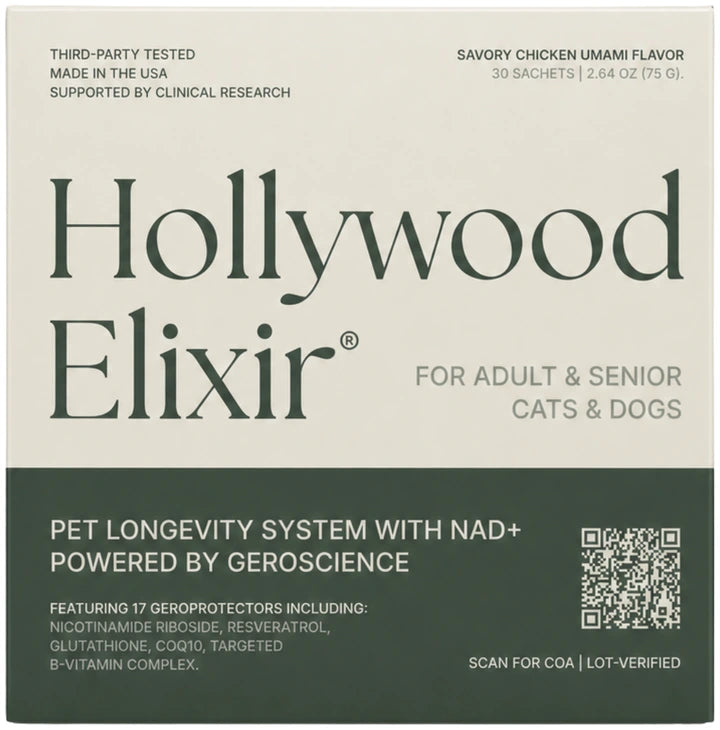
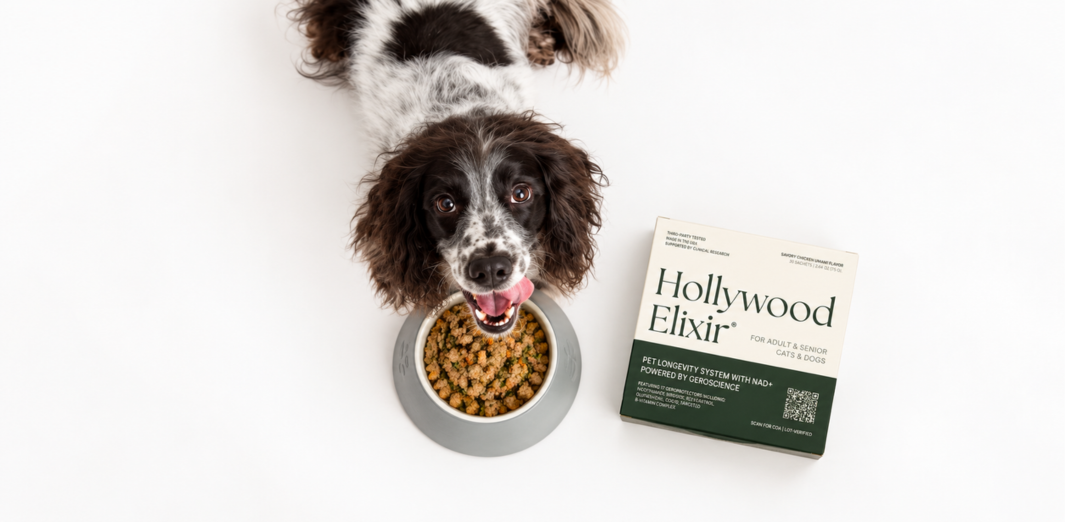
How NR fits into Hollywood Elixir

What testing should tell you about an NR product

What is known about ongoing NR use?
References
Numbered references identify the sources used for specific claims. Read the study design, species and evidence boundaries alongside each finding.
-
Ratajczak J, Joffraud M, Trammell SA, et al. NRK1 controls nicotinamide mononucleotide and nicotinamide riboside metabolism in mammalian cells. Study design/context: Mechanistic studySpecies/context: mouse, mammalian cellsEvidence boundary: Experimental pathway work; not canine or feline absorption, dosing, or clinical efficacy.↩ 1 · ↩ 2 · ↩ 3 · ↩ 4
-
Marinescu AG, Chen J, Holmes HE, et al. Safety Assessment of High-Purity, Synthetic Nicotinamide Riboside (NR-E) in a 90-Day Repeated Dose Oral Toxicity Study, With a 28-Day Recovery Arm. Study design/context: 90-day oral toxicology study with recovery armSpecies/context: ratEvidence boundary: Sprague-Dawley rats, not dogs or cats. Rat toxicology cannot establish long-term pet safety or a pet serving.↩
-
Cardoso D, Barthélémy I, Blot S, et al. Replenishing NAD+ content reduces aspects of striated muscle disease in a dog model of Duchenne muscular dystrophy. Study design/context: Muscular dystrophy disease-model experimentSpecies/context: dogEvidence boundary: Dogs with inherited muscular dystrophy received NAM, not NR. Not healthy senior-dog or feline evidence.↩
-
Simon KE, Russell K, Mondino A, et al. A randomized, controlled clinical trial demonstrates improved owner-assessed cognitive function in senior dogs receiving a senolytic and NAD+ precursor combination. Study design/context: Randomized controlled clinical trialSpecies/context: dogEvidence boundary: Combination-specific owner-assessed cognition result; does not isolate NR or establish efficacy of another formula.↩
-
Trammell SA, Schmidt MS, Weidemann BJ, et al. Nicotinamide riboside is uniquely and orally bioavailable in mice and humans. Study design/context: Pharmacokinetic studySpecies/context: human, mouseEvidence boundary: Human and mouse NAD-related biomarkers; not clinical benefit or a dose for pets.↩ 1 · ↩ 2
-
Elhassan YS, Kluckova K, Fletcher RS, et al. Nicotinamide Riboside Augments the Aged Human Skeletal Muscle NAD+ Metabolome and Induces Transcriptomic and Anti-inflammatory Signatures. Study design/context: Randomized placebo-controlled crossover trialSpecies/context: humanEvidence boundary: Older men; muscle NAD-related metabolites changed without improved mitochondrial bioenergetics. Not pet outcome evidence.↩
-
EFSA Panel on Nutrition, Novel Foods and Food Allergens. Safety of nicotinamide riboside chloride as a novel food pursuant to Regulation (EU) 2015/2283 and bioavailability of nicotinamide from this source, in the context of Directive 2002/46/EC. Study design/context: Human novel-food safety assessment including canine dossier studiesSpecies/context: dogEvidence boundary: Short beagle metabolism and toxicity studies summarized in a human novel-food assessment; not a canine efficacy trial.↩ 1 · ↩ 2 · ↩ 3
-
Therapeutic Goods Administration. Nicotinamide riboside chloride. Study design/context: Ingredient composition specificationEvidence boundary: Not a finished product certificate or canine efficacy assessment.↩ 1 · ↩ 2 · ↩ 3
-
Liu L, Su X, Quinn WJ, et al. Quantitative Analysis of NAD Synthesis-Breakdown Fluxes. Study design/context: Isotope tracing in cells and miceSpecies/context: mouse, cell linesEvidence boundary: Isotope tracing in cells and mice; does not quantify oral NR delivery to canine tissues.↩ 1 · ↩ 2
-
McDermott MM, Martens CR, Domanchuk KJ, et al. Nicotinamide riboside for peripheral artery disease: the NICE randomized clinical trial. Study design/context: Randomized clinical trial in people with PADSpecies/context: humanEvidence boundary: Primary walking result used prespecified one-sided p<0.10; larger confirmation needed, not dog outcome evidence.↩
-
ThorneVet. Longevity Complex — manufacturer document, February 2024. Study design/context: Legacy manufacturer product documentSpecies/context: dog, catEvidence boundary: Manufacturer’s February 2024 ingredient declaration; current formulas may differ. Not a comparative efficacy study.↩
-
American Animal Hospital Association. Evaluating the Healthy Senior Pet. Study design/context: Senior-pet clinical assessment guidanceSpecies/context: dog, catEvidence boundary: Not an NR-specific interaction study or dosing recommendation.↩
-
Reactome. Complex I oxidises NADH to NAD+, reduces CoQ to CoQH2. Study design/context: Curated human respiratory-chain reactionSpecies/context: human biochemical pathwayEvidence boundary: Curated biochemical reaction, not a supplementation or finished-formula trial.↩
-
Reactome. GSR catalyzes glutathione (oxidized) + NADPH + H+ => 2 glutathione (reduced) + NADP+. Study design/context: Curated biochemical reactionSpecies/context: human biochemical pathwayEvidence boundary: Biochemical background on glutathione recycling; not evidence of an effect from an oral pet supplement.↩

Discover LPL-01: How This Fits Into a Larger Canine Longevity System
Aging in dogs is not driven by a single pathway. It’s the result of interacting biological systems—energy metabolism, oxidative stress, immune signaling, and structural integrity—changing over time.
This article explores one piece of that puzzle. If you want to understand how these pieces connect—and what actually moves the needle—you need to zoom out.
Start with the underlying science:
- Canine Geroscience Framework →
A structured view of how aging progresses across cellular energy, inflammation, and resilience systems. - Senior Biological Defense Coverage (BDC) Modeling →
A systems-level map of which biological pathways decline first, and how layered interventions can support them. - 2026 Market Research: Best Dog Longevity Supplements →
A 2026 industry report and review of leading senior-dog and cellular-aging formulas. - LPL-01 Standard →
The formulation system that translates these models into real-world supplementation—covering multiple pathways in a coordinated way.
Keep exploring
What would you like to understand next?
Search practical guides about healthy aging, cellular energy, ingredients, and daily support for dogs.


