CoQ10 for Dogs

The molecule behind cellular energy, the findings in dogs, and how CoQ10 fits a daily formula

By La Petite Labs Editorial 17 min read

Woman hugging a golden retriever while holding a Hollywood Elixir box

CoQ10 helps your dog’s cells turn energy from food into ATP, the molecule that powers much of their work. It carries electrons through mitochondria and also participates in antioxidant defense. Those two roles explain why it appears in both heart-health discussions and healthy-aging formulas. 1 2

Dogs can absorb CoQ10 from supplements, and researchers have tested it in dogs with mitral valve disease. The results are more specific than a promise of extra energy: blood concentrations rise, while clinical benefits have been harder to demonstrate.

Choosing well starts with understanding that difference—and why a formula might pair CoQ10 with an NAD+ precursor and glutathione. Here is the biology, the dog research and the practical comparison behind the label.

CoQ10 is part of the machinery cells use to make ATP. Ubiquinone and ubiquinol are two forms involved in its working cycle. Supplements can raise blood CoQ10 in dogs, but the studies discussed here do not establish a reliable improvement in stamina or a treatment for a heart murmur.

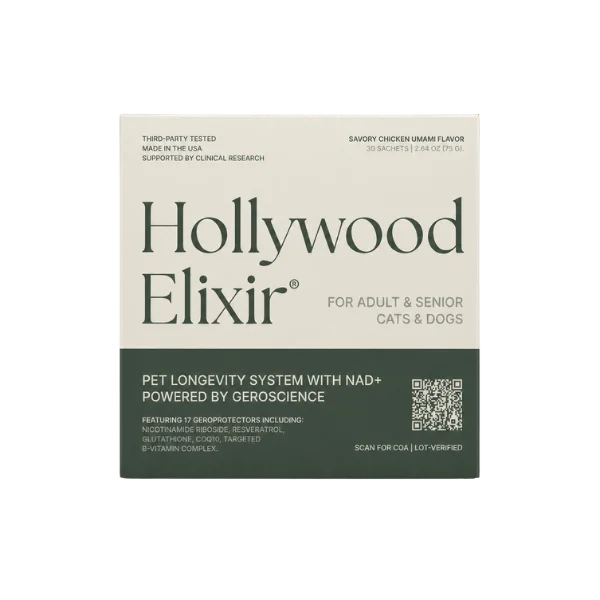
For a cardiac patient, the exact preparation and amount belong in the veterinarian’s plan. For broader daily healthy-aging support, Hollywood Elixir combines CoQ10 with NR and reduced glutathione: ingredients with distinct roles in cellular energy and antioxidant defense. Each standard 2.5 g sachet contains 40 mg CoQ10, 60 mg NR and 50 mg glutathione.

Compare the complete formulation and current serving directions, particularly if your dog already receives other supplements or heart medication.

What CoQ10 Does Between a Meal and a Muscle Contraction

A meal contains energy. Your dog’s cells need to turn it into a form they can spend on work: contracting a muscle, moving substances across a membrane or maintaining a heartbeat. Much of that work uses ATP.

Coenzyme Q10 helps make ATP possible. Inside mitochondria, it carries electrons between parts of the machinery that extracts usable energy from nutrients. It is small enough to move within the inner mitochondrial membrane, connecting reactions that would otherwise remain separate. 1

That ordinary job explains the interest in CoQ10 supplements. The molecule already belongs in canine biology; the question for a supplement is what adding a particular preparation achieves.

Woman holding a Hollywood Elixir box beside a pug, a terrier and a food bowl

Ubiquinone and Ubiquinol: Two Forms of the Same Molecule

CoQ10 changes as it works. Its oxidized form, ubiquinone, accepts electrons and becomes the reduced form, ubiquinol. Passing electrons onward allows the cycle to continue. Ubiquinol also has antioxidant activity. 1 2

Calling one form “active” and the other useless misses this back-and-forth chemistry. Canine studies have successfully raised blood CoQ10 using ubiquinone. Absorption depends on the preparation too, so a name on the front of a bottle cannot settle which product performs better. 2

Woman in sportswear holding a Hollywood Elixir box beside a black-and-tan dog outdoors

Why CoQ10 Comes Up After a Heart Murmur

The heart’s muscle contracts throughout the day and night, so an ingredient involved in cellular energy has an obvious scientific appeal. A murmur, however, is a sound your veterinarian hears, rather than a sign that the dog lacks CoQ10.

In myxomatous mitral valve disease, or MMVD, the valve no longer closes properly and some blood leaks backward. An echocardiogram helps show the valve, heart size and function. A supplement that raises blood CoQ10 has not thereby repaired that mechanical problem. 8

If a murmur prompted this search, keep the diagnostic and monitoring plan in place. CoQ10 can be discussed alongside it; the dog studies below show what that discussion can reasonably build on.

Woman holding a Hollywood Elixir box above her forehead beside a Bernese mountain dog outdoors

The First Finding: Dogs Can Absorb Oral CoQ10

In a 2021 trial, researchers gave dogs with heart failure from MMVD a water-soluble ubiquinone preparation or placebo for two weeks, alongside their cardiac treatment. They were trying to find a dose that would at least triple CoQ10 in plasma, the liquid part of blood.

The 200 mg daily research dose achieved that target. The lower, 100 mg daily dose also raised concentrations, with variation among dogs. Before supplementation, the heart patients did not have significantly lower plasma CoQ10 than the healthy comparison dogs. 3

This answered a useful formulation question: the ingredient reached the circulation. It did not establish that every dog with a murmur is deficient, or that this dose is appropriate for daily use in every dog.

Golden retriever nuzzling a woman holding a Hollywood Elixir box on the grass beside a food bowl

What the Three-Month Heart Study Found
A later trial followed 43 dogs with MMVD for three months. They received either 100 mg of water-soluble CoQ10 twice daily or placebo while continuing heart treatment. Twelve healthy dogs provided a separate comparison.

Among the dogs with heart failure, changes in selected white-cell measures favored CoQ10: neutrophil percentage fell while lymphocyte measures rose relative to placebo. The authors interpreted these as possible anti-inflammatory effects. They did not confirm an improvement in cardiac disease severity or the oxidative-stress markers tested. 4

There is a real finding here, and a clear limit: this was a response in particular blood measures, rather than proof that CoQ10 reverses heart failure.

CoQ10 carries electrons inside mitochondria, helping cells make ATP.

Will an Older Dog Have More Energy?

A longer walk is a more interesting outcome to most owners than a higher blood concentration. Researchers have looked beyond absorption. In a short crossover trial of Cavaliers with MMVD, blood CoQ10 rose after supplementation, but disease severity and owner-rated quality of life did not significantly improve compared with placebo. 2

The studies reviewed here therefore cannot promise more stamina, faster recovery or a predictable return of playfulness. CoQ10’s role in ATP production makes those questions worth investigating; it does not answer them by itself.

If your dog is slowing down, describe the change rather than assuming it reflects cellular aging. A dog who stops because movement hurts needs a different response from one who struggles to breathe.

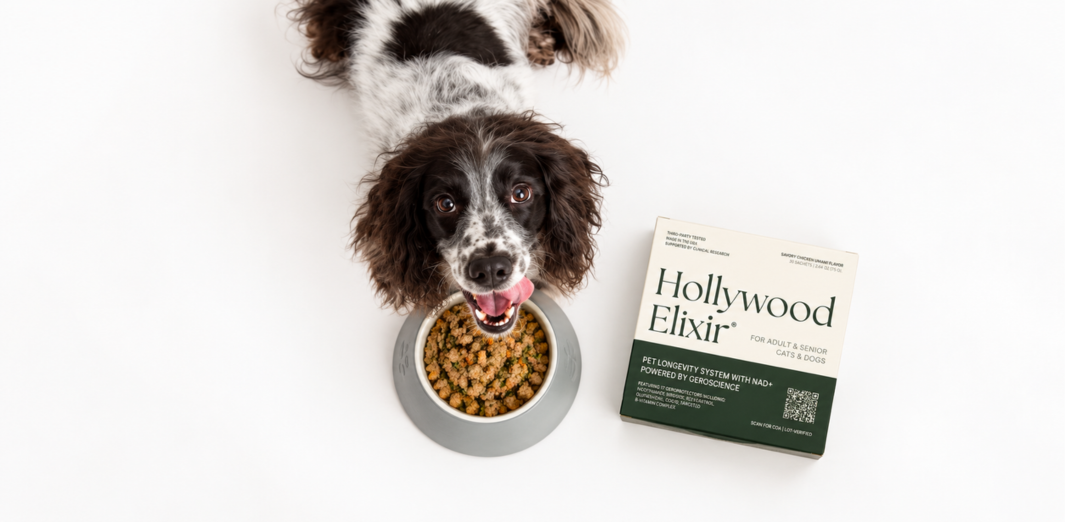
Overhead view of a black-and-white dog beside a food bowl and Hollywood Elixir box

The Brain Study Was About a Statin

CoQ10 also appears in discussions of canine cognition. One often-cited experiment studied older beagles given atorvastatin, a cholesterol-lowering drug. Blood CoQ10 fell, while concentrations in the sampled brain region did not differ significantly between treated dogs and controls. Lower brain CoQ10 was associated with poorer performance on a learning task. 6

The researchers did not give the dogs CoQ10 to test memory improvement. The work makes the brain’s CoQ10 biology interesting; it cannot support a claim that a CoQ10 powder prevents canine dementia. It also does not provide a normal age-by-age chart of canine CoQ10 decline.

Woman smiling beside a golden retriever, a green food bowl and a Hollywood Elixir box

Why CoQ10 and NAD+ Belong in the Same Explanation

NAD+ and CoQ10 are connected by an actual chemical handoff. As cells break down nutrients, NAD+ accepts electrons and becomes NADH. In mitochondria, those electrons pass through a protein complex to CoQ10, which carries them onward. 1

Nicotinamide riboside, or NR, enters the picture earlier. Cells can use NR to make NAD+, so NR and CoQ10 supply different kinds of ingredients: a starting material for one coenzyme and another coenzyme used farther along the energy pathway. 11

This is why an NAD-oriented formula can sensibly contain CoQ10. Our NAD+ guide for dogs follows the broader system; the NR guide examines the precursor itself.

Man holding a Hollywood Elixir box while sitting on an outdoor sofa with a golden retriever

Energy Production Also Needs Antioxidant Defenses

Cells produce reactive oxygen molecules during ordinary metabolism. Some carry signals; excess reactivity can damage cellular components. The body uses several defenses to keep that chemistry manageable.

Glutathione has a particular job in this system. An enzyme uses reduced glutathione to convert hydrogen peroxide into water, leaving glutathione in an oxidized form. Another enzyme recycles it using NADPH. 12 13

NADPH is related to, but distinct from, the NADH used in mitochondrial electron transfer. That distinction helps explain why CoQ10 and glutathione can be complementary ingredients without being interchangeable. One contributes to energy transfer; the other participates in peroxide defense and recycling. The glutathione guide for dogs explores that antioxidant chemistry more closely.

Where Hollywood Elixir Fits

Hollywood Elixir brings this energy-and-defense rationale into a daily powder. Each standard 2.5 g sachet contains 40 mg CoQ10, 60 mg NR and 50 mg glutathione. The detailed ingredient list specifies ubidecarenone for CoQ10 and reduced L-glutathione. 10

For someone considering broader healthy-aging support, the appeal is the combination’s purpose. NR provides material for NAD+ synthesis; CoQ10 belongs in the electron-transfer process; glutathione belongs in antioxidant defense. The formula brings those distinct jobs together, with other ingredients such as vitamin E and astaxanthin, rather than asking CoQ10 to account for every aspect of aging.

That makes Hollywood Elixir’s complete ingredient list worth exploring when cellular energy and antioxidant nutrition are your priorities. The cited dog trials did not test the finished formula or establish that its ingredients work better together.

Ubiquinone and ubiquinol are two forms of CoQ10’s working cycle.

Woman sitting with a beagle in a kitchen while holding a Hollywood Elixir box

DVM Voice: Clinical Vignette of a Common Pattern in Senior Dog Aging

Case provided by JoAnna Pendergrass, DVM

Rex, a 7-year-old Labrador Retriever, was brought in after his owner noticed he was slower to rise, hesitant on stairs, and less able to play as before. Examination showed stiffness and reduced hip mobility; radiographs confirmed degenerative joint changes.

His care required weight management, veterinary-guided pain control, nutritional support, and rehabilitation — a comprehensive plan, but one started only after visible decline appeared.

Clinical takeaway: Rex’s case reflects the value of proactive aging support: maintaining lean body condition, monitoring mobility early, and supporting cellular resilience, antioxidant defense, and healthy inflammatory balance before decline becomes obvious.

Single-case vignette. Not generalizable. Veterinary oversight is essential for pain, stiffness, or suspected joint disease.

Explore Hollywood Elixir Research →
Spotted gray dog beside a Hollywood Elixir box held in a person's hand

CoQ10 Dosage for Dogs: What the Numbers Actually Mean

There is no single dose established by these studies for every dog and every purpose. A cardiac research team selected 200 mg a day to reach a blood-concentration target. Hollywood Elixir lists 40 mg in a standard sachet as part of a multi-ingredient formula. Those are different uses and different preparations. 3 10

For a diagnosed heart condition, ask the veterinarian to specify the exact preparation, amount and schedule they want. For a daily pet formula, use its current directions for your dog and account for products already being given. Do not multiply sachets to reproduce a single-ingredient research dose: that would also multiply every companion ingredient.

A dose printed in a forum cannot resolve those differences.

Golden retriever nuzzling a man holding a Hollywood Elixir box beside a food bowl

Choosing a Formulation You Can Evaluate

CoQ10 is fat-soluble, which makes its delivery an important part of the product. Yet “oil” does not automatically mean better absorption. A beagle crossover study found similarly slow, limited absorption from the particular oil-based and powder-filled products it compared. 5

Look for the full ingredient form and amount, the serving instructions and any absorption evidence for the actual preparation. A study of a different capsule does not validate a powder’s performance. Our antioxidant supplement checklist also covers disclosed amounts and batch documentation. The pet supplement claims decoder explains the difference between an ingredient study and a finished-product claim.

Then consider use at home. A capsule the dog repeatedly spits out and a powder left in the bowl both create the same practical problem: the intended serving was not eaten.

Golden spaniel eating from a green bowl beside a Hollywood Elixir box

Can Dogs Take a Human CoQ10 Supplement?

A human product is not automatically suitable because its main ingredient is CoQ10. The strength, other actives, sweeteners and delivery format all matter. Show the complete label to your veterinarian before sharing a product from your own cupboard.

Xylitol is a specific concern. This sweetener can appear in human supplements and may also be called birch sugar or wood sugar. It can cause dangerous low blood sugar in dogs. If your dog may have eaten it, contact your veterinarian, an emergency clinic or animal poison control immediately. 9

For any accidental excess, keep the packaging and estimate the amount and time of ingestion. Those details help a professional assess the actual exposure. 7

Side Effects and Heart-Medication Precautions

Published dog trials generally found their CoQ10 preparations tolerable over the periods studied. That is reassuring, but it does not guarantee tolerance of every blend. In the three-month trial, short-lived diarrhea occurred in both the CoQ10 and placebo groups. 4

Medication review is particularly relevant for dogs receiving blood-pressure drugs or blood thinners such as warfarin. Pregnancy, nursing, debilitation and known ingredient allergies also warrant specific guidance before use. 7

If a new product is followed by vomiting, diarrhea, reduced appetite or another concerning change, stop it and contact your veterinarian with the label. A change in breathing or collapse needs urgent assessment; it should never be treated as a supplement adjustment.

A Healthy-Aging Purchase and a Cardiac Plan Have Different Goals

For a dog already under cardiac care, a CoQ10 choice belongs inside that treatment plan. A veterinarian may prefer a particular single-ingredient preparation; replacing it with a broader formula changes both the amount and the other ingredients being given.

For an adult dog who is doing well, the choice can instead be about daily nutritional support for the processes explained here. Hollywood Elixir has a coherent place in that decision because it combines an NAD+ precursor, CoQ10 and antioxidant ingredients. It does not require calling a healthy dog deficient.

If you are comparing several kinds of support, the senior-dog supplement label scorecard can help you list ingredients and avoid unnoticed overlap. Keep the purpose of each product visible.

Woman holding a Hollywood Elixir box beside a dapple dachshund and green food bowl on a sofa

Making the Daily Serving Work at Mealtime

Use the directions for the actual product, including how it should be given with food. For a food-mixed powder, check that the dog eats the portion containing it; an untouched half-bowl makes the amount taken uncertain. Follow the agreed schedule instead of adding an extra serving to compensate by guesswork.

Keep one list of the food, supplements and medicines your dog receives. Hollywood Elixir contains whey protein isolate and chicken ingredients as well as its listed actives, which matters when the dog has food sensitivities or follows a restricted diet. 10

Bring that list to routine senior veterinary appointments. It is easier to assess a formula when the whole routine is in view.

Woman cuddling a brown-and-white spaniel while holding a Hollywood Elixir box

How Long Until You Notice a Difference?

Blood concentrations changed within the short canine trials, but an owner could not see those measurements from the other end of a lead. No study reviewed here supplies a dependable timetable for visible benefits from a daily CoQ10 blend.

If your dog has a concern you are tracking, choose an ordinary observation and a review date with your veterinarian. Record comfortable activity, appetite and any changes in treatment or food. Keep exercise suited to the senior dog; a longer or harder walk is not a test the supplement needs to pass.

For a dog already doing well, the review may simply concern tolerance, nutritional fit and whether the routine remains worthwhile. A good month alone cannot show that a product has slowed aging.

A Clearer Reason to Choose CoQ10

CoQ10 earns attention because of what it does inside cells: carrying electrons in energy production and participating in antioxidant chemistry. Canine studies show that oral preparations can reach the bloodstream and offer some findings worth following, particularly in cardiac research.

If your aim is a daily formula that connects cellular energy with antioxidant nutrition, explore Hollywood Elixir. Its CoQ10, NR and reduced glutathione have distinct, understandable reasons to be together.

If the search began with a new murmur, difficulty breathing or a sudden change in activity, take that observation to the veterinary team first. The most useful next step depends on the dog in front of you, as well as the ingredient on the label.

NR, CoQ10 and glutathione have different jobs in cellular energy and antioxidant defense.

Educational content only. This material is not a substitute for veterinary advice. Always consult your veterinarian about your dog’s specific needs. These statements have not been evaluated by the Food and Drug Administration. Products mentioned are not intended to diagnose, treat, cure, or prevent any disease.

Glossary

CoQ10: Coenzyme Q10, a molecule involved in mitochondrial electron transfer and antioxidant chemistry.

ATP: Adenosine triphosphate, a molecule that supplies energy for much of a cell’s work.

Mitochondria: Cell structures where many reactions that make ATP occur.

Ubiquinone: The oxidized form of CoQ10, which accepts electrons.

Ubiquinol: The reduced form of CoQ10, formed after it accepts electrons.

NAD+/NADH: Related forms of a coenzyme used to accept and pass on electrons in metabolism.

NR: Nicotinamide riboside, a precursor cells can use to make NAD+.

Glutathione: A molecule used in cellular antioxidant defenses, including peroxide breakdown.

NADPH: An electron donor used in glutathione recycling; distinct from NADH.

MMVD: Myxomatous mitral valve disease, in which a heart valve degenerates and allows blood to leak backward.

Plasma: The liquid component of blood in which CoQ10 was measured in the trials.

Related Reading

References

Numbered references identify the sources used for specific claims. Read the study design, species and evidence boundaries alongside each finding.

  1. Reactome. Complex I oxidises NADH to NAD+, reduces CoQ to CoQH2. Accessed 2026Species/context: Conserved cellular pathway; human curated record with canine orthologueEvidence boundary: This pathway describes normal electron transfer in mitochondria. It explains the relationship between NADH and CoQ10, rather than the effects of taking a supplement.↩ 1 · ↩ 2 · ↩ 3 · ↩ 4
  2. Liselotte B. Christiansen, Malene K. Morsing, Maria Josefine Reimann, Torben Martinussen, Zita Birlie, Anne Marie V. Schou-Pedersen, Jens Lykkesfeldt, Lisbeth H. Olsen. Pharmacokinetics of Repeated Oral Dosing with Coenzyme Q10 in Cavalier King Charles Spaniels with Myxomatous Mitral Valve Disease. 2020Species/context: DogsEvidence boundary: This short crossover trial tested a solubilized ubiquinone preparation in Cavaliers with mitral valve disease. Higher blood concentrations did not produce a measurable improvement in disease severity or owner-rated quality of life.↩ 1 · ↩ 2 · ↩ 3 · ↩ 4
  3. Natalia Druzhaeva, Aleksandra Domanjko Petrič, Gabrijela Tavčar-Kalcher, Janja Babič, Alenka Nemec Svete. Randomized, double-blinded, controlled trial of the effects of coenzyme Q10 supplementation on plasma coenzyme Q10 concentration in dogs with myxomatous mitral valve disease. 2021Species/context: DogsEvidence boundary: This two-week dose study measured CoQ10 in blood. Its research doses were chosen for an absorption target in dogs with heart failure, not as a universal serving recommendation.↩ 1 · ↩ 2
  4. Natalia Druzhaeva, Alenka Nemec Svete, Gabrijela Tavčar-Kalcher, Janja Babič, Alojz Ihan, Katka Pohar, Uroš Krapež, Aleksandra Domanjko Petrič. Effects of Coenzyme Q10 Supplementation on Oxidative Stress Markers, Inflammatory Markers, Lymphocyte Subpopulations, and Clinical Status in Dogs with Myxomatous Mitral Valve Disease. 2022Species/context: DogsEvidence boundary: The three-month trial found changes in selected white-cell measures in dogs with heart failure. It did not establish improved cardiac disease severity, and all affected dogs continued appropriate heart treatment.↩ 1 · ↩ 2
  5. T. R. Kommuru, M. Ashraf, M. A. Khan, I. K. Reddy. Stability and bioequivalence studies of two marketed formulations of coenzyme Q10 in beagle dogs. 1999Species/context: DogsEvidence boundary: The two preparations had similarly slow, limited absorption. This comparison does not establish that every oil preparation outperforms every powder.↩
  6. Sarah B. Martin, Giovanna Cenini, Eugenio Barone, Amy L. S. Dowling, Cesare Mancuso, D. Allan Butterfield, M. Paul Murphy, Elizabeth Head. Coenzyme Q10 and cognition in atorvastatin treated dogs. 2011Species/context: DogsEvidence boundary: Researchers gave older beagles atorvastatin and measured CoQ10 and cognition. They did not test whether a CoQ10 supplement improves memory or prevents dementia.↩
  7. Alison Hamilton, Rania Gollakner. Coenzyme Q-10. 2025Species/context: Dogs and catsEvidence boundary: Veterinary guidance covers administration, sensitivity and medication precautions. Individual tolerability and interactions still depend on the complete product and the animal’s medical history.↩ 1 · ↩ 2
  8. Cornell University College of Veterinary Medicine. Get a jump on heart murmurs. Accessed 2026Species/context: DogsEvidence boundary: This clinical explanation concerns finding and monitoring heart disease. A murmur or a change in exercise tolerance cannot diagnose a CoQ10 deficiency.↩
  9. U.S. Food and Drug Administration. Paws Off Xylitol; It’s Dangerous for Dogs. Accessed 2026Species/context: DogsEvidence boundary: Some human supplements contain xylitol. Suspected ingestion warrants prompt professional help; this warning concerns the complete product, not CoQ10 itself.↩
  10. La Petite Labs. Hollywood Elixir official ingredient panel. 2026Species/context: Dogs and catsEvidence boundary: The label establishes the amounts in a standard 2.5 g sachet. It does not make the finished formula equivalent to the CoQ10 preparations or doses used in heart-disease trials.↩ 1 · ↩ 2 · ↩ 3
  11. Rachel S. Fletcher, Joanna Ratajczak, Craig L. Doig, Lucy A. Oakey, Rebecca Callingham, Gabriella Da Silva Xavier, Antje Garten, Yasir S. Elhassan, Philip Redpath, Marie E. Migaud, Andrew Philp, Charles Brenner, Carles Canto, Gareth G. Lavery. Nicotinamide riboside kinases display redundancy in mediating nicotinamide mononucleotide and nicotinamide riboside metabolism in skeletal muscle cells. 2017Species/context: Mouse skeletal-muscle cells and miceEvidence boundary: This work traces NR metabolism into NAD+. It supports the precursor explanation, rather than a clinical claim about an NR and CoQ10 combination in dogs.↩
  12. Reactome. Detoxification of Reactive Oxygen Species. Accessed 2026Species/context: Conserved cellular pathways; human curated recordEvidence boundary: The pathway explains how cellular antioxidant enzymes handle reactive molecules. It does not show that a particular oral formula strengthens those defenses in dogs.↩
  13. Reactome. GSR catalyzes glutathione (oxidized) + NADPH + H+ => 2 glutathione (reduced) + NADP+. Accessed 2026Species/context: Conserved cellular pathway; human curated record with canine orthologueEvidence boundary: Glutathione reductase uses NADPH to recycle glutathione. NADPH and the NADH used in mitochondrial electron transfer are related but distinct molecules.↩

FAQ

What is CoQ10, and why do dogs naturally have it?

Coenzyme Q10 carries electrons within mitochondria, helping cells make ATP from energy supplied by nutrients. It also participates in antioxidant defense. These are normal biological functions, which explain interest in supplementation without proving that every dog needs extra CoQ10.

Which CoQ10 benefits for dogs matter most in daily life?

The strongest consistent finding in the studies discussed here is increased blood CoQ10 after certain oral preparations. One three-month heart-disease trial found changes in selected inflammatory blood measures. Reliable improvements in stamina, recovery or everyday quality of life have not been established, so those should not be promised as routine effects.

How does CoQ10 work inside a dog’s body?

CoQ10 accepts and transfers electrons in the mitochondrial energy pathway. It cycles between ubiquinone and ubiquinol as it works. This is related to NAD+/NADH metabolism: NADH passes electrons through a protein complex to CoQ10. NR is a precursor for making NAD+, rather than another name for CoQ10.

Are there dogs who should avoid CoQ10 supplements?

Do not give a product containing an ingredient your dog is allergic to. Get individual guidance for pregnancy, nursing, debilitation, chronic illness or a complex medication plan. Tolerance depends on the complete formula; stop a new supplement and contact your veterinarian if concerning changes occur.

What is a reasonable CoQ10 dosage for dogs to discuss?

The canine studies do not establish one dose for all dogs. Some heart-disease trials used 200 mg daily of a particular preparation, while a daily combination formula may contain a different amount. Ask your veterinarian about the exact product and purpose, and follow the current directions agreed for your dog.

Can CoQ10 interact with my dog’s heart medications?

Medication review is especially relevant with blood-pressure drugs and blood thinners such as warfarin. Bring the complete supplement label and medication list to your veterinarian. Do not reduce, replace or change prescribed cardiac treatment because you have added CoQ10.

How quickly might I notice changes after starting CoQ10?

A rise in blood CoQ10 can occur during a short supplementation study, but that is not a visible result at home. The reviewed research does not provide a dependable timetable for improved energy or stamina. Agree on the reason for use and a review date rather than expecting a change within a set number of weeks.

Do CoQ10 supplements for dogs replace prescription heart treatment?

No. The heart-disease trials evaluated CoQ10 alongside appropriate treatment. A higher blood concentration does not mean a leaky valve has been repaired. Keep prescribed medicines and cardiac monitoring in place, and discuss whether a particular CoQ10 preparation belongs in the plan.

Dalmatian looking toward a Hollywood Elixir box held in a person's hand

Discover LPL-01: How This Fits Into a Larger Canine Longevity System

Aging in dogs is not driven by a single pathway. It’s the result of interacting biological systems—energy metabolism, oxidative stress, immune signaling, and structural integrity—changing over time.

This article explores one piece of that puzzle. If you want to understand how these pieces connect—and what actually moves the needle—you need to zoom out.

Start with the underlying science:

Keep exploring

What would you like to understand next?

Search practical guides about healthy aging, cellular energy, ingredients, and daily support for dogs.