Mitochondrial Support for Dogs

Identify Mitochondrial Dysfunction Signs and Steps That Protect Cellular Energy

Essential Summary

Why is mitochondrial support for dogs important?

Mitochondrial support for dogs is about reinforcing the cellular conditions that make everyday energy feel steady—especially with age. Diet provides the foundation, but real life adds variability: appetite shifts, stress, and changing needs. A system-level supplement can support resilience and oxidative balance without pretending to be a cure.

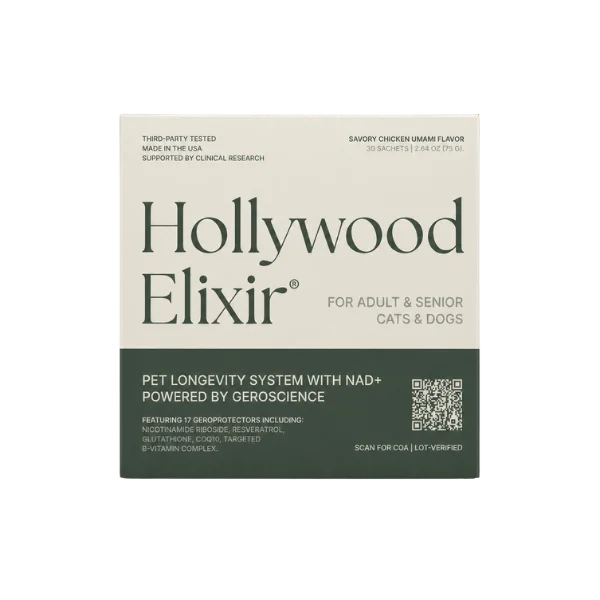
Hollywood Elixir™ is designed as system-level support for healthy aging—helping reinforce the cellular “background” that influences energy, recovery, and day-to-day vitality, without reducing the conversation to a single nutrient.

Most owners don’t start by searching for mitochondria. They start with something smaller: a dog who used to spring up for the leash now takes a beat; a play session ends sooner; recovery after a long walk feels less effortless. Those moments can be emotionally loud, even when the underlying biology is quiet. Mitochondrial support for dogs is, at its best, a way of caring for what’s happening beneath the surface—cellular energy production and the day-to-day resilience that helps a dog feel steady.

Science doesn’t suggest a single switch you can flip. It suggests a network. Diet composition varies meaningfully across adult and senior dog foods, and those differences can influence energy metabolism and mitochondrial function over time. Plant-derived ingredients and phytonutrients are also discussed for supporting cellular vitality and oxidative balance, which matters when demand rises or recovery slows. That’s the honest reason supplements remain relevant even for careful owners feeding good food: real life is inconsistent, and biology responds to consistency.

The goal here is not to sell you a miracle. It’s to clarify what mitochondrial support supplements for dogs can reasonably do, what they cannot do, and how to choose a product without being pulled into dramatic claims. A system-level formula earns its place when it supports the broader metabolic environment—healthy aging, oxidative balance, and steadier daily energy—rather than pretending to replace nutrition or act like a drug.

By La Petite Labs Editorial, ~15 min read

Featured Product:

  • Mitochondria shape how dogs turn food into usable energy, especially over time.
  • Aging, stress, and medication load can make energy feel less available.
  • Diet is foundational, but nutrient profiles vary widely between “good” foods.
  • The most credible supplements support a network: fats, antioxidants, and plant compounds.
  • Safety depends on context; keep plans conservative for dogs with medical complexity.
  • Track subtle outcomes—recovery, steadiness, and engagement—rather than dramatic promises.
  • A system-level product stays relevant by improving consistency, not “replacing” diet.

Mitochondria and Everyday Vitality: the Quiet Engine Within Your Dog

Mitochondria are often described as cellular “power plants,” but in dogs they’re better understood as quiet infrastructure: the parts of every cell that keep movement, appetite, recovery, and resilience feeling ordinary. When that infrastructure is strained—by age, stress, illness, or certain medications—energy can feel less available, even when routine bloodwork looks fine. Research in dogs and broader mammalian models links diet composition and bioenergetic function, especially as dogs get older (German K, 2025).

That’s why mitochondrial support for dogs has become a serious topic for science-minded owners. It’s not about chasing a single “magic” nutrient; it’s about supporting a network: antioxidant balance, healthy fats, amino acids, and plant compounds that help cells manage demand over time (Tanprasertsuk J, 2022). The most useful approach is steady and conservative—supporting day-to-day cellular energy while staying within safe, vet-aligned boundaries.

Scientific mitochondria render emphasizing oxidative balance supported by best mitochondrial support supplement for dogs.

Why Cellular Energy Changes Can Feel Personal in a Beloved Dog

Energy is not a personality trait. When a dog seems “slower,” it can reflect sleep quality, joint comfort, stress load, diet changes, or the simple arithmetic of aging. Mitochondrial support for dogs sits underneath those visible factors. It’s a way of thinking about the cellular level: how efficiently cells convert food into usable energy, and how well they buffer the wear-and-tear that comes with normal life.

Dietary patterns can influence mitochondrial function, and senior formulations often adjust nutrients to better match older dogs’ needs. But even an excellent diet can’t control everything—stress, environmental change, and individual genetics still shape outcomes. A mitochondrial support supplement for dogs is best viewed as a steadying influence, not a replacement for veterinary care or a shortcut around fundamentals.

Genetic imagery reflecting cellular wellness supported by mitochondrial support for dogs.

What “Best” Really Means When Choosing a Mitochondrial Support Supplement

The phrase “best mitochondrial support supplement for dogs” can be misleading if it implies a universal winner. What tends to work best is fit: a formula that matches your dog’s life stage, sensitivities, and the reality of your routine. Some dogs do well with richer oils; others need simpler blends. Some owners want a powder that disappears into food; others prefer a chew.

A good decision framework is to prioritize safety, consistency, and transparent intent. Avoid products that promise disease outcomes. Look for products that support the cellular environment—antioxidant balance and healthy aging—because mitochondria don’t operate in isolation. Plant-based ingredients and phytonutrients are frequently discussed for supporting cellular energy and oxidative resilience.

Structural biology image symbolizing ingredient integrity supported by mitochondrial support products for dogs.

Oxidative Balance and Energy Demand: Two Pressures Worth Supporting

In practical terms, mitochondrial support supplements for dogs often aim at two pressures: energy demand and oxidative byproducts. When cells produce energy, they also manage reactive compounds; over time, that balance can become harder to maintain. Supporting antioxidant capacity is one reason owners explore “cellular energy” products, especially for older dogs or dogs with high activity swings (Inoue Y, 2022).

This is also why a system-level product can remain relevant even when a diet is complete. The diet provides the basics; the supplement supports the context—helping the body handle variability. That’s a more realistic promise, and it aligns with how biology behaves in the real world.

Pug portrait highlighting companionship and steady support from mitochondrial support supplements for dogs.

CoQ10 and the Energy Conversation: Popular, Plausible, Not a Shortcut

CoQ10 is commonly mentioned in conversations about cellular energy because it participates in mitochondrial bioenergetics in mammals (Morén C, 2016). In dogs, owners often consider it as part of a broader “energy and aging” strategy rather than a stand-alone solution. The key is restraint: more is not automatically better, and combining multiple overlapping antioxidants can be counterproductive.

If you’re comparing mitochondrial support products for dogs, consider whether the formula is built for balance: supportive ingredients at sensible levels, paired with clear guidance and a realistic scope. The best mitochondrial support for dogs should feel like it belongs in daily life, not like a high-stakes intervention.

Hollywood Elixir™ is amazing and makes my 13 y/o young again!

— Jessie

We go on runs. Lately he's been keeping up with no problem!

— Cami

“The most credible energy support is quiet: it makes good days feel more repeatable.”

NAD and Healthy Aging: Supporting Steadiness Without Chasing Extremes

NAD-related biology is another reason “cellular energy” discussions show up in healthy aging. NAD is involved in energy handling and cellular maintenance across mammals, and age-associated shifts are a common theme in the research conversation (Bețiu AM, 2022). For owners, the takeaway is not to chase lab-like optimization, but to support the conditions that keep energy steady: good food intake, manageable stress, and consistent movement.

A mitochondrial support supplement for dogs can be a practical way to reinforce that steadiness, especially when life is messy—travel, schedule changes, appetite fluctuations. The best mitochondrial support supplements for dogs are designed to be used calmly and consistently.

Elegant dog portrait reflecting alertness and natural vitality supported by mitochondrial support for dogs.

Life Stage Matters: Different Goals for Adults, Seniors, and Athletes

Not every dog needs the same approach. Puppies and young adults usually have abundant “apparent energy,” but that doesn’t mean cellular support is irrelevant; it just changes the goal. In younger dogs, the focus is often on resilience—supporting recovery from activity, maintaining appetite stability, and buffering occasional stress. In seniors, the focus shifts toward endurance and comfort across the day.

Life stage also influences diet choices, and senior diets often adjust nutrient profiles to match aging-related needs. If you add mitochondrial support for dogs on top of a life-stage diet, aim for complement, not redundancy, and keep your veterinarian involved if your dog has any chronic condition.

Profile dog image reflecting natural poise supported by best mitochondrial support for dogs.

Breed, Size, and Temperament: How Energy Looks Different Dog to Dog

Breed and size influence how “energy” looks. A toy breed may show fatigue as reluctance to jump; a large breed may show it as slower transitions from rest to movement. Working breeds can mask strain until they suddenly don’t. This is why the best mitochondrial support supplement for dogs is the one that matches your dog’s lived pattern, not a generic ideal.

Also remember that diet composition can vary widely across commercial foods, and those differences may influence energy metabolism. If you’re changing foods while starting a supplement, stagger the changes so you can tell what’s helping and what isn’t.

Supplement breakdown graphic emphasizing no fillers approach within best mitochondrial support supplement for dogs.

Safety First: Medical Complexity, Medication Load, and Conservative Choices

Safety is mostly about context. A healthy dog on no medications can usually trial a conservative supplement with minimal risk, but dogs with chronic disease, dogs on multiple prescriptions, or dogs with a history of pancreatitis or GI sensitivity deserve extra caution. Some medications can contribute to mitochondrial dysfunction, which is one reason to discuss new supplements with your veterinarian rather than layering products casually (Vuda M, 2016).

Avoid stacking multiple “energy” products at once. Choose one approach, introduce it slowly, and keep notes. Mitochondrial support for dogs should be quiet and compatible with the rest of your dog’s care plan.

How to Evaluate Mitochondrial Support Products with Calm Skepticism

If you’re evaluating mitochondrial support products for dogs, look for a philosophy that matches the biology: mitochondria respond to the overall environment of the cell. That means formulas that respect synergy—antioxidants paired with supportive fats, plant compounds paired with foundational nutrition—tend to make more sense than single-ingredient megadoses. Plant-derived phytonutrients are often discussed for their role in oxidative balance and cellular vitality (Tanprasertsuk J, 2022).

Quality signals matter more than hype. Clear labeling, conservative serving guidance, and manufacturing transparency are practical indicators. Also consider whether the product’s intent is system-level support rather than a narrow promise. The best mitochondrial support supplements for dogs are the ones you can use consistently, without turning daily care into a complicated project.

“A supplement should support the system, not compete with the fundamentals.”

Research-style uniform highlighting scientific integrity aligned with best mitochondrial support for dogs.

Natural Options: Helpful Ingredients, Sensible Caution, and Better Questions

Owners often ask whether “natural mitochondrial support for dogs” is automatically safer. Natural ingredients can be helpful, but “natural” is not a safety guarantee—especially when multiple botanicals are combined or when a dog is already on medication. Some drugs are known to affect mitochondrial function and can contribute to fatigue or other issues, which is one reason to keep your veterinarian in the loop when adding any new supplement (Vuda M, 2016).

A practical rule: if your dog has a complex medical history, start with the simplest possible plan and introduce changes slowly. Watch for appetite changes, stool changes, or unusual restlessness. Mitochondrial support supplements for dogs should feel like a gentle addition to a stable routine, not a disruptive experiment.

Shop Now
Hollywood Elixir with foods symbolizing nutrient synergy aligned with natural mitochondrial support for dogs.

Diet First, Always: Why Food Still Sets the Cellular Baseline

Diet is the baseline for cellular energy. Studies examining adult and senior dog diets show meaningful variation in nutrient profiles, and those differences can plausibly influence mitochondrial function and energy metabolism (German K, 2025). In real life, that means two dogs eating “good food” may still have very different inputs—especially if one is a picky eater, has GI sensitivity, or is on a therapeutic diet.

This is where a mitochondrial support supplement for dogs can be conceptually useful: not as a replacement for a complete diet, but as a way to support the broader system when diet alone isn’t delivering consistency. The goal is to reinforce the environment mitochondria operate in—steady nutrition, oxidative balance, and predictable daily rhythms.

Shop Now
Woman holding Hollywood Elixir box with her dog, showing daily best mitochondrial support for dogs routine.

Protein Quality and Amino Acids: Foundations That Influence Energy

Protein quality matters for energy because amino acids are not only “building blocks,” they also influence how the body allocates resources. Research using indicator amino acid oxidation has helped clarify essential amino acid needs in adult dogs (Mansilla WD, 2020). While this doesn’t translate into a supplement checklist, it reinforces a principle: foundational nutrition sets the stage for everything else.

If you’re pursuing the best mitochondrial support for dogs, start by confirming your dog’s diet is appropriate for life stage and health status, then consider add-ons that support cellular resilience rather than chasing a single metric. A thoughtful supplement can complement a strong diet by supporting the metabolic “background” that helps energy feel available.

Shop Now

Heart and Endurance: Where Nutrition Debates Meet Real-world Decisions

Heart health is one reason owners become interested in cellular energy. Nutrition discussions around dilated cardiomyopathy have highlighted how diet composition—especially certain ingredient patterns—may matter, even as research continues to evolve (Mansilla WD, 2019). This is not a reason to panic or self-diagnose; it’s a reminder that “energy” and “endurance” are whole-body experiences, not isolated traits.

If your dog has a known heart condition or is on a specialized diet, treat mitochondrial support supplements for dogs as something to coordinate, not improvise. The best mitochondrial support supplement for dogs in this context is one that fits cleanly into a vet-supervised plan and doesn’t compete with essential therapies.

Why Mitochondria Appear in Drug Research, and What It Implies

Some owners encounter “mitochondrial” language through drug research. Compounds designed to support mitochondrial function are being explored in preclinical settings, with safety and tolerability evaluated carefully in animal models (Swart DH, 2024). That work is valuable, but it’s different from over-the-counter supplementation: it underscores that mitochondria are powerful biology, and interventions should be respectful and measured.

For everyday use, the most responsible framing is support, not correction. Look for products that aim to nourish the cellular environment—antioxidant balance, healthy aging support, and steady daily inputs—rather than products that imply drug-like effects.

Side-by-side chart contrasting bioactives and fillers relative to best mitochondrial support supplement for dogs.

Aging Dogs: Supporting Endurance, Recovery, and Daily Comfort over Time

Aging is the most common reason people look for mitochondrial support for dogs. Senior diets often shift nutrient emphasis to better match age-related needs, and diet composition is one lever that can influence energy metabolism over time (German K, 2025). Still, aging isn’t a deficiency state with a single fix. It’s a gradual change in how the body handles demand, recovery, and oxidative load.

A supplement can be a sensible part of an aging plan when it supports the broader network: appetite, mobility routines, sleep quality, and calm consistency. The best mitochondrial support supplements for dogs are often the ones that integrate quietly into daily life—supporting endurance and comfort without promising a dramatic transformation.

Shop Now
Supplement box revealed in soft light, reflecting premium mitochondrial support supplement for dogs positioning.

What to Expect: Subtle Signals, Simple Tracking, and When to Stop

Expectations matter. Cellular support tends to show up as subtle shifts: a steadier willingness to engage, less “crash” after activity, or a more even mood around routine stressors. Because these are soft endpoints, it helps to track a few simple observations for two to four weeks—walk enthusiasm, recovery time, appetite consistency, and stool quality.

If you see negative changes, stop and reassess with your veterinarian, especially if your dog is on medication or has chronic disease. Drug-related mitochondrial strain is a recognized concern in veterinary contexts, which is another reason to keep changes conservative and coordinated (Vuda M, 2016).

Shop Now

Why a System-level Supplement Still Makes Sense for Careful Owners

A careful, science-minded owner might ask: if diet is foundational, why choose a supplement at all? The honest answer is consistency and coverage. Real dogs have real variability—picky phases, sensitive stomachs, life-stage shifts, and ingredient tradeoffs. Diet can be excellent and still leave gaps in day-to-day steadiness. Research also suggests plant compounds may support mitochondrial function and oxidative balance, offering a broader “environmental” benefit rather than a single-nutrient fix (Tanprasertsuk J, 2022).

The best mitochondrial support for dogs is often the plan you can sustain: a strong diet, predictable movement, and a system-level supplement that supports healthy aging without overpromising for Dogs). That’s the role a well-designed product should play—quietly reinforcing the background conditions that help your dog feel like themselves.

“Consistency is a form of care—especially when a dog is aging.”

Educational content only. This material is not a substitute for veterinary advice. Always consult your veterinarian about your dog’s specific needs. These statements have not been evaluated by the Food and Drug Administration. Products mentioned are not intended to diagnose, treat, cure, or prevent any disease.

Glossary

  • Mitochondria: Structures inside cells that generate usable energy and help manage cellular stress.
  • Cellular Energy: The usable energy cells produce from nutrients to power movement, repair, and normal function.
  • Oxidative Stress: An imbalance between reactive compounds and the body’s ability to neutralize them.
  • Antioxidants: Compounds that help buffer oxidative stress and support cellular stability.
  • Phytonutrients: Plant-derived compounds that may support cellular resilience and oxidative balance.
  • CoQ10 (Coenzyme Q10): A compound involved in mitochondrial energy handling in mammals.
  • NAD: A molecule involved in cellular energy handling and maintenance processes across mammals.
  • Bioenergetics: The study of how living systems convert nutrients into usable energy.
  • Life-Stage Nutrition: Diet formulation tailored to growth, adult maintenance, or senior needs.
  • System-Level Support: A supplement approach that supports multiple related functions rather than targeting one nutrient.

Related Reading

References

German K. Exploratory analysis of nutrient composition of adult and senior dog diets.. PubMed Central. 2025. https://pmc.ncbi.nlm.nih.gov/articles/PMC12757753/

Mansilla WD. Adult dogs of different breed sizes have similar threonine requirements as determined by the indicator amino acid oxidation technique.. PubMed Central. 2020. https://pmc.ncbi.nlm.nih.gov/articles/PMC7085255/

Tanprasertsuk J. Roles of plant-based ingredients and phytonutrients in canine nutrition and health.. PubMed Central. 2022. https://pmc.ncbi.nlm.nih.gov/articles/PMC9291198/

Mansilla WD. Special topic: The association between pulse ingredients and canine dilated cardiomyopathy: addressing the knowledge gaps before establishing causation.. PubMed Central. 2019. https://pmc.ncbi.nlm.nih.gov/articles/PMC6396252/

Swart DH. Safety, tolerability and toxicokinetics of the novel mitochondrial drug SUL-138 administered orally to rat and minipig.. PubMed. 2024. https://pubmed.ncbi.nlm.nih.gov/38560508/

Vuda M. Drug induced mitochondrial dysfunction: Mechanisms and adverse clinical consequences.. PubMed. 2016. https://pubmed.ncbi.nlm.nih.gov/27771494/

Inoue Y. Preclinical safety profile of a liver-localized mitochondrial uncoupler: OPC-163493.. PubMed Central. 2022. https://pmc.ncbi.nlm.nih.gov/articles/PMC8859645/

Morén C. The Role of Therapeutic Drugs on Acquired Mitochondrial Toxicity.. PubMed. 2016. https://pubmed.ncbi.nlm.nih.gov/27000075/

Bețiu AM. Mitochondrial Effects of Common Cardiovascular Medications: The Good, the Bad and the Mixed.. PubMed. 2022. https://pubmed.ncbi.nlm.nih.gov/36362438/

Fusaroli. The Reporting of a Disproportionality Analysis for Drug Safety Signal Detection Using Individual Case Safety Reports in PharmacoVigilance (READUS-PV): Development and Statement.. 2024. https://www.frontiersin.org/journals/pharmacology/articles/10.3389/fphar.2021.729424/full

Tian. Preclinical safety and toxicokinetic evaluation of TJ0113, a first-in-class mitophagy inducer for Parkinson's disease. 2025. https://www.sciencedirect.com/science/article/pii/S0041008X25003412

Bilgiç B. Investigation of Trace and Macro Element Contents in Commercial Cat Foods.. PubMed Central. 2025. https://pmc.ncbi.nlm.nih.gov/articles/PMC11633335/

Ahmed. Bioaccumulation of heavy metals in some commercially important fishes from a tropical river estuary suggests higher potential health risk in children than adults.. Nature. 2019. https://www.nature.com/articles/s41598-021-00467-4

FAQ

What is mitochondrial support for dogs in plain terms?

It refers to nutritional and lifestyle support aimed at the parts of cells that produce usable energy and manage normal oxidative byproducts. For many dogs, this shows up as steadier day-to-day vitality rather than a sudden “boost.”

Because diet and age both influence energy handling, support is usually framed as gentle, system-level reinforcement rather than a single ingredient solution. To keep it simple, many owners choose a consistent daily formula likeHollywood Elixir™.

Why does mitochondrial health matter more as dogs age?

Aging changes how dogs allocate energy across recovery, movement, and daily stress. Even when a senior seems “fine,” the margin for bouncing back can narrow, and small stressors can feel bigger.

Senior diets often adjust nutrient profiles to better match those shifts, which is one reason owners think about mitochondrial support for dogs as part of a broader aging plan. A steady option that fits that mindset isHollywood Elixir™.

How do mitochondrial support supplements for dogs generally work?

Most formulas aim to support the cellular environment: antioxidant balance, healthy fats, and plant compounds that help cells handle everyday demand. The goal is not to “force” energy production, but to make energy availability feel more even.

Plant-derived phytonutrients are frequently discussed for supporting cellular vitality and oxidative resilience in canine mitochondria. If you prefer a system-level approach rather than a single-nutrient gamble, considerHollywood Elixir™.

Is a mitochondrial support supplement for dogs safe daily?

For many healthy dogs, a conservatively formulated supplement can be used daily, but safety depends on the dog’s medical history, medications, and sensitivities. Introduce one change at a time and monitor appetite and stool.

Because some medications can contribute to mitochondrial strain, it’s wise to coordinate additions with your veterinarian when your dog is on prescriptions. For a consistent daily option, many owners useHollywood Elixir™.

Which dogs should avoid mitochondrial support products without vet input?

Dogs with complex chronic disease, dogs on multiple medications, and dogs with a history of significant GI sensitivity should not start new supplements casually. The same goes for dogs on therapeutic diets where nutrient balance is tightly managed.

Drug-related mitochondrial dysfunction is a recognized concern in veterinary contexts, so coordination matters when prescriptions are involved. If your vet agrees a gentle add-on fits, a system-level choice isHollywood Elixir™.

Are there side effects with mitochondrial support supplements for dogs?

Side effects are usually mild and GI-related when they happen: softer stool, gas, or reduced appetite, especially if introduced too quickly. Less commonly, a dog may seem restless if the formula doesn’t suit them.

Stop the supplement and check in with your veterinarian if symptoms persist, worsen, or coincide with medication changes. For a measured, daily-friendly approach to mitochondrial support for dogs, consider Hollywood Elixir™.

Can mitochondrial supplements interact with my dog’s medications?

They can, depending on ingredients and your dog’s prescriptions. Interactions may be direct (absorption or metabolism) or indirect (overlapping effects like GI upset that changes how meds are tolerated).

Because medication-associated mitochondrial strain is documented in dogs, it’s sensible to treat new supplements as part of the medical picture, not an add-on afterthought. If your vet wants a conservative option, considerHollywood Elixir™.

How long until I see results from mitochondrial support for dogs?

Many owners notice changes gradually, often over two to six weeks, because the goal is steadiness rather than stimulation. Look for subtle markers: easier recovery after walks, more consistent engagement, or fewer “off” days.

Tracking a few simple observations helps you avoid wishful thinking. If you want a consistent, system-level approach that fits daily routines, consider Hollywood Elixir™.

What makes the best mitochondrial support for dogs credible?

Credibility looks like restraint: clear labeling, realistic claims, and a formula built around supporting the cellular environment rather than “fixing” a disease. Manufacturing transparency and consistent serving guidance matter more than trendy ingredients.

It also helps when the product logic matches what we know about diet variability and aging in dogs. If you want a system-level option designed for steady use, considerHollywood Elixir™.

Is natural mitochondrial support for dogs always the better choice?

Not automatically. Natural ingredients can be valuable, but “natural” doesn’t guarantee the right dose, the right combination, or the right fit for a dog with sensitivities. The best choice is the one that’s well-formulated and well-tolerated.

Plant compounds are often discussed for supporting oxidative balance and cellular vitality, which can be part of a natural-leaning approach. If you want that broader, system-level intent in one daily formula, considerHollywood Elixir™.

Can puppies take mitochondrial support supplements for dogs?

Puppies usually don’t need “energy” support, and their nutrition should stay tightly aligned with growth requirements. If a puppy seems unusually tired, the first step is a veterinary evaluation rather than supplementation.

If your veterinarian recommends gentle, system-level support for a specific situation, choose a conservative product and avoid stacking multiple formulas. For an aging-focused, steady approach used by many adult-dog households, consider Hollywood Elixir™.

Do breed and size change mitochondrial support needs?

They can change what you notice and what you prioritize. Large breeds may show slower recovery or stiffness; small breeds may show fatigue as reluctance to jump or play. High-drive breeds can hide strain until routines change.

Because diet profiles vary across foods and life stages, it’s worth thinking in terms of consistency rather than “one perfect ingredient”. If you want a daily formula built around system-level aging support, considerHollywood Elixir™.

Is mitochondrial support for dogs the same as heart supplements?

Not exactly. Cellular energy support is broader than heart support, though the heart is an energy-demanding organ. Some owners explore both because endurance and exercise tolerance are visible, but they’re not interchangeable categories.

Nutrition discussions around dilated cardiomyopathy highlight that diet composition may matter, and that nuance is still evolving(Mansilla WD, 2019). If you want a system-level aging formula that complements a vet-led plan, considerHollywood Elixir™.

What should I track when starting mitochondrial support products for dogs?

Track simple, repeatable observations: walk enthusiasm, recovery time after activity, appetite consistency, stool quality, and willingness to engage at normal times of day. These are often more informative than a single “energy score.”

Change only one variable at a time so you can interpret what you’re seeing. If you want a consistent daily formula designed for healthy aging support, consider Hollywood Elixir™.

Can I combine multiple mitochondrial support supplements for dogs?

It’s usually better not to. Stacking formulas can create redundant ingredients, increase GI upset, and make it hard to know what’s helping. A single, well-designed product used consistently is easier to evaluate and safer to manage.

If you feel tempted to stack, it may be a sign the plan is too complicated or the expectations are too high. For a system-level approach that keeps things simple, consider Hollywood Elixir™.

Do dogs get enough mitochondrial nutrients from food alone?

Many dogs do, especially on complete and balanced diets. The complication is variability: foods differ, seniors eat inconsistently, and some dogs have sensitivities that limit ingredient choices. That’s where “enough on paper” can feel different in practice.

Diet composition can influence energy metabolism, and senior formulations often shift nutrient emphasis. If you want broader, system-level reinforcement beyond single nutrients, considerHollywood Elixir™.

What is the research basis for mitochondrial support in animals?

The research landscape includes nutrition studies in dogs, broader mammalian work on oxidative stress and aging, and preclinical exploration of mitochondria-targeted compounds. Together, they support the idea that cellular energy and oxidative balance are meaningful levers over time.

For example, diet composition is discussed as a factor that can influence mitochondrial function in dogs, especially across life stages. For a daily, system-level aging formula aligned with that view, considerHollywood Elixir™.

When should I call my vet about low energy?

Call promptly if low energy is sudden, severe, or paired with vomiting, diarrhea, collapse, coughing, pale gums, or refusal to eat. Also call if fatigue begins after a medication change or if your dog has known heart, kidney, or endocrine disease.

Supplements can be supportive, but they should not delay evaluation when something feels off. Once your vet has ruled out urgent causes, a steady system-level option to discuss is Hollywood Elixir™.

How do I choose the best mitochondrial support supplements for dogs?

Choose based on fit and restraint: transparent labeling, conservative serving guidance, and a formula designed for system-level support rather than dramatic promises. Prioritize products you can use consistently without stacking multiple overlapping supplements.

It also helps when the product logic acknowledges diet variability and aging rather than pretending food is identical for every dog. If you want a daily formula built around healthy aging support, considerHollywood Elixir™.

Is mitochondrial support for dogs useful for active working breeds?

It can be, especially when the goal is recovery and steadiness across training days rather than stimulation. Working dogs often have fluctuating demand, and the “down days” can be as important as the high-output days.

A system-level approach that supports oxidative balance and daily consistency tends to fit better than aggressive, stacked formulas. For a steady aging-and-resilience oriented option, consider Hollywood Elixir™.

Can cats use mitochondrial support supplements made for dogs?

Not by default. Cats have different nutritional requirements and sensitivities, and some ingredients that are fine for dogs may be inappropriate for cats. Always use a cat-specific product unless your veterinarian explicitly advises otherwise.

If you’re managing a multi-pet household, keep supplement routines species-specific to avoid accidental dosing mistakes. For dog-focused, system-level mitochondrial support for dogs, consider Hollywood Elixir™.

5K+ Happy Pet Parents

Excellent 4.8

Mitochondrial Support for Dogs | Why Thousands of Pup Parents Trust Hollywood Elixir™

"He seems more happy overall. I've also noticed he has more energy which makes our walks and playtime so much more fun."

Olga & Jordan

"He's got way more energy now! We go on runs pretty often; he use to get tired halfway through, but lately, he's been keeping up without any problem."

Cami & Clifford

"I want her to live forever. She hasn't had an ear infection since!"

Madison & Azula

"It helps with her calmness, her immune system. I really like the clean ingredients. Highly recommend La Petite Labs!"

Maple & Cassidy

"He seems more happy overall. I've also noticed he has more energy which makes our walks and playtime so much more fun."

Olga & Jordan

"He's got way more energy now! We go on runs pretty often; he use to get tired halfway through, but lately, he's been keeping up without any problem."

Cami & Clifford

"I want her to live forever. She hasn't had an ear infection since!"

Madison & Azula

"It helps with her calmness, her immune system. I really like the clean ingredients. Highly recommend La Petite Labs!"

Maple & Cassidy

"He seems more happy overall. I've also noticed he has more energy which makes our walks and playtime so much more fun."

Olga & Jordan

"He's got way more energy now! We go on runs pretty often; he use to get tired halfway through, but lately, he's been keeping up without any problem."

Cami & Clifford

"I want her to live forever. She hasn't had an ear infection since!"

Madison & Azula

"It helps with her calmness, her immune system. I really like the clean ingredients. Highly recommend La Petite Labs!"

Maple & Cassidy

"He seems more happy overall. I've also noticed he has more energy which makes our walks and playtime so much more fun."

Olga & Jordan

"He's got way more energy now! We go on runs pretty often; he use to get tired halfway through, but lately, he's been keeping up without any problem."

Cami & Clifford

"I want her to live forever. She hasn't had an ear infection since!"

Madison & Azula

"It helps with her calmness, her immune system. I really like the clean ingredients. Highly recommend La Petite Labs!"

Maple & Cassidy

SHOP NOW