





Rapamycin for Dogs

What the trials found, what can go wrong, what it costs, and how it compares with Loyal's longevity drugs.

By La Petite Labs Editorial 8 min read

As Seen On

Woman hugging a golden retriever while holding a Hollywood Elixir box
Contents

No one knows yet whether rapamycin helps dogs live longer. Rapamycin, also called sirolimus, is a prescription drug used in human transplant patients. The Dog Aging Project's TRIAD trial is testing it in a planned 580 dogs, and there are no results yet. Small trials in healthy dogs found few side effects and mixed heart results. A vet can legally prescribe it off-label, but the researchers running TRIAD say they can't recommend it for aging outside their trial.

Here's what the studies found, what can go wrong, what it costs, and how it compares with LOY-002.

La Petite Labs publishes this guide and makes Hollywood Elixir, a dog supplement. We don't sell rapamycin, and we're not affiliated with Loyal or the Dog Aging Project.

Does rapamycin work for dogs?

It's unproven. No finished study has measured whether rapamycin extends a dog's life. The case for it comes from lab mice, where it does extend lifespan, and from a few small dog trials that were too short to measure lifespan.12

The dog results point in different directions. A 10-week trial of 24 dogs suggested better heart function, and a six-month trial of 17 dogs at a lower dose found no heart difference.34 TRIAD exists to settle the question.

Rapamycin for dogs at a glance

What it is
A prescription human drug that dampens mTOR, used off-label in dogs
Does it extend dogs' lives?
Unknown; no finished study has measured it
Biggest trial
TRIAD: a planned 580 dogs, weekly for a year, followed for at least three years
Side effects so far
Few in small, short trials; one case of severe high triglycerides
Research dose
0.15 mg/kg once a week in TRIAD, with screening and monitoring
Cost
About $40 to $245 for 30 tablets (GoodRx, 2025), plus exams and bloodwork
How to get it
Only through a vet's prescription

What the dog studies found

StudyDogsRegimenWhat it found
Urfer, 201724 healthy, middle-aged0.05 or 0.1 mg/kg, 3 times a week, 10 weeksNo more side effects than placebo; heart ultrasound suggested improvement
Barnett, 202317 healthy, aged 6 to 100.025 mg/kg, 3 times a week, 6 monthsNo heart difference; no clinically significant adverse events
LeBlanc, 2021324 with bone cancerAdded to amputation and chemotherapyNo improvement in time to spread or in survival
TRIAD, running580 planned, healthy, aged 7+0.15 mg/kg, once a week, 12 monthsMeasuring lifespan and health; no results yet

Competitor label and pricing facts checked November 6, 2026. Sources are listed in the References section below.

Woman holding a Hollywood Elixir box beside a pug, a terrier and a food bowl

Should I give my dog rapamycin?

Not on your own, and not without a vet who will monitor it. The Dog Aging Project says rapamycin's effect on dogs' health and aging is unknown, and it can't recommend using it for age-related decline outside its trial.5

Some vets do prescribe it, and that's legal. The honest trade-off is this: you'd be paying for a drug and its monitoring, accepting unknown long-term risks, for a benefit nobody has shown yet in dogs. That can still be a reasonable choice for some families, but it should be made with a vet and with the evidence in plain view.

Woman in sportswear holding a Hollywood Elixir box beside a black-and-tan dog outdoors

What are the side effects of rapamycin in dogs?

In small trials of healthy dogs, side effects were uncommon and about as frequent as in the placebo groups.234 Three findings are worth knowing:

  • High blood fats. An 8-year-old Labrador on low-dose rapamycin developed severe high triglycerides over six months with no outward signs. It cleared within 15 days of stopping.6 The dog looked fine, which is why bloodwork matters.
  • Smaller red blood cells. The 2017 trial saw lower mean cell volume in treated dogs, with values still in the normal range.3
  • Low platelets. A 2023 trial saw mild, short-lived low platelets at similar rates on rapamycin and placebo.2

In people on clinical doses, the common problems are mouth sores, stomach upset, high blood fats, slow wound healing and infection.2 The dog trials were short, so long-term risks in dogs aren't known.

Woman holding a Hollywood Elixir box above her forehead beside a Bernese mountain dog outdoors

What is rapamycin?

Rapamycin, or sirolimus, is a compound first found in soil bacteria from Easter Island, known locally as Rapa Nui.2 In people, the FDA has approved it for certain tumors and to help prevent organ-transplant rejection.1 At transplant doses it suppresses the immune system.

No rapamycin product is approved for dogs. One is conditionally approved for a heart condition in cats, Felycin-CA1, but it can't legally be used in dogs, as explained below.

Golden retriever nuzzling a woman holding a Hollywood Elixir box on the grass beside a food bowl

How could rapamycin slow aging?

Rapamycin dampens mTOR, a hub inside cells that senses nutrients and directs growth. When mTOR is turned down, cells shift toward upkeep, including clearing out damaged parts.1 In mice, rapamycin extended lifespan even when started in middle age.1

The side effects seen at transplant doses are the catch. Researchers think a low dose given once a week may avoid the immune and metabolic problems of daily dosing, and TRIAD uses that approach. Whether it holds true in dogs over years is part of what's being tested.12

No finished study has measured whether rapamycin extends a dog's life. TRIAD is built to answer that.

What have rapamycin studies in dogs found?

In the 2023 trial, owners of rapamycin dogs reported positive changes in 26.8% of surveys, against 8.1% for placebo owners.4 Owners didn't know which group they were in, so that's interesting, but it's a perception in 17 dogs. It can't stand in for a lifespan result.313

Overhead view of a black-and-white dog beside a food bowl and Hollywood Elixir box

What is the TRIAD trial?

TRIAD, the Test of Rapamycin In Aging Dogs, is a double-blind, placebo-controlled trial run by the Dog Aging Project at several veterinary sites. The plan is 580 dogs. Each gets rapamycin or a placebo once a week for a year, and neither owners nor vets know which.1

Dogs are then followed for at least two more years, and Tufts, one of the sites, lists monitoring visits out to five years.8 The main question is lifespan. The trial also tracks heart function, activity and thinking, so it could tell us about health as well as years.1

Woman smiling beside a golden retriever, a green food bowl and a Hollywood Elixir box

Can my dog join the TRIAD trial?

Only by invitation. As of September 2026, the team was selecting eligible dogs already enrolled in the Dog Aging Project, which is free to join.7

The main requirements are:1

  • 7 years or older, weighing 44 to 121 lb, and spayed or neutered
  • Up to date on vaccines and heartworm prevention, and in good general health
  • No cancer, no hospital stay in the past three months, and no serious ongoing illness
  • An owner who can give a weekly pill for a year and visit a trial site every six months
Man holding a Hollywood Elixir box while sitting on an outdoor sofa with a golden retriever

What dose of rapamycin do dogs get?

Published doses come from research protocols. TRIAD uses 0.15 mg/kg once a week, grouped by weight bands.1 Earlier trials used 0.05 or 0.1 mg/kg three times a week, and 0.025 mg/kg three times a week.34

These aren't home instructions. Each trial screened dogs first and checked them with exams and bloodwork. Absorption also varies. In a study of five hounds, blood levels after five daily doses differed significantly from those after one dose.9 The dose is your vet's decision.

How much does rapamycin for dogs cost?

There's no standard price. GoodRx put a 30-tablet human prescription at $40 to $245 in 2025.10 One US online veterinary service, Helping Pets Live Longer, lists $118 for a one-month supply of the option shown on its product page.11 We haven't vetted that service, and we don't recommend any seller.

The drug is only part of the cost. Budget for the first exam, baseline bloodwork and follow-up tests, because the main published safety problem was silent and showed up in the bloodwork.6

The main published safety problem caused no outward signs. It showed up in the bloodwork.

Spotted gray dog beside a Hollywood Elixir box held in a person's hand

Where can I get rapamycin for my dog?

Only with a prescription from a vet who has examined your dog. FDA rules let a vet prescribe an approved human drug for an animal off-label, within a valid vet-client-patient relationship. Compounding from approved drugs is allowed only under specific conditions.12

Three things to avoid:

  • Sellers with no real vet review, or who promise results the trials haven't shown.
  • Research chemicals. Lab-supply rapamycin isn't made as a medicine for pets.
  • Felycin-CA1 for a dog. It's conditionally approved for cats, and the FDA prohibits off-label use of conditionally approved drugs.1214

Your vet may say no. With no dog lifespan data yet, that's a fair call.5

Golden retriever nuzzling a man holding a Hollywood Elixir box beside a food bowl

Can rapamycin treat cancer in dogs?

The biggest trial says no, at least for bone cancer. In 324 pet dogs with osteosarcoma, adding sirolimus to amputation and chemotherapy made no significant difference. Median survival was 280 days with it and 282 without.13

Whether low-dose rapamycin could lower cancer risk in healthy dogs is unknown. If you see "cancer defense" in marketing, ask for the dog trial behind it. If your dog has cancer, talk to a veterinary oncologist before adding anything.

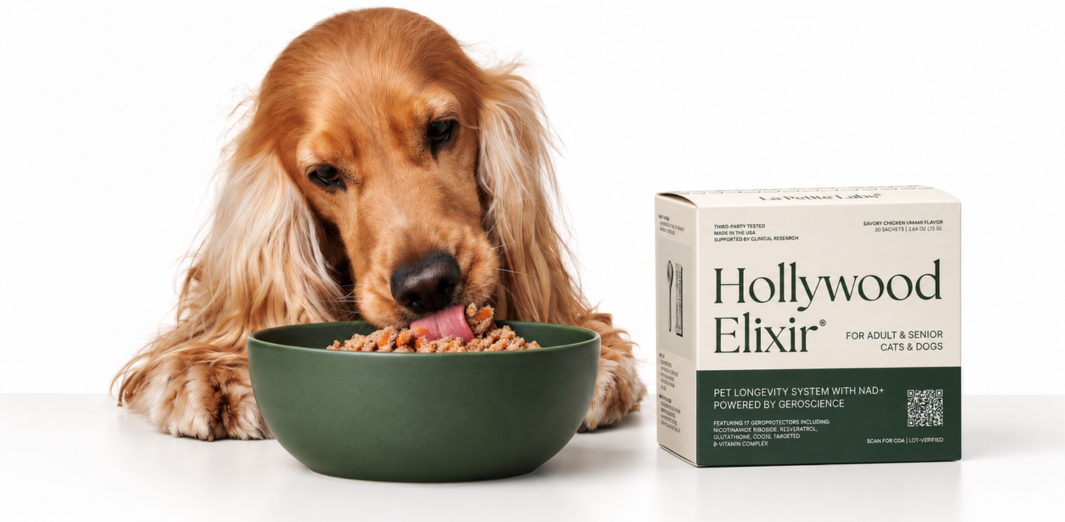
Golden spaniel eating from a green bowl beside a Hollywood Elixir box

Rapamycin vs LOY-002: what's the difference?

LOY-002 is a new drug from the biotech company Loyal, going through FDA review for dogs. Rapamycin is an older human drug being tested for a new use. Neither has shown that it extends a dog's life.

  • Target: LOY-002 aims at insulin and metabolism; rapamycin aims at mTOR.
  • Who's being studied: LOY-002 in dogs 10+ and 14 to 179 lb; rapamycin in dogs 7+ and 44 to 121 lb.
  • Access today: LOY-002 can't be bought. Rapamycin is available off-label through a vet.
  • After approval: a conditionally approved LOY-002 could only be used as labeled, so some dogs wouldn't qualify.15

Our dog longevity drugs guide compares every candidate.

What about metformin and other anti-aging pills?

Rapamycin isn't the only human or older drug people ask about. Metformin is a human diabetes drug, and selegiline is used in dogs for cognitive dysfunction. Neither is approved to extend a dog's life. Our anti-aging pill guide sorts out which pills are drugs, which are supplements, and what each can claim.

Which dogs should avoid rapamycin?

There's no published list for off-label use in aging. TRIAD's exclusions are a useful starting point. It leaves out dogs with cancer, a recent hospital stay, serious ongoing illness, or medications that could interact with rapamycin.1

Tell your vet about any planned surgery or dental work, since slow wound healing is a known problem in people.2 For cats, the FDA says Felycin-CA1 shouldn't be used with liver disease or diabetes.14 That's a cat label and not a dog rule, but ask about both if they apply to your dog.

Woman holding a Hollywood Elixir box beside a dapple dachshund and green food bowl on a sofa

What should I ask my vet before starting?
  • What are we trying to change, and how will we measure it?
  • Which baseline tests do you want, including triglycerides?
  • How often will we repeat them, and what will that cost?
  • Do any of my dog's medications or supplements interact?
  • What result would make us stop?
  • What should we do before surgery or a dental procedure?
  • Where does the drug come from, and which formulation is it?
Woman cuddling a brown-and-white spaniel while holding a Hollywood Elixir box

Is there a natural alternative to rapamycin for dogs?

No. No food or supplement has been shown to do what rapamycin is being tested for, and no natural product has been shown to extend a dog's life.

The best-supported step is free of any pill: keep your dog lean. In a lifelong study of 48 Labradors, dogs fed 25% less than their littermates lived a median of 1.8 years longer.16 Read our diet and dog longevity guide before changing portions, because some seniors are already losing muscle.

Where daily nutrition fits

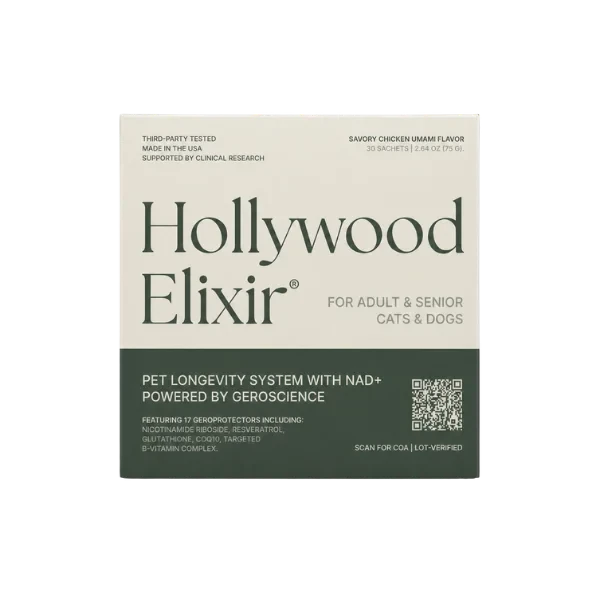
We make Hollywood Elixir, a daily nutrition powder for adult and senior dogs. It's built around nicotinamide riboside, an NAD+ precursor, with CoQ10, glutathione and 14 more actives, and every active amount is printed on the label. It's a supplement, not a rapamycin substitute: it isn't designed to do what rapamycin is being tested for, and it hasn't been tested for lifespan. Its case is practical: one scoop in the food bowl instead of a cupboard of separate supplements. If your dog takes rapamycin, check with your vet before adding it or any other supplement. See the full formula and serving guide.

No food or supplement has been shown to do what rapamycin is being tested for.

Educational content only. This material is not a substitute for veterinary advice. Always consult your veterinarian about your dog’s specific needs. These statements have not been evaluated by the Food and Drug Administration. Products mentioned are not intended to diagnose, treat, cure, or prevent any disease.

Glossary

mTOR: a hub inside cells that senses nutrients and directs growth; rapamycin dampens it.

Sirolimus: the drug name for rapamycin.

Off-label (extra-label): using an approved drug in a way its label doesn't list, which a vet may do under FDA rules.

Conditional approval: FDA permission to sell an animal drug for up to five years while full effectiveness evidence is collected. Off-label use isn't allowed.

TRIAD: the Test of Rapamycin In Aging Dogs, a placebo-controlled trial run by the Dog Aging Project.

Hypertriglyceridemia: high levels of triglycerides, a type of fat, in the blood.

Related Reading

References

Sources and further detail

  1. Coleman AE, Creevy KE, Anderson R et al. *GeroScience* (2025). Test of Rapamycin in Aging Dogs (TRIAD): study design and rationale
  2. Ryave J, Coleman A. *Journal of Veterinary Science* (2025). Rapamycin as a potential intervention to promote longevity and extend healthspan in companion dogs
  3. Urfer SR, Kaeberlein TL, Mailheau S et al. *GeroScience* (2017). A randomized controlled trial to establish effects of short-term rapamycin treatment in 24 middle-aged companion dogs
  4. Barnett BG, Wesselowski SR, Gordon SG et al. *Frontiers in Veterinary Science* (2023). A masked, placebo-controlled, randomized clinical trial of low-dose rapamycin in 17 healthy client-owned dogs
  5. Dog Aging Project, *Can I give my dog rapamycin on my own?*
  6. Evans JB, Chou L, Kaeberlein M et al. *Frontiers in Veterinary Science* (2023). Case report: severe asymptomatic hypertriglyceridemia with long-term low-dose rapamycin in a Labrador retriever
  7. Dog Aging Project, *Is it too late to sign my dog up for TRIAD?* (updated 28 Sept 2026)
  8. Tufts Cummings School of Veterinary Medicine, *Dog Aging Project: test of rapamycin in aging dogs (TRIAD)*
  9. Larson JC, Allstadt SD, Fan TM et al. *American Journal of Veterinary Research* (2016). Pharmacokinetics of orally administered low-dose rapamycin in healthy dogs
  10. GoodRx (7 Aug 2025), Upcoming antiaging drugs for dogs: what you need to know
  11. Helping Pets Live Longer, *Rapamycin for dogs* (listed price, checked November 2026)
  12. FDA, *The ins and outs of extra-label drug use in animals: a resource for veterinarians*
  13. LeBlanc AK, Mazcko CN, Cherukuri A et al. *Clinical Cancer Research* (2021). Adjuvant sirolimus does not improve outcome in pet dogs receiving standard-of-care therapy for appendicular osteosarcoma: a randomized trial of 324 dogs
  14. FDA (14 March 2025), FDA conditionally approves drug for management of ventricular hypertrophy in cats
  15. FDA, *Conditional approval explained: a resource for veterinarians*
  16. Kealy RD, Lawler DF, Ballam JM et al. *JAVMA* (2002). Effects of diet restriction on life span and age-related changes in dogs

FAQ

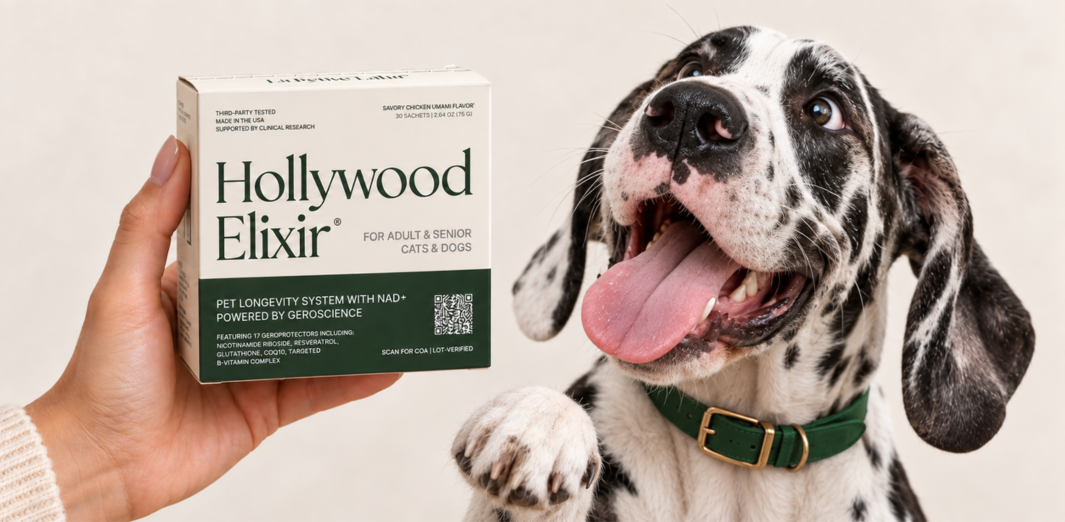
Dalmatian looking toward a Hollywood Elixir box held in a person's hand

Discover LPL-01: How This Fits Into a Larger Canine Longevity System

Aging in dogs is not driven by a single pathway. It’s the result of interacting biological systems—energy metabolism, oxidative stress, immune signaling, and structural integrity—changing over time.

This article explores one piece of that puzzle. If you want to understand how these pieces connect—and what actually moves the needle—you need to zoom out.

Start with the underlying science: