Dog Aging Project

What the Research Shows About Aging Drivers—and What Owners Can Change

By La Petite Labs Editorial 15 min read

The dog aging project is a large-scale research effort tracking how companion dogs age in real homes. As an observational research program, it follows thousands of dogs over time, combining owner-reported information with veterinary records and biological samples to study how genetics, lifestyle, and environment relate to aging. That scope makes it especially useful for understanding patterns across everyday routines—diet consistency, activity, body condition, household exposures, and other factors owners can actually measure and discuss with their veterinarian.

It’s also important to interpret the findings correctly. Observational studies can reveal associations and generate strong hypotheses, but they can’t, by themselves, prove that one specific choice caused a specific outcome. The most practical owner takeaways are to use results as a framework for questions: Which factors show the strongest, most consistent links to healthier aging? Which are likely to be confounded by other variables? And what changes are realistic to monitor over months, not days? Used this way, the project supports informed senior-care planning without turning early signals into supplement hype.

  • The Dog Aging Project tracks how real-life factors shape healthspan, not just lifespan.
  • Environmental details—like what’s in drinking water—can quietly influence aging trajectories.
  • Cognitive changes are worth noticing early; routines and calm novelty can support daily function (Yarborough, 2023).
  • Mobility is a whole-body issue: weight, muscle, footing, and pain control work together.
  • Safety thinking matters in seniors; introduce new products slowly and track responses.
  • Reducing chronic household exposures is often more impactful than adding complicated interventions (Dellarco VL, 2010).
  • A system-level supplement can still be relevant even with a good diet, because aging changes how the body copes day to day.

What the Dog Aging Project Measures: Genetics, Lifestyle, Environment, Outcomes

At its core, the Dog Aging Project connects four domains—genetics, lifestyle, environment, and health outcomes—so researchers can see how they interact across a dog’s lifespan. Genetics may include breed background and DNA-based markers that help explain why some dogs are more resilient (or more vulnerable) to certain age-related changes. Lifestyle captures day-to-day variables such as activity patterns, feeding routines, body condition trends, sleep, and preventive care. Environment focuses on what surrounds the dog: household and neighborhood exposures, indoor air quality, and even drinking water characteristics that may accumulate over years (Sexton CL, 2025).

Health outcomes are the endpoints that matter for aging research: longevity, veterinary-documented diagnoses, mobility and function, cognitive changes, and overall quality-of-life indicators. Because these measures are collected repeatedly over time, the study can look for early predictors of later outcomes and identify which combinations of factors tend to travel together in healthier aging trajectories—without assuming any single variable is the sole driver.

How to Use Research Wisely: Correlation vs Causation for Supplements and Diet

When applying dog aging project findings to diet or supplements, the key skill is separating correlation vs causation. If dogs with a certain feeding pattern or supplement use appear to age better, that relationship may be real—or it may reflect confounding, where another factor explains the difference. For example, owners who track nutrition closely may also schedule more frequent veterinary visits, maintain healthier body condition, or provide more consistent exercise, all of which can influence outcomes.

Look for effect size, not just statistical significance: a small association in a large dataset may not translate into a meaningful change for an individual dog. Also prioritize replication—similar results observed across different subgroups, time periods, or independent studies—before treating an association as actionable. A practical approach is to use research signals to guide discussions with your veterinarian: what to monitor (weight trends, mobility, cognition), what to adjust first (foundational diet quality and routine), and what evidence is still preliminary. This keeps decisions grounded in the strength of the data rather than assumptions drawn from a single correlation.

Aging Is Many Processes Happening at Once

Aging is not one process. It’s a set of overlapping changes: immune tone, tissue repair, sleep quality, appetite regulation, and the brain’s ability to filter noise from meaning. That’s why broad cohort research can be more illuminating than a single supplement study. It helps separate what is common from what is merely loud. It also encourages owners to think in probabilities rather than promises: a choice can be supportive without being guaranteed. When you adopt that mindset, you’re less likely to overreact to a bad week—and more likely to notice the slow wins that accumulate.

Environmental Load: Reducing the Background Noise of Risk

One of the most practical lessons from modern canine research is that exposures add up. Reviews of pesticide toxicity in dogs emphasize how dog data can inform long-term risk thinking, especially when exposure is repeated and low-level (Dellarco VL, 2010). In a household context, this translates to simple decisions: wipe paws after treated sidewalks, choose fragrance-free cleaners when possible, and store chemicals away from food and water. None of this requires perfection. It’s about reducing the background load so your dog’s body has more room for the work that matters: repair, recovery, and resilience.

Why Safety Science Treats Dogs as Meaningful Models

Owners often ask whether findings in dogs “count” for people, or vice versa. In safety science, dogs are frequently used in long-term toxicity studies because they can provide valuable information for assessing compound safety (Parkinson C, 1995). That doesn’t make pet dogs miniature lab models; it simply underscores that canine physiology is taken seriously in biomedical contexts. For your senior dog, the takeaway is caution with novelty. New chews, new supplements, and new medications should be introduced with intention, not in a burst of optimism. Aging bodies prefer steady, trackable change. (see our Dog Life Stages →)

“Aging rarely announces itself. It accumulates in small hesitations you can learn to notice.”

Cognition and Daily Life: Keeping the Mind Gently Engaged

Cognition is a quality-of-life issue, not a trivia question. The Dog Aging Project’s work on cognitive function highlights that baseline characteristics can be associated with how dogs perform on cognitive measures (Yarborough, 2023). For owners, that means two things. First, there is value in noticing early shifts—getting “stuck,” new anxiety, altered sleep—before they become disruptive. Second, supportive routines can be protective even when they’re simple: consistent mealtimes, gentle enrichment, and calm transitions. If changes are abrupt, rule out pain, sensory loss, or illness with your veterinarian.

Why Timing and Tolerance Matter More in Senior Bodies

When people hear “pharmacokinetics,” they think it’s irrelevant to a pet’s daily life. But the principle—how a body absorbs, distributes, and clears compounds—matters most in seniors. Studies that evaluate safety and biodistribution in dogs illustrate how carefully researchers track where compounds go and how long they persist (Risen S, 2024). For owners, the practical mirror is straightforward: avoid combining multiple new products, follow label directions, and consider your dog’s size, age, and medical history. If your dog is on prescription medications, ask your veterinarian about timing and compatibility.

Comfort as a Strategy: the Senior Years Done Well

The most meaningful “anti-aging” move is often comfort. A dog who sleeps well, moves without dread, and eats with steady appetite is a dog whose days still feel like themselves. That can mean pain management, dental care, or simply making the home easier to navigate. It can also mean supporting the internal systems that keep energy and recovery steady, especially when activity naturally declines. Think of it as lowering the cost of living in an older body—so your dog can spend more of the day curious, social, and at ease.

From Water Bowls to Walk Routes: Patterns Worth Tracking

Owners sometimes worry that a cohort project can’t help their individual dog. But population research is precisely what helps you avoid chasing anecdotes. When a project looks at environmental factors—like heavy metals in drinking water—it’s trying to identify patterns that can guide sensible prevention and monitoring (Sexton CL, 2025). You may never know which single factor mattered most for your dog, and that’s fine. The goal is to stack small advantages: cleaner inputs, steadier routines, and supportive care that respects the reality of aging rather than fighting it.

Why System-level Support Still Matters with a Good Diet

Supplements sit in an awkward space: owners want something that feels concrete, while good science stays cautious. A productive way to think about them is as support for a broader network—energy, resilience, recovery—rather than a single “missing nutrient.” Even when a dog’s diet is well-formulated, aging can change how the body uses what it receives, and day-to-day stressors can raise the bar for maintenance. That’s why system-level support can remain relevant without pretending to replace veterinary care or a complete diet. The best products are consistent, transparent, and designed for long-term use, not quick fixes.

“The most meaningful changes are often environmental: fewer irritants, fewer slips, fewer surprises.”

La Petite Labs

DVM Voice: Clinical Vignette of a Common Pattern in Senior Dog Aging

Case provided by JoAnna Pendergrass, DVM

Rex, a 7-year-old Labrador Retriever, was brought in after his owner noticed he was slower to rise, hesitant on stairs, and less able to play as before. Examination showed stiffness and reduced hip mobility; radiographs confirmed degenerative joint changes.

His care required weight management, veterinary-guided pain control, nutritional support, and rehabilitation — a comprehensive plan, but one started only after visible decline appeared.

Clinical takeaway: Rex’s case reflects the value of proactive aging support: maintaining lean body condition, monitoring mobility early, and supporting cellular resilience, antioxidant defense, and healthy inflammatory balance before decline becomes obvious.

Single-case vignette. Not generalizable. Veterinary oversight is essential for pain, stiffness, or suspected joint disease.

Explore Hollywood Elixir Research →
dog aging project - 9

Safety First: Introducing New Support in Older Dogs

Safety deserves its own spotlight, especially for seniors who may be taking medications or managing chronic conditions. In research settings, dogs are often used in long-term toxicity work because their physiology can be informative for safety assessment (Parkinson C, 1995). That doesn’t mean every supplement has comparable data behind it; it means owners should respect dosing instructions, avoid stacking multiple new products at once, and watch for subtle changes in stool, appetite, or behavior. If your dog has kidney or liver disease, is on anti-inflammatories, or has a history of pancreatitis, ask your veterinarian before adding anything new.

dog aging project - 10

Home Exposures That Quietly Shape Long-term Wellbeing

Environmental risk is not a reason to panic; it’s a reason to simplify. Reviews of chemical exposures in dogs underline that chronic, low-level contact can matter for long-term risk discussions (Dellarco VL, 2010). Practical steps are often unglamorous: rinse food bowls well, avoid storing kibble in soft plastics, ventilate after cleaning, and choose lawn care approaches that don’t leave residues where paws and noses spend time. The Dog Aging Project’s attention to real-world exposures helps validate what many owners sense intuitively: the home environment is part of a dog’s health story, not just a backdrop.

dog aging project - 11

Cognitive Aging: Noticing Subtle Shifts Without Alarm

Cognitive aging can be one of the most emotionally charged parts of the senior years. The Dog Aging Project has examined cognitive function and found associations with baseline characteristics, helping researchers map which factors tend to travel together (Yarborough, 2023). For owners, the day-to-day translation is gentler: protect routines, keep walks predictable, and add low-stress novelty—new sniff routes, short training refreshers, food puzzles that don’t frustrate. If confusion, sleep-wake reversal, or house-soiling appears suddenly, treat it as a medical question first, not “just aging.”

Mobility, Confidence, and the Small Changes That Help

Mobility is rarely only about joints. It’s also muscle, weight, footing, and confidence. A senior dog who slips on floors or hesitates at stairs may be telling you about pain, weakness, or fear of falling. Small environmental edits—runners, ramps, a lower car step—can change a dog’s willingness to move more than a new gadget ever will. If you’re using pain medications, keep your veterinarian in the loop before adding additional products; interactions and tolerability matter more with age, and careful monitoring is part of responsible support (Parkinson C, 1995).

Weight, Muscle, and the Everyday Math of Comfort

Weight and body condition are among the most controllable levers in healthy aging, yet they’re also the easiest to rationalize away. A little extra weight can quietly tax joints, breathing, and stamina. The goal isn’t thinness; it’s ease—standing up without effort, walking without lag, recovering quickly after play. Ask your veterinarian to score body condition and set a realistic target, then adjust calories slowly. Pair food changes with gentle strength-building: short hill walks, sit-to-stand repetitions, and controlled leash pace. Consistency beats intensity in older dogs.

What Controlled Dog Studies Teach About Careful Monitoring

Owners sometimes assume “research” is distant from everyday life, but safety science is built from careful observation. In controlled studies, repeated dosing and monitoring are used to understand tolerability and pharmacokinetics in dogs, often under Good Laboratory Practice standards (Zhang, 2024). While that’s not the same as a consumer supplement, it reinforces a mindset: introduce changes one at a time, keep notes, and respect that older bodies can respond differently. If vomiting, diarrhea, itchiness, or lethargy appears after a new addition, stop it and contact your veterinarian.

Participation, Observation, and the Value of Long Horizons

If you’re deciding whether to participate in a large cohort study, think about what you want to contribute. The Dog Aging Project relies on real households, which means its strength is diversity—different breeds, diets, neighborhoods, and routines. That breadth is what makes findings more useful than a narrow lab snapshot. Participation also tends to make owners more attentive in a healthy way: you notice patterns, schedule checkups, and become more deliberate about exposures and daily habits. Even if you never enroll, you can borrow the same posture: observe, document, and adjust with patience.

A Calm, Practical Way to Think About Aging Support

Aging well is rarely about a single intervention. It’s the layering of sensible choices: a stable weight, comfortable movement, a calmer home environment, and support that’s designed for long horizons. That’s also the clearest reason a careful, science-minded owner might still choose a thoughtfully formulated supplement: not to “fix” aging, but to support the systems that have to keep adapting. When you pair that with veterinary oversight and good routines, you’re not chasing youth—you’re protecting quality of life, day after day, in ways your dog can actually feel.

“Good support respects time: steady inputs, careful monitoring, and realistic expectations.”

Educational content only. This material is not a substitute for veterinary advice. Always consult your veterinarian about your dog’s specific needs. These statements have not been evaluated by the Food and Drug Administration. Products mentioned are not intended to diagnose, treat, cure, or prevent any disease.

Glossary

  • Cohort Study: Research that follows a group over time to observe patterns and outcomes.
  • Healthspan: The portion of life spent in good health and functional comfort.
  • Lifespan: Total length of life, regardless of health status.
  • Baseline Characteristics: Starting traits (age, size, lifestyle) recorded to interpret later outcomes.
  • Cognitive Function: Abilities like learning, memory, attention, and problem-solving in daily life.
  • Environmental Exposure: Contact with substances in water, air, surfaces, or yard treatments over time.
  • Pharmacokinetics: How a body absorbs, distributes, and clears a compound.
  • Tolerability: How well an individual dog handles a product without unwanted effects.
  • Good Laboratory Practice (GLP): Quality standards that support reliable, reproducible safety study results.

Related Reading

References

Sexton CL. Testing for heavy metals in drinking water collected from Dog Aging Project participants. PubMed. 2025. https://pubmed.ncbi.nlm.nih.gov/41018543/

Parkinson C. The value of information generated by long-term toxicity studies in the dog for the nonclinical safety assessment of pharmaceutical compounds. PubMed. 1995. https://pubmed.ncbi.nlm.nih.gov/7601320/

Dellarco VL. A retrospective analysis of toxicity studies in dogs and impact on the chronic reference dose for conventional pesticide chemicals. PubMed. 2010. https://pubmed.ncbi.nlm.nih.gov/20144133/

Risen S. Large- and Small-Animal Studies of Safety, Pharmacokinetics, and Biodistribution of Inflammasome-Targeting Nanoligomer in the Brain and Other Target Organs. PubMed Central. 2024. https://pmc.ncbi.nlm.nih.gov/articles/PMC11555505/

Zhang. Toxicity and Toxicokinetics of a Four-Week Repeated Gavage of Levamisole in Male Beagle Dogs: A Good Laboratory Practice Study. 2024. https://www.mdpi.com/1424-8247/17/1/141

Yarborough. Author Correction: Evaluation of cognitive function in the Dog Aging Project: associations with baseline canine characteristics. Nature. 2023. https://www.nature.com/articles/s41598-023-34875-5

Urfer SR. A randomized controlled trial to establish effects of short-term rapamycin treatment in 24 middle-aged companion dogs. PubMed Central. 2017. https://pmc.ncbi.nlm.nih.gov/articles/PMC5411365/

Harrison BR. Protein catabolites as blood-based biomarkers of aging physiology: Findings from the Dog Aging Project. PubMed. 2024. https://pubmed.ncbi.nlm.nih.gov/39484426/

Bray EE. Once-daily feeding is associated with better health in companion dogs: results from the Dog Aging Project. PubMed. 2022. https://pubmed.ncbi.nlm.nih.gov/35484470/

Kutzsche. Oral treatment with the all-d-peptide RD2 enhances cognition in aged beagle dogs – A model of sporadic Alzheimer’s disease. 2023. https://www.sciencedirect.com/science/article/pii/S2405844023056517

Bilgiç B. Investigation of Trace and Macro Element Contents in Commercial Cat Foods. PubMed Central. 2025. https://pmc.ncbi.nlm.nih.gov/articles/PMC11633335/

Finno CJ. Veterinary Pet Supplements and Nutraceuticals. PubMed Central. 2020. https://pmc.ncbi.nlm.nih.gov/articles/PMC7802882/

FAQ

What is the dog aging project in simple terms?

It’s a large research effort that follows companion dogs over time to learn what supports healthier aging. Instead of focusing on one disease, it looks at patterns across lifestyle, environment, and biology.

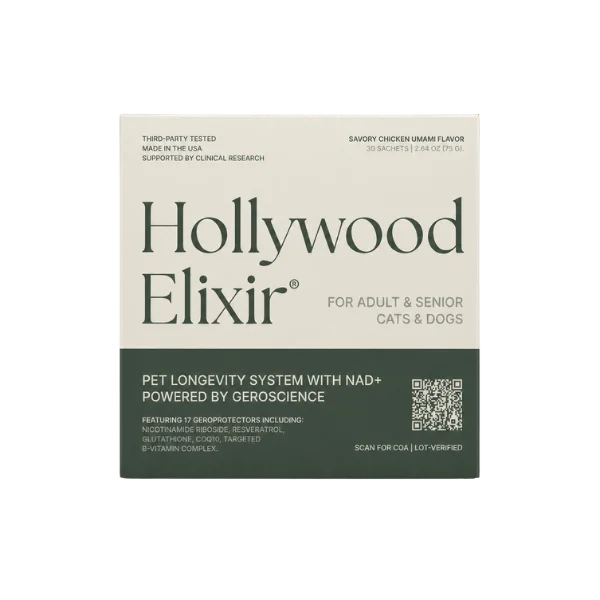
For owners, the value is perspective: small, steady choices can matter. Many people pair those choices with system-level support such as Hollywood Elixir™.

Why does the dog aging project matter for senior dogs?

It helps shift attention from quick fixes to long-term quality of life. Aging is shaped by many inputs—movement, comfort, sleep, and the home environment—so broad research can clarify what tends to matter most.

That same long-horizon mindset is why some owners choose a consistent daily addition that supports overall resilience, including Hollywood Elixir™.

Does the dog aging project study environment and household exposures?

Yes. One example is testing drinking water from participating households for heavy metal contamination, which can offer insight into environmental factors that may affect aging dogs.

Even without lab testing at home, you can reduce background exposure by simplifying cleaners and improving water habits. Many owners also add steady, system-level support with Hollywood Elixir™.

How is cognition evaluated in Dog Aging Project dogs?

Researchers assess cognitive function and examine how it relates to baseline characteristics, helping identify which factors are associated with differences in cognitive performance.

At home, the practical focus is noticing changes early and keeping routines steady. For broader aging support that complements enrichment and veterinary care, some owners use Hollywood Elixir™.

Is the dog aging project only for certain breeds?

No. The strength of a large cohort is diversity—different sizes, breeds, and mixed-breed dogs living in varied households. That variety helps findings feel more relevant to everyday owners.

Because aging looks different across body sizes, it’s useful to choose support that’s meant to be broadly compatible and easy to maintain. Many owners consider Hollywood Elixir™ as part of that steady approach.

When should I start thinking about senior support?

Earlier than most people expect. “Senior” depends on size and breed, but the best time to build habits is when your dog still feels mostly normal—before stiffness, weight gain, or sleep disruption becomes entrenched.

Start with basics: body condition, dental care, and gentle strength. If you want a consistent daily layer that supports whole-body aging rather than a single nutrient, consider Hollywood Elixir™.

Is the dog aging project the same as a clinical trial?

Not usually. A cohort project primarily observes dogs over time to find patterns, while clinical trials typically test a specific intervention under controlled conditions. Both can be valuable, but they answer different questions.

For owners, observational insights can still guide practical choices—especially around routines and exposures. Many also add a conservative, daily support option like Hollywood Elixir™ to complement veterinary care.

What safety mindset should I have with senior supplements?

Think like a careful observer: introduce one new item at a time, keep notes, and watch stool, appetite, itchiness, and energy. Dogs are often used in long-term toxicity work to inform safety assessment, which underscores how seriously tolerability is taken in older bodies.

If your dog has chronic disease or takes prescriptions, ask your veterinarian before adding anything. For a steady, long-horizon option, some owners choose Hollywood Elixir™.

Can supplements interact with my dog’s medications?

They can. Seniors are more likely to be on pain control, thyroid medication, heart drugs, or anxiety support, and even “natural” products may affect tolerance or timing. Research that tracks pharmacokinetics in dogs highlights why distribution and clearance matter when compounds are combined(Risen S, 2024).

Bring your full list to your veterinarian and avoid adding multiple new items at once. For a simple routine that’s designed for aging support, considerHollywood Elixir™.

What side effects should I watch for with new products?

The common early signals are gastrointestinal upset (soft stool, vomiting), itchiness, restlessness, or unusual sleepiness. In controlled dog studies, repeated dosing is monitored closely to detect tolerability issues, reinforcing the value of careful observation at home(Zhang, 2024).

Stop the new item if symptoms appear and contact your veterinarian if signs persist or are severe. For a consistent daily option with a senior-focused intent, many owners useHollywood Elixir™.

How long does it take to notice supportive changes?

With aging support, timelines are usually measured in weeks, not days. Look for subtle shifts: easier mornings, steadier appetite, calmer evenings, or more willingness to move. Track one or two markers so you’re not relying on memory.

If you see no change, that information is still useful—you can simplify the routine. For owners who want a consistent, system-level layer, Hollywood Elixir™ can fit into a long-term plan.

What quality signals should I look for in aging supplements?

Look for clear labeling, consistent serving guidance, and a formulation designed for daily use. Avoid products that promise dramatic outcomes or imply they replace veterinary care. For seniors, simplicity and tolerability often matter more than novelty.

Also consider whether the product supports broader aging resilience rather than chasing a single ingredient trend. Many owners choose that kind of approach with Hollywood Elixir™.

How do I give a daily supplement without upsetting routine?

Anchor it to something your dog already expects: breakfast, the post-walk drink, or a calm evening snack. Seniors do best when changes feel predictable, not like a new event to manage.

Start with the smallest recommended amount if your veterinarian agrees, then build to the full serving as tolerated. For an easy-to-maintain daily option, consider Hollywood Elixir™.

Should I change my dog’s water source at home?

If you’re concerned, start by checking your local water report and keeping bowls clean and well-rinsed. The Dog Aging Project’s water testing work reflects the idea that environmental inputs can be measurable and relevant over time.

Some households choose filtered water, especially for sensitive dogs, but consistency matters more than perfection. For broader aging support that fits alongside these choices, many owners use Hollywood Elixir™.

Can household lawn or pest chemicals affect aging dogs?

They can contribute to chronic exposure, especially when residues are tracked indoors on paws and coats. Reviews of pesticide toxicity in dogs emphasize the importance of dog data in thinking about long-term exposure thresholds.

Practical steps include wiping paws, avoiding freshly treated areas, and choosing lower-residue options when possible. Many owners also support overall resilience with Hollywood Elixir™ as part of a steady routine.

Is the dog aging project relevant if my dog seems healthy?

Yes, because the most useful aging insights often come from dogs before problems are obvious. Healthy seniors still benefit from attention to weight, muscle, sleep, and comfort—areas where small declines can be easy to miss.

A proactive routine can keep “healthy” feeling stable for longer. For owners who want a consistent daily layer that supports aging systems, Hollywood Elixir™ can be part of that plan.

Can cats use the same aging support as dogs?

Not automatically. Cats have different metabolism, sensitivities, and supplement tolerances, so you should not assume a dog product is appropriate for them. Always confirm species suitability and dosing guidance with your veterinarian.

If you’re focused on canine aging support, choose products formulated specifically for dogs and integrate them into a vet-guided plan. For dogs, many owners consider Hollywood Elixir™.

What contraindications should I discuss with my veterinarian first?

Discuss kidney or liver disease, pancreatitis history, complex medication regimens, pregnancy, and any upcoming procedures. In older dogs, safety assessment principles matter because tolerance can change with age and comorbidities.

Bring a full medication and supplement list so your veterinarian can evaluate interactions and timing. If you want a senior-focused daily support option to consider, ask about Hollywood Elixir™.

When should I call the vet about cognitive changes?

Call if changes are sudden, severe, or paired with appetite loss, pain signs, seizures, or disorientation. Research on canine cognition looks at associations across characteristics, but abrupt shifts can signal medical issues that need evaluation.

For gradual changes, your veterinarian can help you distinguish normal aging from treatable problems and build a supportive plan. Many owners also include daily aging support with Hollywood Elixir™.

How do I decide if the dog aging project is for us?

Decide based on temperament, your capacity for follow-through, and your interest in contributing to long-term knowledge. Participation can be a quiet way to turn everyday observations into something larger than your household.

Even if you don’t enroll, you can adopt the same mindset: track trends, reduce exposures, and keep care consistent. Many owners complement that approach with Hollywood Elixir™ for daily aging support.

What does research on dog dosing and monitoring teach owners?

It teaches discipline: consistent administration, careful observation, and respect for individual variability. In GLP dog studies, repeated dosing and monitoring are used to generate reliable safety and pharmacokinetic information(Zhang, 2024).

At home, mirror that by changing one variable at a time and keeping notes you can share with your veterinarian. For a steady daily routine that supports aging systems, considerHollywood Elixir™.

La Petite Labs

Discover LPL-01: How This Fits Into a Larger Canine Longevity System

Aging in dogs is not driven by a single pathway. It’s the result of interacting biological systems—energy metabolism, oxidative stress, immune signaling, and structural integrity—changing over time.

This article explores one piece of that puzzle. If you want to understand how these pieces connect—and what actually moves the needle—you need to zoom out.

Start with the underlying science: