





The 12 Hallmarks of Aging in Dogs, Explained
Read full insightDiet and Dog Longevity
By La Petite Labs Editorial 8 min read
As Seen On
Contents +
Keeping your dog lean is the best-supported way to help them live longer, and you can start today. In a lifelong study of 48 Labrador Retrievers, dogs fed 25% less than their littermates lived a median of 1.8 years longer. A later study of more than 50,000 pet dogs found the same pattern: overweight dogs had shorter lives in all 12 breeds studied. Longevity drugs such as Loyal's LOY-002 aren't available yet, and if they arrive, they won't replace a complete diet.
Here's what the evidence says about weight, senior food, treats and supplements, and what to ask your vet.
La Petite Labs publishes this guide and makes Hollywood Elixir, a dog supplement. We're not affiliated with Loyal.
Can diet help a dog live longer?
Yes, and the evidence is about how much dogs eat. In a study that followed 48 Labradors from 8 weeks old until death, dogs were paired and one in each pair was fed 25% less than the other. The leaner dogs lived a median of 1.8 years longer, and signs of chronic disease generally appeared later.1
It's one breed in one research colony, and the restriction started in puppyhood. Even so, it remains one of the clearest lifespan results from a controlled study in dogs.
Diet and Dog Longevity at a glance
- Best-supported step
- Keep your dog lean: a median 1.8 years longer in a lifelong Labrador study
- Cutting portions
- Ask your vet for a target weight first; some seniors are already losing muscle
- Senior dog food
- Optional if your dog is doing well on a complete and balanced adult food
- Treats and extras
- 10% of daily calories or less
- Supplements
- None has been shown to extend lifespan
- Longevity drugs
- Not available yet, and they wouldn't replace a complete diet
Food, supplements and longevity drugs compared
| Complete diet | Supplement | Longevity drug | |
|---|---|---|---|
| Job | Daily energy and essential nutrients | Adds specific nutrients | Aims to change the biology of aging |
| Replaces the diet? | It is the diet | No | No |
| Lifespan evidence | Staying lean: yes, in dogs | None shown | Trials under way |
| Available now? | Yes | Yes | No |
Competitor label and pricing facts checked November 6, 2026. Sources are listed in the References section below.

How much longer do lean dogs live?

Pet dogs show the same pattern. A 2019 study looked at 50,787 middle-aged pet dogs from about 900 North American vet hospitals. In all 12 breeds studied, dogs that were overweight in middle age had shorter median lifespans.2
The gap ranged from about five months in German Shepherds (12.1 vs 12.5 years) to two and a half years in Yorkshire Terriers (13.7 vs 16.2 years).2 This study looked back at records, so it shows a link rather than proof of cause. Together with the Labrador study, it points in one direction.
How do I know if my dog is a healthy weight?
The number on the scale isn't enough. Vets use a body condition score to judge body fat, usually on a 9-point scale. Each point above the ideal range means roughly 10% overweight.3 As a rough guide, you should be able to feel your dog's ribs easily, and see a waist from above.
Ask your vet to show you how to score your own dog. AAHA, the American Animal Hospital Association, recommends teaching owners to do this, so you can spot a change between visits.4
Should I feed my senior dog less?
Not automatically. Energy needs can change with age, but not the same way in every dog.5 Some seniors slowly gain fat. Others are losing weight and muscle, and eating less would make that worse.
The Labradors in the lifespan study were fed less from puppyhood under research supervision, which isn't a plan for an older dog. Ask your vet for a target weight and a daily calorie figure before you change portions.4
Does my older dog need senior dog food?
Not just because of their age. AAFCO, the group that sets US pet food nutrient profiles, has no specific requirements for senior dogs, and manufacturers don't agree on what "senior" should mean. AAHA says that if an older dog is doing well on a complete and balanced adult food, it's perfectly appropriate to stay on it until a medical condition says otherwise.5
If you do switch, compare the calories per serving and the nutrient profile, not the word on the bag. Change over 4 to 7 days to reduce the chance of stomach upset.4
In a lifelong study of 48 Labradors, the leaner dogs lived a median of 1.8 years longer.
What does "complete and balanced" mean?
"Complete and balanced" on a label means the food is intended as your dog's only diet. To use the phrase, it has to meet an AAFCO nutrient profile or pass an AAFCO feeding trial. Treats, snacks and supplements usually aren't complete and balanced.6 Check that the statement on the bag covers your dog's life stage.
How many treats can a dog have a day?
Keep treats and other extras to 10% of daily calories or less. AAHA's guideline is that complete and balanced food should make up at least 90% of a healthy dog's intake.4 For a dog eating 600 calories a day, that's about 60 calories of extras.
Count everything: training treats, dental chews, toppers, table food, and the food you use to hide pills.3 It adds up fastest when several people in the house are feeding the same dog.
Can a dog lose muscle without losing weight?
Yes. Fat and muscle are separate, and a dog can be overweight and losing muscle at the same time. If one goes up as the other goes down, the scale may barely move.3
That's why vets score muscle separately from fat, by looking at and feeling the muscle over the spine, shoulder blades, skull and pelvis.3 Ask for a muscle check at each visit, especially if your dog has become slower on walks or on stairs.
Does feeding once a day help dogs live longer?
That hasn't been shown. A 2022 Dog Aging Project analysis of owner surveys, covering more than 24,000 dogs, found that dogs fed once a day had lower odds of several health conditions and better cognitive scores than dogs fed more often.7
It's an association from a snapshot in time, so it can't show that meal timing caused the difference, and it didn't measure lifespan. Don't change your dog's meal schedule for this reason alone, especially if they have a medical condition or take medicine with food.
Will longevity drugs replace a good diet?
No. Drugs in development, such as LOY-002, aim to change the biology of aging. Food supplies the energy, protein, vitamins and minerals a dog needs every day. A dog on a longevity drug would still need a complete and balanced diet and a healthy weight.
None of these drugs is available yet. Our dog longevity drugs guide covers where each one stands. Loyal hasn't published feeding instructions for any of them, so any advice on diet will come with the final label.
A dog doing well on a complete and balanced adult food doesn't need to switch just because of a birthday.
Can I give supplements alongside a longevity drug?
Nobody can say yet for a specific product. Loyal's drugs and their exact mechanisms are still confidential, so there's no public interaction information.8 If one is approved, its label and your vet will be the place to check.
Either way, give your vet the full list of what your dog takes. AAHA's guidelines include supplements in a complete nutrition history.3 If your dog is in a clinical trial, ask the study team before adding anything.
Do supplements help dogs live longer?
None has been shown to. Some ingredients have small dog studies behind them, usually measuring one specific thing over weeks or months. The best-designed so far, a 2024 randomized trial in senior dogs, measured owner-rated thinking and memory, not lifespan.9
A supplement can add specific nutrients to the bowl, and for many owners that's reason enough. It just isn't a lifespan treatment, and it doesn't replace weight control or a complete diet. In the US, pet supplements aren't a separate legal category, so "supplement" on a label doesn't mean the FDA has reviewed its claims.10 Our anti-aging pill guide explains how to judge one.
What to look for in a senior dog supplement
- A clear purpose: what is it meant to add that the current diet doesn't?
- Every active ingredient with its amount, so your vet can check for overlap with other products.
- A serving set by your dog's weight, not one size for every dog.
- Batch testing you can check, such as a certificate of analysis.
- Its calories, if it has any, counted within the 10% allowance.4
A feeding record your vet can use
Vets ask about diet, and "the usual food" doesn't tell them much. A note on your phone and a few label photos can give them the whole picture:3
- Main food: the exact product, the amount offered and the amount eaten.
- Extras: treats, chews, toppers, table food and food used for pills, including who gives them.
- Medicines and supplements: full names, amounts and any recent changes.
- Changes in your dog: appetite, drinking, weight, movement or behavior, with rough dates.
"Left half of dinner three nights this week" is more useful than "a bit fussy".
When to see a vet about appetite or weight
Don't try to solve these with a diet change or a supplement. Book a visit if your dog:
- Is losing weight without trying
- Is eating noticeably less, or has stopped finishing meals
- Is drinking much more than usual
- Has become stiff, slow or reluctant on walks or stairs
These can be signs of a medical problem, and the fix depends on the cause. Our guides to a dog that won't eat and lethargy in dogs can help you describe what you're seeing.
What you can do this week
- Weigh your dog, and write the number down.
- Measure the food with a kitchen scale or the same cup every time, rather than estimating.
- Count the extras for one day, including what other people give.
- Check the bag for the complete and balanced statement and the calories per serving.
- Book a check-up and ask for a target weight, a body condition score and a muscle check.
Our dog age calculator and senior dog exercise guide can help with the rest of the routine.
What to ask your vet
- What's my dog's ideal weight, and what's their body condition score today?
- Is my dog losing any muscle?
- How many calories a day should they get, including treats?
- Is there a medical reason to change their food?
- Would a supplement add anything to their current diet?
Where Hollywood Elixir fits
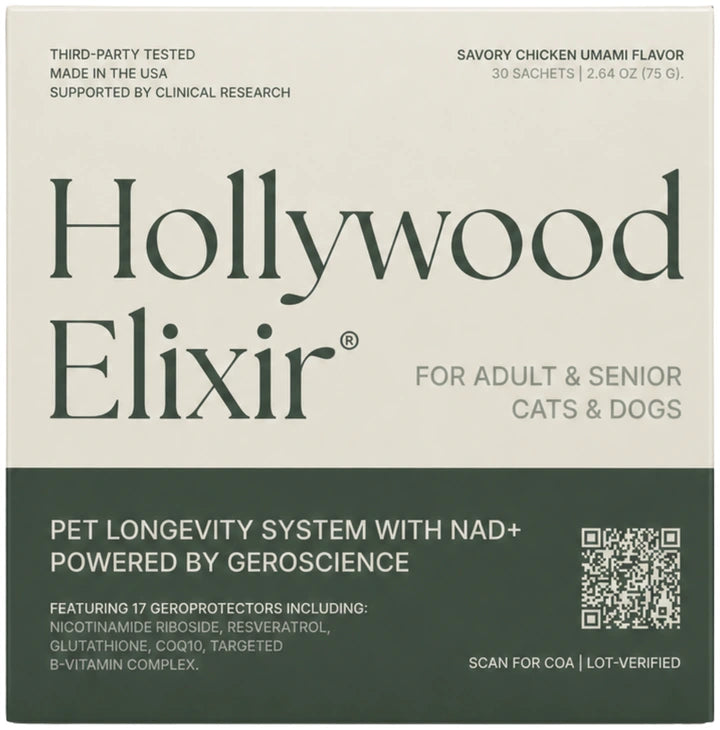
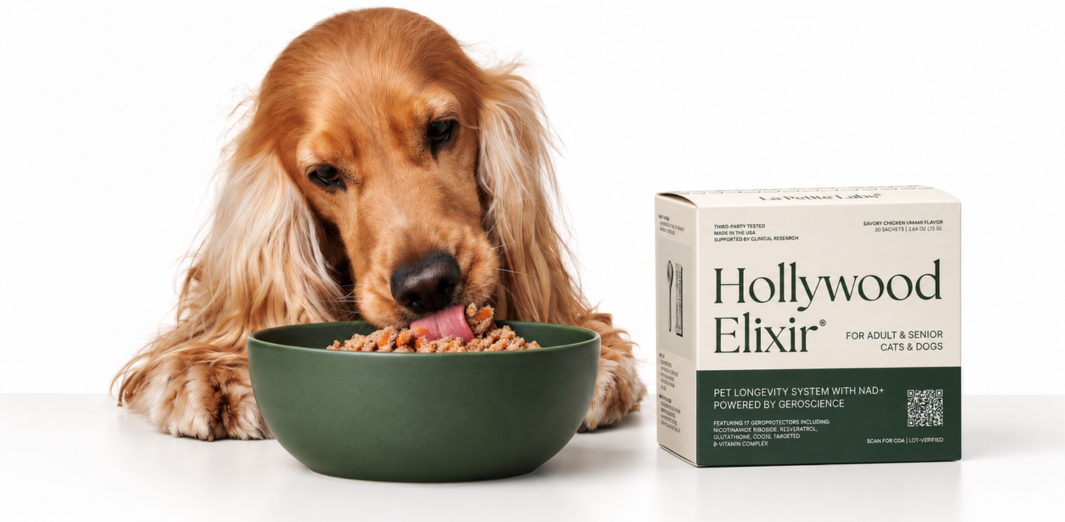
We make Hollywood Elixir, a daily nutrition powder for adult and senior dogs. It's built around nicotinamide riboside, an NAD+ precursor, with CoQ10, glutathione and 14 more actives, and every active amount is printed on the label. It's a supplement, not a complete diet or a longevity drug, and it hasn't been tested for lifespan. Weight and a complete diet come first. Its case is practical: one scoop in the food bowl instead of a cupboard of separate supplements, with the serving set by your dog's weight. If that suits your dog, talk it over with your vet. See the full formula and serving guide.
A longevity drug wouldn't replace a complete diet or a healthy weight.
Educational content only. This material is not a substitute for veterinary advice. Always consult your veterinarian about your dog’s specific needs. These statements have not been evaluated by the Food and Drug Administration. Products mentioned are not intended to diagnose, treat, cure, or prevent any disease.
Glossary
Body condition score (BCS): a hands-on assessment of body fat, usually on a 9-point scale.
Muscle condition score (MCS): a hands-on assessment of muscle over the spine, shoulder blades, skull and pelvis.
Complete and balanced: a food intended as a dog's only diet, meeting an AAFCO nutrient profile or passing an AAFCO feeding trial.
AAFCO: the Association of American Feed Control Officials, which sets US pet food nutrient profiles.
AAHA: the American Animal Hospital Association, which publishes guidelines for vet practices.
Sarcopenia: age-related loss of muscle.
Related Reading
Aging & Senior Dog Guidance
• Dog Age Calculator
• Dog Lifespan by Breed
• Dog Dementia
• Lethargy in Dogs
• My Dog Won't Eat
• Dog Pacing At Night
• Dog Licking Paws
• Can Dogs Dehydrate
Healthy Aging Support
• NAD+ for Dogs
• NMN for Dogs
• Antioxidants Supplements for Dogs
• Best Senior Dog Supplements & Vitamins
• Dog Longevity Drugs
• Rapamycin for Dogs
References
Sources and further detail
- Kealy RD, Lawler DF, Ballam JM et al. *JAVMA* (2002). Effects of diet restriction on life span and age-related changes in dogs
- Salt C, Morris PJ, Wilson D et al. *Journal of Veterinary Internal Medicine* (2019). Association between life span and body condition in neutered client-owned dogs
- AAHA, 2021 Nutrition and Weight Management Guidelines: *Screening evaluation*
- AAHA, 2021 Nutrition and Weight Management Guidelines: *Feeding plans for healthy, appropriate weight cats and dogs*
- AAHA, 2021 Nutrition and Weight Management Guidelines: *Age-specific and breed-specific diets*
- FDA, *Complete and balanced pet food*
- Bray EE, Zheng Z, Tolbert MK et al. *GeroScience* (2022). Once-daily feeding is associated with better health in companion dogs: results from the Dog Aging Project
- Loyal, *For veterinarians* (program status and confidentiality of active ingredients; checked November 2026)
- Simon KE et al. *Scientific Reports* (2024). Senolytic and NAD+ precursor combination in senior dogs
- FDA, *FDA's regulation of pet food*
FAQ
Discover LPL-01: How This Fits Into a Larger Canine Longevity System
Aging in dogs is not driven by a single pathway. It’s the result of interacting biological systems—energy metabolism, oxidative stress, immune signaling, and structural integrity—changing over time.
This article explores one piece of that puzzle. If you want to understand how these pieces connect—and what actually moves the needle—you need to zoom out.
Start with the underlying science:
- Canine Geroscience Framework →
A structured view of how aging progresses across cellular energy, inflammation, and resilience systems. - Senior Biological Defense Coverage (BDC) Modeling →
A systems-level map of which biological pathways decline first, and how layered interventions can support them. - Canine Geroscience Evidence System →
A breakdown of what is strongly supported in the literature versus what is still emerging. - LPL-01 Standard →
The formulation system that translates these models into real-world supplementation—covering multiple pathways in a coordinated way.
Essential Summary
Can diet help a dog live longer?
Yes. Staying lean has the clearest evidence: a median of 1.8 years longer in a lifelong Labrador study.
Ask your vet for a target weight, and keep treats to 10% of daily calories or less.
Longevity drugs aren't available yet, and no supplement has been shown to extend lifespan.

Hollywood Elixir® Senior Dog Supplement
17 science-backed actives in every sachet
Supports senior energy, mobility & cognition
60-day first-box guarantee
Already got the basics covered?
Daily nutrition for the cells that keep them going.
Hollywood Elixir brings nicotinamide riboside, CoQ10, glutathione and 14 more actives, every active amount printed, into the meal they already love.

Hollywood Elixir® Senior Dog Supplement
17 science-backed actives in every sachet
Supports senior energy, mobility & cognition
60-day first-box guarantee
Learn about how our DVMs think about dog aging
Dr. JoAnna Pendergrass DVM

Hollywood Elixir® Senior Dog Supplement
17 science-backed actives in every sachet
Supports senior energy, mobility & cognition
60-day first-box guarantee
Explore your dog’s changing needs over time
Related Reading
Lean dogs lived a median 1.8 years longer in a lifelong study. What the evidence says on weight, senior food, treats, supplements and longevity drugs.