






Loyal for Cats? The Cat Longevity Drug Question

Why Loyal's drugs are for dogs only, which cat drugs are closest, and what helps older cats today.

By La Petite Labs Editorial 9 min read

As Seen On

Woman cuddling an orange-and-white cat and a silver tabby while holding a Hollywood Elixir box
Contents

No. Loyal doesn't make a drug for cats, and no drug is approved to extend a cat's life. All three of Loyal's programs, LOY-001, LOY-002 and LOY-003, are for dogs, and if they win conditional approval, vets couldn't legally prescribe them for cats. The closest drug available today treats one heart condition: Felycin-CA1. Two others are further back: FeliAIM for kidney disease, and PURR-001 for muscle loss.

Here's what each one does, why the dog drugs don't carry over, and what helps an older cat now.

La Petite Labs publishes this guide and makes Hollywood Elixir, a supplement for dogs and cats. We're not affiliated with Loyal or any company named here.

Is there a Loyal for cats?

No. Loyal is developing three drugs: LOY-002 for senior dogs, and LOY-001 and LOY-003 for large dogs. Its products page lists those two categories and nothing for cats.1

We couldn't find any announcement of a Loyal cat program as of November 2026. That could change, but for now anything sold as "Loyal for cats" isn't from Loyal. Our dog longevity drugs guide covers where the dog programs stand.

Cat longevity drugs at a glance

Is there a Loyal for cats?
No; Loyal lists programs for senior and large dogs only
Approved cat longevity drug
None
Available now
Felycin-CA1: by prescription, for one heart condition, not for aging
Filed in Japan
FeliAIM: for chronic kidney disease, filed April 2026
Still investigational
PURR-001: for age-related muscle loss, 35-cat trial posted as a preprint
Can cats take LOY-002?
No; it isn't approved, and conditional approval bans off-label use
Best step today
Vet visits at least every six months from age 10; watch weight and muscle

The drugs closest to a cat longevity drug

Felycin-CA1FeliAIMPURR-001
Aimed atHeart-wall thickening in early HCMChronic kidney diseaseAge-related muscle loss
CompanyTriviumVetIAM CAT, JapanThe Cat Health Company
ActiveSirolimus (rapamycin)AIM proteinReported to include low-dose rapamycin and mirtazapine
StatusFDA conditional approval, March 2025Filed in Japan, April 2026Investigational, not authorized
Evidence43-cat trial (RAPACAT)Exploratory study of AIM: 11 treated cats, 15 controls35-cat, 12-week preprint
Can you get it?Yes, by prescriptionNot in the USNo

Competitor label and pricing facts checked November 6, 2026. Sources are listed in the References section below.
Woman kneeling with two long-haired tabby cats while holding a Hollywood Elixir box beside a food bowl

Is there a longevity drug for cats?

Not yet. No drug is approved to extend a healthy cat's life, and we couldn't find a placebo-controlled lifespan trial in cats like the ones under way in dogs. What exists are drugs aimed at specific problems that shorten cats' lives. Cat longevity medicine may well arrive that way, one disease at a time.

Woman exercising beside a tabby cat, with a Hollywood Elixir box and food bowl on a small table

Can my cat take LOY-002?

No. LOY-002 isn't approved for any animal, so no one can prescribe it. Conditional approval wouldn't change that for cats. The FDA doesn't allow off-label use of conditionally approved animal drugs, and their labels say using them any other way is "a violation of Federal Law."2

Don't give a cat any medicine meant for a dog unless your vet tells you to. Cats handle many drugs differently from dogs, so safety in one species says little about the other.

Orange-and-white cat reaching toward a woman holding a Hollywood Elixir box while sitting in a chair

Why don't the dog drugs carry over to cats?

Each Loyal drug is built around a problem seen in dogs. LOY-001 and LOY-003 target high IGF-1, which Loyal links to the shorter lives of large dogs.3 Cats have nothing like the size range that runs from a Chihuahua to a Great Dane, so that idea has no obvious cat version.

LOY-002 targets insulin and metabolism in senior dogs.3 Cats may share some of that biology, but the studies that support LOY-002 were done in dogs. Before a drug can reach cats, it needs its own safety and effectiveness data in cats.2

Gray-haired man holding a Hollywood Elixir box while two cats rest beside him in an armchair

What's the closest thing to a Loyal for cats?

The Cat Health Company comes closest in mission. It's a Delaware biotech, founded in 2024, that is developing drugs for aging cats.4 The scale is different: its October 2025 round was $1.2 million, while Loyal's February 2026 round was $100 million.45

Its first program, PURR-001, targets age-related muscle loss. In a 12-week, double-blind trial of 35 older cats, body mass rose about 7% on the drug and 1% on placebo, and back-muscle thickness rose about 23% against 9%. Adverse events were similar in both groups.6

Read that carefully. The results are a company preprint and haven't been peer reviewed. The drug reportedly includes the appetite stimulant mirtazapine alongside low-dose rapamycin, and placebo cats gained muscle too.7 PURR-001 hasn't been authorized for sale anywhere, and it's being tested for muscle, not for lifespan.6

Loyal doesn't make a drug for cats, and no drug is approved to extend a cat's life.

What is Felycin-CA1?

Felycin-CA1 is a delayed-release sirolimus (rapamycin) tablet for cats, given once a week. In March 2025, the FDA conditionally approved it to manage thickening of the heart wall in cats with subclinical hypertrophic cardiomyopathy, or HCM, the most common heart disease in cats. It was the first product approved for cats with HCM.8

It's available only by prescription. Cats should be screened for liver disease first, and it shouldn't be used in cats with liver disease or diabetes.8 It reached the US market in 2025, and a larger study, HALT, is under way to support full approval.9

It isn't a longevity drug. Because it's conditionally approved, a vet can't legally prescribe it to a healthy cat for aging.2

Tabby cat looking up at a Hollywood Elixir sachet held above it, with the product box on a small table

Is rapamycin an anti-aging drug for cats?

That hasn't been shown. The main cat trial, RAPACAT, followed 43 cats with subclinical HCM for six months. Low-dose delayed-release rapamycin kept the heart wall thinner than placebo did, and it was well tolerated.10 The trial measured heart-wall thickness, not lifespan.

Results in mice and the dog trials can't simply be applied to cats. For the heart research in more depth, read our rapamycin for cats guide. The dog evidence is in our rapamycin for dogs guide.

Hand gently petting an orange-and-white cat beside a food bowl and Hollywood Elixir box

What is the AIM drug for cat kidney disease?

AIM is a protein that helps clear debris from injured kidneys. A 2016 study found that in cats, AIM binds about 1,000 times more tightly to an antibody in the blood than it does in mice, and it stays stuck during kidney injury. That may be part of why cats are so prone to kidney disease.11

In a 2026 exploratory study of cats with advanced chronic kidney disease, 11 cats got AIM protein and 15 went untreated. About 80% of the treated cats were alive at 360 days, against 20% of the controls.12 That's a large signal from a very small study.

On April 24, 2026, the Japanese company IAM CAT applied for approval of its AIM drug, FeliAIM, in Japan.13 It isn't available in the US. Our AIM and cat kidney disease guide separates the drug from the foods that use the same name.

Man holding a Hollywood Elixir box beside a black cat, an orange tabby and a food bowl

How long do cats live?

In US vet-clinic records covering about 2.4 million cats, life expectancy at birth was 11.18 years.14 A UK study landed close to that, at 11.74 years. Females lived longer than males, 12.51 against 11.18 years, and breeds ranged from about 14.4 years for Burmese and Birman cats to 6.68 for Sphynx.15

Those figures count kittens and young cats too. Cats that reach middle age go on to live longer: in a study that enrolled cats at middle age, median life expectancy was 15.2 years.16 See our cat lifespan by breed guide for more.

What shortens older cats' lives?

In UK vet records, the most common causes of death across all ages were trauma (12.2%), kidney disorders (12.1%), non-specific illness (11.2%) and cancer (10.8%).17 In another UK group of cats followed through age 8, road accidents caused 45.6% of deaths.18

In a seven-year study of 209 aging cats, 84% developed dental disease, 82% had an abnormal orthopedic exam and 59% had a heart murmur. And 84% developed two or more health problems.16 Cats with muscle loss at middle age had about twice the risk of dying.16

Felycin-CA1 is real and available by prescription, but it treats one heart condition. It isn't a longevity drug.

Woman holding a Hollywood Elixir box toward a brown cat perched on the back of a sofa

What helps a cat live longer today?

No drug has been shown to extend a healthy cat's life, but these steps address the problems that often cut lives short:

  • See the vet on schedule. Feline guidelines call for visits at least every six months from age 10 to 15, and every four months after that for healthy cats.19
  • Catch kidney disease early. It can show few signs at first, and early diagnosis and staging can extend survival.20 Read more on chronic kidney disease in cats.
  • Keep them away from traffic. It's a leading cause of early death in the UK data.18
  • Spay or neuter. Unneutered cats had shorter lives in the UK study.15
  • Treat dental disease and pain, both common in older cats.16
Woman leaning toward a fluffy orange cat beside a Hollywood Elixir box and green food bowl

Should my older cat lose weight?

Ask your vet first, because it isn't as simple as it is in dogs. In US data, cats scored as slightly overweight had the longest life expectancy, at 13.67 years. That compared with 12.18 years at an ideal score and 12.56 years for obese cats.14 The UK study linked non-ideal weight, in either direction, to a shorter life.15

These studies look back at records, and thin cats can include sick cats, so the data doesn't mean extra weight is good for them. It does mean an older cat's weight loss deserves attention. Our senior cat diet guide goes through what to feed.

Tabby cat licking its nose beside a food bowl and Hollywood Elixir box

Is there a longevity shot or anti-aging pill for cats?

No. No shot or vaccine has been shown to extend a healthy cat's life. Our longevity shot guide explains what's usually being offered. Supplements sold for aging aren't drugs, and none has been shown to extend a cat's life. Our anti-aging supplements for cats guide compares what they can reasonably do.

When could a real cat longevity drug arrive?

There's no date. The most likely route is a drug approved for one age-related disease that may also help cats live longer. One longevity-sector analysis says "healthspan" isn't yet an approvable claim in veterinary frameworks, so companies will need to anchor their trials to disease or function.4

Three things to watch:

  • Whether LOY-002 wins conditional approval for dogs, which would set a precedent.
  • Whether the HALT study supports full approval of Felycin-CA1.9
  • Whether FeliAIM is approved in Japan, and whether PURR-001 is filed with regulators. The company has said it expected to submit data for conditional approval in the second half of 2026.7

Will Loyal make a drug for cats?

Loyal hasn't said so in anything we could find. It describes its goal as extending the healthy lifespan of dogs, and its three programs are all in dogs.13 It has said it hopes to expand access to a broader group of dogs in the future.3 If it announces a cat program, we'll update this page.

Tabby cat sitting at a table with a food bowl and Hollywood Elixir box

How can I spot a fake cat longevity drug?

Be skeptical of anything that:

  • Claims to be "Loyal for cats" or a cat version of LOY-002
  • Promises added years, or says a product is proven to extend a cat's life
  • Sells rapamycin without a prescription, or as a "research chemical"
  • Cites mouse or dog studies as if they were cat trials

Ask for the cat trial, its size and its comparison group. If there isn't one, you have your answer.

Woman cuddling a silver tabby and a cream-colored cat while holding a Hollywood Elixir box

What should I ask my vet about an aging cat?

  • How often should we check bloodwork, urine and blood pressure at this age?
  • Has my cat's weight or muscle changed since the last visit?
  • Does my cat's breed or a heart murmur make a heart ultrasound worthwhile?
  • If my cat has early HCM, is Felycin-CA1 appropriate?
  • Are there signs of kidney disease, and what stage?
  • Could pain or dental disease explain any changes I've noticed?

Where daily nutrition fits

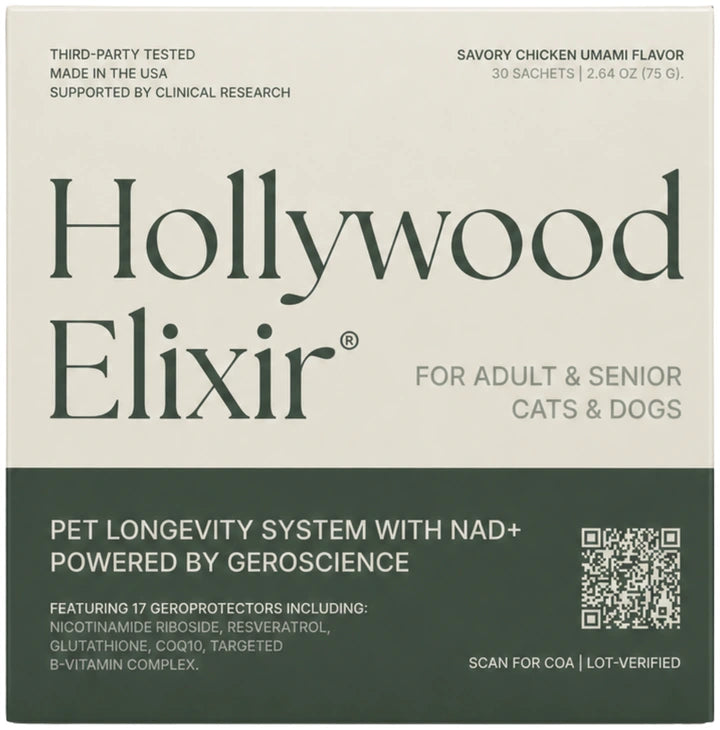
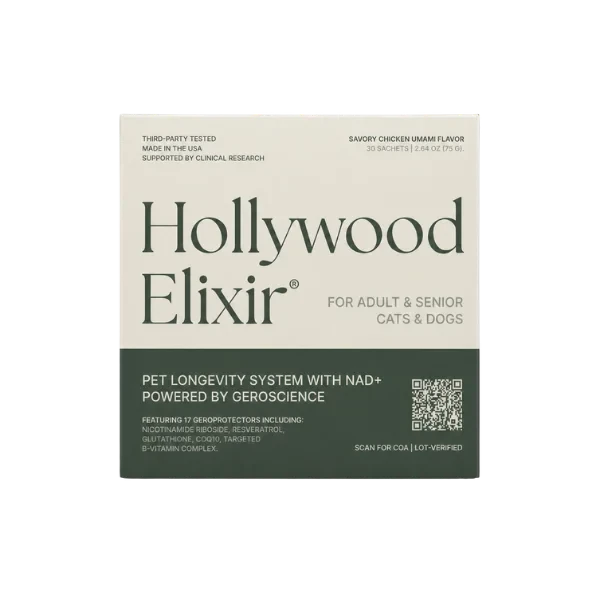
We make Hollywood Elixir, a daily nutrition powder for adult and senior cats and dogs. It's built around nicotinamide riboside, an NAD+ precursor, with CoQ10, glutathione and 14 more actives, and every active amount is printed on the label. It's a supplement, not a longevity drug: it hasn't been tested for lifespan, and it doesn't treat HCM, kidney disease or muscle loss. Its case is practical: one daily serving in the food bowl instead of a cupboard of separate supplements. If your cat has a medical condition, check with your vet first. See the full formula and serving guide.

Regular vet visits and catching kidney disease early can do more for an older cat today than any drug on the horizon.

Educational content only. This material is not a substitute for veterinary advice. Always consult your veterinarian about your cat’s specific needs. These statements have not been evaluated by the Food and Drug Administration. Products mentioned are not intended to diagnose, treat, cure, or prevent any disease.

Glossary

HCM: hypertrophic cardiomyopathy, a thickening of the heart muscle and the most common heart disease in cats.

Subclinical: present, but not yet causing symptoms.

Sirolimus: the drug name for rapamycin.

AIM: apoptosis inhibitor of macrophage, a blood protein involved in clearing kidney debris.

Conditional approval: FDA permission to sell an animal drug for up to five years while full effectiveness evidence is collected. Off-label use isn't allowed.

Sarcopenia: age-related loss of muscle.

Related Reading

References

Sources and further detail

  1. Loyal, *Products in development* (checked November 2026)
  2. FDA, *Conditional approval explained: a resource for veterinarians*
  3. Loyal, *For veterinarians* (checked November 2026)
  4. Longevity.Technology (8 Oct 2025), Cat Health Company secures $1.2m to extend feline healthspan
  5. Loyal (11 Feb 2026), Loyal raises $100M Series C
  6. Longevity.Technology (18 Sept 2026), Cat sarcopenia drug moves toward market
  7. The Underbite (18 Aug 2026), A feline muscle-loss drug clears its first trial
  8. FDA (14 March 2025), FDA conditionally approves drug for management of ventricular hypertrophy in cats
  9. dvm360 (June 2025), Novel cardiology therapy for cats is launched
  10. Kaplan JL, Rivas VN, Walker AL et al. *JAVMA* (2023). Delayed-release rapamycin halts progression of left ventricular hypertrophy in subclinical feline hypertrophic cardiomyopathy: results of the RAPACAT trial
  11. Sugisawa R, Hiramoto E, Matsuoka S et al. *Scientific Reports* (2016). Impact of feline AIM on the susceptibility of cats to renal disease
  12. Tezuka T, Arakawa H, Kudo K et al. *The Veterinary Journal* (2026). A clinical impact of apoptosis inhibitor of macrophage on feline chronic kidney disease
  13. IAM CAT (24 April 2026), Notice of manufacturing and marketing approval application for the AIM cat drug FeliAIM (in Japanese)
  14. Montoya M, Morrison JA, Arrignon F et al. *Frontiers in Veterinary Science* (2023). Life expectancy tables for dogs and cats derived from clinical data
  15. Teng KT, Brodbelt DC, Church DB, O'Neill DG. *Journal of Feline Medicine and Surgery* (2024). Life tables of annual life expectancy and risk factors for mortality in cats in the UK
  16. Pye CR, Dowgray NJ, Eyre K et al. *Frontiers in Veterinary Science* (2026). Patterns of morbidity, multimorbidity, and mortality in aging cats: seven years of the Cat Prospective Aging and Welfare Study
  17. O'Neill DG, Church DB, McGreevy PD et al. *Journal of Feline Medicine and Surgery* (2015). Longevity and mortality of cats attending primary care veterinary practices in England
  18. Taylor AR, McDonald J, Foreman-Worsley R et al. *Journal of Feline Medicine and Surgery* (2025). Mortality and life table analysis in a young cohort of pet cats in the UK
  19. American Association of Feline Practitioners (2021), AAFP releases updated feline senior care guidelines
  20. Taylor S, Finch N, Caney S et al. *Journal of Feline Medicine and Surgery* (2026). 2026 iCatCare consensus guidelines on the diagnosis and management of chronic kidney disease in cats

FAQ

Orange-and-white cat beside a Hollywood Elixir box held in a person's hand

Discover LPL-01: How This Fits Into a Larger Feline Longevity System

Aging in cats unfolds quietly. It’s not driven by a single failure, but by gradual shifts across interconnected systems — cellular energy, oxidative balance, immune tone, and tissue integrity — each influencing the others over time.

This article explores one layer of that system. To understand what actually shapes long-term health, you need to step back and look at how these layers interact.

Start with the underlying science: