



The 12 Hallmarks of Aging in Dogs, Explained
Read full insightResveratrol for Dogs
How this plant compound works, what dog studies found, and how it fits a daily formula
By La Petite Labs Editorial 19 min read

What an antioxidant helps protect

What trans-resveratrol means

Dogs absorb it, then change it

The immune study found several different responses
The memory trial did not find an improvement

Can resveratrol treat heart disease or cancer?

What the 91-day safety study found

DVM Voice: Clinical Vignette of a Common Pattern in Senior Dog Aging
Case provided by JoAnna Pendergrass, DVM
Rex, a 7-year-old Labrador Retriever, was brought in after his owner noticed he was slower to rise, hesitant on stairs, and less able to play as before. Examination showed stiffness and reduced hip mobility; radiographs confirmed degenerative joint changes.
His care required weight management, veterinary-guided pain control, nutritional support, and rehabilitation — a comprehensive plan, but one started only after visible decline appeared.
Clinical takeaway: Rex’s case reflects the value of proactive aging support: maintaining lean body condition, monitoring mobility early, and supporting cellular resilience, antioxidant defense, and healthy inflammatory balance before decline becomes obvious.
Single-case vignette. Not generalizable. Veterinary oversight is essential for pain, stiffness, or suspected joint disease.

How much resveratrol should a dog receive?

Powder or capsule: picture the meal

How resveratrol connects to NAD+

When should you expect to notice a result?

Would a combined powder replace anything on the shelf?
References
Numbered references identify the sources used for specific claims. Read the study design, species and evidence boundaries alongside each finding.
-
Johnson WD and colleagues. Subchronic oral toxicity and cardiovascular safety pharmacology studies of resveratrol, a naturally occurring polyphenol with cancer preventive activity. Evidence boundary: Young beagles received oral resveratrol for 91 days. At the highest dose they ate less and had lower average body weights than controls; the study’s toxicology limit is not a daily supplement recommendation.↩ 1 · ↩ 2 · ↩ 3 · ↩ 4 · ↩ 5 · ↩ 6
-
Muzzio M and colleagues. Determination of resveratrol and its sulfate and glucuronide metabolites in plasma by LC-MS/MS and their pharmacokinetics in dogs. Evidence boundary: This companion study measured unchanged resveratrol and its metabolites after high oral doses in beagles. It explains absorption and conversion, without comparing retail supplement formats.↩ 1 · ↩ 2 · ↩ 3 · ↩ 4
-
Mathew LM and colleagues. Resveratrol administration increases phagocytosis, decreases oxidative burst, and promotes pro-inflammatory cytokine production in healthy dogs. Evidence boundary: Twelve healthy dogs took part in this three-day open-label oral study. Several immune functions changed in different directions; fewer infections or a general anti-inflammatory benefit were not demonstrated.↩ 1 · ↩ 2 · ↩ 3 · ↩ 4
-
Bian Z and colleagues. Resveratrol Ameliorates Chronic Stress in Kennel Dogs and Mice by Regulating Gut Microbiome and Metabolome Related to Tryptophan Metabolism. Evidence boundary: Eighteen dogs living in restricted kennels received resveratrol, fluoxetine or control capsules. Findings from brief behavioral tests, blood and feces do not establish treatment equivalence or household anxiety benefit; brain-tissue experiments used mice.↩ 1 · ↩ 2 · ↩ 3 · ↩ 4 · ↩ 5
-
Story MM and colleagues. Effect of Resveratrol Supplementation on the Performance of Dogs in an Eight-Arm Radial Maze. Evidence boundary: Young healthy dogs received a fixed 60 mg of resveratrol per dog daily over 16 weeks. Tested maze performance did not improve significantly; the study did not test treatment of senior canine cognitive dysfunction.↩ 1 · ↩ 2 · ↩ 3 · ↩ 4 · ↩ 5
-
Chethan GE and colleagues. Antioxidant supplementation during treatment of outpatient dogs with parvovirus enteritis ameliorates oxidative stress and attenuates intestinal injury: A randomized controlled trial. Evidence boundary: Resveratrol was added to veterinary treatment for puppies with parvovirus. Some laboratory measurements improved, but added clinical-score, fecal-virus and survival benefits were not demonstrated.↩ 1 · ↩ 2 · ↩ 3
-
Ho KM and colleagues. Improved Cardiovascular Tolerance to Hemorrhage after Oral Resveratrol Pretreatment in Dogs. Evidence boundary: This twelve-greyhound experiment measured tolerance of severe induced blood loss after resveratrol pretreatment. It did not demonstrate kidney protection or improved everyday stamina.↩
-
Kondratyuk TP and colleagues. Evidence supporting the conceptual framework of cancer chemoprevention in canines. Evidence boundary: Eight dogs received biscuits containing five polyphenols. A laboratory challenge of collected blood cells showed less induced DNA damage; the study did not establish cancer prevention or isolate resveratrol’s effects.↩ 1 · ↩ 2
-
Hubbard BP and colleagues. Evidence for a Common Mechanism of SIRT1 Regulation by Allosteric Activators. Evidence boundary: Biochemical and cell experiments explain how resveratrol can influence SIRT1 under specific conditions. They do not demonstrate a universal longevity switch or the same response to a supplement in dogs.↩ 1 · ↩ 2 · ↩ 3 · ↩ 4
-
Park SJ and colleagues. Resveratrol Ameliorates Aging-Related Metabolic Phenotypes by Inhibiting cAMP Phosphodiesterases. Evidence boundary: Cell and mouse work identified an indirect signaling route involving increased NAD and SIRT1 activity. Resveratrol remains distinct from an NAD precursor, and the findings do not establish an effect of a retail formula in dogs.↩
-
Chow HHS and colleagues. Resveratrol Modulates Drug and Carcinogen Metabolizing Enzymes in a Healthy Volunteer Study. Evidence boundary: Healthy human volunteers took high-dose resveratrol for four weeks. Changes in drug-processing enzymes give a reason to review medicines, without quantifying interaction risks in dogs.↩
-
Trela BC and Waterhouse AL. Resveratrol: Isomeric Molar Absorptivities and Stability. Evidence boundary: Laboratory chemistry distinguished cis and trans forms and examined stability under different conditions. These results do not verify a product’s trans proportion, shelf life or effectiveness in dogs.↩ 1 · ↩ 2
-
Cornell University College of Veterinary Medicine. Grape and raisin toxicity. Evidence boundary: Veterinary guidance explains the kidney-injury risk from grapes and raisins and the need for immediate veterinary contact after ingestion. Whole fruit is not a safe way to supply resveratrol.↩
-
U.S. Food and Drug Administration. Paws Off Xylitol; It’s Dangerous for Dogs. Evidence boundary: FDA guidance identifies xylitol as dangerous to dogs and notes that it may occur in products intended for people, including supplements.↩
-
Fletcher RS and colleagues. Nicotinamide riboside kinases display redundancy in mediating nicotinamide mononucleotide and nicotinamide riboside metabolism in skeletal muscle cells. Evidence boundary: Mouse muscle-cell research explains NR’s role as starting material in NAD synthesis. It does not establish clinical benefit from an NR–resveratrol combination in dogs.↩
-
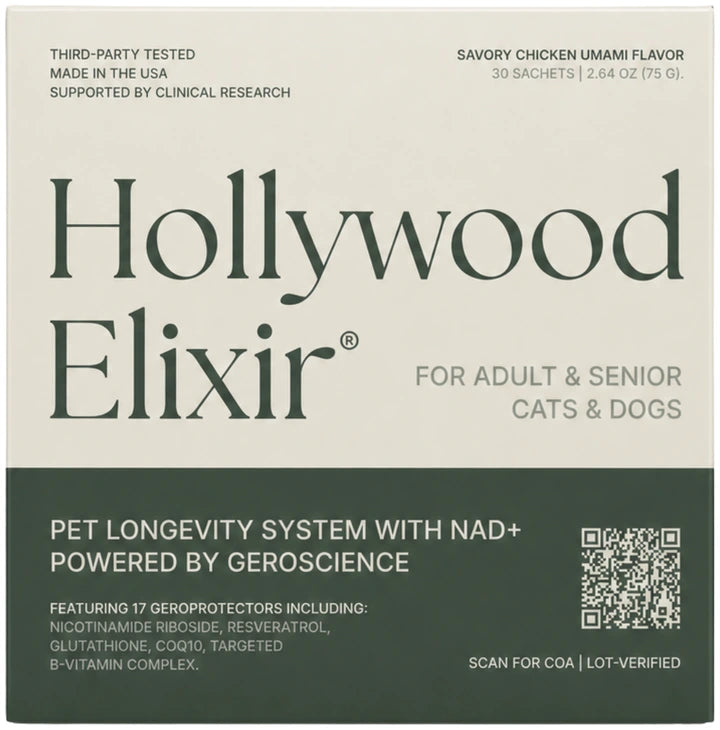
La Petite Labs. Hollywood Elixir Ingredients: NAD+ & Antioxidants. Evidence boundary: The ingredient guide identifies the declared resveratrol amount, standardized botanical extract and other ingredient preparations. It does not separately specify a trans-isomer proportion.↩ 1 · ↩ 2 · ↩ 3
-
La Petite Labs. Hollywood Elixir product supplement facts and directions. Evidence boundary: The product panel gives ingredient amounts per standard 2.5 g sachet, and the directions describe mixing the pre-measured powder into the usual food. Product specifications describe what is supplied; they are not a clinical trial.↩ 1 · ↩ 2 · ↩ 3 · ↩ 4 · ↩ 5

Discover LPL-01: How This Fits Into a Larger Canine Longevity System
Aging in dogs is not driven by a single pathway. It’s the result of interacting biological systems—energy metabolism, oxidative stress, immune signaling, and structural integrity—changing over time.
This article explores one piece of that puzzle. If you want to understand how these pieces connect—and what actually moves the needle—you need to zoom out.
Start with the underlying science:
- Canine Geroscience Framework →
A structured view of how aging progresses across cellular energy, inflammation, and resilience systems. - Senior Biological Defense Coverage (BDC) Modeling →
A systems-level map of which biological pathways decline first, and how layered interventions can support them. - 2026 Market Research: Best Dog Longevity Supplements →
A 2026 industry report and review of leading senior-dog and cellular-aging formulas. - LPL-01 Standard →
The formulation system that translates these models into real-world supplementation—covering multiple pathways in a coordinated way.
Keep exploring
What would you like to understand next?
Search practical guides about healthy aging, cellular energy, ingredients, and daily support for dogs.


