


The 12 Hallmarks of Aging in Dogs, Explained
Read full insightVitamin C for Cats
Cats make their own vitamin C. Here is why it still appears in antioxidant formulas—and when adding it needs care.
By La Petite Labs Editorial 18 min read

Vitamin C helps the body finish making collagen

An antioxidant gives up an electron to help stop a reaction

Vitamin C can help restore vitamin E

Glutathione helps complete the recycling picture

Added antioxidants have been studied in healthy cats

What that study means for a supplement choice

For a sneezing cat, start with the respiratory problem

DVM Voice: Clinical Vignette of a Common Pattern in Senior Cat Aging
Case provided by JoAnna Pendergrass, DVM
Sasha, a 12-year-old cat, was brought in after her owner noticed increased thirst and urination, lethargy, vomiting, and a generally unkempt appearance. Examination showed weight loss, elevated blood pressure, and reduced vitality.
Diagnostic testing revealed elevated kidney markers, poorly concentrated urine, and protein loss in the urine — findings consistent with chronic kidney disease, one of the most common chronic conditions in senior cats.
Her care required a kidney-focused diet, blood pressure management, targeted supplementation, medication support, and regular monitoring — a necessary plan, but one started after clinical signs were already visible.
Clinical takeaway: Sasha’s case reflects why senior-cat wellness should begin before obvious decline. Earlier monitoring, body-condition tracking, hydration awareness, antioxidant support, and daily cellular resilience may help support quality of life as cats age.
Single-case vignette. Not generalizable. Veterinary diagnosis and monitoring are essential for increased thirst, urination, vomiting, lethargy, weight loss, or suspected kidney disease.

Do not use vitamin C as a home remedy for urinary crystals

Water-soluble does not mean unlimited

Read milligrams of vitamin C separately from the serving weight

Keep the food and water your cat reliably accepts

Watch tolerance; do not wait for a promised transformation
References
Numbered references identify the sources used for specific claims. Read the study design, species and evidence boundaries alongside each finding.
-
Sherry Lynn Sanderson / Merck Veterinary Manual. Nutritional Requirements of Small Animals. Species/context: Cat and dog nutrition guidanceEvidence boundary: Cats synthesize vitamin C in the liver; AAFCO has no dietary vitamin-C requirement for cats.↩ 1 · ↩ 2 · ↩ 3
-
R. Myllylä, K. Majamaa, V. Günzler, H. M. Hanauske-Abel and K. I. Kivirikko. Ascorbate is consumed stoichiometrically in the uncoupled reactions catalyzed by prolyl 4-hydroxylase and lysyl hydroxylase. Species/context: Laboratory enzyme studyEvidence boundary: Ascorbate helps reactivate enzymes involved in collagen hydroxylation.↩
-
J. E. Packer, T. F. Slater and R. L. Willson. Direct observation of a free radical interaction between vitamin E and vitamin C. Species/context: Laboratory chemical studyEvidence boundary: Directly observed vitamin C interacting with the vitamin-E radical to regenerate vitamin E.↩ 1 · ↩ 2
-
W. W. Wells, D. P. Xu, Y. F. Yang and P. A. Rocque. Mammalian thioltransferase (glutaredoxin) and protein disulfide isomerase have dehydroascorbate reductase activity. Species/context: Purified enzymes from pig, cattle and human tissuesEvidence boundary: Glutathione-dependent enzymes regenerated ascorbate from its oxidized form in laboratory assays.↩
-
Dennis E. Jewell, Laura A. Motsinger and Inke Paetau-Robinson. Effect of dietary antioxidants on free radical damage in dogs and cats. Species/context: 40 adult cats and 40 adult dogs, analyzed separatelyEvidence boundary: 84-day feeding study compared complete diets containing a C/E/beta-carotene mixture; feline laboratory endpoints supported cell protection.↩ 1 · ↩ 2
-
S. Yu and I. Paetau-Robinson. Dietary supplements of vitamins E and C and beta-carotene reduce oxidative stress in cats with renal insufficiency. Species/context: Cats with spontaneous renal insufficiencyEvidence boundary: Four-week antioxidant-enriched-food study reported reduced DNA-damage markers.↩
-
Kayla Hyland / VCA Animal Hospitals. Ascorbic Acid (Vitamin C). Species/context: Veterinary clinical guidanceEvidence boundary: Administration, diarrhea, stone-related cautions and potential drug interactions.↩ 1 · ↩ 2 · ↩ 3
-
Cornell Feline Health Center. Feline Lower Urinary Tract Disease. Species/context: Feline clinical guidanceEvidence boundary: Urinary signs have multiple causes. Suspected obstruction requires immediate care; avoid independently adding urinary acidifiers to an established diet.↩
-
J. P. Lulich, A. C. Berent, L. G. Adams, J. L. Westropp, J. W. Bartges and C. A. Osborne. ACVIM Small Animal Consensus Recommendations on the Treatment and Prevention of Uroliths in Dogs and Cats. Species/context: Cat and dog clinical consensusEvidence boundary: Struvite management and calcium-oxalate prevention have different urinary-pH goals.↩
-
Joseph W. Bartges. Feline Calcium Oxalate Urolithiasis: Risk factors and rational treatment approaches. Species/context: Feline clinical reviewEvidence boundary: Vitamin C is an oxalate precursor; supplementary C should be avoided in cats at risk of calcium-oxalate stones.↩
-
Farzin Abbasi, Reza Azargoun and Siamak Asri-Rezaei. Evaluation of Serum Vitamin D and C Concentrations in Cats With Gingivostomatitis. Species/context: 15 healthy cats and 15 cats with gingivostomatitisEvidence boundary: Observational comparison found no significant serum vitamin-C difference.↩
-
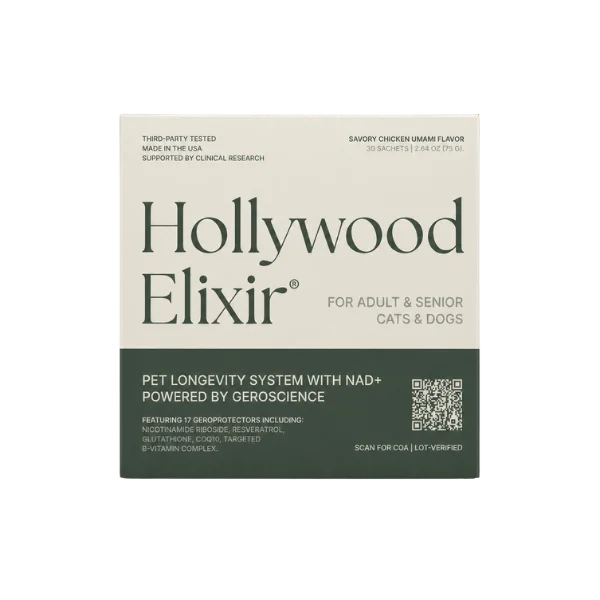
La Petite Labs. Hollywood Elixir: current supplement facts. Species/context: Manufacturer ingredient label for dogs and catsEvidence boundary: Per 2.5 g sachet: vitamin C 10 mg, vitamin E 15 IU, glutathione 50 mg, NR 60 mg and other disclosed ingredients.↩ 1 · ↩ 2
-
Cornell Feline Health Center. Respiratory Infections. Species/context: Feline clinical guidanceEvidence boundary: Respiratory infections have several causes and require appropriate clinical and supportive care.↩

Discover LPL-01: How This Fits Into a Larger Feline Longevity System
Aging in cats unfolds quietly. It’s not driven by a single failure, but by gradual shifts across interconnected systems — cellular energy, oxidative balance, immune tone, and tissue integrity — each influencing the others over time.
This article explores one layer of that system. To understand what actually shapes long-term health, you need to step back and look at how these layers interact.
Start with the underlying science:
- Feline Geroscience Framework →
A structured view of how aging progresses across cellular energy, inflammation, and resilience systems. - Senior Biological Defense Coverage (BDC) Modeling →
A systems-level map of which biological pathways decline first, and how layered interventions can support them. - 2026 Market Research: Best Cat Longevity Supplements →
A feline-specific review of longevity supplements. 2026 Industry report created by LPL-01 Research. - LPL-01 Standard →
The formulation system that translates these models into real-world supplementation—covering multiple pathways in a coordinated way.
Keep exploring
What would you like to understand next?
Search practical guides about healthy aging, cellular energy, ingredients, and daily support for cats.


