Vitamin B12 Supplement for Cats

What B12 does, why cats run low, and how oral supplements compare with injections

By La Petite Labs Editorial 19 min read

Woman cuddling an orange-and-white cat and a silver tabby while holding a Hollywood Elixir box
Hollywood Elixir® Daily longevity system · adult & senior cats Starting at $63/month 

A cat can finish every meal and still struggle to absorb enough vitamin B12. That is one reason this small nutrient often becomes part of a much bigger conversation about weight loss, digestion and appetite. B12 helps cells process certain nutrients and renew themselves; when a deficiency develops, replacing it can be an important part of care. 1 3

There are now useful feline studies to guide the choice between oral B12 and injections, including evidence in cats with pancreatic insufficiency. There is also a separate place for B12 in daily nutrition: Hollywood Elixir includes it alongside NR and CoQ10, whose roles in NAD synthesis and mitochondrial energy transfer complement B12’s own work. Understanding those jobs makes the choice between a prescribed treatment and a broader formula much clearer. 3 9 10 11

B12 helps process certain fats and amino acids and supports folate-dependent cell renewal. A complete diet does not prevent every deficiency because intestinal or pancreatic disease can impair absorption.

A 2024 feline trial found that both oral and injected cyanocobalamin corrected low blood B12; most cats with elevated MMA also improved that metabolic marker. The specific preparation, schedule and follow-up matter.

Hollywood Elixir includes a methylcobalamin preparation beside NR and CoQ10. Those ingredients have complementary roles in nutrient metabolism and cellular energy, while prescribed B12 replacement remains a separate clinical plan.

What vitamin B12 does with the food your cat eats

A meal supplies fuel. B12 helps your cat process part of it. Inside cells, a B12-dependent enzyme turns fragments from certain fats and amino acids into a compound that enters the citric acid cycle—one of the main stages of energy metabolism. Without enough usable B12, that reaction slows and a related substance, methylmalonic acid, can build up. 1

That is a more useful explanation of an “energy vitamin” than the idea of an instant boost. B12 is a cofactor: a small molecule an enzyme needs to carry out its job. Its importance is clearest when a shortage interrupts the chemistry. Adding more to an adequately nourished cat has not been shown by the deficiency studies to produce extra playfulness or stamina.

Woman kneeling with two long-haired tabby cats while holding a Hollywood Elixir box beside a food bowl

B12 also helps cells renew themselves

B12 takes part in another reaction that makes methionine, an amino acid used in proteins and other essential cellular work. The same process returns folate to a usable form. Folate is needed to make the components of DNA, so this connection matters whenever cells divide and replace themselves, including in the production of blood cells. 2

This is why B12 appears in discussions of blood, nerves and metabolism. Those functions are connected through cell chemistry; they are not three separate promises that every B12 product can deliver. Anemia or a new neurological problem still needs its own diagnosis. Giving B12 does not identify the cause.

Woman exercising beside a tabby cat, with a Hollywood Elixir box and food bowl on a small table

Why a cat can eat well and still run low

Getting B12 from a meal into the body takes several steps. In cats, the pancreas makes a carrier protein called intrinsic factor. B12 binds to that carrier, and the complex is taken up near the far end of the small intestine, in the ileum. Disease in the pancreas or intestine can disrupt the journey. 3

That explains an apparent contradiction: a cat can receive a nutritionally complete food and still have a low B12 result. Exocrine pancreatic insufficiency, or EPI, affects the pancreas’s digestive functions; chronic intestinal disease can impair absorption. A low result therefore deserves more attention than simply checking whether the food contains the vitamin. 6

Orange-and-white cat reaching toward a woman holding a Hollywood Elixir box while sitting in a chair

The signs owners notice first

Weight loss in an older cat, recurring vomiting or diarrhea, and changes in appetite are common reasons B12 enters a veterinary investigation. Appetite can fall, but some affected cats eat eagerly and still lose weight. These patterns overlap with the underlying digestive illness, which makes B12 deficiency difficult to recognize from behavior alone. 3 4

Write down what has changed: body weight, how much food is actually eaten, stool consistency and the frequency of vomiting. A photograph of an unfinished bowl is more informative than “a bit picky.” If your cat stops eating, contact your veterinarian promptly; prolonged food refusal can become harmful quickly. New seizures, collapse or severe weakness require urgent care. 12

Gray-haired man holding a Hollywood Elixir box while two cats rest beside him in an armchair

Blood B12 and MMA answer different questions

A serum cobalamin test measures the amount of B12 circulating in the blood. Methylmalonic acid, usually shortened to MMA, gives another clue: it can rise when the B12-dependent metabolic reaction inside cells is not working adequately. One test measures the vitamin; the other helps reveal a consequence of insufficient cellular availability. 3

The two results do not always move together. In a study of cats receiving hydroxocobalamin injections, blood B12 fell between follow-up visits while the group’s median MMA remained within the laboratory’s reference range. Your veterinarian interprets the tests alongside symptoms, treatment dates and the laboratory’s own ranges. A single number from an online chart cannot do all of that. 4

A full food bowl does not guarantee that a cat is absorbing enough B12.

Oral B12 can work—even with pancreatic insufficiency

Owners are often told that a cat with an absorption problem must have injections. Newer feline evidence makes that answer less absolute. A randomized 2024 study compared oral and injected cyanocobalamin in cats with low B12 and either chronic gastrointestinal disease or EPI. All 48 cats who completed the study reached normal blood B12 concentrations. 3

The result also extended beyond the blood vitamin level: most cats who began with elevated MMA had it return to the normal range. The oral treatment was a specific daily preparation given for 12 weeks, with scheduled testing. This gives owners a well-founded reason to discuss an oral option when clinic visits or injections are difficult. It does not mean every liquid, chew or multivitamin will give the same result.

Tabby cat looking up at a Hollywood Elixir sachet held above it, with the product box on a small table

Why your veterinarian may still choose injections

An injection delivers the prescribed amount without depending on a cat swallowing a tablet or finishing medicated food. That can matter when appetite is poor, oral administration repeatedly fails, or the veterinarian wants a route they can administer and verify. Oral treatment, in turn, may be easier for a cat who reliably accepts it at home. 6 7

The useful comparison includes the whole routine: trips to the clinic, handling stress, appetite, cost and the likelihood of a missed dose. If home injections are offered, ask the veterinary team to teach the technique and storage requirements. Difficulty with one route is a reason to adjust the plan, rather than quietly abandon treatment.

Hand gently petting an orange-and-white cat beside a food bowl and Hollywood Elixir box

Cyanocobalamin, hydroxocobalamin or methylcobalamin?

These names describe different forms of B12. Cyanocobalamin was used in the 2024 oral-versus-injection trial. Hydroxocobalamin injections were studied in a separate group of 23 cats with digestive disease and low B12, with improvements in blood and metabolic measurements. Because those studies used different protocols and populations, they do not establish one universally superior form. 3 4

Methylcobalamin is a form used in normal methionine metabolism and appears in some supplements, including Hollywood Elixir’s detailed ingredient list. That biochemical role is real. It does not, by itself, show that an oral methylcobalamin product works better than the cyanocobalamin preparations studied in cats. Choose a treatment by its formulation, clinical evidence and follow-up plan, rather than the appeal of the word “active.” 2 14

Man holding a Hollywood Elixir box beside a black cat, an orange tabby and a food bowl

What a B12 dose actually describes

In the 2024 trial, the oral group received 250 micrograms of cyanocobalamin daily. The injected group received the same amount per injection on a different schedule. This is a description of a clinical study, not a universal prescription: a daily oral dose and an occasional injected dose are different regimens. 3

Before giving a product, confirm the vitamin form, the amount per tablet or milliliter, the prescribed frequency and when to recheck. “One drop” is incomplete without a concentration. A multinutrient powder also brings every other ingredient in its serving, so increasing that powder to chase a B12 number increases the rest of the formula too. Use the product and amount your veterinarian has chosen for the treatment goal. 7

How quickly might a deficient cat improve?

There is reason for optimism when a real deficiency is corrected. In an early study of 19 cats with severe B12 deficiency and intestinal signs, average body weight increased by 8.2% after four weeks of injections, alongside improved biochemical results. Some cats also vomited less or had less diarrhea. That was a small before-and-after study; its average is not a forecast for an individual cat. 5

An improvement in appetite or weight can be encouraging while the digestive diagnosis is still being treated. Persistent symptoms can mean that more than B12 is involved. Use the review date agreed with your veterinarian, and call sooner if your cat worsens. Waiting for a vitamin to work should not postpone help for continuing weight loss or food refusal.

A feline trial found that oral B12 could correct low blood levels even in cats with pancreatic insufficiency.

Silver tabby sitting beside a food bowl and a Hollywood Elixir box held in a person's hand

DVM Voice: Clinical Vignette of a Common Pattern in Senior Cat Aging

Case provided by JoAnna Pendergrass, DVM

Sasha, a 12-year-old cat, was brought in after her owner noticed increased thirst and urination, lethargy, vomiting, and a generally unkempt appearance. Examination showed weight loss, elevated blood pressure, and reduced vitality.

Diagnostic testing revealed elevated kidney markers, poorly concentrated urine, and protein loss in the urine — findings consistent with chronic kidney disease, one of the most common chronic conditions in senior cats.

Her care required a kidney-focused diet, blood pressure management, targeted supplementation, medication support, and regular monitoring — a necessary plan, but one started after clinical signs were already visible.

Clinical takeaway: Sasha’s case reflects why senior-cat wellness should begin before obvious decline. Earlier monitoring, body-condition tracking, hydration awareness, antioxidant support, and daily cellular resilience may help support quality of life as cats age.

Single-case vignette. Not generalizable. Veterinary diagnosis and monitoring are essential for increased thirst, urination, vomiting, lethargy, weight loss, or suspected kidney disease.

Explore Hollywood Elixir Research →
Woman holding a Hollywood Elixir box toward a brown cat perched on the back of a sofa

Feeling better is not always the end of treatment

If the condition that impaired absorption remains, the need for B12 support may remain too. Some cats need an ongoing plan; others can change treatment after reassessment. The decision is based on the clinical course and repeat testing, rather than a rule that every cat needs lifelong injections. 6

Tell the clinic exactly what has been given and when. A recent injection or daily oral treatment changes the context of a blood result. This is also why casually adding several B12-containing products can complicate the picture: the veterinarian needs to know the actual exposure before interpreting a recheck.

Woman leaning toward a fluffy orange cat beside a Hollywood Elixir box and green food bowl

Where Hollywood Elixir’s B12 fits

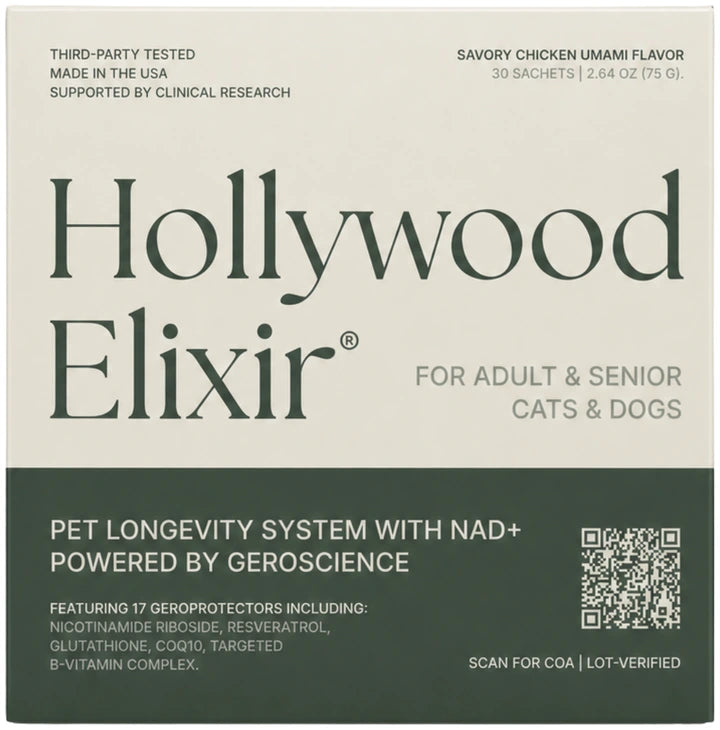
Hollywood Elixir includes B12 within a daily formula built around cellular energy and antioxidant nutrition. Its detailed ingredient list names a 1% methylcobalamin preparation; the standard 2.5 g sachet also declares 60 mg of nicotinamide riboside (NR) and 40 mg of CoQ10. A premix amount is not automatically an active-vitamin amount, so the B12 label should not be read as a match for the clinical doses discussed above. 9 14

There is a concrete reason to consider those nutrients together. B12 supports steps in nutrient processing and cell renewal. NR supplies a precursor the body can use to make NAD, which carries electrons in energy metabolism. CoQ10 transfers electrons within mitochondria as part of the machinery that supports ATP production. Different stages of the same larger task receive nutritional attention. 1 2 10 11

For an owner choosing a daily healthy-aging supplement, Hollywood Elixir offers those ingredients together in a food-mixed formula. The NAD+ guide for cats explains the broader energy system. The formulation rationale is grounded in normal biology; a clinical improvement from the finished blend has not been established by the B12 trials discussed here.

Tabby cat licking its nose beside a food bowl and Hollywood Elixir box

A B12 treatment, a B complex and a daily blend have different jobs

A prescribed B12 preparation can target an identified cobalamin deficit. A B-complex product supplies a selection of B vitamins, with the exact contents depending on its label. Hollywood Elixir combines four declared B vitamins—B2, B3, B6 and B12—with NR, CoQ10 and antioxidant ingredients. It is not a complete B-complex product. 9

That distinction helps you choose deliberately. Someone comparing daily metabolic supplements may value the breadth of Hollywood Elixir’s full ingredient list. A cat undergoing B12 treatment needs the prescribed preparation and monitoring, even if a separate daily supplement is also being considered. Our guide to B vitamins for cats explains what each member of the family does.

Human tablets and “natural B12” need a closer look

A human B12 product may use a familiar vitamin form, but its strength, other ingredients and instructions still need checking for the individual cat. A combined tablet can contain much more than B12. Bring the exact label to the clinic before substituting it for a prescribed product. 7

Spirulina introduces a different issue. An analysis of spirulina tablets found that much of the B12-like material was a related compound called pseudovitamin B12. The study tested composition, not absorption in cats, but it shows why a general “B12-rich” description is not enough to establish a treatment dose. Hollywood Elixir lists B12 separately from its spirulina; the two ingredients should not be counted as interchangeable sources of cobalamin therapy. 13 9 14

Make the routine work for the cat in front of you

For an oral product intended to be mixed with food, a small portion that your cat reliably finishes makes intake easier to judge than a full bowl. Follow the product’s directions and the veterinary plan; some preparations have different requirements. If adding it makes the food unacceptable, contact the clinic about another format before meals become a struggle. 7

Keep a simple record of doses, refusals and any symptoms. Ask what to do after a missed dose rather than doubling the next one. For powders or liquids, use the specified measuring device and follow storage instructions. The goal is to make the intended amount consistently achievable, while preserving your cat’s willingness to eat.

Tabby cat sitting at a table with a food bowl and Hollywood Elixir box

Side effects deserve attention, even with a familiar vitamin

B12 is commonly used in feline care, but a reaction after starting treatment should still be reported. In the 2024 study, two cats were withdrawn after owners reported digestive problems associated with an oral B12-and-folate chew. That does not prove which component caused the problem, and it does not justify dismissing the change as unrelated. 3

Injections can cause discomfort at the injection site. Seek prompt veterinary advice for worsening vomiting, diarrhea or constipation, and urgent help for a suspected allergic reaction such as facial swelling or breathing difficulty. For a combination supplement, review the entire formula, diet and medication list together. “Water-soluble” is not a complete safety assessment. 7

Woman cuddling a silver tabby and a cream-colored cat while holding a Hollywood Elixir box

Senior cats need an individual assessment

Age alone cannot tell you whether a cat needs B12 replacement. An older cat losing weight, developing digestive signs or showing a new drop in energy deserves an investigation; a younger cat with intestinal disease can also be deficient. A stable senior eating an appropriate complete diet starts from a different position. 6 8

For daily care, keep the food’s nutritional adequacy and the supplement’s purpose distinct. A complete-and-balanced food statement addresses the diet’s intended nutritional role. Hollywood Elixir adds selected metabolic and antioxidant ingredients for owners who want that broader daily approach. Neither a vitamin powder nor a handful of organ meat can make an improvised diet nutritionally complete.

Choose the next step by the problem you are solving

If your cat has a low B12 result, agree on the preparation, route and recheck with your veterinarian. Oral therapy may be a practical option even when digestive disease is involved. If your cat is losing weight or refusing food without a diagnosis, investigate the change before choosing a supplement. 3 6

If the question is daily nutritional support for a stable adult cat, Hollywood Elixir’s appeal is its purposeful combination: B12 for nutrient metabolism and cell renewal, NR for NAD synthesis and CoQ10 for mitochondrial electron transfer. Review the serving and the whole label, including how it fits with existing care. Our pet supplement quality guide explains how to evaluate the product behind an ingredient claim. 9 If you are comparing several types of support, the senior-cat supplement guide offers a wider category overview.

B12 helps process nutrients; NR supplies an NAD precursor; CoQ10 carries electrons inside mitochondria.

Educational content only. This material is not a substitute for veterinary advice. Always consult your veterinarian about your cat’s specific needs. These statements have not been evaluated by the Food and Drug Administration. Products mentioned are not intended to diagnose, treat, cure, or prevent any disease.

Glossary

Cobalamin: Another name for vitamin B12, a family of related compounds with essential roles in metabolism.

Cofactor: A molecule an enzyme needs to carry out a chemical reaction.

Intrinsic factor: The carrier protein that helps B12 absorption; in cats, the pancreas produces it.

Ileum: The final part of the small intestine, where the B12–intrinsic-factor complex is absorbed.

Exocrine pancreatic insufficiency: A condition in which the pancreas does not provide enough digestive enzymes; B12 deficiency is a common concern.

Methylmalonic acid: A substance that can rise when B12-dependent cellular metabolism is impaired; abbreviated MMA.

Cyanocobalamin: A B12 form tested in oral and injectable feline treatment regimens.

Hydroxocobalamin: A B12 form studied by injection in cats with gastrointestinal disease.

Methylcobalamin: A form used in the body’s methionine reaction and named in Hollywood Elixir’s detailed ingredient list.

Nicotinamide riboside: A precursor the body can use to make NAD; abbreviated NR.

Related Reading

References

Numbered references identify the sources used for specific claims. Read the study design, species and evidence boundaries alongside each finding.

  1. Reactome. MUT isomerises L-MM-CoA to SUCC-CoA. Accessed 2026Species/context: Conserved mammalian chemistry; human curated pathwayEvidence boundary: This reaction explains a normal B12-dependent step in nutrient metabolism. It does not show that extra B12 increases energy in a cat already receiving enough.↩ 1 · ↩ 2 · ↩ 3
  2. Reactome. MTR transfers CH3 from MeCbl to HCYS. Accessed 2026Species/context: Conserved mammalian chemistry; human curated pathwayEvidence boundary: B12 participates in methionine formation and folate recycling. These reactions help explain its importance to cell renewal; they do not establish that a supplement repairs age-related DNA damage.↩ 1 · ↩ 2 · ↩ 3
  3. Chee-Hoon Chang, Jonathan Lidbury, Jan S. Suchodolski, Joerg M. Steiner. Effect of oral or subcutaneous administration of cyanocobalamin in hypocobalaminemic cats with chronic gastrointestinal disease or exocrine pancreatic insufficiency. 2024Species/context: CatsEvidence boundary: Both oral and injected cyanocobalamin corrected low blood B12 in this trial. The cats had gastrointestinal disease or pancreatic insufficiency, and the study did not test a daily multinutrient formula.↩ 1 · ↩ 2 · ↩ 3 · ↩ 4 · ↩ 5 · ↩ 6 · ↩ 7 · ↩ 8 · ↩ 9 · ↩ 10
  4. Peter H. Kook, Roger H. Melliger, Martin Hersberger. Efficacy of intramuscular hydroxocobalamin supplementation in cats with cobalamin deficiency and gastrointestinal disease. 2020Species/context: CatsEvidence boundary: Hydroxocobalamin injections improved B12 and metabolic measurements in these 23 cats. There was no randomized comparison with other B12 forms, and the cats also received other treatments.↩ 1 · ↩ 2 · ↩ 3
  5. Craig G. Ruaux, Joerg M. Steiner, David A. Williams. Early biochemical and clinical responses to cobalamin supplementation in cats with signs of gastrointestinal disease and severe hypocobalaminemia. 2005Species/context: CatsEvidence boundary: These 19 cats had severe B12 deficiency and intestinal signs. Their weight and biochemical changes after treatment do not predict what extra B12 will do for a healthy cat.↩
  6. Texas A&M Gastrointestinal Laboratory. Cobalamin Information. Accessed 2026Species/context: Cats and dogs; feline recommendations usedEvidence boundary: The laboratory explains why B12 testing and follow-up matter in digestive disease. Treatment route and duration depend on the individual cat and the response to therapy.↩ 1 · ↩ 2 · ↩ 3 · ↩ 4 · ↩ 5
  7. Kayla Hyland, Rania Gollakner. Cyanocobalamin B12 or Cobalamin. 2026Species/context: Dogs and catsEvidence boundary: This clinical handout covers administration, monitoring and possible reactions. The prescribed product and route determine the instructions.↩ 1 · ↩ 2 · ↩ 3 · ↩ 4 · ↩ 5
  8. Cornell Feline Health Center. Feeding Your Cat. Accessed 2026Species/context: CatsEvidence boundary: A complete diet appropriate to life stage provides the nutritional foundation. A vitamin product alone cannot balance an improvised diet or replace food.↩
  9. La Petite Labs. Hollywood Elixir official ingredient panel. 2026Species/context: Cats and dogsEvidence boundary: The current panel declares ingredient amounts per standard 2.5 g sachet. Hollywood Elixir supplies several complementary nutrients and is not the B12 treatment tested in the clinical studies.↩ 1 · ↩ 2 · ↩ 3 · ↩ 4 · ↩ 5
  10. Rachel S. Fletcher, Joanna Ratajczak, Craig L. Doig, Lucy A. Oakey, Rebecca Callingham, Gabriella Da Silva Xavier, Antje Garten, Yasir S. Elhassan, Philip Redpath, Marie E. Migaud, Andrew Philp, Charles Brenner, Carles Canto, Gareth G. Lavery. Nicotinamide riboside kinases display redundancy in mediating nicotinamide mononucleotide and nicotinamide riboside metabolism in skeletal muscle cells. 2017Species/context: Mouse skeletal-muscle cells and miceEvidence boundary: This work traces NR metabolism into NAD+. It explains the precursor pathway, rather than demonstrating a clinical benefit from a multinutrient formula in cats.↩ 1 · ↩ 2
  11. Reactome. Complex I oxidises NADH to NAD+, reduces CoQ to CoQH2. Accessed 2026Species/context: Conserved mitochondrial pathway; human curated recordEvidence boundary: This pathway describes normal electron transfer in mitochondria. It explains the relationship between NADH and CoQ10, rather than the effects of taking a supplement.↩ 1 · ↩ 2
  12. Cornell Feline Health Center. Anorexia. Accessed 2026Species/context: CatsEvidence boundary: Loss of appetite can reflect many illnesses and can quickly become harmful. A cat who stops eating needs veterinary assessment rather than a trial of vitamin powders.↩
  13. F. Watanabe, H. Katsura, S. Takenaka, T. Fujita, K. Abe, Y. Tamura, T. Nakatsuka, Y. Nakano. Pseudovitamin B12 is the predominant cobamide of an algal health food, spirulina tablets. 1999Species/context: Spirulina tablet composition; no animals supplementedEvidence boundary: This analysis distinguished vitamin B12 from a related analogue in spirulina tablets. It was a composition study, not a measurement of B12 absorption or deficiency treatment in cats.↩
  14. La Petite Labs. Hollywood Elixir detailed ingredient list. 2026Species/context: Cats and dogsEvidence boundary: The ingredient list identifies the B12 preparation and the forms of the other ingredients. A premix declaration should not be assumed to specify an equivalent amount of active vitamin for clinical treatment.↩ 1 · ↩ 2 · ↩ 3

FAQ

What is vitamin B12 for cats used for?

B12 helps cells process certain fats and amino acids and supports cell renewal. Veterinarians use a defined B12 preparation to correct low cobalamin, often in cats with intestinal disease or pancreatic insufficiency. Oral and injected cyanocobalamin both have feline clinical evidence. A daily multinutrient supplement has a broader nutritional purpose and should not be substituted for the prescribed treatment.

Is vitamin B12 for cats safe for daily use?

Daily oral B12 was studied for 12 weeks in cats with low cobalamin and gastrointestinal disease or pancreatic insufficiency. That supports a specific treatment option, not unlimited use of every B12-containing product. Follow the prescribed or labeled amount, review other ingredients and supplements, and keep the agreed recheck. Report new digestive problems rather than assuming a water-soluble vitamin cannot cause a problem.

What side effects can vitamin B12 cause in cats?

Possible concerns include discomfort after an injection and an adverse response to an oral preparation. Two cats in a 2024 trial withdrew after owners reported digestive problems with a B12-and-folate chew; the study did not establish which ingredient caused them. Contact your veterinarian for worsening vomiting, diarrhea or constipation, and seek urgent help for facial swelling or breathing difficulty.

Do senior cats benefit more from B12 than younger cats?

Age alone does not establish a need for B12 replacement. The clearest clinical reason is low cobalamin associated with a condition such as intestinal disease or pancreatic insufficiency, which can affect younger cats too. A stable senior eating a complete diet has a different question: whether a daily formula’s selected nutrients fit the existing diet and care plan.

What signs might suggest my cat has low vitamin B12?

Weight loss, repeated vomiting or diarrhea, and appetite changes can accompany low B12. Some cats lose weight despite eating well. These signs also occur with the underlying digestive illness and many other conditions, so they cannot diagnose a vitamin deficiency. A veterinarian may measure blood cobalamin and, when useful, methylmalonic acid to assess the metabolic picture.

Can I give my cat human vitamin B12 supplements?

Have your veterinarian check the exact product before substituting it. The vitamin form, amount per tablet or milliliter, and every other ingredient matter. A human B-complex tablet is not equivalent to a single B12 preparation, and an oral product is not interchangeable with an injection. Ask for specific administration and missed-dose instructions.

Can B12 help cats with anemia or neurologic concerns?

B12 is involved in cell renewal and normal nervous-system function, and a deficiency can be relevant to blood or neurological problems. Treatment is appropriate when the veterinarian identifies low cobalamin as part of the condition. Anemia, weakness, poor coordination or seizures can have other causes; B12 alone does not diagnose or treat all of them. New severe neurological signs need urgent assessment.

When should I call the vet urgently about low B12 signs?

Seek urgent care for collapse, seizures, breathing difficulty or severe weakness. Contact your veterinarian promptly if your cat stops eating, repeatedly vomits or is losing weight; food refusal can become harmful within a short time. These are reasons to assess the cat’s condition, not proof of low B12, and a vitamin trial should not delay that assessment.

Orange-and-white cat beside a Hollywood Elixir box held in a person's hand

Discover LPL-01: How This Fits Into a Larger Feline Longevity System

Aging in cats unfolds quietly. It’s not driven by a single failure, but by gradual shifts across interconnected systems — cellular energy, oxidative balance, immune tone, and tissue integrity — each influencing the others over time.

This article explores one layer of that system. To understand what actually shapes long-term health, you need to step back and look at how these layers interact.

Start with the underlying science:

Keep exploring

What would you like to understand next?

Search practical guides about healthy aging, cellular energy, ingredients, and daily support for cats.