Complete and Balanced Pet Food: A Foundation, Not a Healthspan Score

The adequacy statement is a meaningful nutritional floor for a named species and life stage—not AAFCO approval, a food-quality ranking, or proof of optimized healthspan.

By La Petite Labs Editorial 13 min read

Short answer: complete and balanced means a food is substantiated to supply the recognized essential nutrients in appropriate amounts and relationships for the species and life stage named on the label. It is far more meaningful than 'enough to survive.' It is also not a score of how well that food may support every animal over a lifetime. [1]

Think of the statement as a building-code pass for nutritional adequacy: necessary, consequential, and scoped to an intended use. It does not tell you whether the manufacturer has exceptional quality control, whether the calories fit your pet, whether a medical condition changes the plan, or whether one compliant food outperforms another on healthspan.

  • Complete and balanced is a real adequacy standard—not an empty marketing phrase.
  • AAFCO supplies model definitions and methods; it does not approve individual foods.
  • Read the statement's species, life stage, substantiation wording, and feeding directions together.
  • Formulated-to-meet and feeding-test claims answer different questions; neither is a lifetime trial.
  • There is no separate AAFCO senior nutrient profile for dogs or cats.
  • Adequacy does not rank manufacturer quality control, processing, individual fit, or long-term outcomes.
  • Processing deserves a two-sided assessment, not a slogan about kibble or fresh food.
  • Optional complementary nutrition should have a defined job, disclosed dose, safety logic, and stop rule.

Start With the Direct Answer

Complete and balanced means the food has been substantiated as nutritionally adequate for the species and life stage stated on its label. 'Complete' concerns the required nutrients; 'balanced' concerns their amounts and relationships. The claim qualifies a product to carry the diet for that named use when it is fed as directed. [1]

That is not merely a survival ration. At the same time, it cannot answer every nutrition question. The science library provides wider context, but this page owns the narrower label question: what the adequacy statement establishes, how it is substantiated, and where its evidentiary boundary lies.

Woman sitting poolside with a black-and-white dog and a Hollywood Elixir box

Remove the Phrase 'AAFCO Approved'

AAFCO does not approve, test, certify, or endorse an individual dog or cat food. It is a membership organization whose model laws, ingredient definitions, nutrient profiles, and feeding protocols help regulators create more consistent rules. State and federal authorities enforce the laws that apply in their jurisdictions. [3]

So 'AAFCO approved' is not a quality seal hiding somewhere on the bag. The useful question is whether the label carries an appropriate nutritional-adequacy statement and which recognized route substantiates it. A retailer badge, front-of-pack phrase, or brand claim is not a substitute for that statement.

Man running on grass beside a golden retriever

Read the Whole Adequacy Statement

Do not stop at the words complete and balanced. Record four details: dog or cat, the stated life stage, the substantiation wording, and whether the product is intended for continuous feeding. A claim for adult canine maintenance does not establish adequacy for kitten growth, pregnancy, or another species. [2]

If the label says the product is for intermittent or supplemental feeding only, it is not represented as a sole diet. That can be entirely appropriate for a topper, veterinary product, or complementary food—but its job is different, and the rest of the daily ration must continue to carry the nutritional foundation.

• Species: dog and cat claims are not interchangeable.

• Life stage: adult maintenance differs from growth and reproduction.

• Route: look for formulated-to-meet or feeding-test language.

• Use: distinguish sole-diet adequacy from supplemental or intermittent feeding.

Person running beside a black-and-white dog

Understand the Substantiation Routes

A food may be formulated so its nutrient analysis meets the relevant AAFCO profile, or nutritional adequacy may be substantiated through an animal feeding test using an AAFCO protocol. A third, less common statement identifies a family product as comparable to a feeding-tested lead product. In that case, the marketed formula is similar but not identical to the tested product; the wording does not mean this exact formula completed the feeding test. Read and preserve the exact statement. [1] [2]

These routes should not be collapsed into 'lab numbers bad, feeding tests good.' Formulation can be rigorous, and chemical analysis can scrutinize nutrients that a short protocol cannot. Feeding tests observe animals consuming a diet, but they are not lifetime trials and cannot simulate every breed, disease, calorie intake, or manufacturing deviation.

Dog jumping to catch a green flying disc

Formulated to Meet Is a Composition Claim

'Formulated to meet' means the formula is designed to supply nutrients at the levels specified in the named AAFCO profile. FDA's current explanation notes that every listed nutrient has a minimum and some also have a maximum, with profile comparisons made on defined bases. That is a substantive standard, not an ingredient-list impression. [1]

It does not mean this exact finished batch was fed to animals in an AAFCO protocol. The next diligence questions are whether the company verifies incoming materials and finished products, controls process variation, studies digestibility where relevant, and can provide a meaningful nutrient analysis—not whether the front panel sounds natural or premium.

Complete and balanced is a real adequacy standard—not an empty marketing phrase.

Feeding Tested Is Not Lifetime Tested

A feeding-test statement means animals consumed the product under the applicable AAFCO protocol and the specified measures met that protocol. This adds an in-animal evidence layer that a composition calculation alone does not provide. [1]

But a feeding protocol is bounded by its design and duration. It does not prove that the food maximizes lifespan, prevents chronic disease, suits every medical condition, or outperforms every profile-formulated alternative. Ask what was tested, in which life stage, for how long, and whether the marketed formula is the formula represented by the statement.

Runner's shoes and dog paws beside a Hollywood Elixir box

Life Stage Is Part of the Claim

AAFCO profiles are organized around adult maintenance and growth/reproduction, with large-size growth considerations where applicable. There is no separate AAFCO senior nutrient profile for dogs or cats. A bag can be marketed as senior, but the adequacy statement still identifies the regulatory nutritional life stage it supports. [1]

This matters because 'senior' is not one physiology. A stable older adult, an underweight geriatric cat, and a dog with chronic kidney disease can have different calorie, protein, mineral, texture, and monitoring needs. The adequacy statement remains the foundation; clinical assessment decides whether that foundation fits the individual.

Woman running outdoors with two dogs

What the Statement Reliably Establishes

Within its stated scope, the claim establishes that the food is represented as nutritionally adequate by a recognized method. It helps owners distinguish a sole diet from a complementary product and reduces the risk of treating an appealing but incomplete item as the entire ration. [1] [2]

That is a major public-health and formulation function. Essential nutrient deficiencies and imbalances are not minor aesthetic defects. The critical argument is therefore not that adequacy is meaningless. It is that a threshold designed to answer one crucial question should not be promoted into an answer to every question about quality, processing, individuality, and outcomes.

Two women running outdoors with their dogs

What the Statement Cannot Rank

The statement does not rank sourcing standards, supplier audits, batch consistency, contaminant controls, packaging stability, digestibility, palatability, calorie fit, clinical research, or customer support. It also does not certify that a food is ideal for one animal's disease, medications, body condition, muscle trend, or preferences. [5]

Two foods can both clear the adequacy threshold and differ on these dimensions. Conversely, a fashionable format can score well on an owner's idea of freshness and still require verification of nutritional adequacy and manufacturing competence. The right evaluation adds layers; it does not exchange one slogan for another.

Use the Historical Bioavailability Rationale Correctly

The 2014 committee proposal that informed the profiles' 2016 revision explains that nutrient concentration cannot invariably predict biological availability across every ingredient and formula. We use that archived document only for this technical rationale—not as the current Official Publication or current model text. Digestibility, chemical form, interactions, and processing can affect what reaches the animal. [4]

This caveat is often abused in both directions. It does not prove that profile-formulated foods are deficient. Nor does an ingredient's presence prove that its nutrient is fully available. A serious manufacturer combines formulation expertise, appropriate safety margins, process control, and finished-product verification instead of leaning on a guaranteed analysis alone.

Formulated-to-meet and feeding-test claims answer different questions; neither is a lifetime trial.

Black dog resting its chin in a person's hand beside a senior-dog clinical vignette

DVM Voice: Clinical Vignette of a Common Pattern in Senior Dog Aging

Case provided by JoAnna Pendergrass, DVM

Rex, a 7-year-old Labrador Retriever, was brought in after his owner noticed he was slower to rise, hesitant on stairs, and less able to play as before. Examination showed stiffness and reduced hip mobility; radiographs confirmed degenerative joint changes.

His care required weight management, veterinary-guided pain control, nutritional support, and rehabilitation — a comprehensive plan, but one started only after visible decline appeared.

Clinical takeaway: Rex’s case reflects the value of proactive aging support: maintaining lean body condition, monitoring mobility early, and supporting cellular resilience, antioxidant defense, and healthy inflammatory balance before decline becomes obvious.

Single-case vignette. Not generalizable. Veterinary oversight is essential for pain, stiffness, or suspected joint disease.

Explore Hollywood Elixir Research →
Woman walking with a brown-and-white dog on grass

Audit the Company Behind the Formula

WSAVA recommends questions that live above the adequacy line: Who formulates the diet, and what are their qualifications? Who manufactures it? What quality-control steps apply to ingredients and finished products? Is a complete nutrient analysis available? What product research has been conducted and published? [5]

No single answer is a magic badge. Together, they reveal whether the company can explain how a formula moves from specification to repeatable bowl. A polished label can tell you the intended nutrient profile; it cannot show you an unseen supplier audit, stability program, release test, or corrective-action system.

Man playing with a tan dog beside the water

Calories and Body Condition Sit Above the Label

A complete food can still be fed in an amount that drives unwanted weight gain or loss. In the lifelong Labrador study, the leaner-fed group experienced later chronic disease and a longer median lifespan than paired controls. That demonstrates the importance of energy intake and body condition; it does not make the package directions or a fixed restriction percentage correct for every dog. [6] [7]

Use label calories as a starting input, then track body weight, body condition, muscle condition, appetite, stool, activity, and veterinary findings. A dog diet coverage check can organize the base-diet facts, while a clinician can interpret unexplained change. Nutritional adequacy and appropriate feeding are complementary requirements.

Two dogs looking at a La Petite Labs delivery box on grass

What Processing Can Do Well

Extrusion is a coordinated heat, moisture, pressure, and shaping process—not a single temperature applied to every recipe. In controlled dog feeding research, processing method affected starch gelatinization, nutrient utilization, and stool characteristics. Cooking can improve starch accessibility and contribute to microbial safety and shelf stability. [9]

Those advantages matter at population scale: a diet must be safe, consistent, affordable enough to feed, and acceptable to the animal. 'Processed' is not a complete nutritional diagnosis. The useful questions are what inputs were used, how the process was controlled, which nutrients were adjusted or protected, and what the finished product actually delivers.

What Heat and Storage May Change

Heat and storage can alter some heat-sensitive nutrients and amino-acid availability. In an analysis of 67 commercial pet foods, reactive lysine was often lower than total lysine—a useful illustration that a measured total is not always the whole biological story. Most products in that study still exceeded estimated minimum lysine requirements, and no health outcomes were tested. [8]

The responsible conclusion is process-specific vigilance, not 'all kibble is deficient.' Formulators can account for expected losses, select ingredients, validate conditions, and test finished products. Owners cannot infer those controls from ingredient-order aesthetics, so manufacturer transparency and actual analyses matter more than a universal processing label.

Do Not Turn a Microbiome Difference Into a Lifespan Claim

A 2026 crossover study found short-term post-meal, hormonal, stool, and microbiome differences between a minimally processed diet and an extruded diet. That is evidence that the tested diets produced different biological responses. It is not proof that one format extends life, shortens life, or prevents disease. The formulas also differed in ingredients and macronutrients, so processing cannot be isolated as the cause. [10]

Microbiome measures are especially easy to overread. A statistically different community is not automatically a healthier community, and a plausible pathway is not a clinical outcome. Look for prespecified endpoints, appropriate comparators, duration, effect size, replication, and conflicts before translating a mechanistic result into a feeding verdict.

Woman running on a beach with two dogs

Use the Complete-and-Balanced Boundary Map

The boundary map separates three things that labels often blur: what wording is present, what evidence directly substantiates that wording, and what question remains unanswered. Its healthspan ladder then shows why adequacy belongs near the foundation rather than at the summit.

Use the map in order. First reject a sole diet that lacks appropriate adequacy. Then test real-world delivery and individual fit. Only after those layers are stable should long-term outcome evidence or optional adjuncts influence the decision. Passing a lower rung is necessary; it never makes the higher rungs irrelevant.

Original decision tool — The Complete-and-Balanced Boundary Map: Decode each adequacy route and show which higher-order quality or healthspan question remains open.

• Layer or wording: Formulated to meet | What it establishes: Formula targets the named AAFCO nutrient profile | What it cannot establish: That this exact product completed a feeding trial

• Layer or wording: Animal feeding tests | What it establishes: Product met an applicable AAFCO feeding protocol | What it cannot establish: Lifetime outcomes or suitability for every animal

• Layer or wording: Intermittent or supplemental only | What it establishes: Product has a complementary rather than sole-diet role | What it cannot establish: That its calories, dose, or claims suit this animal

• Layer or wording: Species and life stage | What it establishes: The population for which adequacy is represented | What it cannot establish: A dedicated senior profile or disease-specific fit

• Layer or wording: Manufacturer quality system | What it establishes: How consistently specification may become finished product | What it cannot establish: Clinical benefit without appropriate outcome research

• Layer or wording: Real-world feeding | What it establishes: Calories, intake, digestibility, acceptance, and adherence | What it cannot establish: Why a new symptom or weight trend is occurring

• Layer or wording: Individual clinical fit | What it establishes: How the food works within this animal's full plan | What it cannot establish: Universal superiority over other adequate foods

• Layer or wording: Long-term outcome evidence | What it establishes: What a defined study measured in a defined population | What it cannot establish: All breeds, life stages, formulations, and endpoints

• Layer or wording: Optional complementary layer | What it establishes: A defined add-on goal, dose, and review plan | What it cannot establish: Permission to stack nutrients without checking overlap

Method: The map orders official adequacy requirements, veterinary manufacturer-diligence guidance, feeding execution, individual assessment, and outcome evidence by the distinct question each layer can answer.

Limit: It is a decision framework, not a regulatory checklist, manufacturer score, diet prescription, or proof that every animal benefits from an add-on.

Woman hugging a gray dog outdoors

Run a Ninety-Second Label and Manufacturer Audit

Photograph the adequacy statement and calorie content, not just the ingredient panel. Confirm species, life stage, substantiation route, and feeding status. Then ask whether the company names qualified formulators, owns or identifies its manufacturing arrangement, tests finished products, can provide a full nutrient analysis, and explains its quality-control and research practices. [2] [5]

For cats, the cat diet coverage check keeps the same sequence species-specific. If the food is complete but the animal is losing weight or muscle, eating less, vomiting, drinking more, or changing stool, do not use the adequacy statement as reassurance that nothing is wrong. It describes the product's intended nutrition, not the patient's current diagnosis.

• Verify the exact nutritional-adequacy sentence.

• Match species and life stage to the animal.

• Record calories per cup, can, pouch, or gram.

• Ask who formulates and what the finished-product release checks are.

• Reassess intake, weight, body condition, and muscle condition over time.

Add Only What Has a Defined Job

Does complete and balanced make every topper or supplement pointless? No—but it removes 'more nutrients must be better' as a sound reason. Start with the base diet, actual intake, duplication, medications, disease, and the goal. The pet supplement quality guide can then test identity, daily dose, evidence relevance, safety, and finished-product transparency without pretending ingredient count is a quality score.

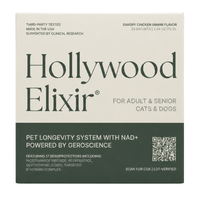
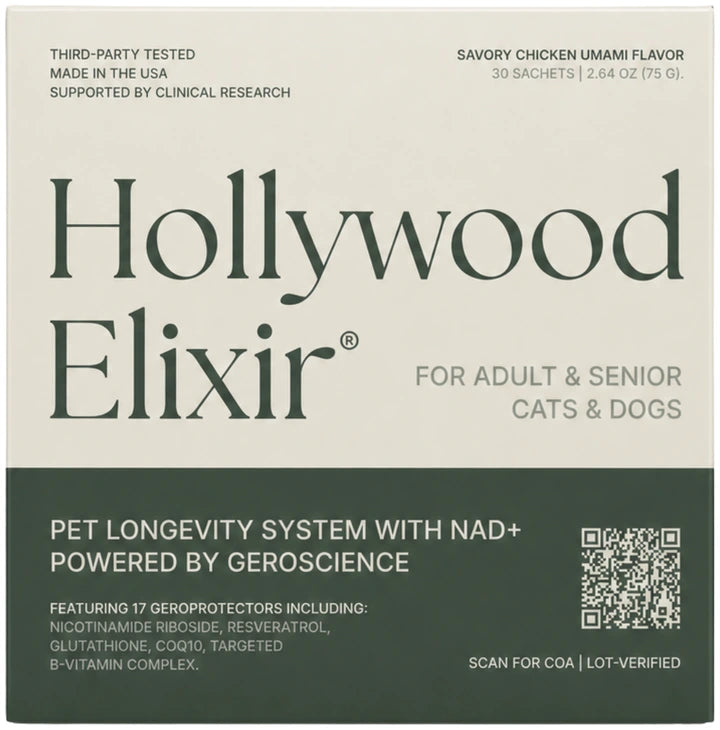
La Petite Labs makes Hollywood Elixir, so this is a disclosed commercial bridge rather than an independent endorsement. We position it as optional complementary nutrition above—not instead of—the complete-food foundation. It is not a protein source, deficiency repair, disease treatment, or lifespan guarantee. Judge it by the same questions: what each ingredient is, how much the labeled serving supplies, why it is present, where evidence stops, and when not to add it.

• Name one goal before adding anything.

• Calculate the daily serving for the individual animal.

• Check overlap with food, treats, medications, and other products.

• Set a review date and a stop rule.

Optional complementary nutrition should have a defined job, disclosed dose, safety logic, and stop rule.

Educational content only. This material is not a substitute for veterinary advice. Always consult your veterinarian about your dog’s specific needs. These statements have not been evaluated by the Food and Drug Administration. Products mentioned are not intended to diagnose, treat, cure, or prevent any disease.

Glossary

  • Nutritional adequacy statement: The label sentence identifying whether and how a food is substantiated for a named species and life stage.
  • Nutrient profile: A set of nutrient concentration targets, including minimums and selected maximums, for a defined species and life stage.
  • Feeding test: A protocol in which animals consume a product and specified observations are evaluated over a defined period.
  • Bioavailability: The fraction of a nutrient that becomes available for absorption and use rather than merely being present analytically.
  • Adult maintenance: The AAFCO life-stage category for maintaining an adult animal rather than supporting growth or reproduction.
  • Supplemental feeding: A feeding role that complements rather than independently supplies the entire nutritionally adequate daily ration.

Related Reading

References

Numbered references support claims cited in the article. Evidence context identifies the study population and design; it does not turn indirect evidence into pet-specific proof.

  1. U.S. Food and Drug Administration. Complete and Balanced Pet Food. U.S. Food and Drug Administration · 2024RegulatoryPopulation: bothEvidence boundary: Official U.S. regulator explanation of label substantiation; it does not rank foods or establish long-term comparative outcomes.↩ 1 · ↩ 2 · ↩ 3 · ↩ 4 · ↩ 5 · ↩ 6 · ↩ 7
  2. Association of American Feed Control Officials. Reading Labels. Association of American Feed Control Officials · 2023RegulatoryPopulation: bothEvidence boundary: AAFCO consumer guidance explains model label language; enforcement and adoption remain functions of federal and state authorities.↩ 1 · ↩ 2 · ↩ 3 · ↩ 4
  3. Association of American Feed Control Officials. Understanding Pet Food and AAFCO's Role. Association of American Feed Control Officials · 2024RegulatoryPopulation: bothEvidence boundary: Official description of AAFCO's standards-setting role; it is not an approval database for individual products.
  4. Association of American Feed Control Officials. 2014 Proposed Revisions to the AAFCO Dog and Cat Food Nutrient Profiles. Association of American Feed Control Officials · 2014RegulatoryPopulation: bothEvidence boundary: Archived proposal that informed the profiles' 2016 revision. It is used only for its technical bioavailability rationale—not as the current Official Publication, current model text, or evidence of current profile structure.
  5. World Small Animal Veterinary Association. Guidelines on Selecting Pet Foods. World Small Animal Veterinary Association · 2021GuidelinePopulation: bothEvidence boundary: Global veterinary guidance supplies manufacturer questions; it does not endorse a particular brand or guarantee that one answer predicts outcomes.↩ 1 · ↩ 2 · ↩ 3
  6. Kealy RD, Lawler DF, Ballam JM, et al. Effects of diet restriction on life span and age-related changes in dogs. Journal of the American Veterinary Medical Association · 2002· DOI 10.2460/javma.2002.220.1315Controlled StudyPopulation: dogEvidence boundary: Lifelong paired study of 48 Labrador Retrievers; it does not justify a universal percentage calorie cut or isolate food processing.
  7. Lawler DF, Larson BT, Ballam JM, et al. Diet restriction and ageing in the dog: major observations over two decades. The British journal of nutrition · 2008· DOI 10.1017/S0007114507871686Controlled StudyPopulation: dogEvidence boundary: A two-decade report from the same 48-dog Labrador cohort with industry involvement; generalization requires caution.
  8. van Rooijen C, Bosch G, van der Poel AF, et al. Reactive lysine content in commercially available pet foods. Journal of nutritional science · 2014· DOI 10.1017/jns.2014.29Primary ResearchPopulation: bothEvidence boundary: Laboratory analysis of 67 foods; it did not measure animal health outcomes, and most tested foods still exceeded estimated minimum lysine needs.
  9. Corsato Alvarenga I, Lierz R, Chen Y, et al. Processing of corn-based dog foods through pelleting, baking and extrusion and their effect on apparent total tract digestibility and colonic health of adult dogs. Journal of animal science · 2024· DOI 10.1093/jas/skae067Controlled StudyPopulation: dogEvidence boundary: Short controlled feeding work on specific formulations and processes; it cannot establish long-term superiority of a processing category.
  10. Louise Campbell, Mary Thompson, Matthew Muir, et al. Diet-induced metabolic and faecal microbiome responses in pet dogs fed a minimally processed versus extruded kibble diet. Frontiers in Veterinary Science · 2026· DOI 10.3389/fvets.2026.1734572Controlled StudyPopulation: dogEvidence boundary: Short crossover comparison of materially different diets with commercial funding; processing cannot be isolated and long-term healthspan was not measured.

FAQ

What does complete and balanced mean on a pet-food label?

It means the food is substantiated to provide the recognized essential nutrients in appropriate amounts and relationships for the named species and life stage when fed as directed. It is a meaningful adequacy claim, not a comparative quality or healthspan score. [1]

Is complete and balanced pet food AAFCO approved?

No. AAFCO develops model standards, nutrient profiles, definitions, and feeding protocols; it does not approve, certify, test, or endorse individual foods. Check the nutritional-adequacy statement rather than looking for an AAFCO approval badge. [3]

Is a feeding-tested food always better than one formulated to meet a profile?

Not automatically. The routes provide different evidence: formulation assesses nutrient targets, while a feeding protocol observes animals eating a product under bounded conditions. Neither alone proves lifetime superiority, and manufacturer expertise and finished-product controls still matter. [1] [5]

Does AAFCO have a separate senior dog or senior cat nutrient profile?

No. The profiles cover adult maintenance and growth/reproduction rather than a dedicated senior category. A senior-marketed food should still show the life stage for which its nutritional adequacy is substantiated. [1]

Does complete and balanced mean a food is optimal for healthspan?

No. It establishes an important nutrient-adequacy foundation. It does not rank quality control, calorie fit, digestibility, individual medical suitability, or long-term outcomes. Those require additional information and, for the animal, ongoing assessment. [5]

Does the label prove highly processed kibble is healthy or unhealthy?

Neither. Adequacy and processing are different questions. Extrusion can improve starch cooking and practical safety while heat can alter some nutrient measures. Evidence should be interpreted by formula, process, finished-product controls, and relevant outcomes—not by a category slogan. [8] [9]

Does a different microbiome mean one pet food is healthier?

Not by itself. A measured microbiome difference is a biological observation, not automatically a beneficial clinical outcome. Diet composition, duration, endpoint relevance, effect size, and replication determine what conclusion the study can support. [10]

Can a pet on complete food still use a supplement or topper?

Sometimes, but adequacy removes routine deficiency correction as the default rationale. Define the add-on's job, calculate its daily dose and calories, check nutrient and medication overlap, confirm species safety, and set a review or stop rule. [2] [5]

What is the most useful first check on a pet-food label?

Find the nutritional-adequacy statement and read its species, life stage, substantiation wording, and feeding status together. Then record calories and evaluate the manufacturer and the individual animal separately. [2] [5]

Hollywood Elixir box behind a spotted dog in the canine longevity-system framework section

Discover LPL-01: How This Fits Into a Larger Canine Longevity System

Aging in dogs is not driven by a single pathway. It’s the result of interacting biological systems—energy metabolism, oxidative stress, immune signaling, and structural integrity—changing over time.

This article explores one piece of that puzzle. If you want to understand how these pieces connect—and what actually moves the needle—you need to zoom out.

Start with the underlying science: