LPL Wellness Instruments · Diet Gap
Does your dog’s diet have gaps?
Identify diet-completeness uncertainty, possible nutrient-gap signals, and questions to bring to your veterinarian. This is a screening tool — not a diagnostic.

—Coverage read
Wellness instrument
Diet coverage check
Diet Coverage · Baseline Adequacy & Support Signals
Baseline adequacy
Veterinary nutrition floor — AAFCO completeness, life-stage match, and displacement control.
Above-baseline support signals
The LPL-01 wellness lens — visible signals around longevity-aligned nutrients, omega balance, processing, and life-stage demands. Not a deficiency score.
Main diet gap drivers
Nutrients to discuss with your vet
Mixed-feeding & displacement notes
Vet handoff summary
This tool does not diagnose nutrient deficiency, disease, or medical status. Results are based only on the information you provided and should be used as a discussion aid with your veterinarian. Home-prepared, raw, restricted, growth, pregnancy/lactation, medical, or prescription-diet cases benefit most from review by a board-certified veterinary nutritionist.
Baseline adequacy and above-baseline support are different questions.
Veterinary nutrition handles the floor: completeness, life-stage fit, feeding management. The LPL-01 lens sits above that — longevity-aligned support, antioxidant defense, skin & coat, daily usability. Different question, different framework.
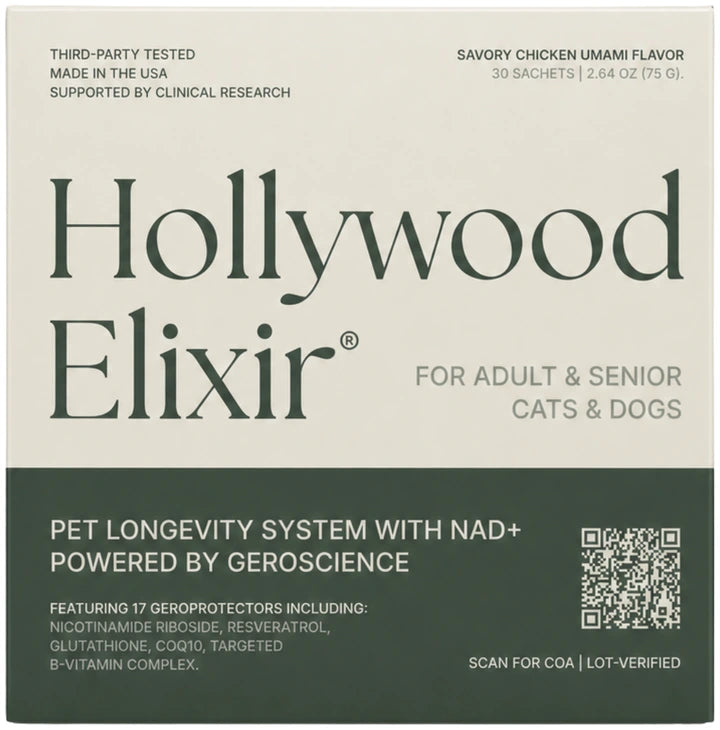
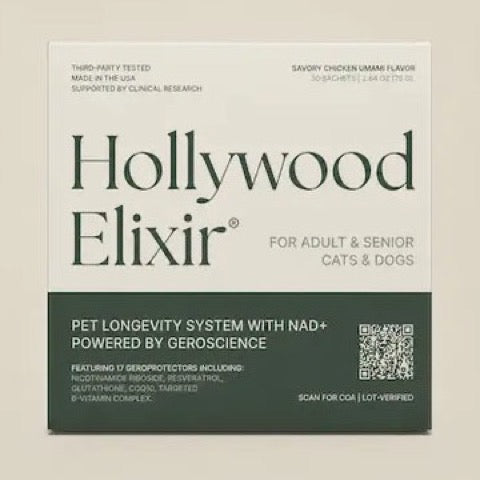
Explore Hollywood ElixirWellness Note
Save it as a note — or bring it to your vet.
Print or save this as a single-page LPL Wellness Note. Includes your inputs, result, interpretation, vet discussion signs, and the date generated — designed to be folded and brought to a visit.
Educational guidance only. Not veterinary diagnosis.

The part you control
You can’t add sand to the glass.
The number above is fixed. What fills those years is built one ordinary day at a time.
Continue exploring
Other wellness instruments
Age, sleep, hydration, calories, body condition, and life-stage framing all shape how pets feel over time. Each tool is a different lens on the same underlying picture.
What a Diet Gap Check Can — and Can’t — Tell You
This tool is a screening instrument. It looks at the pattern of your pet’s diet — main food type, label completeness, treat displacement, supplements, life stage — and flags places where the picture is incomplete or where common gap risks tend to appear. It cannot measure blood levels, tissue stores, or actual nutrient intake. That work belongs to your veterinarian, ideally with a nutritional assessment as recommended by both the WSAVA Global Nutrition Guidelines and the AAHA Nutritional Assessment Guidelines for Dogs and Cats.
What it does well: surface diet patterns that veterinarians already look for during a thorough nutritional history. What it explicitly avoids: confirming a deficiency, prescribing a product to “fix” a gap, or implying that any one supplement closes a nutrient hole. Those are jobs for a clinician.
Why “Complete and Balanced” Matters — and Why It’s a Floor, Not a Ceiling
The AAFCO “complete and balanced” statement means a pet food has been formulated to meet the established nutrient profiles for a specific life stage, or has passed an AAFCO feeding trial. It’s the baseline that protects most pets from obvious nutrient gaps. Without it, the diet has no nutrient adequacy guarantee at all.
But baseline adequacy is not the same as personalized optimization. The complete-and-balanced threshold doesn’t speak to ingredient transparency, processing, digestibility, omega balance, supplement form, or higher-order wellness support like cellular energy or healthy aging. That’s why this tool gives you two lenses: the baseline confidence grade, and the higher-standard diet quality view. Most premium-pet decisions live in the gap between them.
Why Treats and Toppers Can Quietly Erode Coverage
A complete-and-balanced food only does its job if it’s actually most of what the pet eats. When treats, table scraps, broth, peanut butter from puzzle toys, training rewards, and toppers add up to 20 % or more of daily calories, you’ve effectively diluted the base diet — replacing nutrient-balanced calories with calories that have no adequacy backing. AAHA’s nutritional assessment guidance specifically calls out treats as part of the full intake picture. Keeping treats under 10 % of daily calories is the conventional safe ceiling.
Cats and Dogs Need Different Nutrient Logic
Cats are obligate carnivores. They require dietary taurine, preformed vitamin A, and arachidonic acid — none of which they can reliably synthesize from plant sources. A cat eating dog food, a vegetarian diet, a fish-only diet, or a homemade diet without a complete premix is in a different risk category than a dog eating the same pattern. This tool runs species-specific rules for both, and is more conservative with cats by design.
Dogs are more flexible omnivores, but they have their own classic gap patterns: meat-and-rice homemade diets without calcium planning, large-breed puppy growth without life-stage-specific nutrition, and meat-heavy diets with calcium-to-phosphorus imbalance. These patterns the tool will flag automatically.
When to Bring This to a Veterinary Nutritionist
Some situations call for a board-certified veterinary nutritionist — not just a general veterinarian — to formulate or review the diet:
- Long-term home-cooked or homemade raw diets, especially in growing or pregnant/lactating animals.
- Cats on vegetarian, fish-only, or dog-food-based diets.
- Large-breed puppies on non-life-stage-matched diets.
- Pets with diagnosed medical conditions where the diet may need to support or compensate for that condition.
- Stacked supplementation where doses of fat-soluble vitamins (A, D) or minerals (calcium) are unknown.
The American College of Veterinary Internal Medicine maintains a directory of board-certified veterinary nutritionists. For most other questions, your general veterinarian is the right next step — and printing this tool’s vet handoff summary gives them a useful starting point.
How LPL Thinks About Baseline vs. Pathway-Level Support
The La Petite Labs framework treats nutrition in two layers. Baseline adequacy is the floor — a complete-and-balanced food, age-appropriate, with controlled treat displacement. Once that’s in place, pathway-level support is a separate question: cellular energy, antioxidant defense, immune balance, skin and coat resilience, recovery. These are not substitutes for adequate nutrition; they sit above it, and they’re evaluated against the LPL-01 Standard rather than against AAFCO thresholds.
If this tool tells you baseline adequacy is uncertain, the right next step is a veterinary nutrition review — not a supplement. If baseline looks covered, then pathway-level support becomes a legitimate question to evaluate on its own merits, using a more demanding framework. That’s why we’ve built rubrics for longevity supplements, skin and coat, and all-in-one systems.
FAQ
Does this tool diagnose vitamin deficiency?
No. Deficiency can only be confirmed by a veterinarian through clinical assessment, lab work, and sometimes tissue measurements. This tool screens for diet patterns associated with nutrient-gap risk, which is a very different and much less specific question.
Why is “AAFCO complete and balanced” only the baseline?
Because it’s a minimum-adequacy guarantee for a stated life stage — not a guarantee of ingredient quality, digestibility, processing, omega balance, or higher-order wellness support. It protects against obvious gaps; it doesn’t answer optimization questions.
I home-cook for my pet. Is that bad?
Not inherently. The reliability of a home-cooked diet depends almost entirely on the recipe source. Diets formulated or reviewed by a board-certified veterinary nutritionist can be excellent. Diets cobbled together from blog posts or family tradition are where most of the documented nutrient-gap cases come from.
Should I just add a multivitamin to be safe?
Not without a review of what’s already in the diet. Adding fat-soluble vitamins (A, D) on top of a complete diet can cause excess. Stacking multiple supplements without dose awareness is one of the more common avoidable risks. Talk to a veterinarian before adding micronutrient supplements to a complete-and-balanced diet.
What can I bring to my vet visit?
This tool generates a printable vet handoff summary with your diet inputs, risk drivers, and discussion topics. Bring the product label, the typical feeding amount, the treat/topper list, supplement bottles (with doses if known), and — for home recipes — the recipe itself.
All wellness tools
More ways to check in on them
Quick tools for dogs and cats — each one a different lens on how they’re doing, from age and sleep to body condition and diet.
 dog · Calculator
Dog Age
dog · Calculator
Dog Age
 dog · Functional scale
Dog Biological Age
dog · Functional scale
Dog Biological Age
 dog · Scale
Dog Quality of Life
dog · Scale
Dog Quality of Life
 dog · Calculator
Dog Sleep
dog · Calculator
Dog Sleep
 dog · Calculator
Dog Hydration
dog · Calculator
Dog Hydration
 dog · Calculator
Dog Calorie
dog · Calculator
Dog Calorie
 dog · Assessment
Dog Body Condition
dog · Assessment
Dog Body Condition
 dog · Field guide
Dog Life Stage
dog · Guided check
Dog Diet Gap
dog · Field guide
Dog Life Stage
dog · Guided check
Dog Diet Gap
 dog · Reference hub
Dog Lifespan by Breed
dog · Reference hub
Dog Lifespan by Breed
 cat · Calculator
Cat Age
cat · Calculator
Cat Age
 cat · Functional scale
Cat Biological Age
cat · Functional scale
Cat Biological Age
 cat · Scale
Cat Quality of Life
cat · Scale
Cat Quality of Life
 cat · Calculator
Cat Sleep
cat · Calculator
Cat Sleep
 cat · Calculator
Cat Hydration
cat · Calculator
Cat Hydration
 cat · Calculator
Cat Calorie
cat · Calculator
Cat Calorie
 cat · Assessment
Cat Body Condition
cat · Assessment
Cat Body Condition
 cat · Field guide
Cat Life Stage
cat · Field guide
Cat Life Stage
 cat · Guided check
Cat Diet Gap
cat · Reference hub
Cat Lifespan by Breed
cat · Guided check
Cat Diet Gap
cat · Reference hub
Cat Lifespan by Breed