LPL-01 StandardRubric · Canonical scoring

Pet Longevity Supplement Scoring Rubric

A transparent, 100-point framework for evaluating pet longevity supplements across dose transparency, pathway coverage, testing, species-appropriate safety, formulation architecture, and daily usability.

Standard
LPL-01Longevity
Version
2026.12026-05-16
Last reviewed
2026-05-16
Reading time
15 min· 8 criteria

Key Findings

FIVE LINES · 60-SEC READ
  1. 01A public 100-point rubric for judging pet longevity supplements on transparency, pathway coverage, safety, testing, and coherence.
  2. 02Strong formulas disclose meaningful doses, cover multiple aging pathways, and explain why each ingredient belongs together.
  3. 03Ingredient-count marketing, vague anti-aging language, and isolated hero ingredients do not signal a serious longevity formula.
  4. 04The rubric reflects the LPL-01 Standard, our internal framework for formulation architecture, dose clarity, and species-appropriate safety logic.
  5. 05This is buyer education for evaluating products yourself, not a third-party certification, seal, or endorsement program.

§IDefinition

What Is A Longevity Supplement Scoring Rubric?

A pet longevity supplement scoring rubric is a structured framework for evaluating supplements marketed for healthy aging in dogs and cats. The rubric replaces vague "anti-aging" marketing with measurable criteria. A good rubric scores formulas across dose transparency, pathway coverage, formulation architecture, species-appropriate safety logic, and testing transparency.

The framework matters because longevity science distinguishes between lifespan and healthspan, and most consumer products blur the two [1]. A rubric forces clarity. Dose transparency means the label discloses the actual milligrams of each active, not a proprietary blend. Pathway coverage means the formula addresses multiple aging-related systems — mitochondrial function, oxidative stress support, cellular resilience, cognitive aging [3], and NAD+ metabolism [10] — rather than leaning on a single hero ingredient.

Formulation architecture describes how those actives relate to each other and why they belong in the same capsule. Safety logic asks whether dosing respects species biology, since dogs and cats metabolize compounds differently. Testing transparency requires lot-level COAs and third-party verification. The LPL-01 Standard applies this rubric before any formula launches, so buyers can compare products on evidence rather than packaging.

What Makes A Pet Longevity Supplement Worth Evaluating?

Short answer: A pet longevity supplement is worth evaluating when it discloses meaningful doses, targets multiple aging-related pathways, uses species-appropriate safety logic, verifies quality through third-party testing, and explains why its ingredients belong together. Everything else is marketing.

Most longevity products fail before the science even matters. They list trendy actives without disclosed amounts, lean on a single hero ingredient, or borrow human research without addressing whether the dose makes sense for a dog or cat. That gap matters because healthspan and lifespan are shaped by overlapping biological systems, not one molecule [1]. A serious formula reflects that complexity. A marketing formula hides behind a proprietary blend.

The criteria worth weighing are concrete. Dose transparency tells you whether the label matches the research. Pathway coverage tells you whether the formula touches more than one aging system — mitochondrial function, oxidative stress support, cellular resilience, cognitive aging, and immune modulation are all active areas of veterinary nutrition research [3][9][10]. Species-appropriate safety logic tells you whether the ingredients were chosen with dogs and cats in mind, not copied from a human stack. Testing transparency, ideally lot-level COAs, tells you whether what's on the label is what's in the bottle.

Formulation architecture is the piece most brands skip. A good longevity formula explains how its actives relate: which ingredient supports NAD+ pathways, which addresses oxidative stress, which supports mitochondrial output, and why those choices coexist at the doses shown. That biological coherence is what separates a designed formula from a shelf of trendy powders. It's also what the LPL-01 Standard is built to measure — dose transparency, testing transparency, pathway coverage, safety logic, and daily usability, scored before a product is recommended.

One more filter matters: daily usability. A supplement only works if the animal actually takes it, consistently, for months. Palatability, format, and dosing simplicity are not afterthoughts. They determine whether the formula does anything at all. A rubric that ignores usability rewards formulas that look good on paper and sit unused in a cabinet. A rubric that includes it rewards formulas designed to be given every day, which is the only way healthy-aging support compounds over time.


§IIThe Rubric

8 criteria, 100 weighted points.

Each criterion is scored 1–10 against published anchors (fully defined at 10, 9, 8, 7, 4, and 1); between anchors, the lower anchor applies unless every element of the higher anchor is met anchored by deterministic definitions, then multiplied by its weight. Intermediate scores such as 8 or 9 may be assigned when source-backed attributes fall between two anchors. A perfect score is a theoretical benchmark, not an expectation — in practice, even strong products usually reveal some limitation in testing access, species-specific validation, finished-product evidence, or daily usability.

Criteria
8 · independently scored
Tier ladder
10 · 7 · 4 · 1
Maximum total
100 points
C.01 Weight × 15

Dose Transparency

Evaluates whether the brand discloses the actual amount of each active ingredient and provides enough dose clarity for buyers to judge the formula. Longevity supplements often use advanced-sounding ingredients, but without disclosed active doses, ingredient lists cannot be meaningfully evaluated.

Can I see how much of each active ingredient is actually present?

See on the checklist →
10Full individual active-dose disclosure for every meaningful active ingredient, with serving size clearly stated and no proprietary blends hiding active amounts.
9Nearly complete active-dose disclosure, with only minor ambiguity around secondary non-core components or flavor-system ingredients.
8Most core active doses are disclosed, but some meaningful ingredients require more dose clarity or are grouped at a higher level.
7Most meaningful active ingredients have individual doses disclosed, with only minor ambiguity around secondary ingredients, flavoring components, or non-core supportive ingredients.
4Partial disclosure only. The label may show some individual doses, but key active ingredients are hidden inside blends, grouped amounts, or unclear serving-size language.
1Ingredient list is present, but individual active-dose evaluation is not meaningfully possible because doses are absent, hidden, or primarily disclosed as proprietary blends.
C.02 Weight × 15

Pathway Coverage

Evaluates whether the formula supports multiple healthy-aging pathways instead of leaning on one fashionable ingredient. Strong longevity formulas should address interconnected systems such as oxidative stress support, mitochondrial function, NAD+ support, immune modulation, cellular resilience, and normal energy metabolism.

Does the formula support multiple aging-related systems, or does it rely on one hero ingredient?

See on the checklist →
10Clearly supports five or more relevant healthy-aging pathways with ingredients that logically map to each pathway and are not merely decorative inclusions.
9Supports five or more pathways with strong ingredient-to-role logic, though one area may be lighter or less fully developed.
8Supports four or more pathways reasonably well, but not all claimed pathways are equally substantiated by the ingredient stack.
7Supports three to four relevant healthy-aging pathways with reasonable ingredient-to-pathway alignment, though some areas may be lighter or less fully developed.
4Supports one to two relevant pathways, or claims broad longevity support without clearly showing how ingredients map to specific aging-related systems.
1Uses longevity or anti-aging language without a coherent pathway map, or relies almost entirely on one isolated ingredient or vague wellness blend.
C.03 Weight × 15

Testing Transparency

Evaluates whether the finished product is supported by meaningful quality verification, including third-party testing, lot-level COAs, contaminant screening, potency verification, and public batch verification where available. Testing does not prove a formula is well-designed, but it helps verify that the product is safe, consistent, and label-aligned.

Can I verify that the finished product was tested, and can I connect that testing to the batch being sold?

See on the checklist →
10Public lot-level COA or batch verification is available, with third-party testing that addresses relevant safety and quality factors such as heavy metals, microbial safety, contaminants, and label accuracy or potency where applicable.
9Third-party testing and lot-level verification are strong, but one element of public access, potency detail, or batch linkage at point of purchase could be clearer.
8Third-party testing is credible and described, but public batch-level verification is incomplete or not consistently accessible for every current SKU.
7Third-party testing is described or partially documented, but batch-level access, potency details, or public COA lookup may be incomplete.
4Testing is claimed, but documentation is limited, not clearly third-party, not batch-specific, or difficult for buyers to verify.
1No meaningful testing transparency is provided, or the brand relies only on general quality language without accessible evidence.
C.04 Weight × 15

Species-Appropriate Safety Logic

Evaluates whether the product accounts for species-specific needs, tolerances, serving size, ingredient safety, life stage, and practical use in dogs and cats. Longevity formulas must be especially careful because they often include botanicals, antioxidants, mushrooms, polyphenols, NAD+ precursors, and other active compounds.

Does the formula show species-aware safety reasoning, or does it simply borrow human longevity ingredients?

See on the checklist →
10Clear species-appropriate safety logic is visible, including serving-size guidance, pet-specific use instructions, avoidance of obvious high-risk ingredients, and responsible language around dogs, cats, size, age, and veterinary consultation.
9Safety logic is strong, with only minor species, life-stage, or sensitivity details that could be more explicit.
8Generally pet-appropriate, but some serving, species, or ingredient-safety rationale requires more explanation.
7Generally pet-appropriate safety logic is present, but some species, life-stage, or serving-size considerations require more explanation.
4Formula appears pet-directed, but safety rationale is thin, generic, or heavily borrowed from human supplement logic without enough species-specific context.
1Little to no species-specific safety reasoning is visible, or the formula includes concerning ambiguity around use in dogs, cats, size ranges, age, or sensitive pets.
C.05 Weight × 12

Formulation Architecture

Evaluates whether the formula appears intentionally built as a coherent longevity system rather than assembled as a long ingredient list. Strong formulation architecture connects ingredients to roles, avoids redundant clutter, balances serving size against active count, and explains why the components belong together.

Does this look like a designed system or a pile of trend-driven ingredients?

See on the checklist →
10The formula shows clear biological coherence, with ingredients grouped by role, minimal decorative clutter, and an intelligible explanation of how the architecture supports healthy aging systems.
9Architecture is highly coherent and role-based, with only minor redundancy or explanation gaps.
8Architecture is strong overall, but some ingredients or claimed roles are less clearly integrated into the longevity framework.
7The formula is mostly coherent and role-based, though some ingredients may feel less explained or less central to the overall architecture.
4The formula has some relevant ingredients, but the architecture is hard to understand, overly broad, redundant, or weakly explained.
1The formula appears primarily ingredient-count driven, with little visible rationale connecting ingredients to a coherent longevity framework.
C.06 Weight × 10

Evidence Quality And Claim Discipline

Evaluates whether the brand connects its claims to appropriate evidence without overstating what the product can do. In longevity, evidence quality matters because many concepts are borrowed from human geroscience, cellular biology, or early-stage research that may not directly prove outcomes in pets.

Does the brand explain the evidence responsibly, or does it overclaim from early science?

See on the checklist →
10Claims are carefully qualified, evidence is cited or explained, human-longevity concepts are not overstated, and the brand avoids disease, lifespan-extension, or cure language.
9Claim discipline and evidence framing are strong, with only minor areas where language could be more tightly qualified.
8Most claims are responsible, though some evidence explanations may be generalized or lightly supported relative to the strength of the claim.
7Most claims are responsible and reasonably supported, though some evidence explanations may be brief, generalized, or missing nuance.
4Evidence is thin, mostly implied, or selectively framed; claims may lean on advanced-sounding mechanisms without enough qualification.
1The product uses aggressive anti-aging, disease, cure, lifespan, or clinically proven language without adequate support or appropriate qualification.
C.07 Weight × 8

Excipient Quality And Palatability Logic

Evaluates whether non-active ingredients, flavor systems, carriers, and palatability choices support daily use without undermining trust. For pet longevity supplements, a formula only matters if pets will consistently consume it and if the delivery system does not rely on unnecessary fillers or poorly explained additives.

Can this be used daily without relying on questionable fillers, vague flavor systems, or unrealistic compliance assumptions?

See on the checklist →
10Excipient and flavor choices are transparent, minimal, pet-appropriate, and supported by a clear palatability or delivery rationale.
9Excipient and palatability logic are strong, with only minor gaps in documentation of specific carriers or flavor-system rationale.
8Excipient profile is generally pet-appropriate, but some flavoring, carrier, or palatability details could be more explicit.
7Excipient profile appears generally reasonable, though some flavoring, carrier, or palatability details could be clearer.
4The product may be usable, but excipient transparency, filler rationale, or palatability logic is limited or generic.
1Excipient profile is unclear, filler-heavy, poorly explained, or likely to create daily-use friction for pets or owners.
C.08 Weight × 10

Daily Usability And Owner Compliance

Evaluates whether the supplement is practical enough for daily long-term use. Longevity support is not a one-time intervention; format, serving instructions, palatability, storage, subscription logic, and ease of mixing or feeding all influence whether a product can actually become a consistent routine.

Is this realistic to use every day for months or years?

See on the checklist →
10Format, serving instructions, palatability, storage, and daily routine fit are clear, practical, and designed for long-term owner compliance.
9Daily use appears very realistic, with minor friction around mixing, serving size, or pet acceptance.
8Usability is strong for many owners, but format or feeding method may require some adaptation across diet styles.
7Daily use appears realistic for most owners, though format, serving flexibility, or feeding instructions may require some adaptation.
4The supplement may be useful but has clear friction around format, serving size, palatability, storage, or routine consistency.
1Daily use appears impractical, poorly explained, or heavily dependent on owner effort and pet acceptance.

§IIIPractical Translation

The Buyer's Checklist.

16 questions · 8 criteria · take this to the aisle

You do not need to assign a numerical score to use this rubric. Start with the questions below. Strong products make these answers easy to find. Weaker products often require guesswork.

C.01Dose Transparency See rubric →

Can you see the actual dose?

  1. Does the label disclose the amount of each meaningful active ingredient in milligrams or micrograms?
  2. Are key actives hidden inside a proprietary blend or grouped total?
Good signal Individual active doses are visible per serving with no proprietary blends.
Concern The ingredient list looks impressive, but per-ingredient amounts are unclear.
C.02Pathway Coverage See rubric →

Does it support more than one aging-related system?

  1. Does the formula address multiple pathways such as NAD+ support, mitochondrial function, oxidative stress, immune balance, and cellular resilience?
  2. Or does it rely on a single fashionable hero ingredient?
Good signal Ingredients map clearly to several healthy-aging pathways.
Concern The product uses broad longevity language without a coherent pathway map.
C.03Testing Transparency See rubric →

Can you verify the finished product?

  1. Does the brand provide third-party testing or a lot-level Certificate of Analysis (COA)?
  2. Can you connect that testing to the specific batch being sold?
Good signal Batch-linked testing is easy to access on the brand's site.
Concern The brand says 'tested' but does not show meaningful documentation.
C.04Species-Appropriate Safety Logic See rubric →

Was it built for pets, not copied from humans?

  1. Does the product explain use by species, size, life stage, or weight?
  2. Does it avoid simply shrinking a human longevity stack into a pet serving?
Good signal Directions and ingredient choices show pet-specific reasoning.
Concern The science is mostly human-focused with little pet-specific translation.
The rubric is rigorous. The checklist is portable. Ask these in the aisle, on the website, on the phone with a brand rep.
La Petite Labs · Editorial Standard
C.05Formulation Architecture See rubric →

Do the ingredients belong together?

  1. Does the brand explain why these ingredients were combined?
  2. Are the ingredients organized by biological role, or just listed as a long stack?
Good signal The formula reads like a designed system with clear ingredient roles.
Concern The label feels like trend-chasing without a coherent architecture.
C.06Evidence Quality & Claim Discipline See rubric →

Are the claims appropriately restrained?

  1. Does the brand explain evidence without promising lifespan extension or disease outcomes?
  2. Are claims framed around healthy aging, cellular resilience, and oxidative stress support?
Good signal Benefits are qualified and evidence-aware.
Concern The brand uses aggressive anti-aging, cure, or disease-prevention language.
C.07Excipient Quality & Palatability Logic See rubric →

Will pets actually take it daily?

  1. Are flavoring, carriers, and non-active ingredients clearly disclosed?
  2. Does the product show a real plan for daily palatability and acceptance?
Good signal The palatability system is disclosed and intentional.
Concern Taste, fillers, or carriers are vague or generic.
C.08Daily Usability See rubric →

Can this become a real routine?

  1. Are serving instructions simple enough to follow every day?
  2. Does the format fit your pet's food, appetite, and household routine?
Good signal The product is easy to dose, serve, and repeat over months.
Concern The supplement looks good on paper but creates daily friction.

How To Use This Rubric When Comparing Pet Longevity Supplements

Short answer: Use the rubric as a side-by-side filter. Score each product on dose transparency, pathway coverage, formulation architecture, species-appropriate safety logic, testing transparency, and daily usability. The formula that earns points across all six categories — not the one with the longest ingredient list — is the stronger buy.

Start with dose transparency. Open the label and confirm every active ingredient shows a milligram amount per serving, not a hidden proprietary blend. A disclosed dose lets you compare against published research [3][10]. A vague "blend" does not. If a brand will not tell you how much of each active is in the bottle, the rest of the rubric cannot be scored honestly, and the product fails the first gate.

Next, look at pathway coverage and formulation architecture together. Healthy aging is multi-system. It involves mitochondrial function, oxidative stress support, NAD+ biology, and cellular resilience [1][9][10]. A strong formula touches several of these pathways on purpose. A weak formula stacks one hero ingredient and calls it longevity. Ask whether the actives explain each other. Biological coherence matters more than ingredient count.

Then pressure-test safety logic and testing transparency. Species-appropriate dosing is non-negotiable, because dogs and cats metabolize compounds differently than humans and differently from each other [6][8]. Look for lot-level COA access, third-party testing, and a clear adverse-event pathway [11]. A brand that publishes its testing is a brand that expects to be checked. Finally, weigh daily usability — palatability, format, and whether the serving size is realistic for your pet's size and routine. A supplement only works if it actually gets given.

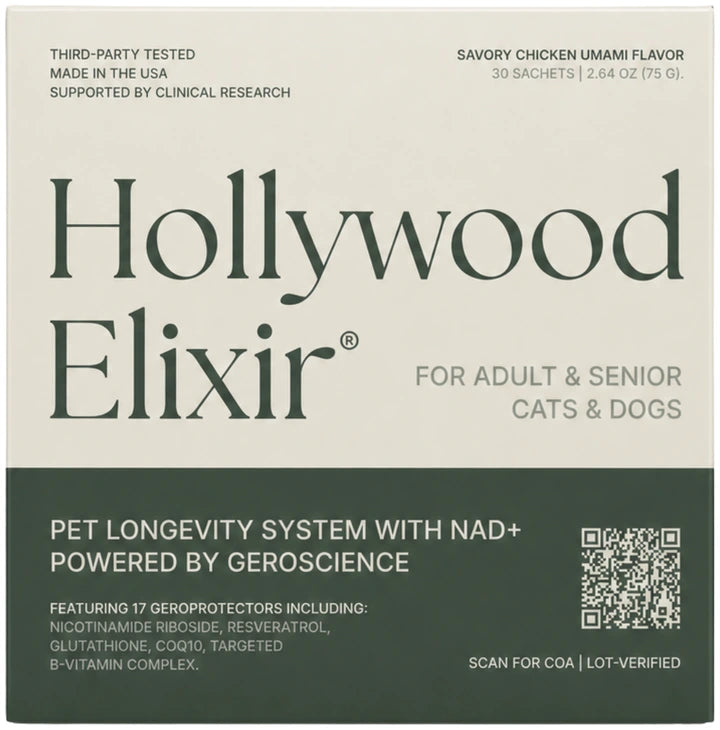
When you apply this rubric across two or three products, the differences sharpen quickly. The LPL-01 Standard was built to make that comparison repeatable, scoring formulas before launch across the same six categories a careful buyer would check. Hollywood Elixir, for example, was designed around disclosed actives that target NAD+ support, mitochondrial function, and oxidative stress support inside a single formulation architecture — which is how it scores against the LPL-01 Standard rather than against marketing language. Use the rubric the same way on every bottle you consider, and the right product tends to declare itself. Supplements support normal aging systems; they do not replace veterinary care.

Why This Page Includes A Worked Example

A rubric becomes easier to use when readers can see it applied. Because La Petite Labs makes Hollywood Elixir, this example is disclosed as non-independent and should be read as a demonstration of the scoring method, not third-party certification.

Scores below are calculated by a deterministic scoring function from source-backed product attributes against the fixed tier definitions in the rubric above. The same function and the same tier definitions are used for every product the rubric scores, including ours.


§IVApplication

A worked example, scored in full.

LPL Scorecard · C.01–C.08Hollywood ElixirScored against the 8 LPL-01 criteria using current public materials, LPL-01 documentation, and internal formula records disclosed for this worked example.
Weighted total 93.2/ 100Publisher example · scored, not ranked
C.01
Dose Transparency w × 15 · score 10
15

Hollywood Elixir earns a full 10/10 for dose transparency, calculated by a deterministic scoring function against the LPL-01 Standard's strictest anchor. The product page discloses individual active doses for all 17 active ingredients with a clearly stated serving size, and no proprietary blends obscure any active amounts — satisfying every condition the anchor requires. There are no gaps to note: the formulation architecture is fully legible to the buyer before purchase.

C.02
Pathway Coverage w × 15 · score 10
15

The deterministic scoring function awarded a perfect 10/10 for pathway coverage because the formulation's active ingredients map credibly and non-decoratively across at least five interconnected biological systems: NAD⁺ metabolism, mitochondrial function, oxidative stress defense, immune modulation, and cellular energy production, with additional support for cognitive function and cellular resilience. Each pathway is addressed by a logically assigned ingredient rather than a single hero compound carrying the full burden of the formula's claims. This breadth of formulation architecture is precisely what the 10/10 anchor requires.

C.03
Testing Transparency w × 15 · score 9
13.5

Testing transparency was calculated by a deterministic scoring function at 9/10, reflecting third-party verification through NSF and Eurofins covering heavy metals, microbial safety, potency, label accuracy, and consistency, with full lot traceability stated and a public COA lookup tool available at /pages/coa-lookup. The score stops short of a perfect mark because the lot-level COA lookup experience has not been confirmed as fully batch-linked at point of purchase across every current SKU — meaning a buyer cannot yet be certain that the specific batch in hand connects seamlessly to a retrievable certificate without additional steps.

C.04
Species-Appropriate Safety Logic w × 15 · score 9
13.5

The formula earns a 9/10 under Species-Appropriate Safety Logic because it demonstrates clear species-aware design: weight-scaled serving guidance (½ to 2 sachets daily), explicit exclusions for puppies, kittens, and pregnant or lactating animals, and responsible veterinary-consultation language all reflect deliberate life-stage and size reasoning. The single point held back reflects the one meaningful gap calculated by the deterministic scoring function — a unified dog-and-cat formulation, while pragmatic, falls short of the separate species-specific clinical validation that would satisfy the highest tier of this criterion.

C.05
Formulation Architecture w × 12 · score 10
12

The formulation architecture score of 10/10 was calculated from source-backed attributes reflecting 17 disclosed actives organized into biologically coherent functional groups, each connected to a specific aging-related role rather than assembled as trend-driven additions. No proprietary blends obscure ingredient quantities, and a published formula rationale explicitly maps the architecture to healthy aging systems under the LPL-01 Standard. The combination of full dose transparency, clear pathway coverage across oxidative stress support and mitochondrial function, and an intelligible system-level explanation leaves no structural gap to penalize.

C.06
Evidence Quality And Claim Discipline w × 10 · score 8
8

Claim discipline here is notably strong — the brand avoids disease, lifespan-extension, and cure language entirely, framing geroscience concepts through responsible constructions like "supports healthy aging," "cellular energy," and "cellular resilience," all grounded in mechanism-level and ingredient-level rationale rather than overreach. The score, calculated by a deterministic scoring function, stops at 8 rather than 10 because no published clinical studies on the finished Hollywood Elixir formulation in dogs and cats are yet available, leaving the evidence base at the ingredient and pathway level rather than finished-formula validation.

C.07
Excipient Quality And Palatability Logic w × 8 · score 9
7.2

Calculated from source-backed attributes, this formulation earns a 9/10 by presenting a minimal, pet-appropriate excipient profile anchored to a chicken and chicken liver umami-based palatability system, with no added sugars, artificial sweeteners, artificial colors, artificial flavors, or chew fillers introducing compliance risk. The formulation architecture is honest and rationally constructed for daily use. The single point withheld reflects that at least one excipient — hydroxypropyl beta-cyclodextrin — lacks fully published, species-specific safety documentation paired alongside the formula, which the LPL-01 Standard requires before awarding a perfect mark.

C.08
Daily Usability And Owner Compliance w × 10 · score 9
9

The daily sachet format with weight-based dosing (½ to 2 sachets) and available subscription cadence reflects strong formulation architecture for long-term routine integration, earning a 9/10 from the deterministic scoring function. Clear feeding guidance removes guesswork for most owners across a range of dog sizes. The one gap preventing a perfect mark is that powder-in-food mixing introduces a modest friction point compared to chew formats — not a compliance barrier for most households, but an honest acknowledgment that zero-friction daily use is not fully achieved.


§VMethodology & Disclosures

How we score, and what could bias us.

04.1 · CONFLICTS OF INTEREST

We make a product in this category.

La Petite Labs makes Hollywood Elixir, a pet longevity supplement. This rubric is published by La Petite Labs and reflects the evaluation principles behind the LPL-01 Standard. Scores should be read as a transparent framework, not as independent third-party certification.

+La Petite Labs is the publisher of this standard.
+La Petite Labs manufactures the worked-example product.
No external sponsor influenced this rubric.
No affiliate revenue from competitor links.
04.2 · HOW WE SCORE

Anchored tiers, deterministic scoring.

Each criterion has a fixed point weight and fixed score-tier definitions (10, 7, 4, 1) with intermediate scores (8, 9) assigned when source-backed attributes fall between two anchors. A criterion scored 10/10 contributes its full weight to the total; a 9/10 contributes 9/10 of its weight, and so on. The eight criteria sum to a maximum of 100 weighted points. Product scores are calculated from source-backed attributes, then explained in plain language.

  • It helps buyers evaluate transparency, testing, formulation architecture, and healthy-aging relevance.
  • It separates visible evidence from marketing language.
  • It provides a consistent scoring framework for future buyer guides and competitor reviews.
04.3 · WHAT THIS RUBRIC DOES NOT DO

The honest limits of this rubric.

The rubric is buyer education, not veterinary care. Specific dosing for a specific animal is the responsibility of a treating veterinarian.

  • It does not diagnose, treat, cure, or prevent disease.
  • It does not prove that any supplement extends lifespan.
  • It does not replace veterinary advice.
  • It does not treat ingredient count as proof of formula quality.

Continue with LPL-01

Read the full methodology, or score a product yourself.

The rubric is open. Apply it to any supplement you are evaluating, and compare against the published example.

Hollywood Elixir® Longevity System product imageHOLLYWOOD-ELIXIR · PRODUCT
SCORED EXAMPLE

Hollywood Elixir

Hollywood Elixir was designed around NAD+ support, mitochondrial function, oxidative stress support, immune modulation, and cellular resilience.

See Hollywood Elixir

Frequently Asked Questions

What does a score on this rubric actually mean?

It is a 100-point public-disclosure evaluation of pet longevity supplements: what a buyer can verify from public materials — dose disclosure, testing and COA access, claims discipline, and daily practicality. It does not measure effectiveness, safety, or ingredient quality, and it is not veterinary advice.

Who applies the rubric, and is the worked example independent?

La Petite Labs Editorial applies fixed, published tier anchors, and scores are computed before any rationale is written. Because La Petite Labs makes Hollywood Elixir, the worked example is disclosed as a publisher example — scored under the same anchors, shown without a ranking, and never presented as third-party certification.

How are in-between scores like 5 or 6 decided?

Anchors are published for the tier ladder, and between anchors the lower score applies unless every element of the higher anchor is met. That rule is stated in the methodology so a second scorer can reproduce every number.

How can I check the scoring for ranked products?

Each companion report applies this rubric to named products with per-entry evidence, dated public sources, and a downloadable dataset: see Best Dog Longevity Supplements and Best Cat Longevity Supplements.


§VIReferences

Primary sources consulted in this standard.

These sources informed the rubric criteria, scoring tier definitions, and methodology disclosure. All references are publicly accessible.

  1. [1]
    Lifespan and Healthspan: Past, Present, and Promise. Eileen M Crimmins ·link.springer.com ·2015
    peer reviewed
  2. [2]
    A masked, placebo-controlled, randomized clinical trial evaluating safety and the effect on cardiac function of low-dose rapamycin in 17 healthy client-owned dogs. Barnett BG, Wesselowski SR, Gordon SG, Saunders AB, Promislow DEL, Schwartz SM, Chou L, Evans JB, Kaeberlein M, Creevy KE ·pubmed.ncbi.nlm.nih.gov ·2023
    peer reviewed
  3. [3]
    Enhancing cognitive functions in aged dogs and cats: a systematic review of enriched diets and nutraceuticals. Blanchard T, Eppe J, Mugnier A, Delfour F, Meynadier A ·pubmed.ncbi.nlm.nih.gov ·2025
    peer reviewed
  4. [4]
    Test of Rapamycin in Aging Dogs (TRIAD): study design and rationale for a prospective, parallel-group, double-masked, randomized, placebo-controlled, multicenter trial of rapamycin in healthy middle-aged dogs from the Dog Aging Project. Coleman AE, Creevy KE, Anderson R, Reed MJ, Fajt VR, Aicher KM, Atiee G, Barnett BG, Baumwart RD, Boudreau B, Cunningham SM, Dunbar MD, Ditzler B, Ferguson AM, Forsyth KK, Gambino AN, Gordon SG, Hammond HK, Holland SN, Iannaccone MK, Illing K, Kadotani S, Knowles SA, MacLean EL, Maran BA, Markovic LE, McGrath S, Melvin RL, Mueller MS, Nelson OL, Olby NJ, Pancotto TE, Parsley E, Potter BM, Prescott JO, Saunders AB, Sawyer HM, Scansen BA, Schmid SM, Smith CC, Tjostheim SS, Tolbert MK, Tropf MA, Visser LC, Ward JL, Wesselowski SR, Windsor RC, Yang VK, Ruple A, Promislow DEL, Kaeberlein M, Dog Aging Project Consortium ·pubmed.ncbi.nlm.nih.gov ·2025
    peer reviewed
  5. [5]
    Rapamycin pharmacokinetic and pharmacodynamic relationships in osteosarcoma: a comparative oncology study in dogs. Paoloni MC, Mazcko C, Fox E, Fan T, Lana S, Kisseberth W, Vail DM, Nuckolls K, Osborne T, Yalkowsy S, Gustafson D, Yu Y, Cao L, Khanna C ·pmc.ncbi.nlm.nih.gov ·2010
    peer reviewed
  6. [6]
    Use of pimobendan in cats: a practical evidence-based review. Gordon SG, Saunders AB, Wesselowski S, Malcolm EL, Watson A ·pmc.ncbi.nlm.nih.gov ·2025
    peer reviewed
  7. [7]
    Effects of rapamycin in experimental organ allografting. Ochiai T, Gunji Y, Nagata M, Komori A, Asano T, Isono K ·pubmed.ncbi.nlm.nih.gov ·1993
    peer reviewed
  8. [8]
    Pharmacokinetics and pharmacodynamics of suberoylanilide hydroxamic acid in cats. McDonnel SJ, Tell LA, Murphy BG ·pmc.ncbi.nlm.nih.gov ·2014
    peer reviewed
  9. [9]
    Urolithin A improves motility, antioxidant defense, and mitochondrial function of chilled canine spermatozoa during 72-h liquid storage. Mirzaei R, Soleimanzadeh A, Asri-Rezaei S ·pubmed.ncbi.nlm.nih.gov ·2026
    peer reviewed
  10. [10]
    Nicotinamide Riboside-The Current State of Research and Therapeutic Uses. Mehmel M, Jovanović N, Spitz U ·pmc.ncbi.nlm.nih.gov ·2020
    peer reviewed
  11. [11]
    Veterinary Adverse Event Reporting for Manufacturers fda.gov ·2025
    regulatory
  12. [12]
    “Complete and Balanced” Pet Food fda.gov ·2023
    regulatory

Sources reviewed 2026-05-16. Pet supplement labels, public COAs, and brand pages may change; this rubric reflects publicly available information at the time of review.

This rubric provides buyer education only and does not diagnose, treat, cure, or prevent disease. It does not replace veterinary advice.