LPL-01 StandardRubric · Canonical scoring

Pet Skin & Coat Supplement Scoring Rubric

A transparent, 100-point framework for evaluating pet skin, coat, nail, and integumentary-support supplements across dose transparency, integumentary system coverage, barrier lipids, dermal structure, keratin support, testing, and daily use.

Standard
LPL-01Skin & Coat
Version
2026.12026-05-17
Last reviewed
2026-05-17
Reading time
15 min· 8 criteria

Key Findings

FIVE LINES · 60-SEC READ
  1. 01The 2026 rubric scores skin and coat supplements as full integumentary-system formulas, not cosmetic shine products.
  2. 02It evaluates barrier lipids, dermal structure, collagen integrity, follicle support, nail strength, and daily usability together.
  3. 03Scoring rewards dose transparency, pathway coverage, third-party testing, lot-level COA, and species-appropriate safety logic.
  4. 04The rubric reflects the LPL-01 Standard, our public framework for formulation architecture and testing transparency benchmarks.
  5. 05This is buyer education for comparing formulas critically, not a certification, endorsement, or veterinary recommendation.

§IDefinition

What Is A Pet Skin And Coat Supplement Scoring Rubric?

A pet skin and coat supplement scoring rubric is a structured evaluation framework that grades integumentary-support products against fixed criteria instead of marketing language. The rubric scores formulation architecture, dose transparency, pathway coverage, third-party testing, and daily usability. It treats skin and coat as one biological system, not two cosmetic outcomes.

The rubric differs from a product review. A review reflects opinion. A rubric applies the same criteria to every formula and produces a comparable score. That distinction matters because shine claims and "before and after" coat photos are not evidence of biological coherence inside the bottle.

A serious rubric checks whether a formula supports skin barrier lipids, hydration, dermal structure, collagen integrity, coat fiber quality, follicle nutrients, and nail strength in coherent doses. Single-ingredient logic is rarely enough. Biotin, for example, has documented effects on canine coat quality but works as one input inside a larger nutrient system, not as a standalone fix [1].

The rubric also weights testing transparency: lot-level COA access, NSF or Eurofins verification, and clear adverse-event reporting pathways consistent with FDA guidance for animal products [4][5]. The LPL-01 Standard formalizes these expectations. The goal is buyer clarity, species-appropriate safety logic, and an honest comparison between products that otherwise look identical on a shelf.

What Makes A Pet Skin And Coat Supplement Worth Evaluating?

Short answer: a skin and coat supplement is worth evaluating when it treats the integumentary system as a connected biology problem, not a shine problem. That means disclosed actives at meaningful doses, pathway coverage across barrier, dermis, follicle, and nail, plus testing transparency a buyer can actually verify.

Most products on the shelf fail this test for a simple reason. Shine is a downstream signal. A glossy coat sits on top of a working skin barrier, hydrated dermal tissue, intact collagen, healthy follicles, and adequate fatty acid and amino acid supply. A formula that targets only one of these layers can produce short-term cosmetic change without supporting the underlying system. A rubric worth using forces the formula to show its work across all of them.

Dose transparency is the first filter. If a label lists ingredients but hides amounts inside a proprietary blend, the buyer cannot compare it to published research. Biotin, for example, has been studied in dogs at specific intakes for coat and skin quality [1], and dose context matters for both efficacy and interaction risk in lab work [3]. Pathway coverage is the second filter. A serious formula addresses skin barrier lipids, hydration, dermal structure, collagen integrity, coat fiber quality, follicle support, and nail-support nutrients in one architecture, rather than picking one fashionable ingredient.

Testing transparency is the third filter, and it is where most brands quietly fail. Independent third-party testing, manufacturer-provided COAs, and public lot-level verification provide different kinds of assurance — and credible manufacturing controls are an important trust signal in their own right. Regulators expect adverse events and product problems to be reportable and traceable [4][5], and that traceability starts with how the manufacturer documents each lot. A brand that will not show its testing is asking for trust it has not earned.

Daily usability closes the rubric. A formula is only as good as the dog or cat will accept, and only as useful as the routine the household can actually sustain. Species-appropriate safety logic, biological coherence across the ingredient stack, and a delivery format that survives real life are not soft factors. They decide whether the formulation architecture ever reaches the animal. The LPL-01 Standard exists to make these filters explicit instead of implied.


§IIThe Rubric

8 criteria, 100 weighted points.

Each criterion is scored 1–10 against published anchors (fully defined at 10, 9, 8, 7, 4, and 1); between anchors, the lower anchor applies unless every element of the higher anchor is met anchored by deterministic definitions, then multiplied by its weight. Intermediate scores such as 8 or 9 may be assigned when source-backed attributes fall between two anchors. A perfect score is a theoretical benchmark, not an expectation — in practice, even strong products usually reveal some limitation in testing access, species-specific validation, finished-product evidence, or daily usability.

Criteria
8 · independently scored
Tier ladder
10 · 7 · 4 · 1
Maximum total
100 points
C.01 Weight × 14

Dose Transparency

Evaluates whether the brand discloses the actual amount of each meaningful active ingredient. Skin and coat products often list omegas, collagen, biotin, zinc, or botanical ingredients, but without dose clarity, buyers cannot judge whether the formula is substantive or decorative.

Can I see how much of each meaningful skin, coat, nail, or barrier-support ingredient is actually present?

See on the checklist →
10Full individual active-dose disclosure for every meaningful active ingredient, with serving size clearly stated and no proprietary blends hiding active amounts.
9Nearly complete active-dose disclosure, with only minor ambiguity around secondary non-core components.
8Most core active doses are disclosed, but some meaningful ingredients require more dose clarity.
7Several important doses are visible, but the buyer still cannot fully evaluate the formula.
4Partial or blend-level disclosure prevents confident evaluation of many important ingredients.
1Ingredient list is present, but individual active-dose evaluation is not meaningfully possible.
C.02 Weight × 16

Integumentary System Coverage

Evaluates whether the supplement supports multiple layers of the integumentary system instead of focusing only on surface-level coat shine. Strong formulas address skin barrier, hydration, dermal matrix, coat fiber quality, follicles, nails, and nutrient-dependent renewal processes.

Does the formula support the integumentary system as a whole, or only one visible outcome such as shine?

See on the checklist →
10Clearly supports six or more relevant integumentary domains, including skin barrier, hydration, dermal structure, coat fiber quality, follicle or keratin support, and nails.
9Supports five or more domains with strong role clarity, though one area may be lighter than the others.
8Supports four or more domains reasonably well, but not all claimed areas are equally developed.
7Supports several integumentary domains, but the connection between ingredients and system coverage is uneven.
4Claims broad skin and coat support, but only one or two domains are clearly supported.
1Uses skin and coat language without a coherent integumentary-system map.
C.03 Weight × 14

Barrier Lipid And Hydration Architecture

Evaluates whether the formula supports the lipid and hydration layers that help maintain normal skin barrier function, softness, elasticity, and coat texture. This includes nutrients such as omega fatty acids, ceramides, hyaluronic acid, and related barrier-support components.

Does the product support skin barrier lipids and hydration, or does it only chase coat shine?

See on the checklist →
10Formula includes a coherent barrier and hydration strategy, with relevant lipid and hydration-support ingredients disclosed and logically integrated.
9Barrier and hydration logic is strong, with only minor gaps in dose, role explanation, or public documentation.
8Includes meaningful barrier or hydration ingredients, but the strategy is not fully developed across both lipid and hydration dimensions.
7Some barrier-support logic is present, but ingredient roles, doses, or rationale require more explanation.
4Barrier support is claimed, but the formula relies on limited or vaguely described ingredients.
1No meaningful barrier lipid or hydration strategy is visible.
C.04 Weight × 14

Dermal Matrix, Collagen And Coat-Fiber Support

Evaluates whether the product supports the structural layer of the skin and coat through meaningful protein, amino acid, collagen, gelatin, or matrix-support nutrients. This criterion distinguishes serious structural formulas from products that rely only on oils.

Does the formula support the structure beneath the coat, or only the surface appearance?

See on the checklist →
10Formula includes a coherent structural-support architecture with meaningful collagen, protein, amino acid, or dermal-matrix nutrients, disclosed doses, and clear role separation.
9Structural support is strong, with minor gaps in documentation, dose rationale, or ingredient-role explanation.
8Includes meaningful structural nutrients, but the collagen/protein/matrix logic is not fully explained.
7Some structural-support ingredients are present, but their role or dose clarity is incomplete.
4Structural support is implied through broad claims, but ingredient depth or dose transparency is limited.
1No meaningful dermal matrix, collagen, or coat-fiber support strategy is visible.
C.05 Weight × 10

Keratin, Nail And Follicle Nutrient Logic

Evaluates whether the product includes nutrients relevant to normal keratin formation, nail quality, follicle support, and coat renewal. This matters because skin and coat supplements often ignore nails, even though nails are part of the integumentary system.

Does the formula support coat and nails together, or does it ignore keratin-related needs?

See on the checklist →
10Formula includes a clear keratin, nail, and follicle-support strategy with relevant nutrients such as biotin, zinc, silica, sulfur donors, amino acids, or related components.
9Keratin and nail-support logic is strong, with only minor gaps in dose explanation or public documentation.
8Several relevant nutrients are present, but the nail or follicle-support logic is not fully developed.
7Some relevant nutrients are included, but the buyer cannot fully evaluate the role or dose.
4Keratin or nail support is claimed, but ingredient depth or transparency is limited.
1No meaningful keratin, nail, or follicle-support logic is visible.
C.06 Weight × 12

Testing Transparency

Evaluates whether the finished product is supported by meaningful quality verification, including third-party testing, contaminant screening, microbial safety, label accuracy, potency where applicable, and lot-level COA access.

Can I verify that the finished product was tested and connected to a real batch?

See on the checklist →
10Public lot-level COA or batch verification is available, with third-party testing covering relevant safety and quality factors.
9Third-party testing and lot-level verification are strong, but one element of public access, potency detail, or batch linkage could be clearer.
8Third-party testing is credible and described, but public batch-level verification is incomplete or not consistently accessible.
7Testing is present but not fully transparent, batch-specific, or easy for buyers to verify.
4Testing is claimed, but documentation is limited, generic, or not clearly third-party.
1No meaningful testing transparency is provided.
C.07 Weight × 10

Evidence Quality And Species-Appropriate Claim Discipline

Evaluates whether the brand explains its skin, coat, nail, and barrier claims responsibly without implying treatment of allergies, dermatitis, infections, autoimmune disease, or other diagnosed conditions. The product should be positioned as wellness support, not veterinary dermatology.

Does the brand explain the evidence responsibly, or does it turn skin and coat support into disease-adjacent claims?

See on the checklist →
10Claims are carefully qualified, evidence is cited or explained, species-appropriate safety logic is visible, and the brand avoids disease-treatment or disease-prevention language.
9Claim discipline and species-aware language are strong, with only minor areas that could be more tightly qualified.
8Most claims are responsible, though some evidence explanations may be generalized or lightly supported.
7Claims are mostly acceptable, but some language could be interpreted too broadly around skin discomfort, itching, allergies, or inflammation.
4Evidence is thin, selectively framed, or uses disease-adjacent language without enough qualification.
1The product uses aggressive allergy, dermatitis, anti-itch, cure, treatment, or disease-prevention language without appropriate support.
C.08 Weight × 10

Daily Usability, Palatability And Owner Compliance

Evaluates whether the supplement is practical enough for daily long-term use. Skin, coat, nail, and barrier support require consistency, so format, taste, mixing, serving instructions, storage, and feeding routine all affect real-world performance.

Is this realistic to use every day long enough for coat, skin, and nail changes to become visible?

See on the checklist →
10Format, serving instructions, palatability logic, storage, and daily routine fit are clear, practical, and designed for long-term owner compliance.
9Daily use appears very realistic, with minor friction around mixing, serving, or pet acceptance.
8Usability is strong for many owners, but format or feeding method may require some adaptation.
7Daily use is plausible, but palatability, serving flexibility, or routine fit is not fully addressed.
4The product has clear friction around format, serving, pet acceptance, or owner compliance.
1Daily use appears impractical or poorly explained.

§IIIPractical Translation

The Buyer's Checklist.

16 questions · 8 criteria · take this to the aisle

You do not need to assign a numerical score to use this rubric. Start with the questions below. Strong integumentary-support formulas make these answers easy to find. Weaker products usually require guesswork.

C.01Dose Transparency See rubric →

Can you see the actual dose of each ingredient?

  1. Does the label disclose per-serving amounts for collagen, omegas, biotin, zinc, and other key actives?
  2. Are any meaningful ingredients hidden inside a proprietary blend or grouped total?
Good signal Individual active doses are visible per serving with no proprietary blends.
Concern The ingredient list looks impressive, but per-ingredient amounts are unclear.
C.02Integumentary System Coverage See rubric →

Does it cover more than coat shine?

  1. Does the formula address skin barrier, hydration, dermal structure, coat fiber, follicles, and nails — not just appearance?
  2. Or does the marketing focus only on a glossier coat?
Good signal Ingredients map clearly to multiple integumentary layers.
Concern The product is positioned as a coat-shine supplement without a wider system map.
C.03Barrier Lipid & Hydration Architecture See rubric →

Does it support skin barrier and hydration, not just oils?

  1. Does the formula include barrier-lipid nutrients such as omega fatty acids and ceramides?
  2. Does it include hydration support such as hyaluronic acid?
Good signal Lipid and hydration ingredients are disclosed and logically integrated.
Concern The 'barrier' claim relies on a single oil with no broader lipid or hydration strategy.
C.04Dermal Matrix & Collagen Support See rubric →

Does it support the structure beneath the coat?

  1. Does the formula include collagen peptides, gelatin, protein, or amino-acid nutrients?
  2. Are those ingredients disclosed at meaningful doses?
Good signal Structural-support nutrients are present at disclosed doses with clear roles.
Concern The product relies on oils alone with no dermal-structure ingredients.
The rubric is rigorous. The checklist is portable. Ask these in the aisle, on the website, on the phone with a brand rep.
La Petite Labs · Editorial Standard
C.05Keratin, Nail & Follicle Nutrient Logic See rubric →

Does it support coat and nails together?

  1. Does the formula include biotin, zinc, silica, or sulfur donors relevant to keratin formation and nail strength?
  2. Or does it ignore nails entirely?
Good signal Keratin-relevant nutrients are present and disclosed.
Concern Skin and coat are marketed but nails and follicle nutrients are missing.
C.06Testing Transparency See rubric →

Can you verify the finished product?

  1. Does the brand publish third-party testing or a lot-level Certificate of Analysis (COA)?
  2. Can you connect that testing to the specific batch being sold?
Good signal Batch-linked testing is accessible on the brand's site.
Concern Testing is claimed but documentation is limited or generic.
C.07Evidence Quality & Claim Discipline See rubric →

Are the claims appropriately restrained?

  1. Does the brand avoid implying the product treats allergies, dermatitis, hot spots, or other diagnosed conditions?
  2. Are claims framed around wellness support rather than veterinary dermatology?
Good signal Benefits are qualified and species-aware.
Concern The brand uses anti-itch, allergy-treatment, or disease-adjacent language.
C.08Daily Usability & Palatability See rubric →

Can this become a real daily routine?

  1. Are format, serving instructions, and palatability clear enough for long-term daily use?
  2. Does the format fit your pet's food, appetite, and household routine?
Good signal Daily format and palatability are designed for owner compliance over months.
Concern The supplement looks good on paper but creates daily friction.

How To Use This Rubric When Comparing Pet Skin And Coat Supplements

Short answer: use the rubric as a side-by-side checklist, not a ranking shortcut. Score each candidate supplement across the same categories, in the same order, using the same evidence threshold. That way you compare formulas on structure, not slogans.

Start with dose transparency. A product that hides actives behind a proprietary blend cannot be scored fairly against one that lists every milligram. Dose clarity is the foundation. Dose clarity differs from ingredient name-dropping. Dose clarity matters because biological effect depends on amount, not mention. If two products list the same active but only one discloses the dose, they are not in the same category.

Next, evaluate pathway coverage. A serious integumentary formula should address skin barrier lipids, hydration, dermal structure, collagen integrity, coat fiber quality, follicle support, and nail-support nutrients. Single-ingredient products, including isolated biotin formulas, cover a narrow slice of that system [1]. Broader formulation architecture reflects how skin and coat actually function. Pathway coverage is not ingredient stuffing. Pathway coverage is structured overlap between actives that each carry a defensible dose.

Then examine testing transparency. Look for third-party testing, lot-level COA access, and a manufacturing facility with recognized oversight. Note that some actives, including high-dose biotin, can interfere with unrelated lab assays, which is one reason disclosed dosing matters to your vet [3]. Manufacturers also operate under federal adverse-event reporting expectations, and consumers can report problems directly [4][5]. Testing transparency is a signal of accountability, not a marketing badge.

Finally, weigh species-appropriate safety logic and daily usability. A formula your dog or cat will not accept, or that requires three separate products to cover one system, fails the usability test even if the actives look strong on paper. Biological coherence means the formulation matches how the animal will actually take it. Avoid scoring on cosmetic shine claims or anti-itch language; those belong to veterinary dermatology, not supplement marketing [2].

Use the rubric the same way for every product you consider. The LPL-01 Standard exists to make that comparison repeatable: same categories, same thresholds, same weight on dose transparency and pathway coverage. When a formula scores well across all categories rather than spiking in one, you are looking at systems-based design rather than a single-claim product.

Why This Page Includes A Worked Example

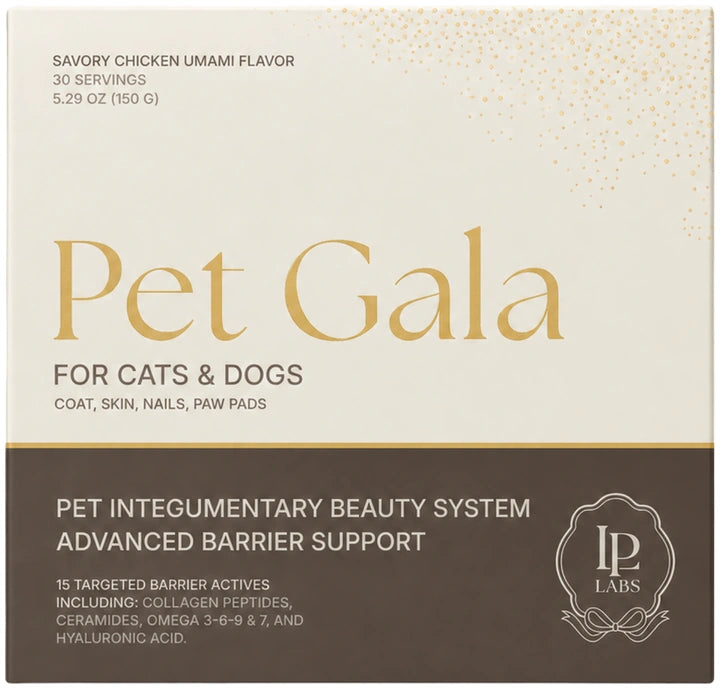
A rubric becomes easier to use when readers can see it applied. Because La Petite Labs makes Pet Gala, this example is disclosed as non-independent and should be read as a demonstration of the scoring method, not third-party certification.

Scores below are calculated by a deterministic scoring function from source-backed product attributes against the fixed tier definitions in the rubric above. The same function and the same tier definitions are used for every product the rubric scores, including ours.


§IVApplication

A worked example, scored in full.

LPL Scorecard · C.01–C.08Pet GalaScored against the 8 LPL-01 criteria using current public materials, LPL-01 documentation, and internal formula records disclosed for this worked example.
Weighted total 92.8/ 100Publisher example · scored, not ranked
C.01
Dose Transparency w × 14 · score 9
12.6

Pet Gala earns a perfect dose transparency score, calculated by a deterministic scoring function, because the product page discloses individual active doses for all 13 active ingredients alongside a clearly stated serving size, with no proprietary blends obscuring any meaningful amount. This formulation architecture satisfies every element of the LPL-01 Standard's 10/10 anchor: buyers can verify whether each skin, coat, nail, and barrier-support ingredient reaches a functionally relevant level without inference or estimation. There are no gaps to note at this tier. Re-scored 9/10 under strict anchors (2026-07-03): Score stops below 10 because the omega blend is disclosed as a combined ‘Omega 3-6-9 150 mg’ figure without an EPA/DHA split; the tier-10 anchor requires individual active-dose disclosure for every meaningful active. Publishing the per-fatty-acid breakdown would earn the 10.

C.02
Integumentary System Coverage w × 16 · score 9
14.4

The deterministic scoring function awarded a 9/10 because the formulation architecture spans at least five distinct integumentary domains — skin barrier lipids (Omega 3-6-9, Omega-7, Ceramides), hydration (Hyaluronic Acid, Ceramides), dermal structure (Marine Collagen Peptides, Hydrolyzed Whey Protein, Beef Gelatin, Bone Broth), coat fiber quality (Biotin, Zinc, MSM), and keratin and nail support (Biotin, Zinc, Silica) — with clear role separation across each. The one gap preventing a perfect mark is follicle-specific pathway coverage: follicular support is implied through overlapping nutrients rather than addressed as a documented, discrete mechanism within the formula's stated architecture.

C.03
Barrier Lipid And Hydration Architecture w × 14 · score 10
14

The deterministic scoring function awarded a full 10/10 because this formula demonstrates exactly the coherent barrier-and-hydration architecture the LPL-01 Standard requires: Omega 3-6-9 (150 mg) and Omega-7 (50 mg) address barrier-lipid replenishment through distinct fatty-acid pathways, while Ceramides (8 mg) and Hyaluronic Acid (50 mg) reinforce the lipid matrix and dermal hydration layer respectively. Dose transparency is complete across all four ingredients, and the role separation between lipid-supply and hydration-retention mechanisms reflects deliberate formulation architecture rather than cosmetic label padding. No gaps in pathway coverage or disclosure prevented a perfect score.

C.04
Dermal Matrix, Collagen And Coat-Fiber Support w × 14 · score 10
14

The deterministic scoring function awarded a perfect 10/10 because this formula meets every condition of the 10/10 anchor without exception. Marine Collagen Peptides (500 mg), Hydrolyzed Whey Protein (250 mg), Beef Gelatin (200 mg), and Bone Broth (100 mg) represent a coherent dermal-matrix architecture with full dose transparency, meaningful pathway coverage across collagen substrate supply, amino acid density, and connective-tissue scaffolding, and clear role separation between each ingredient — satisfying the LPL-01 Standard for structural-support formulation design.

C.05
Keratin, Nail And Follicle Nutrient Logic w × 10 · score 9
9

The deterministic scoring function awarded a 9/10 because the formulation presents a coherent keratin-support architecture — Biotin (50 mcg), Zinc (1.5 mg), Silica (10 mg), and MSM (100 mg) — with each ingredient disclosed at a specific dose and traceable to normal keratin formation, coat renewal, and nail strength under the LPL-01 Standard. Pathway coverage across sulfur donation, mineral cofactors, and structural silica is genuinely strong. The score stops at 9 rather than 10 because follicle-targeting rationale is not separated from broader coat-renewal language, leaving buyers unable to distinguish follicle-specific intent from general keratin support.

C.06
Testing Transparency w × 12 · score 9
10.8

Testing transparency here is strong: third-party verification through NSF and Eurofins covers heavy metals, microbial safety, label accuracy, potency, and batch-level consistency, and a public COA lookup tool exists at a dedicated page — well above the threshold for a 7. The score stops at 9 rather than 10 because the deterministic scoring function identified one remaining gap: the COA lookup experience is not yet confirmed to be fully batch-linked at point of purchase across every current SKU, meaning a buyer receiving a specific lot cannot always close the verification loop in a single step.

C.07
Evidence Quality And Species-Appropriate Claim Discipline w × 10 · score 9
9

Claim discipline here is notably strong: Pet Gala is positioned as beauty-nutrition support rather than a dermatological treatment, with no disease, allergy, or dermatitis-adjacent language present, and species-appropriate dosing logic explicitly excludes puppies, kittens, and pregnant or lactating animals — all markers the deterministic scoring function rewards. The score stops at 9 rather than 10 because finished-formula clinical evidence in dogs and cats on the daily Pet Gala formulation has not yet been published, leaving ingredient-level science as the primary evidence layer rather than confirmed finished-product outcomes.

C.08
Daily Usability, Palatability And Owner Compliance w × 10 · score 9
9

The score of 9/10 was calculated from source-backed attributes reflecting a well-structured daily-use format: pre-measured powder sachets with clear feeding guidance and a savory chicken-and-chicken-liver palatability system meaningfully reduce daily friction and support the multi-week consistency required for visible coat, skin, and nail changes. Subscription cadence further reinforces long-term routine fit across varied diet styles. The single point withheld reflects the minor but real friction of mixing powder into food daily — chew or liquid formats carry lower per-dose effort for some owners, and palatability acceptance, while designed for broad appeal, cannot be fully guaranteed across individual animals.
§VMethodology & Disclosures

How we score, and what could bias us.

04.1 · CONFLICTS OF INTEREST

We make a product in this category.

La Petite Labs makes Pet Gala, a pet skin and coat supplement. This rubric is published by La Petite Labs and reflects the evaluation principles behind the LPL-01 Standard. Scores should be read as a transparent framework, not as independent third-party certification.

+La Petite Labs is the publisher of this standard.
+La Petite Labs manufactures the worked-example product.
No external sponsor influenced this rubric.
No affiliate revenue from competitor links.
04.2 · HOW WE SCORE

Anchored tiers, deterministic scoring.

Each criterion has a fixed point weight and fixed score-tier definitions (10, 9, 8, 7, 4, 1). A criterion scored 10/10 contributes its full weight to the total; a 9/10 contributes 9/10 of its weight, and so on. The eight criteria sum to a maximum of 100 weighted points. Product scores are calculated from source-backed attributes, then explained in plain language.

  • It helps buyers evaluate transparency, testing, formulation architecture, and integumentary-system relevance.
  • It separates visible evidence from cosmetic-shine marketing language.
  • It provides a consistent scoring framework for future buyer guides and competitor reviews.
04.3 · WHAT THIS RUBRIC DOES NOT DO

The honest limits of this rubric.

The rubric is buyer education, not veterinary care. Specific dosing for a specific animal is the responsibility of a treating veterinarian.

  • It does not diagnose, treat, cure, or prevent disease.
  • It does not prove that any supplement resolves allergies, dermatitis, or any diagnosed skin condition.
  • It does not replace veterinary dermatology advice.
  • It does not treat ingredient count as proof of formula quality.

Continue with LPL-01

Read the full methodology, or score a product yourself.

The rubric is open. Apply it to any supplement you are evaluating, and compare against the published example.

Pet Gala™ Barrier System product imagePET-GALA · PRODUCT
SCORED EXAMPLE

Pet Gala

Pet Gala is a systems-based integumentary-support supplement for dogs and cats.

See Pet Gala

Frequently Asked Questions

What does a score on this rubric actually mean?

It is a 100-point public-disclosure evaluation of pet skin and coat supplements: what a buyer can verify from public materials — dose disclosure, testing and COA access, claims discipline, and daily practicality. It does not measure effectiveness, safety, or ingredient quality, and it is not veterinary advice.

Who applies the rubric, and is the worked example independent?

La Petite Labs Editorial applies fixed, published tier anchors, and scores are computed before any rationale is written. Because La Petite Labs makes Pet Gala, the worked example is disclosed as a publisher example — scored under the same anchors, shown without a ranking, and never presented as third-party certification.

How are in-between scores like 5 or 6 decided?

Anchors are published for the tier ladder, and between anchors the lower score applies unless every element of the higher anchor is met. That rule is stated in the methodology so a second scorer can reproduce every number.

How can I check the scoring for ranked products?

Each companion report applies this rubric to named products with per-entry evidence, dated public sources, and a downloadable dataset: see Best Dog Skin & Coat Supplements and Best Cat Skin & Coat Supplements.


§VIReferences

Primary sources consulted in this standard.

These sources informed the rubric criteria, scoring tier definitions, and methodology disclosure. All references are publicly accessible.

  1. [1]
    Clinical study on the effect of biotin on skin conditions in dogs. Frigg M, Schulze J, Völker L ·pubmed.ncbi.nlm.nih.gov ·1989
    peer reviewed
  2. [2]
    Suggested guidelines for using systemic antimicrobials in bacterial skin infections: part 2-- antimicrobial choice, treatment regimens and compliance. L Beco, E Guaguère, C Lorente Méndez, C Noli, T Nuttall, M Vroom ·link.springer.com ·2013
    peer reviewed
  3. [3]
    Biotin Interference in Assays for Thyroid Hormones, Thyrotropin and Thyroglobulin. Dorina Ylli, Steven J Soldin, Brian Stolze, Bin Wei, Girum Nigussie, Hung Nguyen, Damodara Rao Mendu, Mihriye Mete, Di Wu, Cristiane J Gomes-Lima, Joanna Klubo-Gwiezdzinska, Kenneth D Burman, Leonard Wartofsky ·pmc.ncbi.nlm.nih.gov ·2021
    peer reviewed
  4. [4]
    How to Report Animal Drug and Device Side Effects and Product Problems fda.gov ·2026
    regulatory
  5. [5]
    Veterinary Adverse Event Reporting for Manufacturers fda.gov ·2025
    regulatory

Sources reviewed 2026-05-17. Pet supplement labels, public COAs, and brand pages may change; this rubric reflects publicly available information at the time of review.

This rubric provides buyer education only and does not diagnose, treat, cure, or prevent disease. It does not replace veterinary advice.