
The 12 Hallmarks of Aging in Dogs, Explained
Read full insightBrain Health for Cats
Spot early cognitive shifts and protect aging neural circuits sooner.
By La Petite Labs Editorial 15 min read

Brain health for cats comes down to one practical goal: protecting steady cognitive function — balance, memory, sleep, appetite rhythms, and temperament — so a cat stays recognizably themselves year after year. It declines when neural inflammation, oxidative stress, and age-related synapse loss chip away at that steadiness, often quietly and before owners notice obvious change.
The catch is that brain health isn't a single lever. It's shaped by diet quality, sleep, pain, sensory change, and the cumulative wear of stress — and because cats are obligate carnivores, the brain's building blocks are tied closely to animal-based nutrition. As cats age, the margin narrows: shifting appetite, weight, and senior diets can quietly change nutrient intake.
That's where a daily formula becomes a reasonable choice rather than a trendy one. Even on a strong diet, aging is about resilience — how well the body keeps up normal energy and repair over time — so supportive nutrition aims at durability across a life, not at fixing a 'bad' diet.
- Brain health for cats is steady function over years — movement, sleep, appetite rhythms, and temperament — not a single milestone.
- Cognitive change is usually subtle at first: more hesitation, less curiosity, disrupted sleep, or new nighttime restlessness; patterns matter more than one odd day.
- A brain-supportive diet starts with nutrient density, which matters most when appetite or calories change with age.
- Weight-loss plans should protect essential nutrient intake, since restriction can quietly reduce key nutrients the nervous system relies on (Grant CE, 2020).
- Some neurological risks are avoidable — certain toxins and product sensitivities belong in any brain-health plan (Matula E, 2024).
- The best brain-health support complements diet by supporting whole-body resilience, rather than acting like a single 'brain vitamin.'
The Brain as an Organ: Quiet Work Behind Every Ordinary Day
When people talk about “brain health,” they often mean personality, memory, and mood. For cats, it’s also posture, balance, appetite rhythms, sleep, and the quiet competence of everyday movement. Brain health for cats is less about a single milestone and more about maintaining steady function across years—especially as sensory input changes and the body’s reserves narrow with age.
A useful way to think about the brain is as an organ with unusually high demand. It relies on consistent energy delivery, adequate building blocks from food, and protection from avoidable stressors. Cats are obligate carnivores, so the baseline “materials” for neural tissue and signaling are closely tied to animal-based nutrition (Sun M, 2024).

What Are the Early Signs of Cognitive Decline in Cats?
Normal aging looks subtle: a cat hesitates before jumping, seems less curious, or startles more easily. None of these signs automatically means disease — they signal that the brain is working with changed inputs, since vision, hearing, and joint comfort all shape how it reads the world. The goal of brain health for cats isn't to reverse time; it's to preserve adaptability.
Because the brain is wired into the rest of the body, weight, appetite, and overall diet quality all matter. Senior diets vary widely in nutrient profile and calorie density, which influences whole-body health and, indirectly, brain function (Summers SC, 2020). A thoughtful plan looks at the whole system, not one ingredient.

Home Life That Supports Attention, Sleep, and Calm Coordination
If you’re looking for brain health tips for cats, start with the basics that the nervous system quietly depends on: predictable routines, stable sleep, and low-friction access to resources. Cats are pattern-driven. When the environment is calm and consistent, the brain spends less effort “monitoring” and more effort maintaining normal function.
Enrichment matters, but it doesn’t need to be elaborate. Short, frequent play sessions, puzzle feeders, and gentle novelty (a new scent, a rotated toy) can keep attention and motivation engaged. These are not treatments; they’re ways to keep the brain practicing what it already does well—focus, coordination, and decision-making.

Building a Brain Health Diet for Cats Without Overcomplicating Meals
A brain health diet for cats is, first, a diet that reliably meets essential needs. Cats have specific amino acid requirements that are naturally supplied by animal tissues, and those amino acids support neurological function and normal cognition (Sun M, 2024). When diets are improvised, heavily restricted, or poorly balanced, the brain may be competing with other organs for limited resources.
This is especially relevant during weight loss. In obese cats undergoing energy restriction, nutrient intake can fall short of recommended levels unless the plan is carefully designed and monitored (Grant CE, 2020). If your cat is dieting, it’s worth treating “nutrient density” as a brain-support topic, not just a body-weight topic.

Does My Cat Need a Brain Health Supplement?
Owners often ask whether a brain health supplement for cats is 'necessary' when the food is complete and balanced. The honest answer: most single nutrients are already covered by a quality diet, but brain aging isn't a single-nutrient problem. It's a network problem — energy handling, cellular repair, oxidative load, and how the body responds to everyday stress.
That's where a supplement earns a place: not as a replacement for food, but as system-level support that complements a strong diet. For science-minded owners, the decision usually comes down to whether a product supports broad resilience instead of chasing one 'magic' ingredient.
“The brain doesn’t age alone; it ages inside a whole animal.”
Everyday Safety: Avoiding Exposures That Can Affect the Nervous System
Safety belongs in any conversation about brain health products for cats. A cat’s nervous system can be affected by exposures that seem unrelated to “brain care,” including certain toxins and medications. For example, bromethalin intoxication can cause severe neurological effects and may present after a delay, complicating recognition and treatment (Matula E, 2024).
Even some parasite control products have documented neurological adverse effects in susceptible animals. Isoxazolines have been associated with neurological reactions in cats and dogs (Bates N, 2024). This doesn’t mean these products are never appropriate—only that brain health includes avoiding preventable risks and discussing individual susceptibility with your veterinarian.
Individual Risk: Genetics, Sensitivity, and Vet-guided Prevention Choices
Genetics can also shape neurological risk. Certain eprinomectin-containing parasiticides can cause neurological toxicosis in cats with specific genetic susceptibility, even at label doses (Mealey KL, 2024). For an owner, the practical takeaway is simple: “over-the-counter” does not always mean “one-size-fits-all,” especially when the nervous system is involved.
If your cat shows sudden wobbliness, tremors, unusual vocalization, or marked behavior change, treat it as urgent. Brain health for cats is supported by long-term habits, but it’s protected by fast action when something is off.

What “Best” Means: Quality Signals in Brain Health Products for Cats
What does “best brain health supplements for cats” really mean in practice? Look for clarity, consistency, and restraint: transparent labeling, quality control, and a purpose that fits your cat’s life stage. A supplement should not promise to diagnose, treat, cure, or prevent disease. It should support normal function and healthy aging.
Also consider the cat in front of you. A picky eater may need a format that doesn’t disrupt meals. A cat with multiple medications needs a plan that respects timing and tolerability. The “best” choice is often the one that can be used steadily, without turning daily care into a negotiation.

Whole-body Aging: Why the Brain Depends on More Than One System
Aging brains do not age in isolation. Muscle, liver, kidneys, and gut all influence what the brain receives and how it responds. That’s why a narrow approach—adding one nutrient because it’s trending—often disappoints. A broader approach asks: is the whole body supported well enough that the brain can do its job?
Senior cat foods can differ meaningfully in nutrient density and energy content, which affects weight stability and overall metabolic health (Summers SC, 2020). If your cat is older, it’s worth reviewing the diet periodically with your veterinarian, especially if appetite, weight, or activity changes.
Tracking Change Without Panic: Patterns, Not One-off Moments
Owners sometimes notice “brain days” and “not-brain days.” A cat may seem bright one week and withdrawn the next. Before assuming cognitive decline, consider sleep disruption, pain, dehydration, or household change. The brain is sensitive to small shifts in comfort and predictability, and cats are experts at masking discomfort.
If you’re tracking brain health tips for cats, keep notes that are easy to compare: appetite, litter box habits, play interest, grooming, and social engagement. Patterns are more informative than single moments, and they give your veterinarian a clearer picture if you need to investigate further.
“A good plan supports steadiness—sleep, routine, nutrition, and safety—more than novelty.”

DVM Voice: Clinical Vignette of a Common Pattern in Senior Cat Aging
Case provided by JoAnna Pendergrass, DVM
Sasha, a 12-year-old cat, was brought in after her owner noticed increased thirst and urination, lethargy, vomiting, and a generally unkempt appearance. Examination showed weight loss, elevated blood pressure, and reduced vitality.
Diagnostic testing revealed elevated kidney markers, poorly concentrated urine, and protein loss in the urine — findings consistent with chronic kidney disease, one of the most common chronic conditions in senior cats.
Her care required a kidney-focused diet, blood pressure management, targeted supplementation, medication support, and regular monitoring — a necessary plan, but one started after clinical signs were already visible.
Clinical takeaway: Sasha’s case reflects why senior-cat wellness should begin before obvious decline. Earlier monitoring, body-condition tracking, hydration awareness, antioxidant support, and daily cellular resilience may help support quality of life as cats age.
Single-case vignette. Not generalizable. Veterinary diagnosis and monitoring are essential for increased thirst, urination, vomiting, lethargy, weight loss, or suspected kidney disease.

Weight Management Without Nutrient Gaps That Undercut Vital Function
Nutrition questions often become sharper during weight management. Restricting calories can unintentionally restrict essential nutrients if the plan isn’t designed for it (Grant CE, 2020). For the brain, that matters because the nervous system depends on steady access to amino acids and vitamins that support normal signaling and maintenance.
If your cat needs to lose weight, ask your veterinarian about a structured approach that protects nutrient intake while reducing calories. The aim is not just a smaller number on the scale, but a cat who remains engaged, coordinated, and comfortable while the body changes.

Support Versus Claims: Reading Labels with a Clear, Calm Eye
A practical way to evaluate brain health products for cats is to separate “support” from “claims.” Support looks like: helping maintain normal energy, healthy aging, and resilience to everyday stress. Claims look like: promising to fix a diagnosis or replace veterinary care. The first is reasonable; the second is a red flag.
Because cats are sensitive to taste and texture, usability is part of quality. A product that is theoretically perfect but never taken is not a solution. The best brain health for cats is the plan you can keep—diet, environment, and a supplement that fits smoothly into the day.

When to Involve Your Veterinarian in Supplement Decisions
If you’re considering a brain health supplement for cats, bring your veterinarian into the decision when your cat is senior, on medications, or has a complex history. This is not about fear; it’s about avoiding avoidable interactions and making sure the supplement aligns with the bigger plan.
It’s also worth remembering that neurological signs can have non-neurological causes. A cat who seems “confused” may be dealing with pain, sensory loss, or a change in routine. Supplements can support healthy aging, but they should not delay an exam when symptoms are new or escalating.
Small Environmental Adjustments That Reduce Cognitive Load over Time
For many households, the most meaningful brain health tips for cats are the quiet ones: keep water accessible, reduce slipping hazards, add a step to a favorite perch, and protect sleep. These changes reduce the brain’s workload by reducing uncertainty and physical strain.
If your cat is older, consider “sensory kindness.” Night lights can help cats who hesitate in the dark. Consistent furniture placement helps cats navigate confidently. These are small interventions, but they support the brain’s core job: making sense of the environment without constant recalculation.
The Real Value of Supplements: Resilience, Not a Single Ingredient
When owners search for the best brain-health support for cats, they're usually trying to buy time — more recognition, more play, more ease. No supplement can promise those outcomes, but a formula can be built around the realities of aging biology: supporting the body's capacity to keep normal function steady over time.
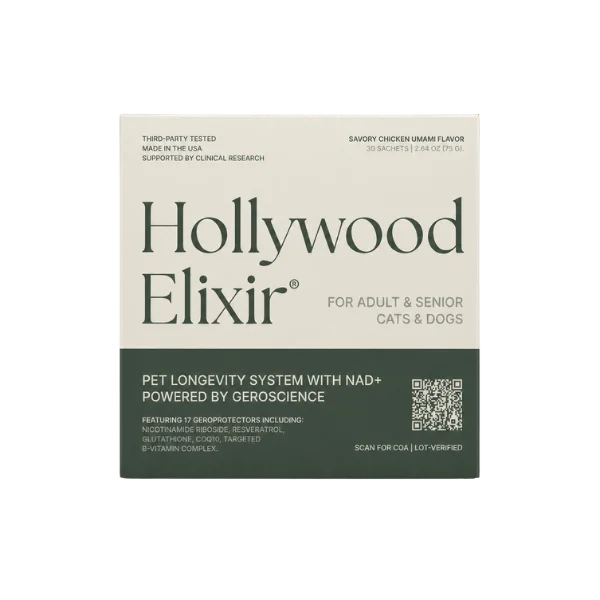
That's the commercial truth that still respects scientific honesty. Even when a diet meets minimums, aging is about resilience, not adequacy. Hollywood Elixir is built as that system-level layer — a food-mixed daily routine with readable actives for NAD+ and antioxidant support (nicotinamide riboside at 60 mg, glutathione at 50 mg, astaxanthin) rather than a narrow 'brain vitamin.' You can see what your cat is getting and review the label with your vet.

Toxins and Timing: Why Fast Action Protects Brain Health
Cats are uniquely vulnerable to certain household and pest-control toxins, and neurological effects can be dramatic. Bromethalin exposure is one example where severe neurological injury may develop and can be delayed, making early recognition difficult (Matula E, 2024). Prevention here is part of brain health for cats: secure storage, careful bait placement, and immediate veterinary contact if exposure is suspected.
Similarly, if a cat has a history of neurological sensitivity, discuss parasite prevention choices with your veterinarian. Some products have reported neurological adverse effects in cats and dogs (Bates N, 2024), and individual risk tolerance varies by household and medical history.

Senior Nutrition Check-ins: Keeping Diet Aligned with Changing Needs
A brain health diet for cats should be evaluated in context: life stage, body condition, and appetite. Senior foods vary, and that variability can matter when you’re trying to keep weight stable without sacrificing nutrient density (Summers SC, 2020). If your cat is eating less, the “per-calorie” nutrient profile becomes more important, not less.
Because cats rely on animal-based amino acids for normal neurological function (Sun M, 2024), prioritize high-quality protein sources and avoid drastic diet shifts unless medically indicated. When changes are needed, gradual transitions protect appetite and reduce stress—both of which indirectly support the brain.
A Layered Plan for Best Brain Health for Cats Across a Lifetime
The most convincing approach to brain health for cats is layered: a nutrient-dense diet, an environment that supports confidence, and a supplement that aims at whole-body aging support rather than a single “brain” promise. This is why many careful owners still choose a product even when food is strong—because the goal is durability across time, not just meeting a minimum today.
If you want brain health products for cats that fit this philosophy, look for formulations designed for graceful aging and daily consistency. The best choice is the one that supports the broader system the brain depends on, while staying realistic about what supplements can and cannot do.
“The best choices are the ones you can use consistently, without turning care into conflict.”
Educational content only. This material is not a substitute for veterinary advice. Always consult your veterinarian about your dog’s specific needs. These statements have not been evaluated by the Food and Drug Administration. Products mentioned are not intended to diagnose, treat, cure, or prevent any disease.
Glossary
- Cognition: A cat’s ability to process information, learn routines, and respond appropriately to the environment.
- Enrichment: Safe activities that engage attention and natural behaviors, supporting mental engagement over time.
- Nutrient Density: The amount of essential nutrients delivered per calorie, especially important for seniors or dieting cats.
- Obligate Carnivore: A species that requires nutrients found primarily in animal tissues; cats depend on this for normal function.
- Amino Acids: Protein building blocks that support many body functions, including normal neurological signaling.
- Neurological Signs: Observable changes such as tremors, unsteady gait, seizures, or sudden behavior shifts that warrant prompt evaluation.
- Palatability: How appealing a food or supplement is to a cat; critical for consistency in long-term support.
- System-Level Support: An approach that supports whole-body aging resilience rather than targeting a single nutrient or symptom.
- Routine Stability: Predictable daily patterns that reduce stress load and help cats maintain steady behavior and sleep.
Related Reading
Aging & Senior Cat Guidance
• Cat Age Calculator: Cat Years to Human Years
• Lethargy in Cats
• Senior Cat Not Eating
• Cat Drinking A Lot
• Why Is My Senior Cat Withdrawn?
Healthy Aging Support
• NAD+ for Cats
• NMN for Cats
• Vitamins For Older Cats
• Senior Cat Food
References
Grant CE. Dietary intake of amino acids and vitamins compared to NRC requirements in obese cats undergoing energy restriction for weight loss. PubMed. 2020. https://pubmed.ncbi.nlm.nih.gov/33160364/
Summers SC. Evaluation of nutrient content and caloric density in commercially available foods formulated for senior cats. PubMed Central. 2020. https://pmc.ncbi.nlm.nih.gov/articles/PMC7517497/
Sun M. Considerations on amino acid patterns in the natural felid diet: a review. PubMed Central. 2024. https://pmc.ncbi.nlm.nih.gov/articles/PMC11603590/
Mealey KL. Application of eprinomectin-containing parasiticides at label doses causes neurological toxicosis in cats homozygous for ABCB11930_1931del TC. PubMed. 2024. https://pubmed.ncbi.nlm.nih.gov/38366723/
Matula E. Delayed transforaminal brain herniation in a cat following bromethalin intoxication. PubMed. 2024. https://pubmed.ncbi.nlm.nih.gov/39099308/
Bates N. Neurological adverse effects of isoxazoline exposure in cats and dogs. PubMed. 2024. https://pubmed.ncbi.nlm.nih.gov/38616548/
Kulpa JE. Safety and tolerability of escalating cannabinoid doses in healthy cats. PubMed. 2021. https://pubmed.ncbi.nlm.nih.gov/33769105/
Atkins CE. Clinical toxicities of cats. PubMed. 1975. https://pubmed.ncbi.nlm.nih.gov/1103436/
Taylor S. 2022 ISFM Consensus Guidelines on Management of the Inappetent Hospitalised Cat. PubMed Central. 2022. https://pmc.ncbi.nlm.nih.gov/articles/PMC11107985/
Masson. Retrospective study on the use of venlafaxine in 176 cats diagnosed with behavioral disorders. 2025. https://www.sciencedirect.com/science/article/abs/pii/S1558787824000935
Ahmed. Bioaccumulation of heavy metals in some commercially important fishes from a tropical river estuary suggests higher potential health risk in children than adults. Nature. 2019. https://www.nature.com/articles/s41598-021-00467-4
RVA. Toxic element levels in ingredients and commercial pet foods. PubMed Central. 2021. https://pmc.ncbi.nlm.nih.gov/articles/PMC8546090/
Bilgiç B. The Values of Potentially Toxic Elements (PTEs) in Prescription and Non-prescription Dry Cat and Dog Diets in Turkey. PubMed. 2025. https://pubmed.ncbi.nlm.nih.gov/40442459/
Summers S. Evaluation of iron, copper and zinc concentrations in commercial foods formulated for healthy cats. PubMed Central. 2022. https://pmc.ncbi.nlm.nih.gov/articles/PMC10812249/
Peloquin. Presumed Choline Chloride Toxicosis in Cats With Positive Ethylene Glycol Tests After Consuming a Recalled Cat Food. 2021. https://www.sciencedirect.com/science/article/pii/S1938973621000416
Watson. Drivers of Palatability for Cats and Dogs-What It Means for Pet Food Development. Springer. 2023. https://link.springer.com/article/10.1007/s12011-025-04680-4
FAQ
What does brain health mean for cats day to day?
In daily life, brain health shows up as steady coordination, normal sleep-wake rhythms, predictable social behavior, and a cat who navigates the home with confidence. Small changes can be normal with age, but patterns matter more than single moments.
A supportive plan pairs routine, enrichment, and nutrition with system-level aging support, which is where Hollywood Elixir™ fits naturally.
Why does brain health for cats matter as they age?
As cats age, the brain has to do the same work with changing sensory input, shifting body comfort, and sometimes a narrower nutritional margin. Supporting normal function early can help preserve adaptability and reduce the impact of everyday stressors.
Owners often choose a broad, daily approach rather than chasing a single ingredient, and Hollywood Elixir™ is built to support graceful aging at the whole-body level.
How can I tell if my cat seems mentally slower?
Look for consistent changes: reduced play interest, altered sleep patterns, new vocalizing at night, or hesitation with familiar jumps. Also consider non-brain causes like pain, vision changes, or stress, since these can mimic “slowness.”
If changes are new or worsening, a veterinary exam is the right next step, alongside steady daily support such as Hollywood Elixir™ for overall aging resilience.
What are simple brain health tips for cats at home?
Keep routines predictable, offer short play sessions, rotate a few toys, and make navigation easy with steps or stable perches. Hydration and quiet sleep also matter more than most people expect.
These basics work best when paired with consistent, system-level support for aging, which is why many owners add Hollywood Elixir™ to a stable routine.
What should a brain health diet for cats include?
A strong diet emphasizes complete-and-balanced nutrition with high-quality animal-based protein, since cats rely on specific amino acids found in animal tissues for normal neurological function. Consistency and palatability matter, especially for seniors.
Diet is the foundation, and a whole-body aging formula can complement it—many owners choose Hollywood Elixir™ for broader resilience beyond any single nutrient.
Do senior cat foods always support brain health well?
Not always. Senior foods can vary meaningfully in nutrient profiles and caloric density, which can influence weight stability and overall health. The best choice depends on your cat’s appetite, body condition, and medical history.
Many owners pair an appropriate senior diet with steady aging support from Hollywood Elixir™ to keep the plan consistent over time.
Can weight loss affect my cat’s brain and behavior?
Yes, indirectly. During calorie restriction, nutrient intake can fall short if the plan isn’t designed carefully, which is why monitoring matters. Hunger, stress, and rapid routine changes can also affect sleep and behavior.
A veterinarian-guided weight plan plus steady, system-level support—such as Hollywood Elixir™—can help keep overall function stable.
When should I consider a brain health supplement for cats?
Many owners consider supplements when a cat enters the senior years, when appetite becomes less reliable, or when they want to support normal energy and engagement over time. The goal should be healthy aging support, not a promise to fix a diagnosis.
If you want a system-level option that fits alongside a good diet, consider Hollywood Elixir™ as part of a broader brain-and-body plan.
Are brain health supplements for cats safe for daily use?
Safety depends on the formula, your cat’s health status, and what else they take. For seniors, cats with chronic conditions, or cats on medications, it’s wise to review any supplement with your veterinarian to avoid avoidable interactions.
A well-designed daily product should prioritize consistency and tolerability, which is part of the intent behind Hollywood Elixir™ for ongoing aging support.
What side effects might I notice with new supplements?
The most common issues are digestive: reduced appetite, soft stool, or occasional vomiting, especially if introduced abruptly. Any marked lethargy, agitation, or neurological signs should be treated as a reason to stop and call your veterinarian.
Introducing changes slowly and choosing a product designed for daily use can help, including Hollywood Elixir™ as part of a steady routine.
Can supplements interact with flea, tick, or deworming products?
Interactions are possible, and neurological sensitivity is a special consideration. Some parasite control products have reported neurological adverse effects in cats and dogs(Bates N, 2024). If your cat has a history of tremors or unusual reactions, discuss timing and product choice with your veterinarian.
A cautious, coordinated plan can still include daily aging support from Hollywood Elixir™when your veterinarian agrees it fits.
What household toxins are most dangerous to a cat’s brain?
Rodenticides are a major concern. Bromethalin intoxication can cause severe neurological effects and may present after a delay, which can complicate recognition. Any suspected exposure is an emergency—call your veterinarian or an animal poison hotline immediately.
Prevention plus long-term resilience support is a sensible pairing, and many owners include Hollywood Elixir™ in their broader aging plan.
Are some cats genetically sensitive to certain parasite medications?
Yes. There are documented cases where eprinomectin-containing parasiticides caused neurological toxicosis in genetically susceptible cats, even at label doses(Mealey KL, 2024). This is uncommon, but it’s a reminder that “standard” products may not be standard for every individual.
If your cat has had unusual reactions before, coordinate prevention choices with your veterinarian and consider steady aging support like Hollywood Elixir™as part of the overall plan.
How long does it take to notice changes with supplements?
Timelines vary. Some owners notice changes in appetite, engagement, or daily “spark” within a few weeks, while others see more gradual shifts over a couple of months. Because behavior fluctuates naturally, tracking a few simple markers weekly can be more reliable than day-to-day impressions.
Consistency matters most, which is why Hollywood Elixir™ is positioned for steady, long-horizon aging support.
What quality signals matter when choosing brain health products for cats?
Look for transparent labeling, clear intended use, and manufacturing standards that suggest consistency from batch to batch. Avoid products that lean on dramatic promises or imply they replace veterinary care. Palatability and ease of use are also quality signals in real life.
A product designed around daily, system-level aging support—like Hollywood Elixir™—often fits best with a careful owner’s expectations.
How do I give a supplement to a picky cat?
Start small and keep the experience neutral. Mix into a strongly preferred wet food, use a tiny “test portion” first, and avoid changing multiple things at once. If your cat refuses, don’t escalate into a struggle—stress can undermine the goal.
Choosing a product intended to integrate smoothly into daily feeding, such as Hollywood Elixir™, can make consistency more realistic.
Is brain health for cats different from dogs’ brain support?
Yes, partly because cats are obligate carnivores with distinct nutritional requirements and strong preferences around food texture and flavor. Their routines are often more rigid, too, so environmental stability can play an outsized role in day-to-day behavior.
A cat-appropriate approach emphasizes consistency and whole-body aging support, which is the intent behind Hollywood Elixir™ for feline-friendly daily use.
What age should I start supporting my cat’s brain?
There’s no single “right” age. Many owners begin focusing on healthy aging support in midlife, before noticeable changes appear, because consistency over time is often more meaningful than last-minute additions. For seniors, the focus is on comfort, routine, and nutrient density.
If you want a steady, long-term option that complements diet and lifestyle, Hollywood Elixir™ is designed for graceful aging support.
What should I ask my vet about supplements and cognition?
Ask whether your cat’s current diet is meeting needs for their life stage, whether pain or sensory loss could be affecting behavior, and whether any medications or preventives raise neurological considerations. Bring a short log of changes so the discussion stays concrete.
If your veterinarian agrees a system-level approach fits, you can discuss adding Hollywood Elixir™ for ongoing aging support.
What research themes matter most for feline brain aging?
In cats, practical research themes include whether diets reliably deliver essential nutrients across life stages, and how changes in calorie intake affect nutrient sufficiency. Cats’ reliance on animal-based amino acids is a central nutritional reality for normal neurological function.
Because aging is multi-factorial, many owners choose broad support rather than a single-nutrient bet, including Hollywood Elixir™ for system-level resilience.

Discover LPL-01: How This Fits Into a Larger Feline Longevity System
Aging in cats unfolds quietly. It’s not driven by a single failure, but by gradual shifts across interconnected systems — cellular energy, oxidative balance, immune tone, and tissue integrity — each influencing the others over time.
This article explores one layer of that system. To understand what actually shapes long-term health, you need to step back and look at how these layers interact.
Start with the underlying science:
- Feline Geroscience Framework →
A structured view of how aging progresses across cellular energy, inflammation, and resilience systems. - Senior Biological Defense Coverage (BDC) Modeling →
A systems-level map of which biological pathways decline first, and how layered interventions can support them. - 2026 Market Research: Best Cat Longevity Supplements →
A feline-specific review of longevity supplements. 2026 Industry report created by LPL-01 Research. - LPL-01 Standard →
The formulation system that translates these models into real-world supplementation—covering multiple pathways in a coordinated way.
Essential Summary
Why is brain health for cats important?
Brain health in cats is built from steady inputs: a nutrient-dense diet, predictable routines, and protection from avoidable toxins. Because aging affects the whole body, the most reliable support is system-wide—helping energy, resilience, and daily function stay consistent over time, rather than chasing a single “brain” ingredient.
Hollywood Elixir is designed for graceful aging support—an approach that matters because the brain depends on the whole body’s capacity to maintain normal energy, repair, and resilience. Instead of acting like a narrow brain health supplement for cats, it fits into a broader plan that pairs a strong diet with daily, system-level support.
Longevity Core
Hollywood Elixir®
★★★★★(313)
More good years, starting now — steady energy, engagement, and a pet who keeps showing up fully, every day.
Starting at $89/mo
Hollywood Elixir is amazing! She put back on 5 lbs to a healthy weight, her eyes are shiny, her coat is beautiful!
— Jessie
She hopped up onto the windowsill again for the first time in years.
— Charlie
Considering brain health for cats?
If you're searching to understand brain health in cats
For most households, the most reliable approach to brain health for cats is layered: a complete-and-balanced diet with strong protein sources, a home setup that reduces stress and slipping hazards, and a supplement that supports whole-body aging rather than chasing a single “brain” promise. If your cat is senior, dieting, or on medications, ask your veterinarian to review the plan for fit and safety. For owners who want a daily, system-level option that complements good nutrition and routine, Hollywood Elixir is designed to support graceful aging without pretending to replace veterinary care.
Veterinary Insights

Learn about how our DVMs think about cat aging
Dr. JoAnna Pendergrass DVM


Longevity Core
Hollywood Elixir®
★★★★★(313)
More good years, starting now — steady energy, engagement, and a pet who keeps showing up fully, every day.
Starting at $89/mo
Wellness Tools
Explore your cat’s changing needs over time


Related Reading
The brain is easy to romanticize, but in a cat it’s also intensely practical. It keeps balance steady on a windowsill, turns sound into a snap of attention, and coordinates the small decisions that make a home feel familiar.
