



5 Coat Warning Signs of Illness in Dogs & Cats
Read full insightPeptides for Dogs
From protein in the food bowl to collagen in a supplement: how peptides fit your dog’s nutrition
By La Petite Labs Editorial 17 min read
Peptides for Dogs
From protein in the food bowl to collagen in a supplement: how peptides fit your dog’s nutrition

What “hydrolyzed” means on a label

Short fragments can reach the blood

Why one peptide can behave differently from another

Collagen supports skin; keratin makes the hair

A dog study measured how the paws carried weight

Muscle needs the whole amino-acid supply

Hydrolyzed diets have a different purpose

DVM Voice: Clinical Vignette of When Skin Changes Point Deeper Than the Surface
Case contributed by Sarah Calvin, DVM
Rosey, a 10-year-old Shih Tzu, was brought in after two weeks of paw redness and head shaking. Her owner had also noticed lower energy, thinning abdominal hair, and mild generalized itchiness over the previous few months.
Examination showed inflammation in the ears, skin folds, and paws. Testing confirmed mixed yeast and bacterial infections, while parasites and fungal disease were ruled out. Because Rosey’s skin changes appeared alongside reduced energy and coat thinning, her veterinarian performed a broader workup, which revealed hypothyroidism as a likely underlying contributor.
Her care required a staged approach: treating the infections, addressing the thyroid imbalance, and then restoring the skin barrier through diet, bathing support, paw care, and omega-3 supplementation.
Six months later, Rosey’s owner reported a thicker coat, fewer tangles, less breakage, no itch, and restored energy.
Clinical takeaway: Rosey’s case shows why skin and coat changes should not be treated as cosmetic alone. Healthy skin depends on immune balance, endocrine health, nutrition, barrier integrity, and daily support for resilient coat growth.
Single-case vignette. Not generalizable. Veterinary diagnosis and oversight are essential for itching, redness, ear irritation, hair thinning, recurrent infections, or suspected endocrine disease.

BPC-157 is a separate discussion

Read the ingredient amount, not just the scoop size

There is no single dose for “peptides”

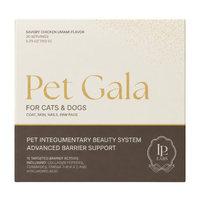
Where Pet Gala fits

Decide what would count as a worthwhile change
References
Numbered references identify the sources used for specific claims. Read the study design, species and evidence boundaries alongside each finding.
-
Erin D. Connolly, Guoyao Wu. Functions and Metabolism of Amino Acids in the Hair and Skin of Dogs and Cats. Evidence boundary: This review chapter describes amino-acid roles in hair and skin; its public abstract does not establish a collagen-supplement effect.↩ 1 · ↩ 2
-
Britta Dobenecker, Linda Franziska Böswald et al. The oral intake of specific Bioactive Collagen Peptides (BCP) improves gait and quality of life in canine osteoarthritis patients—A translational large animal model for a nutritional therapy option. Species/context: dogEvidence boundary: This small, manufacturer-funded canine osteoarthritis trial tested a specific porcine hydrolysate for 12 weeks, with mixed gait and owner-reported outcomes.↩
-
U.S. Food and Drug Administration. “Complete and Balanced” Pet Food. Evidence boundary: FDA guidance explains nutritional adequacy statements and life-stage needs; it does not evaluate a particular supplement.↩ 1 · ↩ 2
-
Canadian Academy of Veterinary Dermatology. Diagnosing Food Allergies in Dogs: Elimination Diet Trials. Evidence boundary: This veterinary handout concerns supervised elimination diets; a hydrolyzed supplement alone does not reproduce a complete diet trial.↩ 1 · ↩ 2
-
Koji Iwai, Takanori Hasegawa et al. Identification of food-derived collagen peptides in human blood after oral ingestion of gelatin hydrolysates. Species/context: humanEvidence boundary: This human study detected short collagen-derived peptides in blood after gelatin hydrolysates; it did not test canine tissue repair or clinical benefit.↩
-
Sherry Lynn Sanderson. Nutritional Requirements of Small Animals. Evidence boundary: This veterinary nutrition chapter explains canine amino-acid needs and protein quality; it does not assess a particular collagen supplement.↩ 1 · ↩ 2
-
Karen A. Moriello. Structure of the Skin in Dogs. Evidence boundary: This owner guidance describes skin anatomy and influences on hair growth; it is not a supplement trial.↩
-
Lei He, Donglin Feng et al. Pharmacokinetics, distribution, metabolism, and excretion of body-protective compound 157, a potential drug for treating various wounds, in rats and dogs. Species/context: dog, ratEvidence boundary: This study measured BPC-157 pharmacokinetics in rats and beagles; it did not test recovery in injured companion dogs or an oral collagen powder.↩
-
U.S. Food and Drug Administration. Paws Off Xylitol; It's Dangerous for Dogs. Evidence boundary: FDA describes xylitol poisoning in dogs and the need for immediate professional help after suspected ingestion.↩
-
Cristiana Paul, Suzane Leser et al. Significant Amounts of Functional Collagen Peptides Can Be Incorporated in the Diet While Maintaining Indispensable Amino Acid Balance. Evidence boundary: This human-diet modeling paper describes collagen’s amino-acid limitations; its dietary substitution calculations do not establish canine feeding amounts.↩
-
U.S. Food and Drug Administration. Proper Storage of Pet Food & Treats. Evidence boundary: FDA advises stopping a suspect food product and contacting a veterinarian when a pet becomes unwell; this is general response guidance rather than a peptide safety trial.↩
-
Yukiko Mizutani, Susumu Mitsutake, Kiyomi Tsuji, Akio Kihara and Yasuyuki Igarashi. Ceramide biosynthesis in keratinocyte and its role in skin function. Species/context: Mammalian epidermal biology reviewEvidence boundary: Biological background on the skin barrier; not a trial of an oral pet supplement.↩ 1 · ↩ 2

Discover LPL-01: How This Fits Into a Complete Canine Integumentary Support System
Skin, coat, and nails aren’t cosmetic features. They’re the visible surface of deeper biological systems—barrier function, hydration balance, structural protein turnover, and lipid integrity—working in concert.
When these systems fall out of sync, it shows: dull coat, shedding, dryness, brittleness, sensitivity.
This article explores one piece of that puzzle. If you want to understand how true coat quality and skin resilience are built—and what actually moves the needle—you need to zoom out.
Start with the underlying science:
- Canine Skin & Coat Framework →
A structured view of how skin, coat, and nail health are maintained across collagen synthesis, lipid balance, and barrier function. - Barrier Protection Coverage Modeling →
A systems-level map of which integumentary pathways are most vulnerable—and how layered nutritional inputs can support them. - 2026 Market Research: Best Dog Skin & Coat Supplements →
A category review of dog formulas for coat quality, skin barrier support, fatty acid balance, collagen support, shedding, and visible beauty. - LPL-01 Standard →
The formulation system that translates these models into real-world supplementation—covering multiple pathways in a coordinated way.
Keep exploring
What would you like to understand next?
Search practical guides about skin, coat, barrier health, ingredients, and daily care for dogs.


