








Collagen for Dogs

Collagen supports connective tissue; Pet Gala brings it together with skin-barrier and moisture care

By La Petite Labs Editorial 18 min read

As Seen On

Woman cuddling a golden retriever and a collie beside a Pet Gala box and a food bowl
Pet Gala™ Skin & Coat Supplement for Dogs

Contains 500 mg Marine Collagen Peptides

From$43/moSave up to 46%Shop Now
Contents

Collagen for Dogs

Collagen supports connective tissue; Pet Gala brings it together with skin-barrier and moisture care

Collagen for dogs is a protein ingredient associated with the body’s supporting tissues, including the skin beneath the coat. Supplements may contain small collagen peptides, gelatin or undenatured type II collagen. Those preparations have different structures and research behind them. 1 2 4

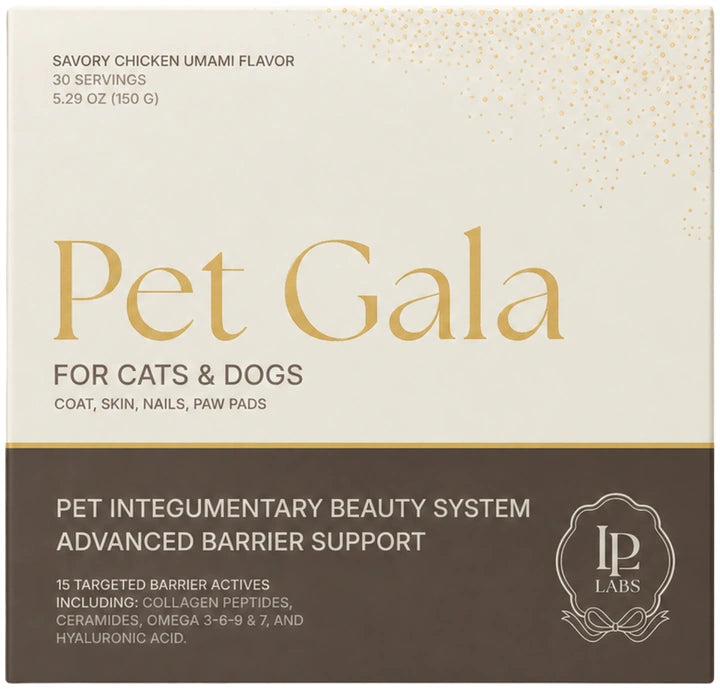
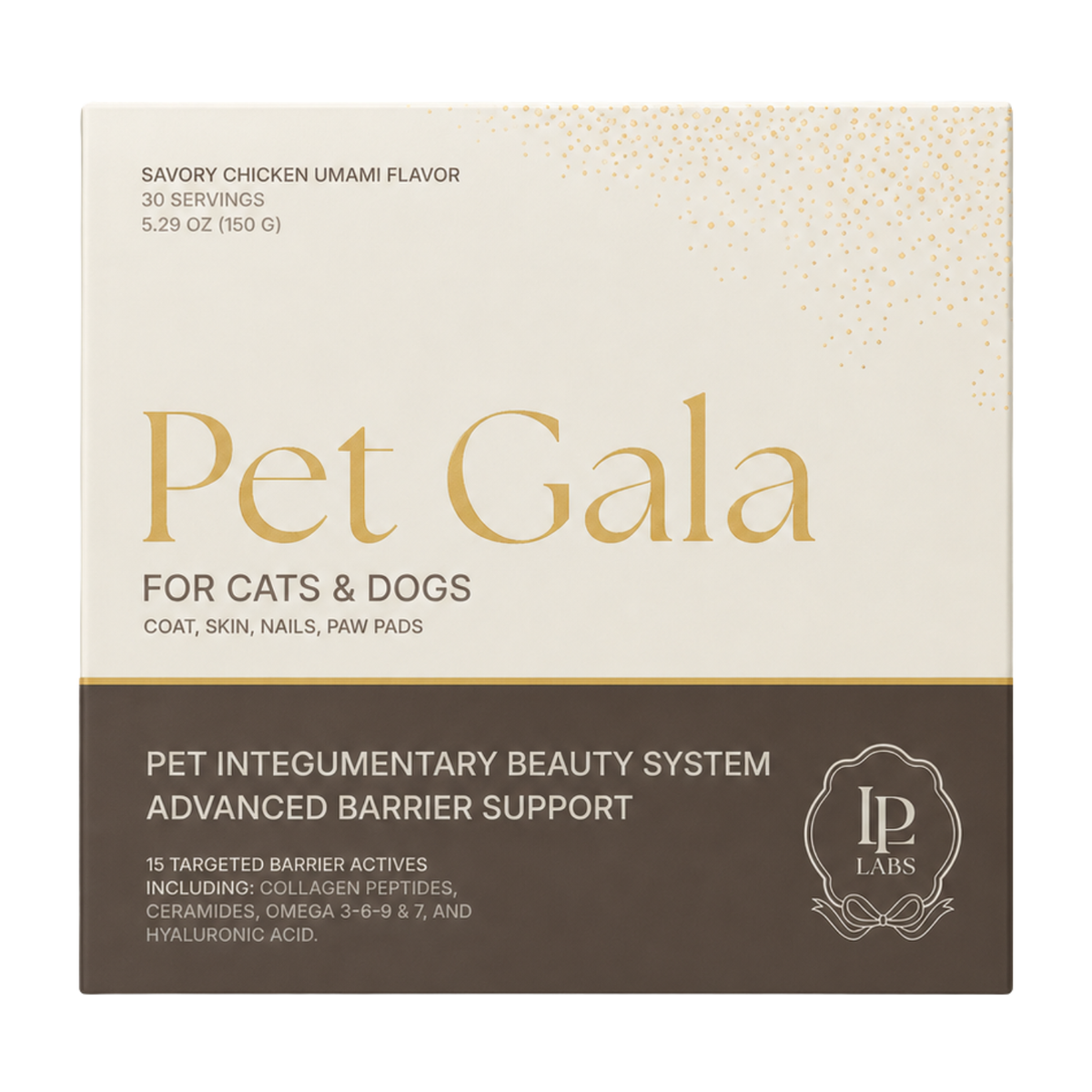
Pet Gala places marine collagen in a full 13-active formula for daily skin, coat, paw and nail nutrition. Protein ingredients, omegas, ceramides and hyaluronic acid bring structural and moisture care together in one portion for food. 16

Collagen is a structural protein beneath a dog’s coat and in other connective tissues. This guide explains hydrolyzed peptides, gelatin and undenatured type II collagen, the actual canine joint findings, and how Pet Gala combines protein ingredients with barrier and moisture care for skin, coat, paws and nails.

Collagen supports the skin beneath the coat

Collagen is one of the major proteins in the deeper layers of skin. It helps give that tissue its supporting structure. Hair and the outer skin contain a different major protein: keratin. 1

That makes skin-and-coat nutrition a broader question than adding collagen alone. The tissue beneath the hairs and the hairs themselves need materials for their own proteins. Fats, vitamins, minerals and enough food energy also belong in the daily diet. 12

A complete food suited to your dog’s life stage is the foundation. Our food and skin-and-coat guide explains that starting point; the sections below help you choose what a collagen supplement adds.

Woman cuddling a golden retriever and a fluffy white dog while holding a Pet Gala box beside a food bowl

Peptides, gelatin and undenatured collagen differ

Three names appear often on collagen products:

  • Hydrolyzed collagen peptides: collagen broken into smaller protein fragments.
  • Gelatin: collagen whose original organized structure has been unfolded during processing. Further hydrolysis can produce smaller peptides.
  • Undenatured type II collagen: a preparation that retains its native three-dimensional structure. Its proposed joint-support mechanism involves recognition by immune tissue in the gut, often called oral tolerance. 2 4

These terms describe meaningful differences. A study of a small amount of undenatured type II collagen cannot tell you how much hydrolyzed marine powder to give. Start with the actual preparation and its product directions.

Woman holding a Pet Gala box beside a curly-coated brown dog outdoors

The animal source is part of the choice

Collagen ingredients can come from cattle, pigs or marine tissues. The source tells you something about the material and which animal ingredients you are introducing. Processing also affects the resulting preparation. 2 3

“Marine” does not establish that every product contains the same peptides or has the same clinical effects. Pet Gala’s declaration names marine collagen peptides, without specifying a type I-and-III combination. It also contains milk, beef and chicken ingredients elsewhere in the formula. 16

For a dog with known food sensitivities, review the whole ingredient list. The marine collagen guide goes further into that source; source identity alone is not a ranking of which product will work best.

Woman cuddling a Dalmatian while holding a Pet Gala box

Digestion turns collagen into usable protein material

Collagen is a protein. Digestion releases amino acids and small peptides, and the pattern of peptides can vary with the source and manufacturing process. Research on absorption and tissue distribution relies heavily on human and experimental-animal work; it does not establish a universal absorption percentage for dogs. 3

Think of an oral collagen ingredient as part of the protein material the dog consumes. A scoop does not travel unchanged into a patch of dry skin or a sore joint. Your dog’s cells and tissues carry out their own metabolism.

That is why the complete preparation matters in a feeding study. The name “collagen” is a starting point for understanding a product, not a guarantee that every formulation produces the same result.

Cream-colored dog resting on a person's lap beside a Pet Gala box and a food bowl

A canine cell study explored collagen production

In a 2017 experiment, researchers applied specific porcine collagen peptides directly to canine cartilage-cell cultures. After two to three weeks, the cells produced more type II collagen, aggrecan and elastin than untreated controls. The PETAGILE preparation was supplied by its manufacturer. 9

This finding helps explain why scientists investigate particular peptide preparations: they can influence the production of structural material under laboratory conditions. The cells were exposed directly, so the experiment did not test digestion or a skin-and-coat supplement fed to living dogs.

The useful distinction is between an observed cellular response and an outcome an owner can see. The next studies looked at dogs themselves.

Collagen supports the skin beneath the coat; the hairs themselves contain a different major protein, keratin.

Specific peptides improved weight-bearing in one trial

A 2024 double-blind trial enrolled 41 dogs with osteoarthritis; 31 completed 12 weeks. Eleven received specific porcine collagen peptides, eleven received omega-3 plus vitamin E, and nine received placebo. 5

The collagen group improved affected-limb weight-bearing compared with placebo. Owner-rated quality of life improved more than with omega-3/vitamin E, but not significantly more than placebo. Pain scores and measured activity had no significant treatment effect.

GELITA funded the study; employee and patent interests were disclosed. The positive gait finding concerns the particular porcine preparation tested. Skin changes and cartilage regrowth were not measured.

Hand lifting a sachet from an open Pet Gala box beside a dog's long golden coat

A mixed-food study found selected pain improvements

A 2017 trial tested food containing curcuminoids, hydrolyzed collagen and green tea extract. Of 48 enrolled dogs with osteoarthritis, 42 completed three months, with 21 in each group. 6

Pain during veterinary manipulation improved, and the change in owner-rated pain severity favored the supplemented food. The primary force-plate measure, however, showed no significant between-group improvement. Royal Canin funded the study and approved the final publication; company employment and other relevant interests were disclosed.

This was a combined food intervention. It provides a finding about that mixture, rather than isolating collagen’s contribution. It also illustrates why “improved pain assessment” and “improved measured gait” should not be treated as the same result.

Woman leaning toward a golden retriever in a kitchen while holding a Pet Gala box

Undenatured type II has its own research

A small 2005 study divided 15 arthritic dogs into three groups. The dogs receiving undenatured type II collagen showed improvements in subjective pain and lameness assessments over 90 days; signs returned after withdrawal. It was a small study of that intact preparation. 7

A 2022 systematic review found that the collagen research it assessed was weakened by small groups and subjective measures that were not always validated. That review came before the 2024 peptide trial described above. 8

For joint care, ask about evidence for the specific form and product being considered. Undenatured type II and hydrolyzed marine peptides offer different formulation choices; their portions are not interchangeable.

Man cuddling two dogs while holding a Pet Gala box

A slowing dog deserves an answer to what changed

The owner of eight-year-old Puddy described a dog who was slowing down and having fewer zoomies. They were already planning a checkup and wanted to do more. Replies mentioned human collagen alongside many other products. This individual conversation captures a familiar concern; it does not establish a diagnosis or a successful treatment.

Bring that same specificity to your own decision: is your dog reluctant to rise, avoiding a favorite activity, or showing a change in the coat? A mobility assessment and a skin-care plan answer different questions.

Age alone does not identify a collagen shortage. A useful supplement choice starts with what you want to support and what the dog’s health assessment shows.

Match skin-and-coat care to the actual concern

A dull coat, flakes and itching can have several causes. Diet, grooming, allergies, parasites and illness can all affect skin and hair. 12 The guides to dull coats, dandruff and common parasites help put the visible change in context.

New hair loss, ongoing itching or recurring ear problems deserve attention to their cause. A collagen product is not a diagnostic test.

For daily nutrition, choose a formula whose purpose fits the tissue you are caring for. Our skin-and-coat supplement guide and dry-skin guide take that question beyond a single protein ingredient.

In a 12-week canine trial, a specific porcine collagen preparation improved weight-bearing compared with placebo.

Woman in a white coat sitting with a pug while holding a Pet Gala box

DVM Voice: Clinical Vignette of When Skin Changes Point Deeper Than the Surface

Case contributed by Sarah Calvin, DVM

Rosey, a 10-year-old Shih Tzu, was brought in after two weeks of paw redness and head shaking. Her owner had also noticed lower energy, thinning abdominal hair, and mild generalized itchiness over the previous few months.

Examination showed inflammation in the ears, skin folds, and paws. Testing confirmed mixed yeast and bacterial infections, while parasites and fungal disease were ruled out. Because Rosey’s skin changes appeared alongside reduced energy and coat thinning, her veterinarian performed a broader workup, which revealed hypothyroidism as a likely underlying contributor.

Her care required a staged approach: treating the infections, addressing the thyroid imbalance, and then restoring the skin barrier through diet, bathing support, paw care, and omega-3 supplementation.

Six months later, Rosey’s owner reported a thicker coat, fewer tangles, less breakage, no itch, and restored energy.

Clinical takeaway: Rosey’s case shows why skin and coat changes should not be treated as cosmetic alone. Healthy skin depends on immune balance, endocrine health, nutrition, barrier integrity, and daily support for resilient coat growth.

Single-case vignette. Not generalizable. Veterinary diagnosis and oversight are essential for itching, redness, ear irritation, hair thinning, recurrent infections, or suspected endocrine disease.

Explore Pet Gala Research →
Woman smiling beside a chocolate-brown dog while holding a Pet Gala box

Pet Gala brings structure and moisture care together

Pet Gala combines 13 actives for daily skin, coat, paw and nail nutrition. Marine collagen, hydrolyzed whey, beef gelatin and bone broth provide protein ingredients. The formula also includes omega blends, ceramides for its barrier-support purpose, and water-binding hyaluronic acid. Biotin, zinc, silica, MSM and L-carnitine complete the declared combination. 16

Choose the prepared combination to bring skin structure, coat care and moisture support into the same daily meal. You do not have to assemble separate collagen, oil, ceramide and hyaluronic-acid products.

The nutritional roles explain the formula’s purpose. The canine joint studies tested different preparations and do not establish clinical outcomes for finished Pet Gala.

Hand petting a brown dog beside a Pet Gala box and a bowl of food

All 13 ingredients in a full Pet Gala sachet

The manufacturer declares these amounts per full 2.5 g sachet: 16

  • Marine collagen peptides: 500 mg
  • Hydrolyzed whey protein: 250 mg
  • Beef gelatin: 200 mg
  • Bone broth: 100 mg
  • Omega 3-6-9: 150 mg
  • Omega 7: 50 mg
  • Ceramides: 8 mg
  • Hyaluronic acid: 50 mg
  • Biotin: 50 mcg
  • Zinc: 1.5 mg
  • Silica: 10 mg
  • MSM: 100 mg
  • L-carnitine: 20 mg

Additional ingredients are chicken flavor, chicken liver powder, yeast extract, glycine and hydroxypropyl beta-cyclodextrin. The omega amounts describe the declared blends or ingredients; they are not individual EPA, DHA or pure palmitoleic-acid measurements.

The full ingredient guide keeps the combination together. The amount your dog eats follows the adult weight bands below, rather than assuming every dog receives one full sachet.

German shepherd raising a paw beside a Pet Gala box on a small table

Why combine collagen with other protein ingredients?

Collagen-rich ingredients and whey offer different protein materials. Skin collagen and hair keratin have different amino-acid patterns, so these tissues need a range of amino acids. 1

Pet Gala combines marine collagen with hydrolyzed whey, beef gelatin and bone broth. 16 That brings several protein ingredients into the same preparation while leaving the complete meal to supply the dog’s overall protein and energy needs.

If your first goal was a better-cared-for coat, this is the connection: collagen belongs with nutrition for the hairs themselves and the skin around them. Appropriate protein and amino acids support the continual work of maintaining skin and growing hair. 13

The skin barrier and moisture need different materials

Ceramides are lipids normally found in the outer skin. They help form the barrier that limits water loss. This moisture barrier has a different job from collagen’s supporting structure deeper in the skin. Veterinary ceramide preparations include topical products, a distinct route from a food-mixed formula. 14

Hyaluronic acid, or hyaluronan, binds water in the material around cells, forming hydrated spaces in tissue. 15 Pet Gala combines both ingredients with omega 3-6-9 and omega 7, plus biotin, zinc, silica, MSM and L-carnitine in its full skin-and-coat preparation. 16

Structural protein ingredients and moisture care therefore have complementary places in the daily portion. For more on the fats side of that nutrition, see the fatty-acid guide.

Choose the preparation before the format

Does the brand explain what type of collagen it uses? Are serving directions clear? Are there quality controls?

These shopping questions are useful whether you are comparing powdered collagen for dogs, liquid collagen or a chew. Check the animal source, the amount in the actual portion, the rest of the formula and the outcome the product is intended to support.

These formats can work if the product is well-made and your dog accepts it. Powder and liquid describe how you give a product; the format alone does not establish better absorption. A human label’s serving is also not a dog’s serving.

When your aim is full skin-and-coat nutrition, Pet Gala supplies the prepared combination for food. For a targeted joint plan, discuss the particular collagen preparation with the veterinary team.

Man leaning toward a golden retriever while holding a Pet Gala box beside a food bowl

Use the adult portion that fits your dog

Pet Gala’s current daily directions for adult dogs are: 17

  • Under 7 lb: half a sachet
  • 7–30 lb: one sachet
  • Over 30 lb: two sachets

Mix the portion into food and serve immediately. Those portions supply 250 mg, 500 mg or 1,000 mg of the declared marine collagen ingredient, respectively, along with the corresponding portion of the other ingredients. This is the manufacturer’s product-specific serving guidance, not a conversion from the joint trials.

Use it alongside the regular complete meal. Keep the full formula and portion visible when reviewing other supplements, so the same ingredients are not added repeatedly without a reason.

Brown-and-white dog raising a paw beside a Pet Gala box held in a person's hand

Account for sensitivities and specific health needs

Pet Gala contains milk, fish, beef and chicken sources. 16 If your dog has a known food allergy, assess the whole formula against the ingredients being avoided. The allergy-chew alternatives guide can help frame that broader choice; a collagen powder is not automatically hypoallergenic.

A history of urinary stones changes the discussion. The Minnesota Urolith Center advises avoiding collagen or cartilage supplements in calcium oxalate stone formers, and MSM in cystine stone formers. 11 Pet Gala contains both collagen ingredients and MSM, so bring that specific history to the veterinarian before choosing it.

For a medicated dog or one on a prescribed diet, review the actual label. Veterinary guidance for undenatured type II products notes possible digestive upset and allergic reactions; it is not an interaction test for every collagen mixture. 10

Choose full daily skin-and-coat nutrition

Choose Pet Gala for marine collagen within a full formula for skin structure, coat care and moisture support. Its 13 actives bring the protein ingredients, omegas, ceramides, hyaluronic acid and supporting nutrients into one prepared daily portion. 16

Keep regular grooming alongside nutrition. Brushing removes loose hair and distributes natural oils; consistent observations are more useful than expecting a guaranteed week for a visible change. 12 The coat-shine guide and shedding guide connect that practical care with what you see at home.

Choose Pet Gala for daily skin, coat, paw and nail nutrition, with the full combination already prepared for your dog’s food.

Pet Gala combines 13 actives for daily skin, coat, paw and nail nutrition.

Educational content only. This material is not a substitute for veterinary advice. Always consult your veterinarian about your dog’s specific needs. These statements have not been evaluated by the Food and Drug Administration. Products mentioned are not intended to diagnose, treat, cure, or prevent any disease.

Glossary

  • Collagen: A structural protein in skin and other connective tissues.
  • Keratin: A major protein in hair and the outer skin.
  • Peptide: A short chain of amino acids.
  • Hydrolysis: Processing that breaks proteins into smaller fragments.
  • Gelatin: A collagen preparation whose original organized structure has been unfolded.
  • Undenatured type II collagen: Collagen that retains its native structure, used in specific joint-support preparations.
  • Oral tolerance: A proposed immune-recognition mechanism involved in undenatured type II collagen research.
  • Ceramides: Lipids found in the outer skin barrier.
  • Hyaluronan: Another name for hyaluronic acid, a water-binding molecule around cells.

Related Reading

References

Numbered references identify the sources used for specific claims. Read the study design, species and evidence boundaries alongside each finding.

  1. Connolly ED, Wu G. Functions and Metabolism of Amino Acids in the Hair and Skin of Dogs and Cats. 2024· DOI 10.1007/978-3-031-54192-6_6Evidence boundary: A scientific chapter on structural proteins and amino acids in dog and cat skin and hair.↩ 1 · ↩ 2 · ↩ 3 · ↩ 4
  2. Holwerda AM, van Loon LJC. The impact of collagen protein ingestion on musculoskeletal connective tissue remodeling: a narrative review. 2022· DOI 10.1093/nutrit/nuab083Evidence boundary: A review describing collagen sources, gelatin and hydrolysate production.↩ 1 · ↩ 2 · ↩ 3 · ↩ 4
  3. Blees NR, Teunissen M, Dobenecker B, Prawitt J, Tryfonidou MA, Corbee RJ. Collagen Hydrolysates as Nutritional Support in Canine Osteoarthritis: A Narrative Review. 2025· DOI 10.1111/jpn.14076Evidence boundary: A canine-focused review of hydrolysates and absorption research, published online in 2024 and in print in 2025.↩ 1 · ↩ 2 · ↩ 3
  4. Gencoglu H, Orhan C, Sahin E, Sahin K. Undenatured Type II Collagen (UC-II) in Joint Health and Disease: A Review on the Current Knowledge of Companion Animals. 2020· DOI 10.3390/ani10040697Evidence boundary: A review of undenatured type II collagen and its proposed oral-tolerance mechanism.↩ 1 · ↩ 2
  5. Britta Dobenecker; Linda Franziska Böswald; Sven Reese; Stephanie Steigmeier-Raith; Lukas Trillig; Steffen Oesser; Michael Schunck; Andrea Meyer-Lindenberg; Jutta Hugenberg. The oral intake of specific Bioactive Collagen Peptides (BCP) improves gait and quality of life in canine osteoarthritis patients—A translational large animal model for a nutritional therapy option. 2024· DOI 10.1371/journal.pone.0308378Evidence boundary: A 12-week study of specific porcine collagen peptides, gait and owner assessments in dogs with osteoarthritis.↩ 1 · ↩ 2
  6. Comblain F, Barthélémy N, Lefèbvre M, Schwartz C, Lesponne I, Serisier S, Feugier A, Balligand M, Henrotin Y. A randomized, double-blind, prospective, placebo-controlled study of the efficacy of a diet supplemented with curcuminoids extract, hydrolyzed collagen and green tea extract in owner’s dogs with osteoarthritis. 2017· DOI 10.1186/s12917-017-1317-8Evidence boundary: A three-month trial of a food containing curcuminoids, collagen and green tea in dogs with osteoarthritis.↩
  7. Deparle LA, Gupta RC, Canerdy TD, Goad JT, D’Altilio M, Bagchi M, Bagchi D. Efficacy and safety of glycosylated undenatured type-II collagen (UC-II) in therapy of arthritic dogs. 2005· DOI 10.1111/j.1365-2885.2005.00668.xEvidence boundary: A small study of undenatured type II collagen in arthritic dogs.↩
  8. Barbeau-Grégoire M, Otis C, Cournoyer A, Moreau M, Lussier B, Troncy E. A 2022 Systematic Review and Meta-Analysis of Enriched Therapeutic Diets and Nutraceuticals in Canine and Feline Osteoarthritis. 2022· DOI 10.3390/ijms231810384Evidence boundary: A systematic review of osteoarthritis nutrition studies available before the later 2024 peptide trial.↩
  9. Michael Schunck; Helen Louton; Steffen Oesser. The Effectiveness of Specific Collagen Peptides on Osteoarthritis in Dogs-Impact on Metabolic Processes in Canine Chondrocytes. 2017· DOI 10.4236/ojas.2017.73020Evidence boundary: An experiment exposing canine cartilage cells directly to specific porcine collagen peptides.↩
  10. Kayla Hyland. Undenatured Collagen Type II. 2026Evidence boundary: Veterinary guidance on undenatured type II products and individual precautions.↩ 1 · ↩ 2
  11. Minnesota Urolith Center. Are joint supplements "ok" for dogs and cats with uroliths? 2025Evidence boundary: Stone-type guidance concerning collagen, cartilage and MSM supplements.↩ 1 · ↩ 2
  12. Malcolm Weir; Ryan Llera; Tammy Hunter; Cheryl Yuill. Coat and Skin Appearance in the Healthy Dog. 2026Evidence boundary: Veterinary guidance on food, grooming and factors affecting canine skin and coat.↩ 1 · ↩ 2 · ↩ 3 · ↩ 4
  13. Justin Shmalberg. Diets and the Dermis: Nutritional Considerations in Dermatology. 2017Evidence boundary: Veterinary nutrition guidance on the nutrients involved in skin and hair maintenance.↩
  14. Hamilton A. VCA Animal Hospitals. Ceramides. 2024Evidence boundary: Veterinary information on ceramides as skin lipids and their topical use.↩
  15. Simpson M, Schaefer L, Hascall V, Esko JD. Hyaluronan. 2022· DOI 10.1101/glycobiology.4e.16Evidence boundary: A scientific chapter describing water-binding hyaluronan in extracellular matrices.↩
  16. La Petite Labs. Pet Gala ingredient guide and declared supplement facts. 2026Evidence boundary: The manufacturer’s 13-ingredient Pet Gala declaration and full-sachet amounts.↩ 1 · ↩ 2 · ↩ 3 · ↩ 4 · ↩ 5 · ↩ 6 · ↩ 7 · ↩ 8 · ↩ 9 · ↩ 10 · ↩ 11 · ↩ 12
  17. La Petite Labs. Pet Gala daily serving directions. 2026Evidence boundary: Manufacturer directions for adult weight-based daily portions.↩ 1 · ↩ 2

FAQ

What is collagen for dogs, in simple everyday terms?

It is a protein ingredient associated with supporting tissues such as skin. Products can contain hydrolyzed peptides, gelatin or undenatured type II collagen, which are different preparations. Hair itself contains substantial keratin, so a full skin-and-coat formula addresses more than collagen alone. 1 2

Is collagen for dogs safe for most healthy pets?

Safety depends on the complete product, portion and dog. Check animal-source ingredients and use the intended species and life-stage directions. Possible digestive or allergic reactions are described for undenatured type II products; that guidance is not a universal safety test for every collagen formula. 10

Does collagen for dogs interact with medications or conditions?

The actual formula and history matter. Stone-type guidance is particularly relevant: the Minnesota Urolith Center advises avoiding collagen/cartilage in calcium oxalate stone formers and MSM in cystine stone formers. Review medicines and prescribed diets with the veterinary team. Pet Gala includes collagen ingredients and MSM. 11 16

Do senior dogs benefit from collagen for dogs?

The goal matters more than age alone. Particular preparations have been studied in dogs with osteoarthritis, but that does not mean every older dog needs collagen or has a deficiency. For daily skin-and-coat nutrition, Pet Gala brings marine collagen into its full 13-active adult formula. 5 16

Can cats take collagen for dogs or dog collagen products?

Use a product labeled for cats and follow its cat-appropriate directions; do not convert a human or dog-only serving by guesswork. Pet Gala is formulated for adult dogs and cats, with the declared weight-band portions. Its milk, fish, beef and chicken ingredients still need to fit the individual animal. 16 17

When will I see results from collagen for dogs?

There is no verified universal week for a visible coat change. The studies discussed here measured particular joint outcomes with specific preparations, not a guaranteed coat response to every collagen powder. Follow the care plan for the actual concern and reassess persistent or worsening changes. 12

What should I look for in the best collagen for dogs?

Look for the collagen form, animal source, amount in the daily portion, complete ingredient list and meaningful quality information. Choose for the goal: targeted joint support and full skin-and-coat nutrition are different decisions. Pet Gala combines marine collagen with 12 other declared actives for skin, coat, paw and nail care. 16

Is liquid collagen for dogs better than powdered collagen?

The format alone does not establish better absorption or a better result. Compare the preparation and portion, then choose a format your dog accepts. A product’s ingredients and processing matter more to its identity than whether it is poured or sprinkled. 3

Black-and-white dog between a bowl of food and a Pet Gala box held in a person's hands

Discover LPL-01: How This Fits Into a Complete Canine Integumentary Support System

Skin, coat, and nails aren’t cosmetic features. They’re the visible surface of deeper biological systems—barrier function, hydration balance, structural protein turnover, and lipid integrity—working in concert.

When these systems fall out of sync, it shows: dull coat, shedding, dryness, brittleness, sensitivity.

This article explores one piece of that puzzle. If you want to understand how true coat quality and skin resilience are built—and what actually moves the needle—you need to zoom out.

Start with the underlying science:

Keep exploring

What would you like to understand next?

Search practical guides about skin, coat, barrier health, ingredients, and daily care for dogs.