
The 12 Hallmarks of Aging in Dogs, Explained
Read full insightNicotinamide Riboside and NAD+ for Cats
Understand the NAD+ decline behind aging and how NR may support it.
By La Petite Labs Editorial 15 min read

This page covers one specific NAD+ ingredient, nicotinamide riboside or NR, in depth: what it is, how it is meant to work, and the practical questions before you give it to a cat. NR is one of several vitamin B3 family forms, and it earns attention as an NAD+ precursor, meaning the body can convert it toward NAD+. Three questions decide whether that matters in practice: is NR absorbed well enough, do feline tissues convert it efficiently, and what safety signals exist for cats? The honest answer is that most published NR evidence comes from human and rodent models, so feline-specific expectations should stay measured. New to NAD+ entirely? Start with the broader NAD+ for cats overview, then come back here for the ingredient detail. Treat NR as a dossier of identity, conversion potential, and tolerance rather than a guaranteed result.
Does Nicotinamide Riboside Work in Cats?
NR has to clear two steps before it helps a cat: it must be absorbed from the gut, then converted inside cells into [NAD](https://lapetitelabs.com/pages/nad-plus-for-cats) — which is why ‘taking NR’ and ‘raising NAD’ are related but not identical. The commonly discussed route is the NRK pathway: nicotinamide riboside kinases phosphorylate NR into NMN, and NMNAT enzymes convert NMN to NAD (Mehmel, 2020). Each step is a place where response can differ.
Several things shape that response in cats. Absorption depends on GI health, diet, and medications that affect digestion or transit. Conversion capacity varies by tissue and individual — how strongly the NRK/NMNAT steps are expressed, and whether other precursor routes compete downstream (Mehmel, 2020). Illness can shift how precursors are handled, so two cats on the same dose may show different NAD changes, or none you can measure. With feline pharmacokinetic data still limited, treat that variability as expected, not surprising.

Safety notes for NR in cats: GI tolerance, comorbidities, and when to pause
Safety data for NR is stronger in humans and laboratory models than it is in cats, so a conservative, monitoring-first approach is appropriate (Mehmel, 2020). The most practical early watch-outs are gastrointestinal: loose stool, vomiting, gas, or general GI upset. Some cats may also show appetite changes (reduced interest in food or, less commonly, increased hunger). Any persistent GI signs, dehydration risk, or refusal to eat warrants pausing the supplement and contacting a veterinarian.
Cats with kidney or liver comorbidities deserve extra caution. These conditions can change how nutrients and metabolites are processed and may also narrow the margin for tolerating appetite disruption or dehydration. A medication review matters as well: before starting NR, confirm with your vet that it fits alongside the cat’s current prescriptions and supplements, especially if the cat is on multiple drugs or has chronic disease monitoring.
Stop and contact your veterinarian promptly if you notice repeated vomiting, marked lethargy, worsening appetite, diarrhea lasting more than a day, signs of abdominal pain, or any sudden change in drinking/urination patterns. In cats, “wait and see” can become risky quickly when hydration and caloric intake drop.

What Animal and Human Research Can Suggest, Carefully and Modestly
One reason nicotinamide riboside supplements for cats attract attention is the way NR has behaved in diet-stress research. In models of high-fat feeding, NR metabolism has been linked to protection against liver stress and damage signals (Sambeat A, 2019). This is not a claim about treating feline liver disease; it is a clue that NAD-related support can matter when metabolism is under pressure.
Other animal work suggests NR can influence metabolic flexibility and adipose tissue behavior, which are part of how bodies adapt to changing energy demands (Shi W, 2017). For cats—who are obligate carnivores with their own metabolic quirks—translation requires caution, but the theme is consistent: NAD availability sits near the center of energy management.
If you are considering a nicotinamide riboside supplement for cats, it helps to think in systems: liver support is not a single ingredient; it is appetite, protein tolerance, hydration, and inflammation balance. NR may be one piece of a broader “cellular resilience” approach, not a standalone answer.

Mixed Findings Matter: Setting Expectations Without Losing the Plot
The internet often treats supplements as if they work the same way in every body. NR is a useful reminder that context matters. In some obese-mouse research, nicotinamide riboside supplementation showed limited metabolic benefits and did not meaningfully shift certain muscle protein acetylation patterns (Williams AS, 2022). That kind of mixed result is not a failure; it is a signal that biology is conditional.
For cat owners, this is a reason to avoid “miracle” expectations and to choose products and routines that are safe, consistent, and easy to maintain. If a cat’s primary issue is pain, dental disease, kidney disease, or hyperthyroidism, the most meaningful gains usually come from diagnosing and managing those conditions—not from adding a new powder.
Where NR can still make sense is as part of a longevity-minded foundation: supporting the metabolic network that aging touches, even when no single study can predict an individual cat’s response. This is also why “best nicotinamide riboside supplements for cats” should be judged by quality, transparency, and fit—not by hype.

Energy Signaling Versus “More Energy”: a Useful Distinction for Owners
Owners sometimes ask whether NR is “just for energy.” In cellular studies, NR has been shown to induce metabolic changes that resemble an energy-stress signal, shifting how cells prioritize fuel use and repair (EWF, 2024). That is not the same as making a cat hyper or restless; it is a description of intracellular signaling.
In real life, the most relevant question is whether a cat’s daily functioning looks steadier over time: grooming, jumping, appetite, sleep quality, and recovery after activity. Those are subtle endpoints, and they are also the ones most likely to be influenced by many variables at once—pain control, protein intake, hydration, and stress in the home.
If you decide to explore nicotinamide riboside for cats, treat it as a long-horizon support tool. Track a few simple observations weekly, and keep your veterinarian in the loop—especially if your cat is older or already on medication.
“The most responsible way to read NR research for cats is as plausibility, not promise.”
Nicotinamide Riboside Dosage for Cats: Why Vet Guidance Matters
There is no established, evidence-backed nicotinamide riboside dose for cats — most published dosing comes from human or rodent studies that can't be safely converted into a home cat plan (Elhassan YS, 2019). So the dose itself is a vet decision.
A vet can weigh age, kidney and liver status, current diet, and other medications before you add any NAD-related supplement — especially for cats with chronic kidney disease, diabetes, or GI sensitivity, where small changes land hard.
When you compare products, favor ones built for companion animals, with clear labeling and no ‘proprietary blend’ ambiguity. A careful plan maximizes safety and consistency, not dose.
Safety, Tolerance, and When to Stop a New Supplement
Safety questions deserve a higher standard than benefit questions. While NR is widely discussed in human wellness, cats are not small humans, and their metabolism can respond differently to many compounds. Because NR feeds into NAD chemistry, it can influence cellular energy handling in ways that are not always predictable across species (Mehmel, 2020).
Potential side effects reported anecdotally with new supplements in cats—regardless of ingredient—often include appetite changes, loose stool, or vomiting. If any of these occur, stop the product and contact your veterinarian. If your cat is on prescription diets or medications, ask specifically about interactions and monitoring.
A practical safety filter for “best nicotinamide riboside supplement for cats” is not the loudest claim; it is the quiet evidence of manufacturing quality, conservative formulation, and a brand that encourages vet involvement rather than bypassing it.

The Gut Angle: Tolerance, Consistency, and Whole-cat Outcomes
One underappreciated angle is the gut. In diet-related animal research, NR supplementation has been associated with shifts in gut microbiota and with mitigation of weight gain under high-fat feeding conditions (Lozada-Fernández VV, 2022). This does not mean NR is a weight-loss tool for cats; it suggests that NAD-related inputs can ripple outward into systems that influence digestion and energy balance.
For cats, the gut conversation is often about tolerance. Any new supplement can disrupt a sensitive stomach, especially in older cats or those with inflammatory bowel tendencies. Introducing changes slowly, maintaining consistent feeding times, and avoiding multiple new products at once can reduce confusion when you are trying to interpret cause and effect.
If you are choosing among nicotinamide riboside supplements for cats, consider the full formula and delivery format. A cat who refuses a supplement receives no benefit, and a cat who tolerates it well can stay consistent—often the most underrated variable in any longevity plan.

Timeline and Tracking: What “Working” Can Look Like at Home
Owners often ask when they might “see results.” With cellular-support ingredients, the more realistic timeline is measured in weeks to months, and the outcomes are subtle: steadier routines, less day-to-day variability, and a sense that your cat is aging with fewer sharp edges. In human muscle research, NR changed NAD+ levels and biological signals, but those are not the same as visible, immediate changes at home.
A useful approach is to pick two or three observations you can track without overinterpreting: willingness to jump, grooming completeness, and appetite consistency. If you change food, litter, or pain control at the same time, you lose the ability to learn what is actually helping.
The best nicotinamide riboside for cats is the one you can evaluate calmly: consistent use, simple notes, and a willingness to stop if tolerance is poor. Longevity support should feel steady, not urgent.
Choosing Quality: What “Best” Should Mean for Cat Supplements
Quality matters more than novelty. When people search for the best nicotinamide riboside supplements for cats, they are often trying to avoid two extremes: under-dosed “fairy dust” formulas and aggressive, human-styled products that ignore feline sensitivity. A good product should make it easy to understand what you are giving and why.
Look for clear ingredient disclosure, conservative serving guidance, and manufacturing practices that reduce contamination risk. Avoid products that promise disease outcomes or use before-and-after language. If a brand cannot explain how its formula fits into a cat’s overall health plan—diet, hydration, mobility, dental care—it is not thinking in the way feline longevity requires.
Finally, consider the “whole formula” question. NR is one lever in NAD support, but aging is multi-factorial. Many owners choose a system-level product because it supports the broader network that influences cellular resilience, rather than betting everything on a single isolated compound.
“Best rarely means strongest; it usually means safest, clearest, and easiest to keep consistent.”

DVM Voice: Clinical Vignette of a Common Pattern in Senior Cat Aging
Case provided by JoAnna Pendergrass, DVM
Sasha, a 12-year-old cat, was brought in after her owner noticed increased thirst and urination, lethargy, vomiting, and a generally unkempt appearance. Examination showed weight loss, elevated blood pressure, and reduced vitality.
Diagnostic testing revealed elevated kidney markers, poorly concentrated urine, and protein loss in the urine — findings consistent with chronic kidney disease, one of the most common chronic conditions in senior cats.
Her care required a kidney-focused diet, blood pressure management, targeted supplementation, medication support, and regular monitoring — a necessary plan, but one started after clinical signs were already visible.
Clinical takeaway: Sasha’s case reflects why senior-cat wellness should begin before obvious decline. Earlier monitoring, body-condition tracking, hydration awareness, antioxidant support, and daily cellular resilience may help support quality of life as cats age.
Single-case vignette. Not generalizable. Veterinary diagnosis and monitoring are essential for increased thirst, urination, vomiting, lethargy, weight loss, or suspected kidney disease.

Life Stage Fit: Young Adults, Seniors, and Medically Complex Cats
Cats at different life stages have different needs. For a young adult cat, the priority is usually maintaining a stable weight, good dental health, and low stress—things that protect long-term vitality more than any single supplement. For a senior cat, the conversation shifts toward preserving function and comfort while monitoring chronic conditions.
Because NR is tied to NAD availability, it is often discussed in the context of aging tissues and recovery capacity. Still, older cats are also more likely to have kidney disease, thyroid disease, or arthritis, which can change what “support” should look like. This is where veterinary input becomes essential, not optional.
If you are exploring nicotinamide riboside for cats as part of graceful aging, think of it as a background support—something that complements pain management, appropriate protein intake, and environmental comfort. The goal is steadiness, not transformation.

Cats Versus Dogs: Shared Biology, Different Practical Realities
Some owners wonder whether cats and dogs respond similarly to NR. The short answer is that we cannot assume they do. Species differ in digestion, liver enzyme activity, and nutrient handling, and cats have unique requirements as obligate carnivores. That is why cross-species supplement advice can be risky.
What we can say is that NAD chemistry is fundamental across mammals, and NR is a known NAD+ precursor. That shared biology is the reason NR is even on the table. But the details—tolerance, ideal serving size, and which cats are good candidates—are where species-specific caution matters most.
If you see a product marketed primarily for dogs and “also fine for cats,” treat that as a prompt to ask more questions, not fewer. A nicotinamide riboside supplement for cats should respect feline physiology and the realities of feline palatability.

A Calm Decision Framework for Owners Who Want to Be Careful
A thoughtful decision framework starts with your cat’s baseline. If your cat is losing weight, vomiting, drinking more, hiding, or missing jumps, those are medical signals first. Supplements should not be used to “wait out” symptoms. In diet-stress research, NR has been linked to liver-protective signaling, but that is not a substitute for diagnosis (Sambeat A, 2019).
If your cat is stable and you are thinking about longevity support, ask: What is the goal—energy steadiness, healthy aging, appetite consistency, or recovery after activity? Then choose one change at a time, and track it. This is how you avoid the common trap of adding three products and learning nothing.
In that context, nicotinamide riboside for cats can be a reasonable consideration, but it should sit inside a broader plan that includes diet quality, hydration, and comfort. The best plans are boring in the best way: consistent and measurable.
Nicotinamide Riboside Versus Other Vitamin B3 Forms
If you are comparing products, it helps to separate “NR as an ingredient” from “a longevity formula that supports NAD-related aging biology.” NR is one input into NAD+ availability, but the lived experience of aging is shaped by oxidative stress, inflammation tone, mitochondrial function, and appetite regulation—systems that rarely move in isolation.
This is the commercial reality many science-minded owners notice: even if NR is interesting, they still want a product that supports the broader network without forcing them to build a complicated stack. A system-level formula can be more coherent than chasing the “best nicotinamide riboside for cats” as a single-ingredient contest.
In other words, the goal is not to replace what a cat already gets from food; it is to support the metabolic network that becomes less forgiving with age. That is why many owners choose a comprehensive aging blend even when they are specifically curious about NR.
Administration That Works: Palatability, Routine, and Simple Variables
Administration is where good intentions often fail. Cats are precise creatures; they notice texture, smell, and routine changes. If you are introducing nicotinamide riboside supplements for cats, pick a method that respects that precision: a small amount mixed into a familiar food, offered at the same time daily, with no other new variables.
If your cat is a grazer, avoid mixing supplements into a full bowl that sits all day; you lose control of intake and you risk spoilage. For cats on prescription diets, confirm with your veterinarian that adding any supplement is appropriate. If your cat refuses food after a change, revert immediately and reassess.
The best nicotinamide riboside supplement for cats is the one your cat will actually take consistently. In longevity support, adherence is not a minor detail; it is the difference between a plan and a theory.

Living with Uncertainty: a Responsible Way to Trial NR Support
It is also worth acknowledging uncertainty without letting it paralyze you. NR research includes encouraging signals—like NAD+ increases in older humans and metabolic shifts in animal studies —and also mixed outcomes depending on context (Williams AS, 2022). For a cat owner, that means you should treat NR as optional support, not a cornerstone.
A reasonable standard is: if your cat is stable, your veterinarian is comfortable with the plan, and the product is high quality, a trial period can be appropriate. If your cat is unstable, symptomatic, or newly diagnosed with a chronic disease, focus first on medical management and nutrition.
This is the quiet middle path: open to the promise of cellular support, disciplined about safety, and unwilling to confuse supplementation with care. That mindset tends to produce the best outcomes, regardless of ingredient.

When to Call Your Veterinarian: Clear Triggers and Better Questions
When should you call the vet? Any time a supplement coincides with vomiting, diarrhea lasting more than a day, refusal to eat, marked lethargy, or behavior that feels “not your cat.” If your cat has kidney disease, liver disease, diabetes, or is on long-term medication, involve your veterinarian before starting. NR influences NAD-related chemistry, which is foundational and interconnected.
Also call if you are using supplements to cope with a fear—fear of aging, fear of decline, fear of missing a window. Those emotions are understandable, but they can push decisions faster than your cat’s biology can tolerate. A vet visit can turn anxiety into a plan.
If you proceed, ask your veterinarian what to monitor (weight trend, appetite, hydration, labs) and what would count as a reason to stop. That clarity is part of what makes longevity support feel calm rather than compulsive.
The Takeaway: Longevity Support Should Feel Steady, Not Urgent
A science-minded owner might still choose a system-level product even after coming here for NR, because aging isn't a single-nutrient problem. NR feeds NAD+, but a cat's daily experience of aging is shaped by several systems at once — energy, inflammation tone, oxidative load, appetite, and recovery.
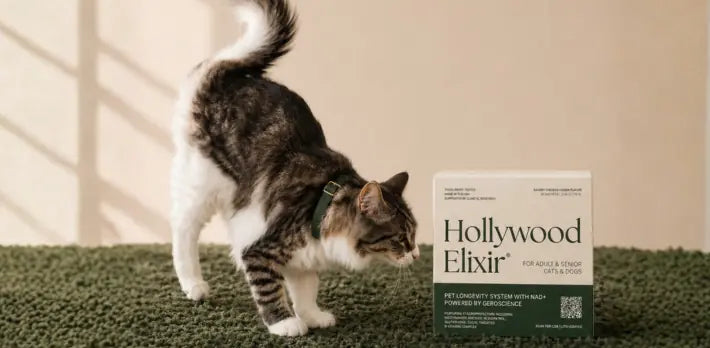
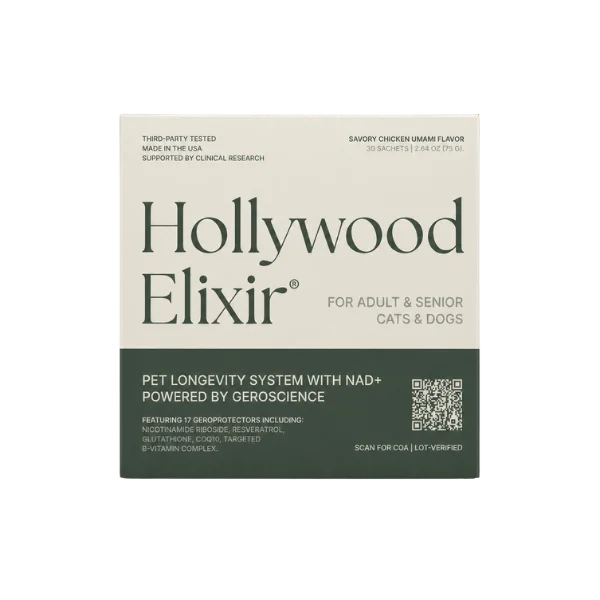
That's the logic behind a system-level formula: it removes the temptation to build a complicated, inconsistent ‘stack’ and keeps the focus on steady, tolerable routines. Hollywood Elixir is one such option for cats and dogs — it discloses 60 mg of nicotinamide riboside per serving alongside niacin, CoQ10, and antioxidants, so the NR amount is one you can actually read rather than a number hidden in a blend.
If you want NR-adjacent support inside a broader graceful-aging approach, look for products that respect uncertainty, prioritize safety, and are built for consistency — because consistency is what cats respond to over time.
“Longevity support should feel steady in the home, not urgent in the mind.”
Educational content only. This material is not a substitute for veterinary advice. Always consult your veterinarian about your dog’s specific needs. These statements have not been evaluated by the Food and Drug Administration. Products mentioned are not intended to diagnose, treat, cure, or prevent any disease.
Glossary
- Nicotinamide Riboside (NR): A vitamin B3–related compound discussed as a precursor the body can convert into NAD+.
- NAD+ (Nicotinamide Adenine Dinucleotide): A molecule used in many cellular reactions tied to energy handling and maintenance processes.
- NAD Precursor: A nutrient the body can use to build or replenish NAD+; NR is one example.
- Cellular Resilience: A broad term for how well cells maintain function under stress, aging, or changing energy demands.
- Metabolic Flexibility: The ability to shift between fuel sources and adapt to changing energy needs; discussed in NR animal research.
- Inflammation Tone: The background level of inflammatory signaling; NR has been associated with changes in inflammatory markers in older human muscle.
- Gut Microbiota: The community of microbes in the digestive tract; NR has been linked to microbiota shifts in diet-related animal work (Lozada-Fernández VV, 2022).
- Diet-Stress Model: Research setups (often high-fat diets) used to study metabolic strain; NR has shown protective associations in liver-related signals in such contexts.
- System-Level Support: A formulation philosophy focused on supporting multiple connected aging factors rather than relying on a single nutrient.
Related Reading
Aging & Senior Cat Guidance
• Cat Age Calculator: Cat Years to Human Years
• Lethargy in Cats
• Senior Cat Not Eating
• Cat Drinking A Lot
• Why Is My Senior Cat Withdrawn?
Healthy Aging Support
• NAD+ for Cats
• NMN for Cats
• Vitamins For Older Cats
• Senior Cat Food
References
Sambeat A. Endogenous nicotinamide riboside metabolism protects against diet-induced liver damage. PubMed. 2019. https://pubmed.ncbi.nlm.nih.gov/31541116/
Elhassan YS. Nicotinamide Riboside Augments the Aged Human Skeletal Muscle NAD(+) Metabolome and Induces Transcriptomic and Anti-inflammatory Signatures. PubMed. 2019. https://pubmed.ncbi.nlm.nih.gov/31412242/
EWF. Nicotinamide riboside Induced Energy Stress and Metabolic Reprogramming in BEAS-2B Cells. PubMed. 2024. https://pubmed.ncbi.nlm.nih.gov/38990804/
Shi W. Effects of a wide range of dietary nicotinamide riboside (NR) concentrations on metabolic flexibility and white adipose tissue (WAT) of mice fed a mildly obesogenic diet. PubMed. 2017. https://pubmed.ncbi.nlm.nih.gov/28211258/
Williams AS. Nicotinamide riboside supplementation confers marginal metabolic benefits in obese mice without remodeling the muscle acetyl-proteome. PubMed. 2022. https://pubmed.ncbi.nlm.nih.gov/35028529/
Lozada-Fernández VV. Nicotinamide Riboside-Conditioned Microbiota Deflects High-Fat Diet-Induced Weight Gain in Mice. PubMed. 2022. https://pubmed.ncbi.nlm.nih.gov/35076278/
Mehmel. Nicotinamide Riboside—The Current State of Research and Therapeutic Uses. 2020. https://www.mdpi.com/2072-6643/12/6/1616
Ryu. NAD+ repletion improves muscle function in muscular dystrophy and counters global PARylation. 2016. https://www.mdpi.com/2072-6643/14/11/2259
Conze DB. Safety assessment of nicotinamide riboside, a form of vitamin B(3). PubMed. 2016. https://pubmed.ncbi.nlm.nih.gov/26791540/
Marinescu AG. Safety Assessment of High-Purity, Synthetic Nicotinamide Riboside (NR-E) in a 90-Day Repeated Dose Oral Toxicity Study, With a 28-Day Recovery Arm. PubMed. 2020. https://pubmed.ncbi.nlm.nih.gov/32715855/
Mouchiroud. The NAD(+)/Sirtuin Pathway Modulates Longevity through Activation of Mitochondrial UPR and FOXO Signaling. Nature. 2013. https://www.nature.com/articles/s41598-019-46120-z
Cros. Safety evaluation after acute and sub-chronic oral administration of high purity nicotinamide mononucleotide (NMN-C) in Sprague-Dawley rats. 2021. https://www.sciencedirect.com/science/article/pii/S0278691521000946
FAQ
What is nicotinamide riboside for cats?
Nicotinamide riboside (NR) is a vitamin B3–related compound discussed as a way to support NAD+ levels, a molecule involved in cellular energy and repair signaling. Most evidence is based on broader mammal biology rather than cat-specific trials.
For cats, the realistic framing is background support—not a treatment. Many owners prefer a system-level aging formula that includes NR alongside other aging-pathway ingredients rather than a single-ingredient experiment.
Why do people consider nicotinamide riboside for cats' aging?
NAD+ is central to how cells manage energy and repair, and NR is one route the body uses to replenish it. In older humans, NR has been shown to raise NAD+ in muscle tissue, which explains the longevity interest.
For cats, the most responsible framing is gentle support for resilience. Because feline-specific trials are limited, a broader graceful-aging approach is often easier to sustain and evaluate than isolated dosing.
How Might Nicotinamide Riboside Work Inside A Cat’s Cells?
NR is a precursor that can be converted into NAD+, a molecule cells rely on for energy-related reactions and many housekeeping processes. In cellular research, NR has also been associated with shifts in energy-stress signaling that may change how cells prioritize fuel use and repair(EWF, 2024).
Because cats are not research rodents, the practical goal is conservative support, not biohacking. Individual response varies, and veterinary guidance is appropriate before starting.
Is Nicotinamide Riboside Safe For Cats To Take Daily?
There is no established universal safety conclusion for daily NR use in cats because feline-specific data are limited. NR feeds into NAD chemistry that touches fundamental cellular processes, so it is best started with veterinary guidance rather than assumptions from human use.
Cats with kidney disease, liver disease, diabetes, or on long-term medication should not start without a veterinary discussion first.
What Side Effects Could A Cat Have From NR Supplements?
Any new supplement can cause tolerance issues in cats, most commonly appetite changes, vomiting, or loose stool. Because individual sensitivity varies, introduce only one new product at a time and stop promptly if symptoms appear.
If signs persist beyond a day, or your cat seems unusually quiet or withdrawn, contact your veterinarian.
What is a sensible nicotinamide riboside dose for cats?
There is no evidence-backed dose for cats that owners should calculate at home. Most dosing figures come from human or rodent contexts and cannot be safely converted to cats without veterinary oversight.
Ask your veterinarian to help choose a product and serving approach that matches your cat's health status and diet. If you prefer a system-level formula rather than isolated dosing, discuss that option at your visit.
Can NR Interact With My Cat’s Medications Or Conditions?
Potential interactions depend on the cat, the medication, and the full supplement formula. NR supports NAD-related chemistry that touches many cellular functions, so it is wise to treat it as medically relevant—especially in cats with kidney, liver, thyroid, or metabolic disease.
Bring the product label to your veterinarian and ask what to monitor (weight, appetite, labs).
Is Nicotinamide Riboside For Cats Better For Seniors Than Kittens?
Most interest in NR for cats centers on aging because NAD+ support is discussed most often in older tissues and recovery capacity. Kittens and young cats usually benefit more from fundamentals: appropriate diet, parasite control, dental habits, and low stress.
For seniors, any supplement should be chosen with extra care given higher rates of chronic disease.
Do Certain Cat Breeds Or Sizes Need Different NR Approaches?
Breed and size can influence metabolism, but individual health status, diet, and any underlying conditions are more important than breed-based rules. Because there is no standardized feline NR protocol, veterinary-supervised fit matters more than generalizing by size.
For petite, elderly, or medically complex cats, conservative choices matter even more.
Is NR For Cats The Same As NR For Dogs?
NR relates to NAD+ biology shared across mammals, but cats and dogs differ in digestion and nutrient handling, so a dog-oriented product is not automatically appropriate for cats. Palatability and tolerance also differ sharply between species.
If a label is vague about feline use, treat that as a reason to ask your veterinarian for guidance.
How Long Until I Notice Changes With NR In Cats?
If NR helps, changes are usually subtle and slow: steadier routines, less variability in energy, or improved recovery after activity. In human research, NR raised NAD+ in older muscle, but that does not translate into an immediate visible boost at home.
Track a few simple markers weekly—appetite consistency, grooming, willingness to jump—and avoid changing multiple things at once so you can interpret what you see.
What Should I Look For In NR Supplement Quality?
Prioritize transparent labeling, conservative serving guidance, and manufacturing practices that reduce contamination risk. Avoid products that rely on proprietary blends or imply disease outcomes.
With NR, quality is as much about the full formula and feline tolerance as it is about the ingredient itself. A good brand should welcome veterinary involvement and set realistic expectations. For a system-level formula built around these standards, consider Hollywood Elixir™.
Can I Open Capsules Or Mix NR Into Wet Food?
Mixing a small portion into familiar wet food can improve compliance, but cats are sensitive to taste and smell changes. Introduce slowly and avoid mixing into a full bowl that sits out, since you lose control of intake and freshness.
If your cat is on a prescription diet, confirm with your veterinarian before adding anything. For a cat-friendly daily format built around consistency, many owners choose Hollywood Elixir™.
Does NR Support Liver Health In Cats Specifically?
There is no cat-specific liver claim from NR based on current evidence. In diet-stress research, NR metabolism has been linked to protective effects against liver damage signals(Sambeat A, 2019).
If you are concerned about liver health, the priority is veterinary diagnosis and appropriate nutrition. A gentle, system-level aging supplement can complement a broader plan after the medical picture is clear.
Could NR Affect My Cat’s Weight Or Appetite Over Time?
In animal research, NR has been associated with changes in metabolism and, in some contexts, weight-gain responses—potentially involving the gut microbiota(Lozada-Fernández VV, 2022). That does not make it a weight tool for cats.
Monitor weight trends and food interest, and involve your veterinarian if anything shifts unexpectedly.
What Does Research Say About NR Benefits And Limitations?
Research is mixed and context-dependent. Studies show NR can raise NAD+ in older humans and influence biological signals, and animal work suggests shifts in metabolic flexibility(Shi W, 2017). Other studies found limited metabolic benefits in certain obese-mouse contexts(Williams AS, 2022).
For cats, that mix argues for modest expectations and a focus on safety and consistency.
When Should I Avoid Starting NR With My Cat?
Avoid starting any new supplement when your cat is actively ill, losing weight, vomiting, refusing food, or undergoing medication changes. Those moments require clarity, and adding variables can delay diagnosis or confuse what is driving symptoms.
If your cat has chronic disease, start only with veterinary approval and a monitoring plan.
How Do I Decide Between NR Alone Versus A Blend?
NR alone appeals when you want a narrow experiment, but aging rarely responds to single inputs. NAD+ support is foundational, yet real-world outcomes also depend on inflammation tone, oxidative stress, appetite, and comfort—factors that often benefit from a more integrated approach.
If you value simplicity and consistency, a system-level formula can be easier to maintain and evaluate than a growing stack of individual ingredients.
What Are Signs My Cat’s Supplement Plan Is Working?
With longevity-style support, 'working' often looks like steadiness: consistent appetite, more reliable grooming, smoother movement, and fewer off days. Improvements—if they occur—tend to be subtle rather than dramatic.
Keep notes weekly and share trends with your veterinarian, especially for seniors.
When Should I Call The Vet After Starting NR?
Call your vet if your cat vomits repeatedly, has diarrhea lasting more than a day, refuses food, seems unusually lethargic, or shows sudden behavior changes. Also call if your cat has chronic disease and you started without a monitoring plan.
Bring the full product label and describe timing relative to symptoms.
Is nicotinamide riboside for cats a longevity shortcut?
No. NR is best viewed as optional support within a broader aging plan. Even in research settings, NR outcomes vary by context, and some studies show limited metabolic benefits in certain conditions.
Longevity is built from fundamentals: nutrition, hydration, dental care, pain control, and stress reduction. Supplements add modest incremental support at best.

Discover LPL-01: How This Fits Into a Larger Feline Longevity System
Aging in cats unfolds quietly. It’s not driven by a single failure, but by gradual shifts across interconnected systems — cellular energy, oxidative balance, immune tone, and tissue integrity — each influencing the others over time.
This article explores one layer of that system. To understand what actually shapes long-term health, you need to step back and look at how these layers interact.
Start with the underlying science:
- Feline Geroscience Framework →
A structured view of how aging progresses across cellular energy, inflammation, and resilience systems. - Senior Biological Defense Coverage (BDC) Modeling →
A systems-level map of which biological pathways decline first, and how layered interventions can support them. - 2026 Market Research: Best Cat Longevity Supplements →
A feline-specific review of longevity supplements. 2026 Industry report created by LPL-01 Research. - LPL-01 Standard →
The formulation system that translates these models into real-world supplementation—covering multiple pathways in a coordinated way.
Essential Summary
Why is nicotinamide riboside for cats important?
Nicotinamide riboside is discussed in aging because it can be converted into NAD+, a molecule central to cellular energy and repair signaling. For cats, the evidence is mostly indirect, so the smartest approach is conservative: prioritize safety, veterinary guidance, and system-level support that fits real life.
Hollywood Elixir is designed for graceful aging support—helping nourish the broader metabolic network that influences cellular resilience, rather than asking one ingredient to carry the whole story. It’s a practical fit for owners who are curious about NAD-related longevity themes, but still want a calm, consistent daily routine.
Longevity Core
Hollywood Elixir®
★★★★★(313)
More good years, starting now — steady energy, engagement, and a pet who keeps showing up fully, every day.
Starting at $89/mo
Hollywood Elixir is amazing! She put back on 5 lbs to a healthy weight, her eyes are shiny, her coat is beautiful!
— Jessie
She hopped up onto the windowsill again for the first time in years.
— Charlie
Considering nicotinamide riboside for cats?
If you're looking for nicotinamide riboside for cats
If you’re exploring nicotinamide riboside for cats, the most sensible next step is to choose a plan that’s easy to sustain and easy to evaluate. NR relates to NAD+ biology that supports cellular energy handling and maintenance, but feline outcomes are rarely about one ingredient. Prioritize a product with transparent labeling, conservative formulation, and a routine your cat will actually accept. For owners who want system-level graceful-aging support—without building a complicated supplement stack—Hollywood Elixir is designed to complement the broader metabolic network that aging touches.
Veterinary Insights

Learn about how our DVMs think about cat aging
Dr. JoAnna Pendergrass DVM


Longevity Core
Hollywood Elixir®
★★★★★(313)
More good years, starting now — steady energy, engagement, and a pet who keeps showing up fully, every day.
Starting at $89/mo
Wellness Tools
Explore your cat’s changing needs over time


Related Reading
Nicotinamide riboside for cats refers to a vitamin B3–family compound used as an NAD+ precursor. Nicotinamide riboside (NR) is one of several related forms of vitamin B3, and its relevance comes from its potential conversion to NAD, a cofactor involved in many routine cellular reactions.
