





L-Theanine for Dogs

What the dog studies show, which fears it isn't meant for, and why green tea isn't a substitute.

By La Petite Labs Editorial 10 min read

As Seen On

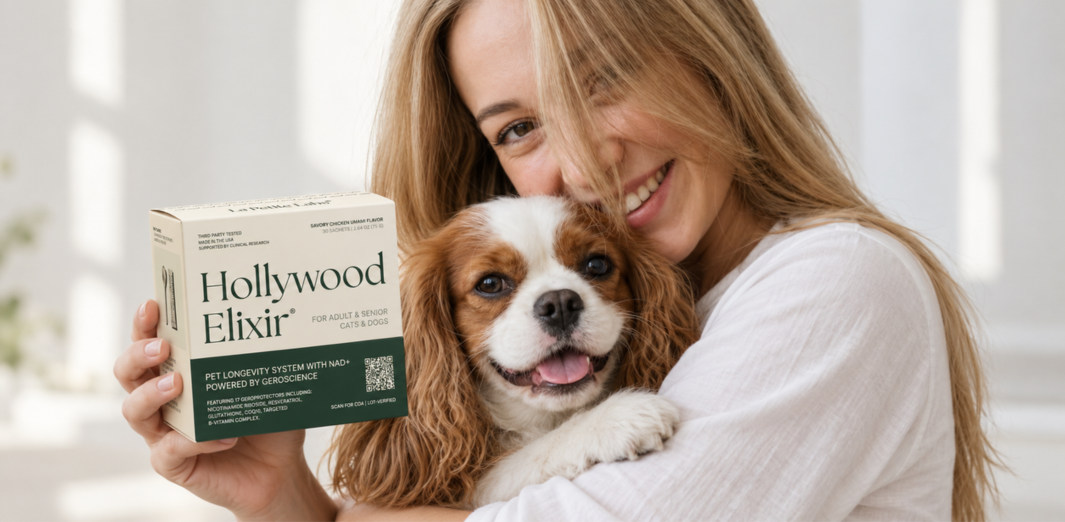
Woman hugging a golden retriever while holding a Hollywood Elixir box
Hollywood Elixir® Senior Dog Supplement

17 science-backed actives

From$50/moSave up to 47%Save up to 44%Shop Now
Contents
L-theanine may take the edge off mild stress in dogs, but the evidence is thin and it isn't meant for severe fears. The best-known dog study had no placebo group, and almost a third of its dogs dropped out. Vets use it as a gentle add-on to behavior work, and few side effects are reported. The veterinary product isn't intended for severe phobias, separation anxiety or dogs with a history of aggression.

This guide covers what L-theanine is, what the studies found, how long it takes, and when a dog needs more than a supplement.

  • What it is: An amino acid found in green tea leaves. Pet products use a purified form.1, 7
  • Evidence: One open study in storm-sensitive dogs and one laboratory study of dogs fearful of people. Neither settles the question.2, 3
  • Best fit: Mild nervousness and stress from the environment, alongside behavior work.7
  • Not for: Severe phobias, separation anxiety or dogs with a history of aggression.1, 7
  • Timing: It can take several days to show, and each serving wears off within 24 hours.1
  • Side effects: Mild stomach upset is the main one listed. Tell your vet if your dog takes blood pressure medicine.1
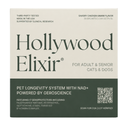
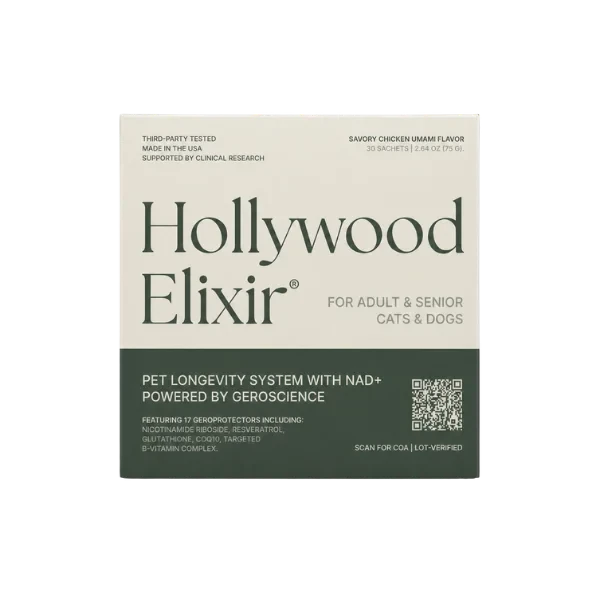
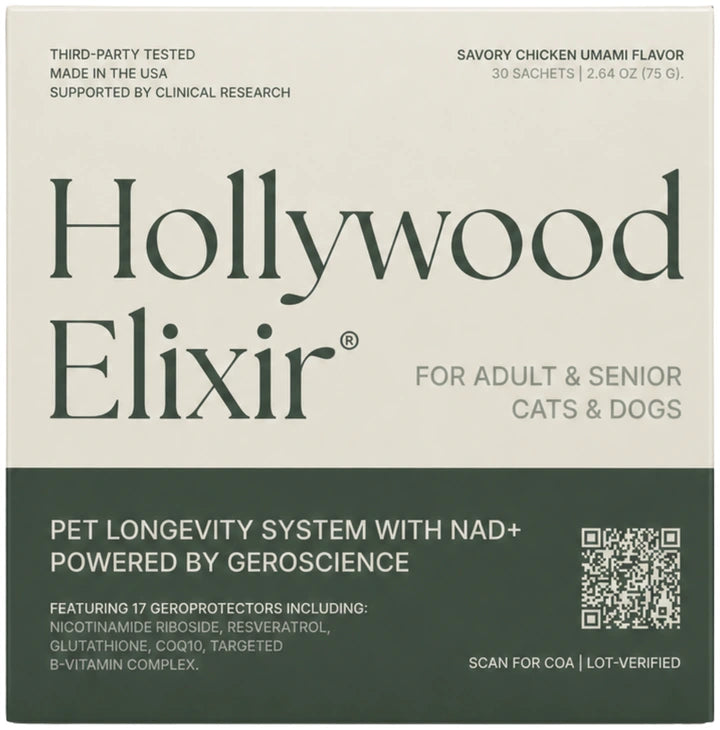
  • In Hollywood Elixir: No. Hollywood Elixir has no L-theanine and isn't a calming aid. It's daily nutrition.

What is L-theanine, and why is it given to dogs?

L-theanine is an amino acid found naturally in green tea leaves.1 It's built much like glutamate, one of the brain's signaling chemicals, and can bind to the same receptors.4 In mammals studied so far, it reaches the brain within the first hour after it's swallowed.12

In people, L-theanine is linked with a relaxed but alert state, without drowsiness.4 That profile is why it ended up in pet products. VCA Animal Hospitals describes it as a nutritional supplement used for anxiety in dogs and cats, given as a chewable tablet.1

Pet products don't use tea. The best-known veterinary tablet contains a pure synthetic form of L-theanine, which matters because tea leaves also carry caffeine.7

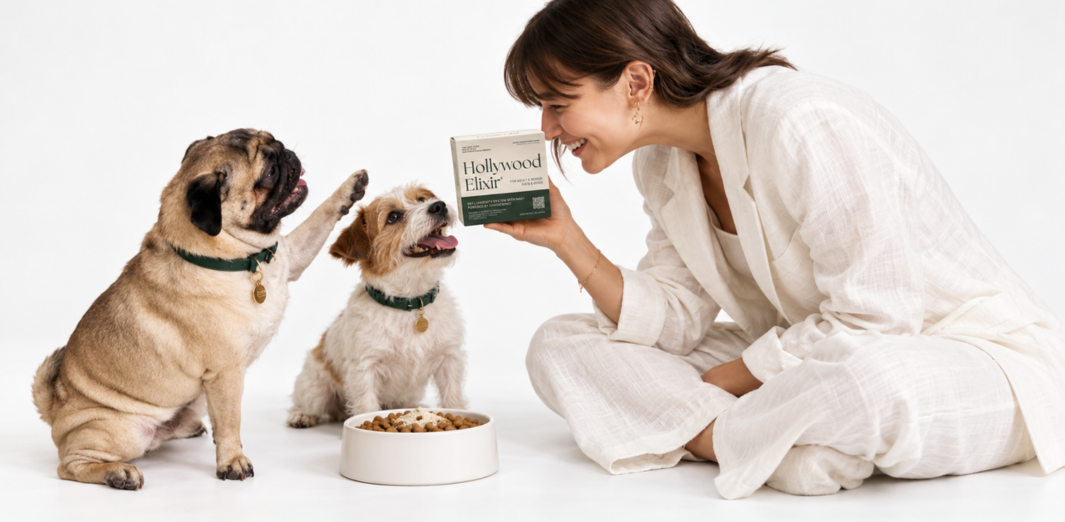
Woman holding a Hollywood Elixir box beside a pug, a terrier and a food bowl

Does L-theanine work for dog anxiety?

L-theanine has some support for mild fear in dogs, and we found no placebo-controlled trial in pet dogs. Two studies are usually cited: an open study of dogs afraid of storms, and a laboratory study of dogs fearful of unfamiliar people.2, 3

Both reported calmer dogs. The storm study had no placebo group, so it can't rule out hopeful scoring by owners.

A large owner survey gives a sense of the odds. Only 27% of owners who used calming supplements for noise fear said they worked, the lowest rate of any approach in the survey. The survey didn't separate L-theanine from other supplements.2

So treat L-theanine as a mild helper with modest odds.

Woman in sportswear holding a Hollywood Elixir box beside a black-and-tan dog outdoors

What did the storm study in dogs find?

L-theanine's best-known dog study followed pet dogs that were afraid of thunderstorms. Owners gave a veterinary L-theanine tablet and scored their dogs' behavior during storms.2

The results looked good. Owner-reported anxiety scores fell, and dogs returned to normal sooner after a storm ended. Drooling, pacing, panting, hiding and following people around all eased.2, 3

The weak points are just as clear. Every owner knew the dog was getting the supplement, and 8 of the 26 dogs dropped out before the end. A review of noise-fear treatments warns that the dogs left in the analysis may not be typical.2

Woman holding a Hollywood Elixir box above her forehead beside a Bernese mountain dog outdoors

Which kinds of anxiety is L-theanine not meant for?

L-theanine isn't meant for the hardest cases. The maker of the main veterinary tablet says it is not intended for animals with severe phobias, separation anxiety or a known history of aggression.7 VCA Animal Hospitals lists the same groups under "do not use".1

That leaves a narrower job: nervousness and stress brought on by the environment.7

For a dog that panics, destroys doors or injures itself when left alone, a supplement is the wrong tool. Those dogs need a behavior plan and often prescription medicine, such as fluoxetine or clomipramine.

Golden retriever nuzzling a woman holding a Hollywood Elixir box on the grass beside a food bowl

How much L-theanine can a dog have?

No independent body has set a standard amount of L-theanine for dogs. In practice the amount comes from the product label and your vet.

  • Veterinary tablets come in two sizes: one for pets up to 22 lb and one for dogs over 22 lb.7
  • The dog studies gave tablets twice a day for one to two months.4
  • Human trials have mostly used 200 to 400 mg a day, which says little about a 15 lb dog.6

VCA advises giving it at the same time each day, with or without food.1 Don't size down a human capsule by guesswork.

So treat L-theanine as a mild helper with modest odds.

Is L-theanine safe for dogs?

L-theanine has a clean safety record so far, with one gap: we found no long-term safety study in dogs.

  • Laboratory safety: in a 13-week feeding study in rats, researchers set the no-adverse-effect level at the highest amount tested, 4,000 mg per kg of body weight a day.8
  • People: an analysis of 31 controlled trials reported no serious adverse events.5
  • Cats: in a 30-day study of 33 cats, no serious side effects were reported, and two cats were sleepier for the first few days.4
  • Dogs: VCA Animal Hospitals lists only mild stomach upset as a side effect.1

The maker adds two cautions. Safe use in pregnant or breeding animals hasn't been proven. And a dog that gets worse, or hasn't improved after 60 days, should stop and see the vet.7

Overhead view of a black-and-white dog beside a food bowl and Hollywood Elixir box

What are the side effects of L-theanine in dogs?

L-theanine's listed side effects are mild. VCA Animal Hospitals names loose stools, gas and stomach upset, and notes that sensitivities can develop with repeated exposure.1

Drowsiness isn't expected. The authors of the cat trial note that no sedative effect had been reported in dogs, rats or people.4 In their own study, two cats were sleepier in the first days and then recovered.4

Stop the supplement and call your vet if you see vomiting, ongoing diarrhea, itching or swelling, or if the anxiety gets worse.

Woman smiling beside a golden retriever, a green food bowl and a Hollywood Elixir box

How long does L-theanine take to work?

L-theanine isn't a quick fix for most dogs. VCA Animal Hospitals says it may take several days to take effect, and that the change may be hard to see from the outside.1

The studies point the same way. The dog studies gave it twice a day for one to two months, and in cats the scores improved by day 15 and again by day 30.4

Each serving is short-lived. Its effects should stop within 24 hours, and may last longer in dogs with liver or kidney disease.1 That's why it's given daily, and why starting it on the day of the fireworks may be too late.

Man holding a Hollywood Elixir box while sitting on an outdoor sofa with a golden retriever

Can I give my dog green tea or human L-theanine?

Green tea is not a safe way to give a dog L-theanine. Tea leaves contain caffeine, and caffeine can cause vomiting, an abnormal heart rhythm, tremors and seizures in pets.11

Concentrated green tea extract is worse. In safety studies, fasted dogs given green tea extract developed severe liver, gut and kidney damage, and some died.9, 10

Human L-theanine capsules avoid the caffeine but bring other problems. They're sized for adults, and chewable products for people can be sweetened with xylitol, which causes low blood sugar and liver damage in pets.11 A veterinary product with a weight guide is the safer choice.

What does the human research on L-theanine say?

L-theanine has been studied far more in people than in dogs, and the human results are modest.

  • A 2020 review of 9 controlled trials concluded that 200 to 400 mg a day may help reduce stress and anxiety in people under stressful conditions. It called for larger and longer studies.6
  • A 2026 analysis pooled 31 controlled trials with 1,168 people. The drop in short-term stress was modest and leaned on weaker studies. Effects on anxiety were inconsistent.5
  • The same analysis found a clearer benefit for attention, and no serious adverse events.5

Two lessons carry over to dogs. The effect, if real, is small. And the safety picture is good. Judge a product by what your own dog does on it, not by the label.

For a dog that panics, destroys doors or injures itself when left alone, a supplement is the wrong tool.

Woman sitting with a beagle in a kitchen while holding a Hollywood Elixir box

DVM Voice: Clinical Vignette of a Common Pattern in Senior Dog Aging

Case provided by JoAnna Pendergrass, DVM

Rex, a 7-year-old Labrador Retriever, was brought in after his owner noticed he was slower to rise, hesitant on stairs, and less able to play as before. Examination showed stiffness and reduced hip mobility; radiographs confirmed degenerative joint changes.

His care required weight management, veterinary-guided pain control, nutritional support, and rehabilitation — a comprehensive plan, but one started only after visible decline appeared.

Clinical takeaway: Rex’s case reflects the value of proactive aging support: maintaining lean body condition, monitoring mobility early, and supporting cellular resilience, antioxidant defense, and healthy inflammatory balance before decline becomes obvious.

Single-case vignette. Not generalizable. Veterinary oversight is essential for pain, stiffness, or suspected joint disease.
Explore Hollywood Elixir Research →
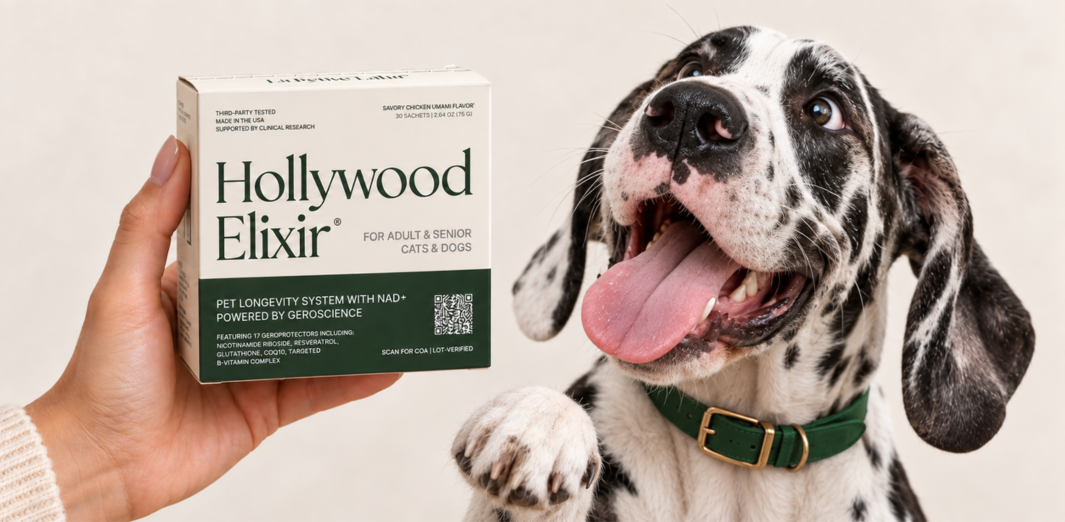
Spotted gray dog beside a Hollywood Elixir box held in a person's hand

Can L-theanine be given with other medicines?

L-theanine has few known interactions. VCA Animal Hospitals lists one group to use with caution: blood pressure medicines, because L-theanine can lower blood pressure and add to their effect.1

VCA also notes that the mirror-image forms, D-theanine and D,L-theanine, can reduce absorption of L-theanine.1 Check that a product lists L-theanine, not a mixed form.

The maker says its tablet can be given alongside other medications.7 Still tell your vet about it, especially if your dog takes trazodone, gabapentin or another calming drug, so the whole plan is in one place.

Golden retriever nuzzling a man holding a Hollywood Elixir box beside a food bowl

Which dogs should not take L-theanine?
L-theanine isn't right for every dog. Skip it, or ask your vet first, for:

  • dogs with severe phobias or separation anxiety, who need stronger help;1
  • dogs with a history of aggression;1
  • pregnant or breeding dogs, where safety hasn't been proven;7
  • dogs on blood pressure medicine;1
  • dogs that have reacted to it, or to the tablet's other ingredients, before.1

Dogs with liver or kidney disease may feel each serving for longer, so their vet should be involved too.1

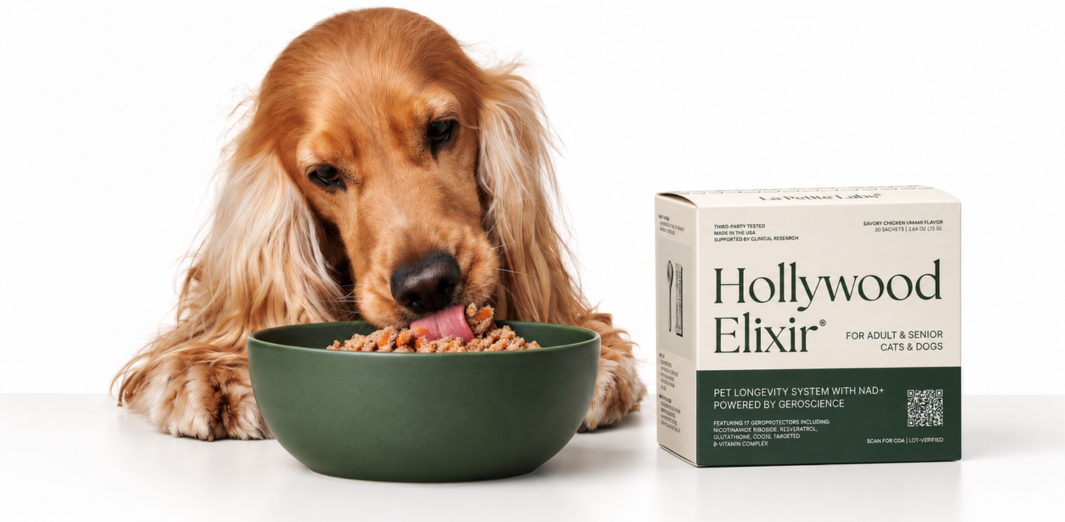
Golden spaniel eating from a green bowl beside a Hollywood Elixir box

Is L-theanine worth trying for a senior dog's anxiety?

L-theanine is a low-risk thing to try for an older dog that has become more nervous, once medical causes are ruled out. New anxiety in a senior can have a physical cause, such as pain or failing sight or hearing.

Start with a vet visit, because treating the cause does more than calming the symptom. Our guide to old dog anxiety covers what vets check for, and our guide to cognitive supplements for dogs covers nutrition for the aging brain.

If your vet is happy to add L-theanine, give it daily for a few weeks and keep notes. The maker's own cutoff is 60 days without improvement.7

How do you choose an L-theanine product for a dog?

A good L-theanine product for a dog is plain, measured and made for pets. Check for:

  • L-theanine named as the active ingredient, with the amount per chew in milligrams;
  • the L form, since D-theanine and mixed forms can cut absorption;1
  • a feeding guide by body weight;
  • no green tea extract, caffeine or xylitol;9, 11
  • a short ingredient list, so you know what's doing the work.

Calming chews often blend several ingredients, which makes it hard to tell what helped. The FDA doesn't review supplements for safety or effectiveness before sale, so you're relying on the brand's own testing.1

That's why printed amounts matter. Hollywood Elixir lists all 17 of its actives with amounts, and L-theanine isn't one of them.

Is L-theanine different for dogs and cats?

L-theanine is sold for both species, and the evidence differs a little for each.

  • Dogs: an open study in storm-sensitive dogs and a laboratory study of fear of people.2, 3
  • Cats: an open 30-day study of 33 stressed cats given 25 mg twice a day. Scores improved in 30 of the 33, with no placebo group.4
  • Both: the same cautions apply, and the same veterinary tablet is used. The small size covers cats and dogs up to 22 lb.7

The stress signs differ more than the supplement does. Dogs tend to pant, pace and hide, while stressed cats more often urinate outside the box or become tense and watchful.3, 4 Our guide to L-theanine for cats covers the feline side.

Woman holding a Hollywood Elixir box beside a dapple dachshund and green food bowl on a sofa

When should you see the vet instead of trying L-theanine?
L-theanine is for mild, predictable nervousness. See your vet first if your dog:

  • panics, escapes or hurts itself during storms or when left alone;
  • has growled, snapped or bitten;
  • has become anxious suddenly, especially in old age;
  • isn't eating, sleeping or settling for days at a time.

VCA also says to check in if things haven't improved within 60 days, or if they get worse.1 Our guide to a stressed dog lists the signs worth acting on.

Woman cuddling a brown-and-white spaniel while holding a Hollywood Elixir box

What works better than L-theanine for a fearful dog?

Several approaches have more behind them than L-theanine.

  • Behavior work: the maker itself positions L-theanine alongside a behavior modification program, not in place of one.7
  • Prescription medicine: a review of noise-fear treatments concludes that supplements will likely give insufficient relief when used alone.2
  • Pressure vests: 44% of owners in the survey said they helped, the best result among non-drug products.2

For night-time restlessness in older dogs, vets sometimes use melatonin. Ask your vet which fits your dog's kind of fear.

Is L-theanine in Hollywood Elixir?

No. Hollywood Elixir doesn't contain L-theanine, and it isn't a calming aid.

It's a daily supplement for adult and senior dogs. Each sachet has 25 mg of reishi mushroom and 1 mg of vitamin B6, alongside 60 mg of nicotinamide riboside, an NAD+ precursor, and 14 more actives. That makes 17, each with its amount printed on the label.

It goes into food once a day: one sachet for dogs from 7 to 30 lb, two for dogs over 30 lb. Hollywood Elixir hasn't been tested for anxiety, fear or lifespan, and it won't settle a dog during a storm.

Where it fits is the everyday side of caring for an older dog. If that's what you're weighing up, our guide to NAD+ for dogs and our guide to reishi mushroom for dogs explain what's in it. See the full Hollywood Elixir formula and serving guide.

The effect, if real, is small.

Educational content only. This material is not a substitute for veterinary advice. Always consult your veterinarian about your dog’s specific needs. These statements have not been evaluated by the Food and Drug Administration. Products mentioned are not intended to diagnose, treat, cure, or prevent any disease.

Glossary

L-theanine: An amino acid found in green tea leaves, used in supplements for mild stress.

Open-label study: A study in which everyone knows which treatment is being given.

Placebo: A look-alike treatment with no active ingredient, used for comparison.

Separation anxiety: Distress that a dog shows when left alone or apart from its owner.

Green tea extract: A concentrate of tea compounds called catechins, which is different from purified L-theanine.

Xylitol: A sugar substitute that causes low blood sugar and liver damage in dogs.

Related Reading

References

Numbered references identify the sources used for specific claims. Read the study design, species and evidence boundaries alongside each finding.

FAQ

Can I give my dog L-theanine every day?

Yes, daily use is how it's meant to be given. VCA Animal Hospitals advises giving it at the same time each day, and the maker says its tablet can be given long term. Check back with your vet if nothing has changed after 60 days.

Does L-theanine make dogs sleepy?

It isn't expected to. Researchers note that no sedative effect has been reported in dogs, and sleepiness isn't among the side effects VCA lists. Tell your vet if your dog seems dull on it.

Will L-theanine help my dog with fireworks or thunderstorms?

It might take the edge off mild fear if it's started days ahead. In one open study, storm scores improved, but 8 of 26 dogs dropped out and there was no placebo group. It isn't intended for severe noise phobia.

How far ahead of a stressful event should I start L-theanine?

Start well ahead. VCA says it may take several days to take effect, and the studies ran for weeks. Ask your vet for a start date that fits the event.

Does Hollywood Elixir contain L-theanine?

No. Hollywood Elixir has no L-theanine and isn't a calming aid. It's a daily nutrition formula with reishi mushroom, vitamin B6, nicotinamide riboside and 14 more actives, each with its amount on the label.

Is L-theanine safe for puppies?

We found no puppy studies. The maker's cautions cover pregnant and breeding animals, and VCA lists no age limit. Ask your vet before giving any calming supplement to a puppy.

Can L-theanine replace my dog's anxiety medication?

No. It's a mild supplement, and a review of noise-fear treatments concluded that supplements will likely give insufficient relief when used alone. Don't stop a prescribed medicine without your vet's guidance.

Is green tea extract the same as L-theanine?

No. Green tea extract is mostly catechins, a different group of compounds. In safety studies, fasted dogs given green tea extract suffered severe organ damage. Pet L-theanine products use the purified amino acid instead.

Can L-theanine help with car travel or vet visits?

We found no study of L-theanine for travel or vet visits in dogs. The maker describes it for nervousness and environmental stress. Because it can take days to work, a single tablet before the trip is unlikely to be enough.

Dalmatian looking toward a Hollywood Elixir box held in a person's hand

Discover LPL-01: How This Fits Into a Larger Canine Longevity System

Aging in dogs is not driven by a single pathway. It’s the result of interacting biological systems—energy metabolism, oxidative stress, immune signaling, and structural integrity—changing over time.

This article explores one piece of that puzzle. If you want to understand how these pieces connect—and what actually moves the needle—you need to zoom out.

Start with the underlying science:

Keep exploring

What would you like to understand next?

Search practical guides about healthy aging, cellular energy, ingredients, and daily support for dogs.