





Ginger for Dogs

What the dog studies found, how much has been used, and what works better for car sickness.

By La Petite Labs Editorial 12 min read

As Seen On

Woman hugging a golden retriever while holding a Hollywood Elixir box
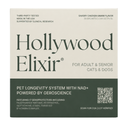
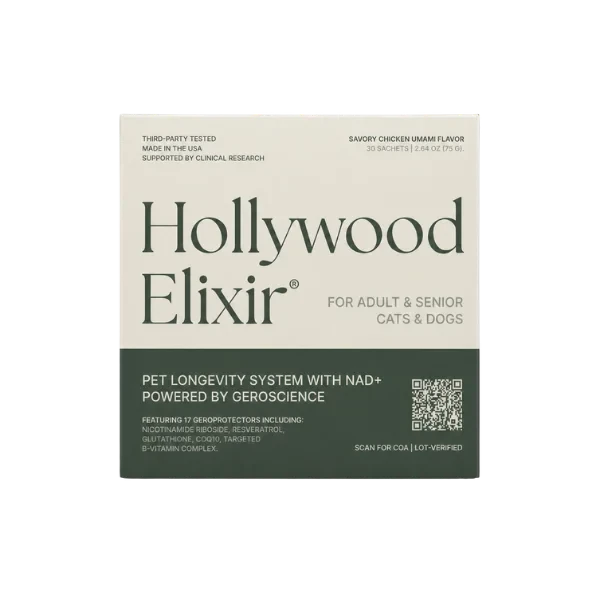
Hollywood Elixir® Senior Dog Supplement

17 science-backed actives

From$50/moSave up to 47%Save up to 44%Shop Now
Contents

Ginger is safe for most dogs in small, food-level amounts, and in one lab study ginger extracts reduced vomiting in dogs given a chemotherapy drug. That is where the dog research stops. No trial has tested ginger for an everyday upset stomach or for car sickness in dogs, and no official amount exists.

This guide covers what the dog studies found, how much has been used, the side effects and medicine clashes, and what vets reach for when ginger isn't enough.

  • What it is: The underground stem of the ginger plant, used as a spice and a stomach remedy.2
  • Does it work: In one dog study, ginger extracts reduced vomiting caused by a chemotherapy drug. A water extract did nothing.1
  • Car sickness: We found no dog study. In people, most studies of ginger for motion sickness found no help.2
  • Amount: No official amount exists. One vet-reviewed guide lists ¼ teaspoon of raw ginger or less for a small dog and about ¾ teaspoon for a giant one.5
  • Safety: U.S. feed rules list ginger as a safe seasoning. The known side effects are stomach upset and mouth irritation.6, 4
  • Watch for: Pain relievers, insulin, cyclosporine and planned surgery can all clash with ginger. Ask your vet first.4
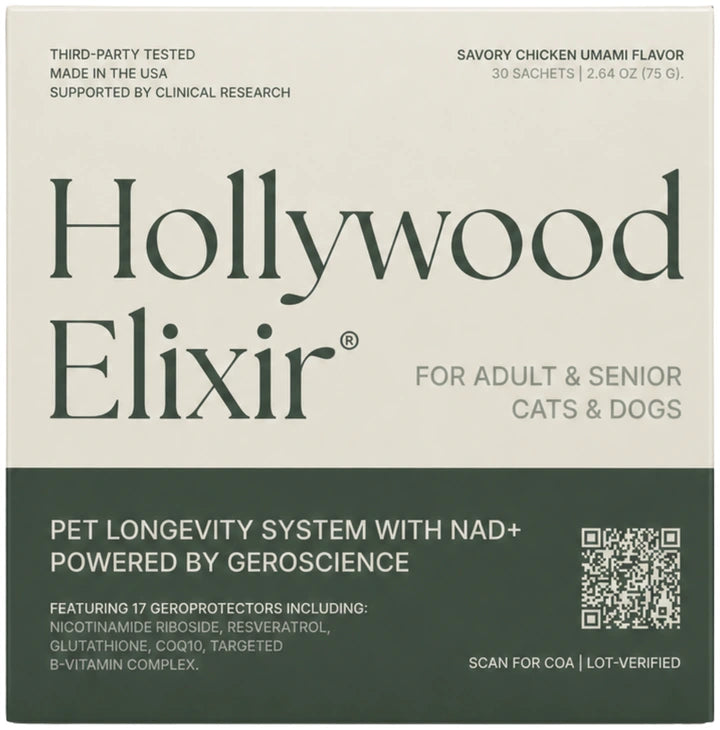
  • In Hollywood Elixir: No. Hollywood Elixir has no ginger and isn't a nausea remedy. It's daily nutrition.

What is ginger, and why do people give it to dogs?

Ginger is the underground stem, or rhizome, of the plant Zingiber officinale. It comes from the warm parts of Asia and is used both in food and for health purposes.2 Its active compounds are called gingerols and shogaols. Shogaols form from gingerols during processing, so fresh and dried ginger differ a little in makeup.3

People take ginger for nausea and vomiting, for osteoarthritis and for other complaints.2 Dog owners borrow it for the same jobs: a queasy stomach, a car ride or a stiff older dog.5

Veterinary references know it too. The Merck Veterinary Manual lists ginger among the common botanical products in veterinary medicine and gives its "suggested" actions as anti-nausea, anti-inflammatory and pain-relieving.4 The same chapter says the evidence for plant products in animals is scarce and often of poor quality.4

Woman holding a Hollywood Elixir box beside a pug, a terrier and a food bowl

Does ginger help a dog with nausea or vomiting?

Ginger reduced vomiting in the one dog study that tested it, under narrow conditions. Researchers gave healthy dogs cisplatin, a chemotherapy drug, at an amount that makes every dog vomit. Two ginger extracts given by mouth, at 25 to 200 mg per kg of body weight, protected the dogs significantly.1

Three details matter at home:

  • The extracts that worked were made with acetone or alcohol. A water extract did nothing at the same amounts.1
  • Both were weaker than granisetron, a prescription anti-nausea drug.1
  • Neither stopped vomiting set off by a second drug, apomorphine.1

We found no study of ginger for the upsets dogs get at home, such as a raided trash can or a stomach bug.

Woman in sportswear holding a Hollywood Elixir box beside a black-and-tan dog outdoors

What have studies of ginger in dogs found?

Studies of ginger in dogs are few and mostly old. We found four that gave ginger to living dogs, and none of them fed fresh ginger to a pet.

  • Vomiting, 1997: two ginger extracts reduced chemotherapy vomiting in healthy dogs.1
  • Stomach movement, 1999: in 5 dogs, 1 gram of dried ginger placed in the stomach triggered contractions in the antrum, one part of the stomach.7
  • Heartworm, 1987: 12 injections of a ginger extract cut the young worms in the blood by up to 98%.8
  • Arthritis, 2023: a blend containing ginger extract eased chronic pain over three months.9

Each one used an extract, an injection or a blend, so none tells you what a pinch of kitchen ginger does.

Woman holding a Hollywood Elixir box above her forehead beside a Bernese mountain dog outdoors

Does ginger help with car sickness in dogs?

Ginger hasn't been tested for car sickness in dogs, as far as we could find. The human record is weak. The U.S. National Center for Complementary and Integrative Health says most studies of ginger for motion sickness haven't found it helpful.2 In one, 28 volunteers in a rotating chair got no protection from 500 or 1,000 mg of ginger.10

Dogs do have a tested option. On the FDA-approved label for maropitant (Cerenia) tablets, 55% of dogs vomited during a one-hour car ride after a placebo, against 7% after the drug.11 Our guide to Cerenia for dogs explains how vets use it.

Fear plays a part as well. Some dogs show signs in a car that isn't moving, and training a dog to accept travel solves some cases.12

Golden retriever nuzzling a woman holding a Hollywood Elixir box on the grass beside a food bowl

How much ginger can a dog have?

No official amount of ginger exists for dogs. We found none from a regulator or a veterinary body, so these are the figures the sources give.

  • Kitchen guide: PetMD's vet-reviewed guide lists less than ¼ teaspoon of raw ginger for dogs under 20 lb, about ½ teaspoon at 31 to 50 lb and about ¾ teaspoon over 90 lb.5
  • Vomiting study: 25 to 200 mg of extract per kg of body weight, by mouth.1
  • Flavoring level: Europe's food safety agency judged a concentrated ginger extract safe in pet food at 1 mg per kg of food.3

The kitchen figures are one publisher's rule of thumb, and no trial has tested them. Treat them as a ceiling to check with your vet, not a target.

A remedy for an upset stomach shouldn't cause one.

Is ginger safe for dogs?

Ginger is safe for most healthy dogs in small amounts, going by the regulators who have reviewed it. U.S. rules for animal food list ginger among the spices and seasonings that are generally recognized as safe.6 In 2020 the European Food Safety Authority judged ginger oil safe at up to 20 mg per kg of complete feed, and a stronger ginger extract safe at 1 mg per kg of pet food.3

Those are flavoring levels. Above them the evidence thins out, and we found no long-term safety study of ginger supplements in dogs. One lab test offers some comfort: on dog liver cells in a dish, ginger-root extract was far less toxic than clove-leaf oil, cinnamon-bark oil or thymol.13

Three things raise the risk for an individual dog:

  • Medicines: ginger can clash with pain relievers, diabetes medicine and cyclosporine.4
  • Surgery: vets group ginger with three other herbs that may affect clotting.4
  • Extras: sugar-free ginger sweets may contain xylitol, which can kill a dog.14
Overhead view of a black-and-white dog beside a food bowl and Hollywood Elixir box

What are the side effects of ginger in dogs?

Ginger's side effects are mostly digestive. The Merck Veterinary Manual names abdominal discomfort, diarrhea, stomach irritation and irritation of the mouth and throat as possible.4 The U.S. health agency that reviews ginger for people gives a similar list and adds heartburn.2

Amount matters. In human arthritis trials, people taking ginger were more than twice as likely as people on placebo to quit because of side effects.15

For your dog, that argues for a small start and a close watch over the first few days. Stop the ginger and call your vet if you see vomiting, loose stools or drooling, or if your dog goes off food. A remedy for an upset stomach shouldn't cause one.

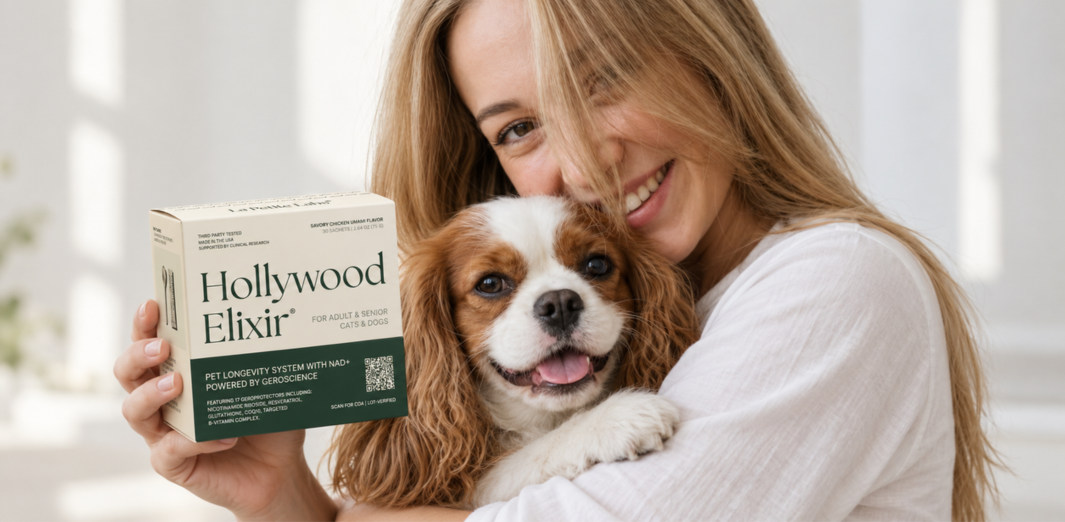
Woman smiling beside a golden retriever, a green food bowl and a Hollywood Elixir box

Can ginger interact with a dog's medicines?

Ginger can clash with at least three kinds of medicine, according to the Merck Veterinary Manual.4

  • NSAID pain relievers such as carprofen: ginger may raise the risk of bleeding.
  • Diabetes medicines such as insulin: ginger can add to the drop in blood sugar.
  • Cyclosporine, an immune-suppressing drug sold as Atopica: ginger may lower the level in the blood. In rats, ginger juice cut the peak level by 70.9%.16

The bleeding risk is unsettled even in people. In a review of 10 human studies, four of the eight clinical trials found that ginger made platelets less sticky, and four found no effect.17

Until dogs are studied, tell your vet about ginger before any operation and whenever a new medicine is prescribed.

Man holding a Hollywood Elixir box while sitting on an outdoor sofa with a golden retriever

Which dogs should not have ginger?

Some dogs should skip ginger unless their vet approves it:

  • dogs on an NSAID, diabetes medicine or cyclosporine;4
  • dogs with surgery or dental work coming up;4
  • puppies and pregnant or nursing dogs, because we found no study of ginger in any of them;
  • dogs on a prescription diet, which PetMD's vets say shouldn't get foods or treats outside it;5
  • dogs with repeated vomiting, blood in the vomit or belly pain, who need a diagnosis first.20

For people, the U.S. health agency says ginger supplements may be safe in pregnancy and that little is known about breastfeeding.2 Nobody has checked either in dogs.

Fresh, powdered or capsule: which form of ginger is best for dogs?

Nobody has compared the forms of ginger in dogs, so there is no proven best one. Here is what the sources say about each.

  • Fresh or powdered root: the plain kitchen forms. PetMD's guide favors very small amounts of fresh-grated ginger or ginger powder mixed into food.5
  • Capsules, chews and extracts: more concentrated, and harder to judge. The Merck Veterinary Manual notes that herbal products for animals have no set standards or routine quality testing.4
  • Tea: probably the weakest form. In the dog vomiting study, the water extract was the one that failed.1 That is our inference, since tea itself wasn't tested.
  • Essential oil: not for dogs. Europe's food safety agency classes ginger oil as an irritant to skin, eyes and airways.3

Form also changes what a dog takes in. Merck notes that the way a plant product is prepared affects its shelf life, how well it is absorbed and its risk of contamination.4

Ginger itself is rarely the problem in ginger-flavored human foods.

Woman sitting with a beagle in a kitchen while holding a Hollywood Elixir box

DVM Voice: Clinical Vignette of a Common Pattern in Senior Dog Aging

Case provided by JoAnna Pendergrass, DVM

Rex, a 7-year-old Labrador Retriever, was brought in after his owner noticed he was slower to rise, hesitant on stairs, and less able to play as before. Examination showed stiffness and reduced hip mobility; radiographs confirmed degenerative joint changes.

His care required weight management, veterinary-guided pain control, nutritional support, and rehabilitation — a comprehensive plan, but one started only after visible decline appeared.

Clinical takeaway: Rex’s case reflects the value of proactive aging support: maintaining lean body condition, monitoring mobility early, and supporting cellular resilience, antioxidant defense, and healthy inflammatory balance before decline becomes obvious.

Single-case vignette. Not generalizable. Veterinary oversight is essential for pain, stiffness, or suspected joint disease.
Explore Hollywood Elixir Research →
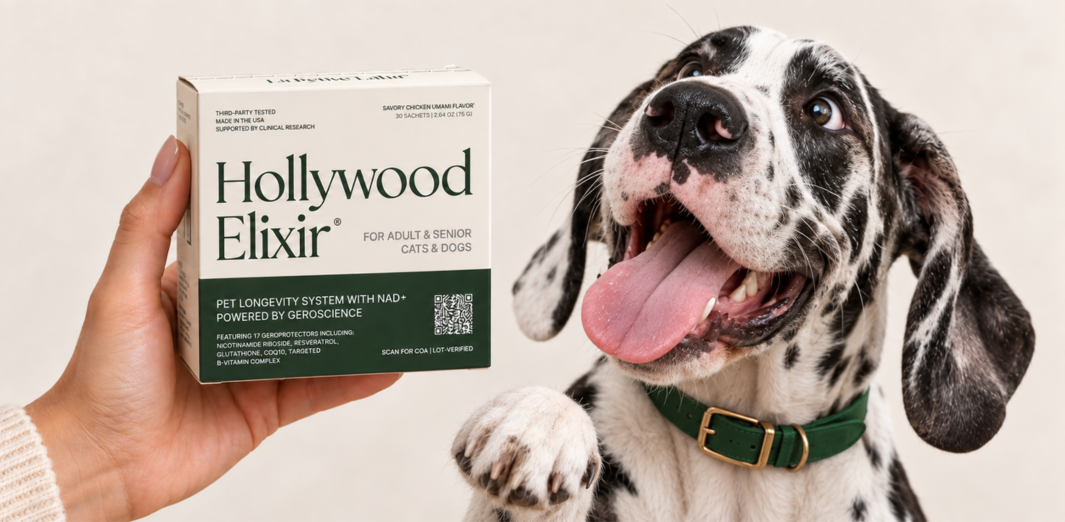
Spotted gray dog beside a Hollywood Elixir box held in a person's hand

Can dogs eat gingerbread, ginger candy or pickled ginger?

Ginger itself is rarely the problem in ginger-flavored human foods. The other ingredients are.

  • Sugar-free candy and baked goods may contain xylitol. Poisoning can start within 20 minutes and can kill a dog.14
  • Gingerbread usually contains nutmeg, which PetMD's vets call toxic to dogs.5
  • Raisins, chocolate and macadamia nuts show up in ginger cakes and cookies. The ASPCA lists all three as foods to keep away from dogs.18
  • Pickled ginger carries added sugar and salt. A dropped slice or two is unlikely to hurt, PetMD says, but don't offer it.5

If your dog raids a tin of ginger cookies, read the label for xylitol first. Call your vet or an animal poison line right away if it's listed.14

Golden retriever nuzzling a man holding a Hollywood Elixir box beside a food bowl

Does ginger help dogs with arthritis?
Ginger hasn't been tested alone for arthritis in dogs. The closest study is a 2023 placebo-controlled trial of a supplement that combined cannabis oil, boswellia and ginger extract. Over three months, the treated dogs had less chronic pain and lower blood markers of inflammation.9 With three ingredients in one product, nobody can say what the ginger added.

In people the effect is small. A review that pooled 24 systematic reviews rated ginger's pain relief in osteoarthritis as a small effect backed by high-quality evidence.19

A dog in pain needs a vet's plan first. Our guides to turmeric for dogs, a spice from the ginger family,4 and to pain, inflammation and arthritis cover the wider options.

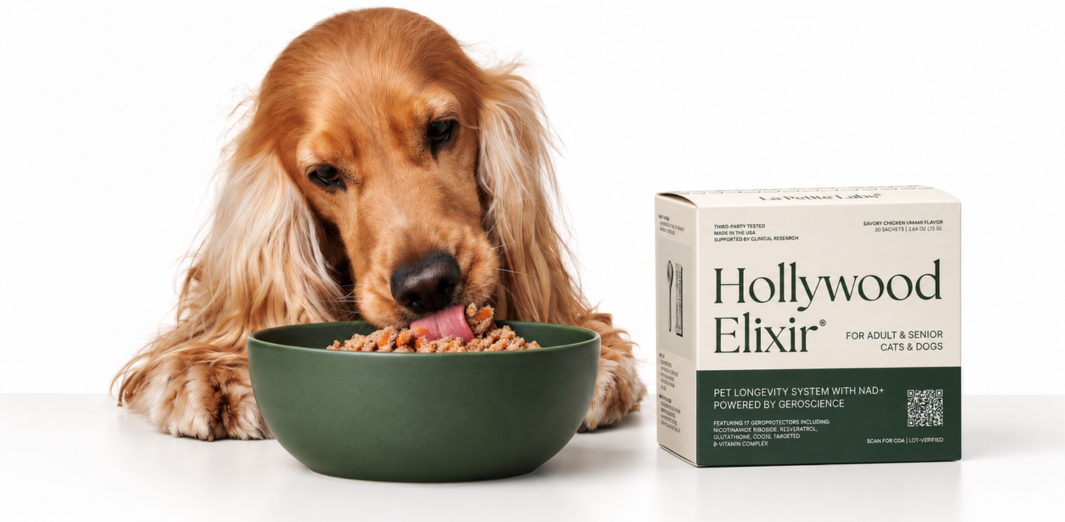
Golden spaniel eating from a green bowl beside a Hollywood Elixir box

Can ginger treat heartworm in dogs?

Ginger is not a heartworm treatment, despite one striking old study. In 1987, researchers injected an alcohol extract of ginger under the skin of dogs with natural heartworm infections. Twelve injections at 100 mg per kg cut the young worms in the blood by up to 98%. Fifty-five days after the last one, the count was still down by 83%.8

Nothing came of it as a treatment. The extract was injected, not fed, and half of the treated dogs became lethargic early on.8 We found no study in which ginger given by mouth changed a heartworm infection.

Keep your dog on the heartworm preventive your vet prescribes, and leave ginger in the kitchen for this one.

How do you choose a ginger product for a dog?

A good ginger product for a dog is plain, clearly labeled and free of risky extras. The label is most of what you have to go on, because herbal products for animals have no set standards or routine quality testing.4

Look for:

  • ginger named as the ingredient, with the amount per chew or scoop in milligrams;
  • no xylitol, which the FDA says can turn up in sugar-free candy, desserts and dietary supplements;14
  • no "proprietary blend" that hides how much of each herb is inside;4
  • a short ingredient list, so a reaction can be traced to its cause;
  • no ginger essential oil.3

Supplements aren't approved by the FDA before they go on sale, so a claim on the front of the pack proves little.2

We hold our own product to the printed-amount standard. Hollywood Elixir lists all 17 of its actives with their amounts, and ginger isn't one of them.

Plain kitchen ginger sidesteps most of these label problems.

Is ginger different for dogs and cats?

Ginger is a different proposition for cats, and the gap matters in a home with both.

  • Evidence: dogs have a vomiting study and a handful of lab experiments.1, 7 We found no study that gave ginger to cats.
  • Clearance: the body removes ginger's active compounds partly through a liver step called glucuronidation. Cats are unusually poor at it, so Europe's food safety agency builds in an extra five-fold safety factor for them.3
  • Travel drugs: antihistamines can prevent motion sickness in dogs and are ineffective in cats.12
  • Kitchen risks: onion and garlic, ginger's usual partners in cooking, damage red blood cells in both species. Cats are the more susceptible.18

So a dog's ginger chew isn't something to share with the cat. Our guide to ginger for cats covers the feline side.

Woman holding a Hollywood Elixir box beside a dapple dachshund and green food bowl on a sofa

When should a vomiting dog see the vet instead of trying ginger?
Ginger is only for a mildly queasy dog that is otherwise bright and eating. See your vet if the vomiting:

  • happens more than once or twice a day, or goes on for days;
  • comes with blood, belly pain, weakness, fever, dehydration or weight loss.20

Two emergencies can look like plain vomiting at first. A dog that retches again and again and brings nothing up, with a swollen belly and drooling, may have bloat. About 25% to 30% of dogs with bloat die.21

A dog that can't stop vomiting may have a blocked intestine.21 Either one means the emergency clinic, now.

Woman cuddling a brown-and-white spaniel while holding a Hollywood Elixir box

What works better than ginger for a dog's nausea?

Prescription anti-nausea medicine has far stronger evidence in dogs than ginger does, and simple care helps too.

  • Maropitant (Cerenia) is FDA-approved to prevent acute vomiting and motion-sickness vomiting in dogs.11 Across two trials that enrolled 189 dogs, it cut car-ride vomiting by 86.1% when given about two hours before travel.22
  • Other prescription drugs: our guide to ondansetron for dogs covers a second option vets use.
  • Careful refeeding: once vomiting has stopped for 24 hours, a vet may suggest a teaspoonful of easily digested food, built up slowly. Water shouldn't be taken away without a vet's say-so.20
  • Travel training can settle a dog whose car sickness is partly fear.12

Is ginger in Hollywood Elixir?

No. Ginger isn't one of the 17 actives in Hollywood Elixir, and the product isn't a nausea or car-sickness remedy.

The two do different jobs. Ginger is a kitchen root that people reach for when a stomach is queasy. Hollywood Elixir is daily nutrition for adult and senior dogs.

Its plant compounds are polyphenols: each sachet carries 25 mg of quercetin and 15 mg of resveratrol, next to 60 mg of nicotinamide riboside, an NAD+ precursor, and 14 more actives. All 17 amounts are printed on the label.

The powder is mixed into food once a day: half a sachet under 7 lb, one sachet from 7 to 30 lb and two sachets above 30 lb. It's a supplement, and it hasn't been tested for nausea, vomiting, car sickness or lifespan.

If plant compounds for an aging dog are what you're after, our guides to quercetin for dogs and the best longevity supplements for dogs are the place to start. See the full Hollywood Elixir formula and serving guide.

Each one used an extract, an injection or a blend, so none tells you what a pinch of kitchen ginger does.

Educational content only. This material is not a substitute for veterinary advice. Always consult your veterinarian about your dog’s specific needs. These statements have not been evaluated by the Food and Drug Administration. Products mentioned are not intended to diagnose, treat, cure, or prevent any disease.

Glossary

Rhizome: An underground stem. The part of the ginger plant sold as ginger root.

Gingerols: Active compounds in ginger. Processing turns some of them into shogaols.

Cisplatin: A chemotherapy drug that causes vomiting, used in the dog study of ginger.

Maropitant: A prescription anti-nausea drug (Cerenia) approved for dogs.

Xylitol: A sugar substitute in sugar-free products that is poisonous to dogs.

Bloat: A life-threatening twisting and swelling of a dog's stomach.

Related Reading

References

Numbered references identify the sources used for specific claims. Read the study design, species and evidence boundaries alongside each finding.

FAQ

Can dogs eat raw ginger?

Yes, in small amounts. PetMD's vet-reviewed guide lists less than ¼ teaspoon of raw ginger for a dog under 20 lb and about ¾ teaspoon for a dog over 90 lb. No trial has tested those figures, so check with your vet if your dog takes any medicine.

How much ginger can I give my dog for an upset stomach?

No amount has been tested for that. The one dog study used lab extracts against chemotherapy vomiting, and kitchen guides top out at about ¾ teaspoon of raw ginger for the largest dogs. Vomiting that repeats or comes with other signs needs a vet, not ginger.

Is ginger tea good for dogs?

Ginger tea is probably the weakest form. In the only dog vomiting study, a water extract of ginger did nothing, while extracts made with acetone or alcohol worked. Tea itself hasn't been tested in dogs.

Can I give my dog ginger every day?

No study has followed dogs on daily ginger, so its long-term safety isn't known. Regulators treat ginger as a safe flavoring at low levels. Ask your vet before making it a habit, above all for a dog on other medicines.

Can ginger replace my dog's anti-nausea medicine during chemotherapy?

No. In the dog study, ginger extracts were weaker than granisetron, a prescription anti-nausea drug. Keep to the plan from your dog's cancer team, and ask them before adding ginger or any other supplement.

Does Hollywood Elixir contain ginger?

No. Hollywood Elixir has no ginger and isn't a nausea remedy. It's a daily nutrition powder with 17 actives, including 25 mg of quercetin and 15 mg of resveratrol per sachet.

Does ginger help dogs with bloat?

We found no study of ginger for bloat. Bloat is a life-threatening emergency in which the stomach twists and fills with gas. A dog that retches without bringing anything up needs an emergency vet at once, and ginger would only waste time.

Is ginger safe for puppies?

We found no study of ginger in puppies, so there is nothing to base an amount on. Call your vet about a vomiting puppy before you try ginger or any other home remedy.

Is ginger good for senior dogs?

No study has tested ginger in older dogs. If your senior dog takes an NSAID for arthritis, note that the Merck Veterinary Manual flags a possible bleeding risk when ginger is combined with one. Ask your vet first.

Dalmatian looking toward a Hollywood Elixir box held in a person's hand

Discover LPL-01: How This Fits Into a Larger Canine Longevity System

Aging in dogs is not driven by a single pathway. It’s the result of interacting biological systems—energy metabolism, oxidative stress, immune signaling, and structural integrity—changing over time.

This article explores one piece of that puzzle. If you want to understand how these pieces connect—and what actually moves the needle—you need to zoom out.

Start with the underlying science:

Keep exploring

What would you like to understand next?

Search practical guides about healthy aging, cellular energy, ingredients, and daily support for dogs.