




The 12 Hallmarks of Aging in Dogs, Explained
Read full insightGinger for Cats
By La Petite Labs Editorial 11 min read
As Seen On

17 science-backed actives
Contents +
Ginger in tiny, food-flavoring amounts is considered safe for cats, but no study has tested whether it helps a cat with nausea or vomiting. Cats are also poor at the liver step that clears ginger's active compounds, so regulators give them a wider safety margin than other animals.
This guide explains what is and isn't known about ginger in cats, which forms to keep away from them, and what vets use when a cat keeps being sick.
- What it is: The underground stem of the ginger plant, used in food and as a home remedy for nausea.1
- Cat evidence: None. We found no study that gave ginger to cats.
- Why cats differ: Cats are poor at glucuronidation, a liver step that clears ginger's active compounds. Europe's food safety agency adds a five-fold safety factor for them.2
- Amount: No amount has been set or tested for cats. The only assessed level is a flavoring trace of 1 mg of ginger extract per kg of food.2
- Avoid: Ginger essential oil, alcohol-based tinctures and human dishes that pair ginger with onion or garlic.3, 4
- Vet first: A cat that vomits more than once a week needs a checkup. Ginger is no stand-in for a diagnosis.5
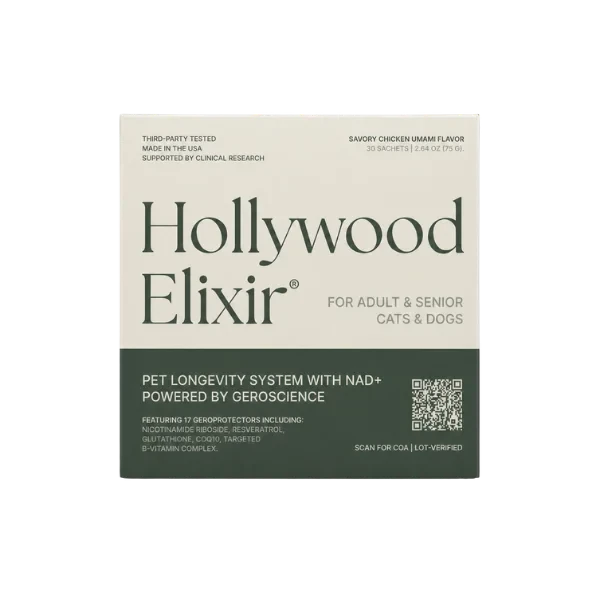
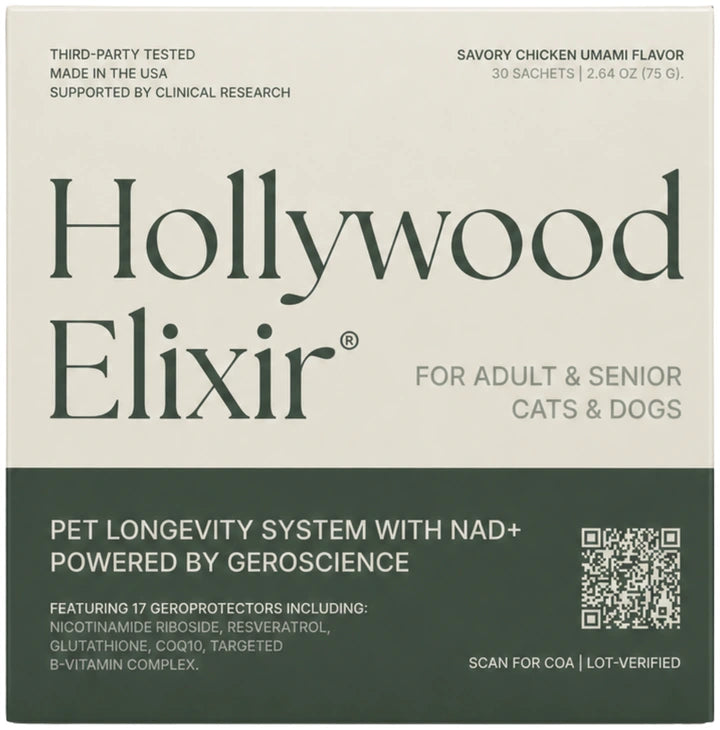
- In Hollywood Elixir: No. Hollywood Elixir contains no ginger and isn't an anti-nausea product. It's daily nutrition.
What is ginger, and why would a cat be given it?
Ginger is the underground stem of Zingiber officinale, a plant that probably came from Southeast Asia and now survives only as a crop.2 Cooks use the fresh or dried root as a spice. As a remedy, it is promoted for nausea and vomiting, among other things.1
The compounds behind its effects are gingerols and shogaols, which belong to the plant phenols.2
Cat owners tend to arrive at ginger from one of three places: a cat that throws up, a cat that hates the car, or an older cat that has gone off its food. The idea comes from human medicine, where ginger has its best support in pregnancy nausea.1
Veterinary texts mention ginger as well. The Merck Veterinary Manual includes it in a table of common botanical products, with anti-nausea action listed as a "suggested" property. The same chapter warns that evidence for plant products in animals is scarce.6
Is there any research on ginger in cats?
No research has tested ginger in cats, as far as we could find. We searched the medical literature for ginger, its Latin name and its main compounds together with cats. Nothing came back in which a living cat was given ginger: no trial for vomiting, travel, appetite or safety.
The one cat-specific document is a safety opinion. In 2020 the European Food Safety Authority reviewed ginger oil and extracts as flavorings for animal feed. It applied an extra five-fold safety factor for cats, and judged ginger extract safe in cat food at 1 mg per kg of feed.2
So every claim that ginger works for cats is borrowed from dogs or from people.
Does ginger help a cat with nausea or vomiting?
Nobody knows whether ginger helps a nauseated cat, because nobody has tried it in a study. The nearest animal evidence is a single dog experiment from 1997. Ginger extracts made with acetone or alcohol reduced vomiting brought on by a chemotherapy drug. A water extract failed, and the extracts that worked were still weaker than a prescription anti-nausea drug.7
Results in people are mixed. Across 12 trials in 1,278 pregnant women, ginger eased nausea but did not clearly cut the number of vomiting episodes.8 In a 2023 trial of 48 people having cisplatin chemotherapy with radiotherapy, ginger capsules did no better than placebo.9
A cat's vomiting also has causes that no spice can reach, from hairballs to kidney disease.5
Why do cats handle ginger differently from dogs and people?
Cats handle ginger differently because of the way their livers clear plant compounds. In other animals, gingerols and shogaols leave the body largely through glucuronidation, a step that tags a compound for removal.2 In mice, that step explains why so little free ginger compound reaches the blood after an extract is given by mouth.10
Cats are unusually poor at it. The European Food Safety Authority describes cats as having a genetic shortfall in the enzymes that do the job.2
What that means for a cat given ginger has never been measured. It is the reason regulators set the feline safety factor five times higher. In our view it is also a good reason not to scale a dog's or a person's amount down by weight.
How much ginger can a cat have?
No amount of ginger has been set, tested or published for cats by any authority we could find. These are the only figures on record:
- Flavoring level: ginger extract is judged safe in cat food at 1 mg per kg of complete feed. That is a flavoring trace, far from a supplement serving.2
- Dog experiment: 25 to 200 mg of extract per kg of body weight. Those were lab extracts given to dogs, and nobody has tried them in cats.7
If your vet suggests ginger for your cat, ask for the product, the amount and the stopping date in writing. Don't work an amount out from a dog chart or a human label.
So every claim that ginger works for cats is borrowed from dogs or from people.
Is ginger safe for cats?
Ginger is considered safe for cats at the trace levels used to flavor food, and that is as far as the evidence goes. U.S. rules for animal food list ginger among the spices and seasonings generally recognized as safe.11 Europe's food safety agency cleared ginger extract at 1 mg per kg of cat food.2
Beyond a trace, three gaps remain.
- No feline safety study. We found no study in which cats received measured ginger for days or weeks.
- Slow clearance. Cats are poor at the liver step that handles ginger's compounds, which is why their safety factor is five times larger.2
- Irritation. In veterinary patients generally, ginger's reported effects include abdominal discomfort, diarrhea and irritation of the stomach, mouth and throat.6
We also found no report of ginger poisoning a cat. With an accidental taste, the bigger worry is often what the ginger came with. Onion and garlic damage red blood cells, and cats are more susceptible to them than dogs.4
What are the side effects of ginger in cats?
Ginger's side effects have not been recorded in cats, so the list comes from other species. For veterinary patients as a group, the Merck Veterinary Manual gives belly discomfort, diarrhea, an irritated stomach and a sore mouth and throat.6 In people, the U.S. agency that reviews herbs adds heartburn.1
The signs can be easy to miss. Nausea in animals shows up as drooling, lip licking, restlessness or lethargy.12 In cats, vomiting is usually preceded by heavy salivation and repeated swallowing.13
Stop the ginger if you see any of these. If your cat then turns down food, call your vet the same day. Our guide to a senior cat that isn't eating explains what to watch.
Can ginger interact with a cat's medicines?
Ginger may interact with medicines that cats are prescribed. For veterinary patients, the Merck Veterinary Manual lists three:6
- NSAIDs such as meloxicam: a possible increase in bleeding risk;
- Glucose-lowering medicines such as insulin: an added fall in blood sugar;
- Cyclosporine (Atopica): lower levels of the drug in the blood.
The manual also names ginger as one of four herbs that could cause unexpected bleeding during surgery.6 Human studies of the clotting effect are split. In one review, four clinical trials found that ginger reduced platelet clumping and four found no change.14
None of it has been checked in cats. Tell your vet about any ginger product before a dental cleaning, an operation or a new prescription.
Which cats should not have ginger?
Ginger is a poor fit for several groups of cats:
- kittens, and pregnant or nursing queens, since ginger has never been studied in them, as far as we could find;
- cats on an NSAID, insulin or cyclosporine;6
- cats booked for surgery or dental work;6
- cats with kidney disease or another long-term illness, whose nausea belongs in the treatment plan;
- any cat that vomits more than once a week, which Cornell's Feline Health Center says should be seen promptly.5
For a healthy adult cat, the plain position is that ginger has no proven benefit to set against these unknowns.
Which forms of ginger are riskiest for cats?
The form matters more for cats than the ginger itself. From most to least worrying:
- Essential oil. Concentrated essential oils are a danger to pets on the coat or by mouth, the ASPCA warns, and swallowing them can cause vomiting, diarrhea and depression.3 Europe's food safety agency also rates ginger oil an irritant to skin, eyes and airways.2
- Alcohol tinctures. Some herbal extracts are preserved in alcohol,6 and the ASPCA lists alcohol among the things pets should never have.4
- Human dishes. Stir-fries, curries and sauces pair ginger with onion and garlic, which damage red blood cells. Cats are more susceptible than dogs.4
- Sweets and baked goods. Ginger cookies and cakes can carry chocolate, which the ASPCA also lists as a hazard for pets.4
- Capsules and chews made for people or dogs. Their strength is set for a much larger body, and nobody runs routine quality checks on herbal products sold for animals.6
- Fresh or powdered root. The plainest form, and still untested in cats.
The form matters more for cats than the ginger itself.
DVM Voice: Clinical Vignette of a Common Pattern in Senior Cat Aging
Case provided by JoAnna Pendergrass, DVM
Sasha, a 12-year-old cat, was brought in after her owner noticed increased thirst and urination, lethargy, vomiting, and a generally unkempt appearance. Examination showed weight loss, elevated blood pressure, and reduced vitality.
Diagnostic testing revealed elevated kidney markers, poorly concentrated urine, and protein loss in the urine — findings consistent with chronic kidney disease, one of the most common chronic conditions in senior cats.
Her care required a kidney-focused diet, blood pressure management, targeted supplementation, medication support, and regular monitoring — a necessary plan, but one started after clinical signs were already visible.
Clinical takeaway: Sasha’s case reflects why senior-cat wellness should begin before obvious decline. Earlier monitoring, body-condition tracking, hydration awareness, antioxidant support, and daily cellular resilience may help support quality of life as cats age.
Single-case vignette. Not generalizable. Veterinary diagnosis and monitoring are essential for increased thirst, urination, vomiting, lethargy, weight loss, or suspected kidney disease.
Does ginger help cats with hairballs?
Ginger has no evidence behind it for hairballs. We found no study, and the idea doesn't fit how hairballs form. Swallowed hair can't be digested, so it clumps into a wad in the stomach.13 Bringing one up every week or two is not uncommon and usually causes no lasting trouble, according to Cornell's Feline Health Center.5
What helps is less hair going down. The Merck Veterinary Manual suggests frequent brushing and notes that some cat foods and treats are made to limit hairballs.13
See your vet if the hairballs are frequent or the vomiting repeats. Something more serious than hair could be to blame.13
Does ginger help cats with car sickness?
Ginger hasn't been tested for travel sickness in cats. In people, most studies of ginger for motion sickness found it didn't help.1
Cats also need different drugs than dogs. Antihistamines, which prevent motion sickness in dogs, are ineffective in cats, and the Merck Veterinary Manual points vets to maropitant.12 In a pharmacology study, maropitant at 1 mg per kg was highly effective at preventing vomiting brought on by motion in cats.15 Our guide to Cerenia for cats covers how it's used.
Fear is often part of the picture. A cat can show signs in a car that isn't moving, and getting the cat used to travel is sometimes all it takes.12
Can ginger settle nausea in a senior cat with kidney disease?
Ginger has not been studied in cats with kidney disease, and they are the cats where guessing is least wise. A kidney cat that vomits or stops eating needs its treatment plan adjusted by the vet.
Tested help exists. In a blinded trial, 41 cats with stage II or III chronic kidney disease were enrolled to get maropitant or a placebo every day for two weeks, and 33 finished. Vomiting fell significantly in the cats on maropitant. Appetite scores and weight did not change.16
Our guide to chronic kidney disease in cats explains how nausea fits into the wider plan.
How do you choose a ginger product for a cat?
The safest choice for most cats is no ginger product at all, since none has been tested in the species. If your vet does suggest one, the label has to do the work that research hasn't. Nobody sets standards for the herbal products sold for animals, the Merck Veterinary Manual notes.6
Check for:
- a product made for cats, with a feline amount on the label, not a dog chew cut into pieces;
- ginger listed with its amount in milligrams, not folded into a "proprietary blend";6
- no essential oils and no alcohol base;3, 4
- no onion or garlic in any form;4
- a short ingredient list, so a reaction can be traced.
The FDA doesn't approve supplements before they reach the shelf, so marketing claims carry little weight.1
We print the amount of every active on our own product for the same reason. Hollywood Elixir lists all 17, and ginger isn't among them.
Is ginger the same for cats and dogs?
Ginger is not the same for cats and dogs, in evidence or in safety margin.
- Research: dogs have a vomiting experiment from 1997.7 Cats have nothing.
- Clearance: in lab tests, liver preparations from dogs broke ginger's compounds down fast.10 Cats are poor at the main clearance step.2
- Safety factor: five times larger for cats in Europe's feed assessment.2
- Travel drugs: antihistamines prevent motion sickness in dogs and don't work in cats.12
- Kitchen risks: onion and garlic harm both species, cats more readily.4
In a home with both, store the dog's ginger chews where the cat can't get them, and never split one between the two. Our guide to ginger for dogs covers what the dog studies found.
When should a vomiting cat see the vet instead of trying ginger?
A vomiting cat should go to the vet, with no home remedy first, if any of these apply:
- vomiting more than once a week;
- lethargy, weakness or a poor appetite;
- blood in the vomit;
- more thirst than usual, a change in urination, or diarrhea at the same time.5
Cornell's Feline Health Center lists the usual culprits: string or yarn, poisonous plants, human medicines, parasites, bowel disease, diabetes, kidney disease and an overactive thyroid.5 None of them responds to ginger.
If you think your cat has swallowed string or something toxic, don't wait to see whether the stomach settles. Call your vet or a poison line and say how much is missing.4
What works instead of ginger for a nauseated cat?
Finding the cause works better than any remedy, ginger included, and vets have measured tools for the nausea itself.
- Prescription anti-nausea medicine. Cornell notes that a vet may prescribe an anti-emetic for dietary upsets and some metabolic diseases.5 Maropitant has feline data for both motion and kidney-related vomiting.15, 16 Our guide to ondansetron for cats covers a second option.
- Supportive care. Lasting vomiting often calls for fluids, then a bland, easily digested diet once the vomiting has stopped.5
- Treating the disease. Dewormers for parasites, diet or medicine for bowel disease, and specific treatment for metabolic disease.5
Each of these starts with an exam, which is the step a home remedy can delay.
Is ginger in Hollywood Elixir?
No. Hollywood Elixir contains no ginger, and it isn't made for nausea, vomiting or travel sickness.
Ginger is a kitchen root that people turn to for a queasy stomach. Hollywood Elixir is something else: daily nutrition for adult and senior cats. Among its 17 actives are two plant polyphenols, 25 mg of quercetin and 15 mg of resveratrol per sachet, plus 60 mg of nicotinamide riboside, an NAD+ precursor. Every amount is on the label, so you and your vet can see exactly what your cat gets.
It's a powder stirred into food once a day: half a sachet for cats under 7 lb, one sachet from 7 to 30 lb. As a supplement, it hasn't been tested for nausea, kidney disease or lifespan, and it's no substitute for a diagnosis.
Once your cat's stomach has been checked, everyday nutrition is a separate question. Our guides to quercetin for cats and the best supplements for senior cats are a good next read. See the full Hollywood Elixir formula and serving guide.
None of them responds to ginger.
Educational content only. This material is not a substitute for veterinary advice. Always consult your veterinarian about your cat’s specific needs. These statements have not been evaluated by the Food and Drug Administration. Products mentioned are not intended to diagnose, treat, cure, or prevent any disease.
Glossary
Rhizome: The underground stem of a plant. Ginger root is a rhizome.
Gingerols and shogaols: The active compounds in ginger. Shogaols form from gingerols during processing.
Glucuronidation: A liver step that tags compounds for removal. Cats have an unusually low capacity for it.
Oleoresin: A concentrated extract of dried ginger root, the form assessed for pet food.
Maropitant: A prescription anti-nausea drug (Cerenia) with studies in cats.
Hairball: A wad of swallowed hair that a cat brings up.
Related Reading
Aging & Senior Cat Guidance
• Cat Age Calculator: Cat Years to Human Years
• Cat Lifespan by Breed
• Lethargy in Cats
• Senior Cat Not Eating
• Cat Drinking A Lot
• Why Is My Senior Cat Withdrawn?
Healthy Aging Support
• NAD+ for Cats
• NMN for Cats
• Vitamins For Older Cats
• Senior Cat Food
• Longevity Drugs for Cats
References
Numbered references identify the sources used for specific claims. Read the study design, species and evidence boundaries alongside each finding.
- [1]
- [2]
- [3]
- [4]
- [5]
- [6]
- [7]
- [8]
- [9]
- [10]
- [11]
- [12]
- [13]
- [14]
- [15]
- [16]
FAQ
Can cats eat ginger?
A trace of plain ginger in food is considered safe, and regulators allow it as a flavoring in cat food. Larger amounts have never been tested in cats, so there is no proven benefit to set against the unknowns. Ask your vet before adding it.
Is ginger toxic to cats?
We found no report of ginger poisoning a cat, and regulators allow ginger flavoring in cat food at trace levels. The effects reported in other species are stomach and mouth irritation. Ginger essential oil and dishes containing onion or garlic are the bigger dangers.
Is it an emergency if my cat licked some ginger?
We found no report of ginger poisoning in cats, and trace amounts are allowed as a flavoring in cat food. Check what else was in the dish. Onion, garlic, alcohol or essential oil are reasons to call your vet or a poison line.
Can I give my cat ginger for vomiting?
No study supports it. Ginger has only been tested against vomiting in dogs and people, and a cat that vomits more than once a week needs a vet visit to find the cause. Ask your vet about tested anti-nausea medicine.
Is ginger tea safe for cats?
Ginger tea hasn't been tested in cats. In the one dog experiment, a water-based ginger extract was the form that failed to reduce vomiting. Offer fresh water, and call your vet if the vomiting continues.
Can ginger replace my cat's prescribed anti-nausea medicine?
No. Ginger has no studies in cats, while maropitant reduced vomiting in a placebo-controlled trial of cats with kidney disease. Keep giving the prescribed medicine, and tell your vet if it isn't controlling the nausea.
Does Hollywood Elixir contain ginger?
No. Hollywood Elixir contains no ginger and isn't an anti-nausea product. It's a daily nutrition powder with 17 actives, among them 25 mg of quercetin and 15 mg of resveratrol in each sachet.
Is it safe to diffuse ginger essential oil around cats?
The ASPCA says a diffuser run for a short time in a room your cat can't enter is unlikely to be a problem. Concentrated ginger oil on the coat or swallowed is another matter. Keep the bottle and the diffuser out of reach.
Is ginger safe for kittens?
Ginger has never been studied in kittens, as far as we could find, so no amount can be called safe for them. A kitten that is vomiting or off its food needs a vet visit, not a kitchen remedy.
Discover LPL-01: How This Fits Into a Larger Feline Longevity System
Aging in cats unfolds quietly. It’s not driven by a single failure, but by gradual shifts across interconnected systems — cellular energy, oxidative balance, immune tone, and tissue integrity — each influencing the others over time.
This article explores one layer of that system. To understand what actually shapes long-term health, you need to step back and look at how these layers interact.
Start with the underlying science:
- Feline Geroscience Framework →
A structured view of how aging progresses across cellular energy, inflammation, and resilience systems. - Senior Biological Defense Coverage (BDC) Modeling →
A systems-level map of which biological pathways decline first, and how layered interventions can support them. - 2026 Market Research: Best Cat Longevity Supplements →
A feline-specific review of longevity supplements. 2026 Industry report created by LPL-01 Research. - LPL-01 Standard →
The formulation system that translates these models into real-world supplementation—covering multiple pathways in a coordinated way.
Keep exploring
What would you like to understand next?
Search practical guides about healthy aging, cellular energy, ingredients, and daily support for cats.
Hollywood Elixir®Senior Cat SupplementSenior cat energy, mobility & cognitionFrom$50/moSave up to 47%Save up to 44%Shop Now
Limited time offerEnds Nov 30
Hollywood Elixir®Senior Cat SupplementSenior cat energy, mobility & cognitionFrom$50/moSave up to 47%Save up to 44%Shop Now
Essential Summary
What should cat owners know about ginger?
No study has tested ginger in cats. The evidence people quote comes from one dog experiment and from human trials.
Cats are poor at the liver step that clears ginger's compounds, so regulators apply a safety factor five times larger for them.
A cat that vomits more than once a week needs a vet visit. Keep ginger oil, tinctures and onion or garlic dishes out of reach.

Hollywood Elixir® Senior Cat Supplement
17 science-backed actives in every sachet
Supports senior energy, mobility & cognition
60-day first-box guarantee
Hollywood Elixir is amazing! She put back on 5 lbs to a healthy weight, her eyes are shiny, her coat is beautiful!
— Jessie
She hopped up onto the windowsill again for the first time in years.
— Charlie
Thinking about your cat's everyday nutrition?
Everyday nutrition, every amount on the label.
Hollywood Elixir gives adult and senior cats 25 mg of quercetin, 15 mg of resveratrol and 15 more actives in each sachet. It has no ginger in it and isn't an anti-nausea product.

Hollywood Elixir® Senior Cat Supplement
17 science-backed actives in every sachet
Supports senior energy, mobility & cognition
60-day first-box guarantee
Learn about how our DVMs think about cat aging
Dr. JoAnna Pendergrass DVM

Hollywood Elixir® Senior Cat Supplement
17 science-backed actives in every sachet
Supports senior energy, mobility & cognition
60-day first-box guarantee
Explore your cat’s changing needs over time
Related Reading
No study has tested ginger in cats. See why regulators add a 5-fold safety margin for cats, which forms to avoid, and when vomiting needs a vet.