








Turmeric and Curcumin for Dogs

What three arthritis trials found, how much the studies gave, and why absorption boosters deserve a second look.

By La Petite Labs Editorial 11 min read

As Seen On

Woman hugging a golden retriever while holding a Hollywood Elixir box
Hollywood Elixir® Senior Dog Supplement

17 science-backed actives

From$50/moSave up to 47%Save up to 44%Shop Now
Contents

Turmeric is safe for dogs in small, food-level amounts, but the proof that it eases arthritis is weak. Three controlled trials have tested turmeric or curcumin products in dogs with osteoarthritis. None changed how much weight the dogs put on their sore legs, though vets or owners noticed some improvement in two of them. Curcumin, the main active compound, is also poorly absorbed.

This guide covers what the dog studies found, the amounts they used, the side effects, and the treatments with stronger evidence behind them.

  • What it is: Turmeric is a spice from the ginger family. Curcumin, its main active compound, makes up about 3% of the powder.9, 10
  • Arthritis evidence: Weak. Force-plate results didn't improve in any of three dog trials, and a systematic review found weak or no evidence for a turmeric extract.1, 2, 3, 4
  • Absorption: Poor. Three special formulations reached about two to three times the blood levels of plain curcumin in beagles.6
  • Amount: None is established. One 60-day study gave dogs 6.6 mg of curcumin per kg of body weight.5
  • Safety: An 8-week trial in 61 dogs recorded no serious side effects.1
  • Watch for: Products with black pepper extract or other absorption boosters. In people, those forms have been linked to liver injury.9
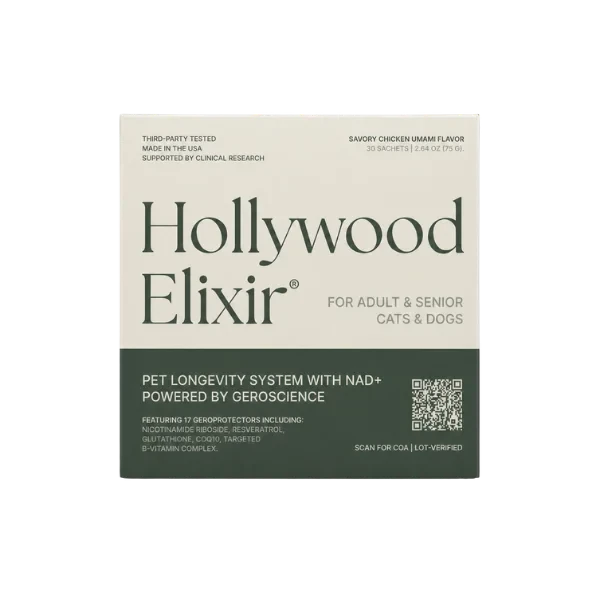
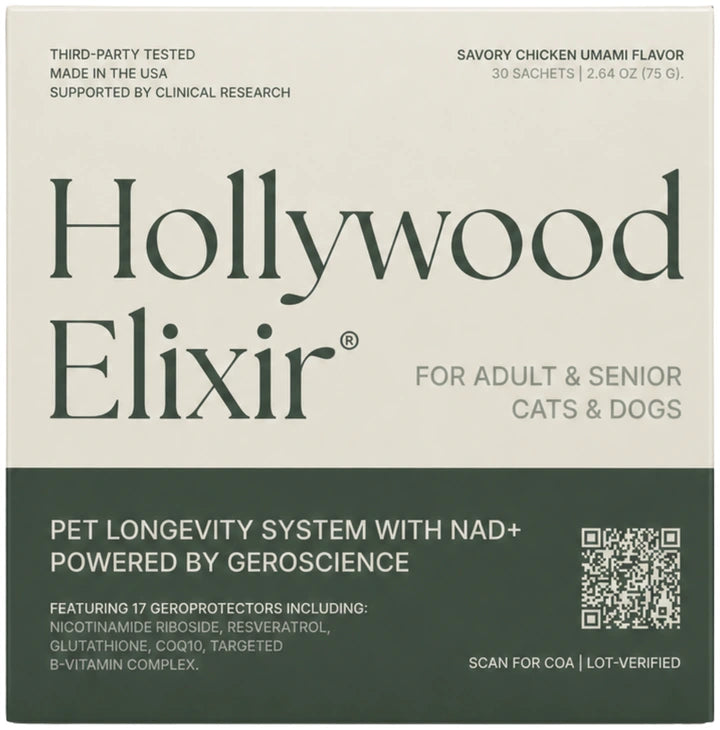
  • In Hollywood Elixir: No. Hollywood Elixir has no turmeric or curcumin. It uses other plant antioxidants, such as quercetin and resveratrol.

What are turmeric and curcumin, and how do they differ?

Turmeric is the ground root of Curcuma longa, a plant in the ginger family.9 Curcumin is the compound that gives it its yellow color, and it gets most of the research attention. It belongs to a small group of related compounds called curcuminoids.9

The two are easy to mix up on a label, and the gap between them is large.

  • Turmeric powder is the whole ground root. Pure turmeric powder averaged 3.14% curcumin by weight in a laboratory test of 28 spice products.10
  • Turmeric extract is concentrated. The extract used in pet-food research contains at least 90% curcuminoids.14

So a teaspoon of spice and a capsule of extract deliver very different amounts of the active compound. When a study or a product says "turmeric", check which one it means.

Woman holding a Hollywood Elixir box beside a pug, a terrier and a food bowl

Is turmeric good for dogs with arthritis?

Turmeric has been tested for dog arthritis more than for any other use, and the results are underwhelming. A systematic review graded the evidence for each osteoarthritis treatment in dogs. It found strong evidence for three prescription anti-inflammatory drugs, and weak or no evidence for P54FP, a turmeric extract.4

Two newer trials haven't changed that picture. Force-plate readings stayed flat in both, and pain scores improved in one.2, 3

Subjective scores are easier to shift than force-plate readings, so treat the gains as possible, not proven. Turmeric is reasonable to try alongside proper arthritis care, never in place of it.

Woman in sportswear holding a Hollywood Elixir box beside a black-and-tan dog outdoors

What did the three dog arthritis trials find?

Turmeric or curcumin has been tested in three placebo-controlled trials in pet dogs with osteoarthritis.

  • Turmeric extract, 61 dogs, 8 weeks: no difference in force-plate results. Vets rated the turmeric group better overall, and owners' ratings fell just short of significance.1
  • Curcuminoids with collagen and green tea, 42 dogs, 3 months: no difference in force-plate results or blood markers. Pain when the joint was handled eased, and dogs rose from lying down more easily.2
  • Curcumin with green-lipped mussel and blackcurrant leaf, 32 dogs, 16 weeks: no difference from placebo.3

Two of the three tested mixtures, so any benefit can't be pinned on curcumin.

Woman holding a Hollywood Elixir box above her forehead beside a Bernese mountain dog outdoors

Does curcumin lower inflammation in dogs?

Curcumin does shift inflammation signals in dogs' blood, which is the best argument in its favor.

  • Gene activity, 12 arthritic dogs: six got curcumin and six got an anti-inflammatory drug for 20 days. The number of abnormally active genes fell by a similar amount in both groups.7
  • Gene activity, 18 dogs with joint disease: 60 days of curcumin turned down four inflammation genes, including TNF.5
  • Antioxidant enzymes: young beagles fed curcumin had higher antioxidant enzyme activity in their blood.8

These studies measured blood markers, not how well the dogs moved. Curcumin isn't the only plant polyphenol studied in dogs.15 Our guide to polyphenols for dogs covers the others, including the quercetin and resveratrol used in Hollywood Elixir.

Golden retriever nuzzling a woman holding a Hollywood Elixir box on the grass beside a food bowl

How much turmeric or curcumin can a dog have?

No amount of turmeric or curcumin has been established for dogs. These are the amounts that studies and regulators have used.

  • Joint study: 6.6 mg of curcumin per kg of body weight, given in the diet for 60 days.5 That works out to 66 mg for a 22 lb (10 kg) dog.
  • Dog food study: kibble containing about 33 mg of curcumin per kg of food.8
  • As a flavoring: European regulators judged turmeric extract safe at 15 mg per kg of complete feed for all animal species.13

If your vet agrees to a trial, judge it over eight to twelve weeks, the length of the main trials.1, 2

Subjective scores are easier to shift than force-plate readings, so treat the gains as possible, not proven.

Is turmeric safe for dogs?

Turmeric has a reassuring record in dogs at the amounts studied. In the 8-week arthritis trial, no serious side effects were recorded.1 European regulators consider turmeric extract safe as a feed flavoring for all animal species at 15 mg per kg of feed.13

Three points keep it from being a free pass.

  • Blood chemistry: beagles fed curcumin for six weeks had higher blood glucose, urea, triglycerides and cholesterol than the control dogs.8 The study was small, and nobody knows what that means over years.
  • Liver: in people, liver damage has been reported with curcumin products built for high absorption.9 This hasn't been studied in dogs.
  • Oxalate: turmeric is rich in soluble oxalate, and it raised urinary oxalate in a human study.12 That's a reason for caution in dogs that form calcium oxalate stones, although it hasn't been measured in dogs.

Human guidance describes ordinary turmeric as likely safe for up to two or three months, which is about as far as the dog trials go.9, 2

Overhead view of a black-and-white dog beside a food bowl and Hollywood Elixir box

What are the side effects of turmeric in dogs?

Turmeric's most likely side effect in a dog is an upset stomach. In people, it can cause nausea, vomiting, acid reflux, diarrhea or constipation, and the same gut effects are what to watch for in a dog.9

The dog trials themselves were quiet. No serious side effects were recorded over eight weeks, and more dogs left the placebo group than the turmeric group because their arthritis got worse.1

Stop the supplement and call your vet if your dog vomits, has diarrhea or goes off food. The liver warning signs listed for people are tiredness, poor appetite, dark urine and yellowing of the skin or eyes.9 Turmeric also stains, so expect yellow on light fur, bowls and floors.

Woman smiling beside a golden retriever, a green food bowl and a Hollywood Elixir box

Should dogs get turmeric with black pepper?

Black pepper is added to turmeric because its extract, piperine, slows the breakdown of curcumin. In a human study, 20 mg of piperine raised curcumin's bioavailability by 2,000%.11

That trick has a cost. Piperine works by blocking glucuronidation, one of the main ways the liver and gut clear compounds, and many medicines leave the body the same way.11 The U.S. National Institutes of Health also notes that liver damage has been reported in people who took highly absorbable curcumin products.9

None of the three dog arthritis trials lists piperine among its ingredients.1, 2, 3 If your dog takes any daily medicine, choose a product without it, or ask your vet first.

Man holding a Hollywood Elixir box while sitting on an outdoor sofa with a golden retriever

What is golden paste, and does it work for dogs?

Golden paste is a homemade mix of turmeric powder, oil and ground black pepper, cooked into a paste and stirred into food. The oil and pepper are there to push more curcumin into the blood.

We found no published study of golden paste in dogs. Its curcumin content is also low and variable, because kitchen turmeric averages about 3% curcumin.10

If you make it, three cautions apply. The pepper raises the same questions as piperine supplements. The oil adds fat and calories. And the amount of curcumin in each spoonful is a guess.

Why is curcumin so poorly absorbed?

Curcumin is hard to get into the bloodstream. Researchers give three reasons: little of it is absorbed from the gut, the body breaks it down quickly, and what remains is cleared fast.15 In one human study, blood levels after 2 grams of plain curcumin were very low or undetectable.11

Dogs show the same problem. When 24 beagles were given plain curcumin or one of three special formulations, the formulations reached about two to three times the blood levels of plain curcumin.6

The main approaches on the market are:

  • pairing curcumin with piperine from black pepper;
  • binding it to phospholipids;
  • wrapping it in cyclodextrin, liposomes or nanoparticles.15, 6

Better absorption isn't automatically better for the dog. The liver injuries reported in people involved the highly absorbable forms.9 We also found no dog trial comparing a boosted product with a plain one for arthritis.

Better absorption isn't automatically better for the dog.

Woman sitting with a beagle in a kitchen while holding a Hollywood Elixir box

DVM Voice: Clinical Vignette of a Common Pattern in Senior Dog Aging

Case provided by JoAnna Pendergrass, DVM

Rex, a 7-year-old Labrador Retriever, was brought in after his owner noticed he was slower to rise, hesitant on stairs, and less able to play as before. Examination showed stiffness and reduced hip mobility; radiographs confirmed degenerative joint changes.

His care required weight management, veterinary-guided pain control, nutritional support, and rehabilitation — a comprehensive plan, but one started only after visible decline appeared.

Clinical takeaway: Rex’s case reflects the value of proactive aging support: maintaining lean body condition, monitoring mobility early, and supporting cellular resilience, antioxidant defense, and healthy inflammatory balance before decline becomes obvious.

Single-case vignette. Not generalizable. Veterinary oversight is essential for pain, stiffness, or suspected joint disease.
Explore Hollywood Elixir Research →
Spotted gray dog beside a Hollywood Elixir box held in a person's hand

Which dogs should not have turmeric?

Turmeric isn't a good fit for every dog. Ask your vet before giving it to a dog that:

  • has had calcium oxalate bladder or kidney stones, since turmeric raises urinary oxalate in people;12
  • has gallbladder disease or a blocked bile duct, because curcumin makes the gallbladder contract in people;16
  • is pregnant or nursing, where human guidance says turmeric supplements may be unsafe;9
  • has liver disease or raised liver enzymes;9
  • takes daily medicine, especially if the product contains piperine.11

These cautions come mostly from human research. Dog-specific safety data stop at a few months.1, 2

Golden retriever nuzzling a man holding a Hollywood Elixir box beside a food bowl

Can turmeric replace an NSAID for a dog in pain?
Turmeric can't replace an anti-inflammatory drug for a dog in pain. The systematic review of dog arthritis treatments found strong evidence for carprofen, firocoxib and meloxicam, and weak or no evidence for the turmeric extract.4

One small study did compare the two, but only in blood tests. Curcumin and an NSAID each calmed inflammation genes in six arthritic dogs over 20 days.7 The study wasn't designed to compare pain relief.

We found no trial of turmeric given together with an NSAID. Our guides to carprofen and meloxicam explain how the prescription options work.

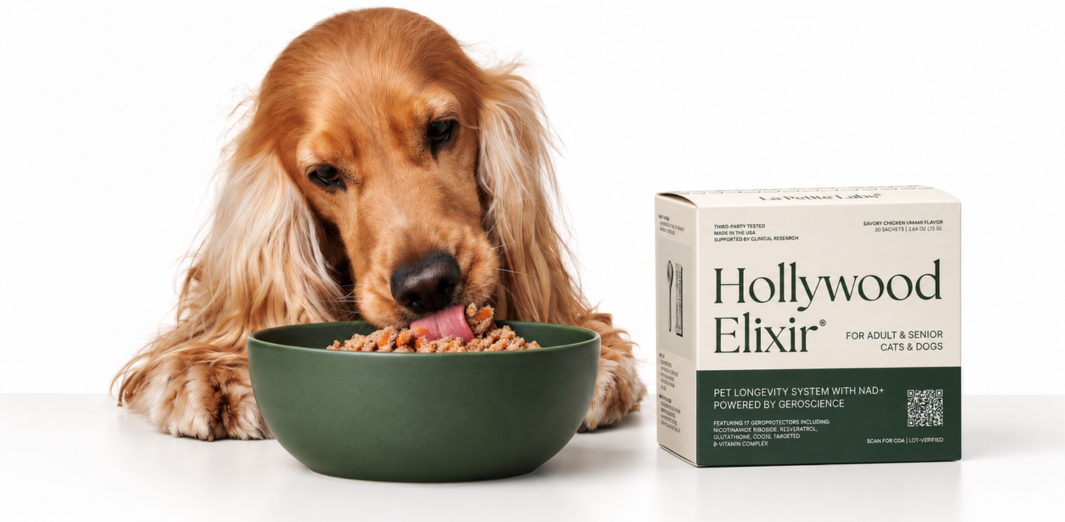
Golden spaniel eating from a green bowl beside a Hollywood Elixir box

Is turmeric worth trying for a senior dog?

Turmeric is a low-risk extra for a senior dog whose arthritis care is already in place, and the expected benefit is small. Prescribed pain relief has far stronger evidence behind it than any spice.4

A sensible trial looks like this:

  • agree on it with your vet, and pick a plain product without piperine;
  • write down two or three things to track, such as rising from bed, stairs and walk length;
  • reassess at eight to twelve weeks, and stop if nothing has changed.1, 2

Older dogs are also more likely to have a long medicine list, so the vet conversation matters more with age.

How do you choose a turmeric supplement for a dog?

A good turmeric product for a dog tells you exactly how much curcumin is in it. Human health authorities warn that curcumin products vary in how much they contain and often include other plant ingredients, such as piperine.9

Look for:

  • the curcuminoid content per chew or capsule, in milligrams;
  • a product made for dogs, with a feeding guide by body weight;
  • no piperine or black pepper extract, unless your vet wants it;9
  • a company that publishes third-party testing.

Then check the form. A capsule of 500 mg turmeric powder holds roughly 15 mg of curcumin, while 500 mg of a 90% extract holds about 450 mg.10, 14

Joint blends are common, and two of the three dog trials used them.2, 3 With a blend, read the amount of each ingredient, since a long list can hide very small amounts. It's the standard we hold Hollywood Elixir to: all 17 amounts are on the label, and turmeric isn't one of them.

Is turmeric different for dogs and cats?

Turmeric has been studied differently in the two species. Dogs have the arthritis trials. Cats have newer work on safety.

  • Safety: healthy adult cats ate a diet with turmeric extract for four months without effects of clinical concern.14
  • Joints: in a 16-cat trial of a curcumin and green-lipped mussel blend, grooming, activity and stair climbing improved.3
  • Metabolism: cats have a much lower capacity than most mammals to clear plant phenolic compounds through glucuronidation, so amounts can't be copied across from a dog product.17

That last point is why a dog supplement shouldn't be shared with the household cat. Our guide to turmeric and curcumin for cats covers the feline studies.

Woman holding a Hollywood Elixir box beside a dapple dachshund and green food bowl on a sofa

When should you see the vet instead of trying turmeric?

Turmeric is for a dog whose joint problem already has a name. See your vet first if your dog:

  • limps, or holds a leg up;
  • struggles to rise, climb stairs or jump into the car;
  • yelps, pants or licks at a joint;
  • has become stiff or slow over a few weeks.

Joint pain has causes that a spice won't touch, from torn ligaments to hip dysplasia. A dog in pain today needs relief that works today. Ask about weight, exercise and prescription options such as grapiprant or Librela.

Woman cuddling a brown-and-white spaniel while holding a Hollywood Elixir box

What works better than turmeric for dog joint pain?

Several options have stronger evidence than turmeric for arthritis in dogs.

  • Prescription NSAIDs: carprofen, firocoxib and meloxicam earned the top evidence rating in a systematic review.4
  • Fish oil omega-3s: in a 38-dog trial, a food rich in fish oil improved force-plate results in 82% of dogs, against 38% on a regular food.18
  • Green-lipped mussel: a food containing it reached a moderate rating in the same review.4 Our guide to green-lipped mussel for dogs has the details.

Turmeric sits below all of these. It fits best as an add-on once the basics are in place. Our guide to omega fatty acids for dogs covers fish oil.

Is turmeric in Hollywood Elixir?

No. Hollywood Elixir doesn't contain turmeric or curcumin, and it isn't a joint supplement or a pain treatment.

What it does contain is a different set of plant compounds. Each sachet has 25 mg of quercetin, 15 mg of resveratrol and 2 mg of astaxanthin, alongside 60 mg of nicotinamide riboside, an NAD+ precursor, and 13 more actives. All 17 amounts are printed on the label, so you can see exactly what your dog gets.

It's a daily powder for adult and senior dogs: one sachet from 7 to 30 lb, two over 30 lb. Hollywood Elixir hasn't been tested for arthritis or lifespan, and a dog in pain needs a vet.

If you came to turmeric looking for plant antioxidants for an aging dog, our guides to quercetin for dogs and the best dog longevity supplements are the next read. See the full Hollywood Elixir formula and serving guide.

Prescribed pain relief has far stronger evidence behind it than any spice.

Educational content only. This material is not a substitute for veterinary advice. Always consult your veterinarian about your dog’s specific needs. These statements have not been evaluated by the Food and Drug Administration. Products mentioned are not intended to diagnose, treat, cure, or prevent any disease.

Glossary

Turmeric: The ground root of Curcuma longa, a plant in the ginger family, used as a spice.

Curcumin: The main active compound in turmeric and the source of its yellow color.

Curcuminoids: The group of related compounds in turmeric that includes curcumin.

Piperine: A compound from black pepper that slows the breakdown of curcumin.

Bioavailability: The share of a swallowed compound that reaches the bloodstream.

Force plate: A floor sensor that measures how much weight a dog puts on each leg.

Related Reading

References

Numbered references identify the sources used for specific claims. Read the study design, species and evidence boundaries alongside each finding.

FAQ

Can I sprinkle turmeric powder on my dog's food?

A small pinch of kitchen turmeric is unlikely to harm a healthy dog, and it's unlikely to do much either. The powder is about 3% curcumin, and little of that is absorbed. Check with your vet first if your dog has had bladder stones.

How long does turmeric take to work in dogs?

The dog arthritis trials ran for 8 to 16 weeks, and the gene studies saw changes in blood markers within 20 to 60 days. Give a trial eight to twelve weeks before you judge it, and stop if nothing has changed.

Can turmeric cure or shrink cancer in dogs?

No study shows that. Turmeric extracts have been tested on dog cancer cells in laboratory dishes, and we found no clinical trial in dogs with cancer. Don't delay or replace cancer treatment with turmeric.

Is turmeric safe for dogs with kidney disease?

There's no dog study to go on. Turmeric is high in soluble oxalate, which raised urinary oxalate in people, so ask your vet before giving it to a dog with kidney disease or a history of stones.

Can puppies have turmeric?

There's little reason to give it. In one study, young beagles fed curcumin for six weeks didn't grow or gain weight any faster, and some blood values rose. A puppy with a joint or growth problem needs a vet.

Does Hollywood Elixir contain turmeric?

No. Hollywood Elixir has no turmeric or curcumin. Its plant compounds are quercetin, resveratrol and astaxanthin, with the amount of each printed on the label, and it isn't a joint treatment.

Is curcumin better than turmeric for dogs?

Curcumin extract delivers far more of the active compound: about 90% curcuminoids against roughly 3% in the spice. That makes the amount easier to control. It doesn't change the weak trial evidence, and concentrated products deserve more caution.

Does turmeric help dogs with itchy skin or allergies?

We found no controlled trial of turmeric for skin disease or allergies in dogs. The dog research covers arthritis and blood markers. For an itchy dog, a diagnosis comes first.

Can I give my dog my own turmeric capsules?

Check the label first. Human products often add piperine or come in high-absorption forms, and the capsule size is set for an adult person. A product made for dogs, with a weight-based guide, is the safer choice.

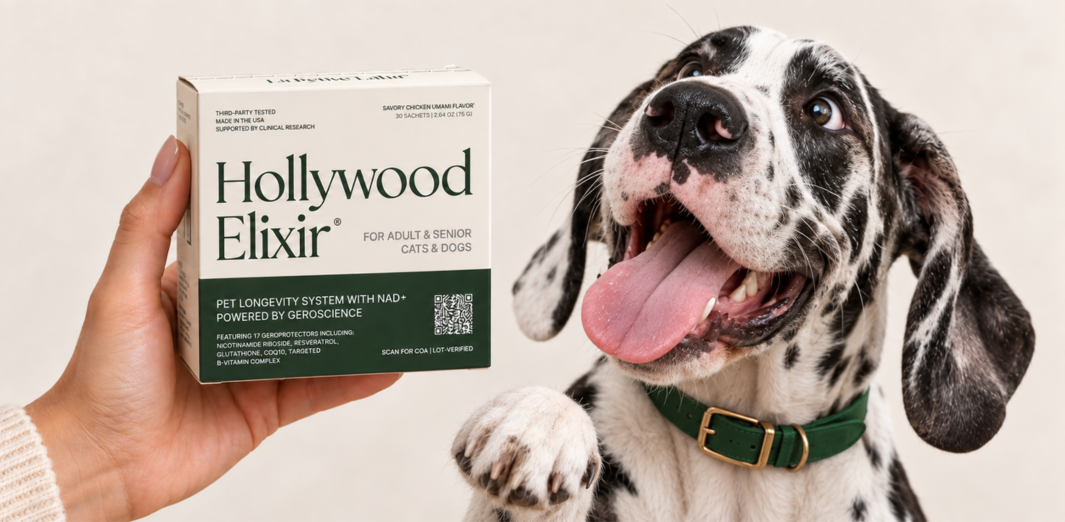
Dalmatian looking toward a Hollywood Elixir box held in a person's hand

Discover LPL-01: How This Fits Into a Larger Canine Longevity System

Aging in dogs is not driven by a single pathway. It’s the result of interacting biological systems—energy metabolism, oxidative stress, immune signaling, and structural integrity—changing over time.

This article explores one piece of that puzzle. If you want to understand how these pieces connect—and what actually moves the needle—you need to zoom out.

Start with the underlying science:

Keep exploring

What would you like to understand next?

Search practical guides about healthy aging, cellular energy, ingredients, and daily support for dogs.