The 12 Hallmarks of Aging in Dogs, Explained
Read full insightCellular Detox in Cats
By La Petite Labs Editorial 15 min read
“Cellular detoxification for cats” is not a weekend cleanse you can buy in a bottle. A cat’s real detox work is quiet and constant: the daily processing of normal metabolic byproducts, the management of oxidative stress, and the steady handoff between liver, kidneys, gut, and the cells themselves — with glutathione systems and bile flow doing much of the routine work.
Important caveat first: if your cat has actually eaten something toxic — a houseplant, chocolate, a chewed medication — that is an emergency, not a supplement situation (see below). For everyday wellness, this topic matters because cats live longer, spend years indoors, and can carry low-grade exposures over time; researchers have even found persistent organic pollutants in feline kidney tissue. None of that is cause for alarm. It’s why steady, sensible support — exposure reduction, hydration, and dietary consistency — is a rational, realistic choice rather than a dramatic detox cycle.
- Cellular detoxification is everyday maintenance — handled by glutathione and antioxidant systems, the liver, kidneys, and gut — not a one-time event.
- Emergency first: if your cat ate a toxic plant, chocolate, antifreeze, or a chewed medication, call your vet or animal poison control now — supplements have no role in acute poisoning.
- Long-term, low-grade exposures (food, dust, indoor air) can matter more than rare dramatic “toxins.”
- The credible approach pairs exposure reduction with hydration and dietary consistency, not megadosing.
- Cats are uniquely sensitive to some drugs and compounds, so support should be gentle and conservative.
- Quality signals: transparency, conservative claims, and vet-compatible positioning.
A Quiet Definition of Detox That Fits Real Feline Life
When people search for cellular detoxification for cats, they’re rarely imagining a dramatic “cleanse.” They’re usually noticing quieter signals: a coat that lost its shine, a cat that seems older than last season, a litter box pattern that feels slightly off, or a general sense that resilience has thinned. Cellular detoxification, in a practical sense, is the body’s ongoing work of processing everyday exposures and normal metabolic byproducts so tissues can keep doing their jobs.
Cats live close to the ground, groom meticulously, and spend years in the same indoor ecosystem. That makes “background load” matter: trace contaminants in food, dust, and household materials can accumulate over time. Researchers have documented persistent organic pollutants in feline kidneys, underscoring why long-horizon support is a reasonable, science-minded goal rather than a fad (Nomiyama, 2024).
The most credible approach isn’t about chasing a single ingredient. It’s about supporting the network that keeps cells steady: antioxidant balance, healthy energy metabolism, and the liver–kidney partnership that handles what the body wants to move along. That’s also why a system-level formula can still make sense even for owners who already feed thoughtfully—because aging biology is not a single-nutrient problem.
Why Cellular Housekeeping Matters More as Cats Age
Cellular detoxification is sometimes described as if the body has a single “filter” you can flush. In cats, it’s better understood as a set of overlapping processes: the liver’s transformation of compounds, the kidneys’ excretion role, the gut’s barrier function, and the cell’s own ability to manage oxidative byproducts and damaged components. When these systems are supported, cats tend to handle ordinary life with more stability.
This matters because cats can carry exposures for a long time. Research has found persistent organic pollutants in pet cats, including in kidney tissue, raising reasonable questions about cumulative load across a lifetime. Add in indoor air, dust, and dietary variability, and the case for gentle, ongoing support becomes less about trends and more about time.
The goal of the best cellular detoxification for cats is not to force detoxification, but to support the systems that already do it—especially as aging changes metabolism and recovery speed. That’s the context in which Hollywood Elixir is meant to be used.
Everyday Exposures: Food, Dust, and the Indoor Ecosystem

If your cat has just eaten something poisonous, skip the “detox” framing entirely and act fast: call your veterinarian or an animal poison control line immediately, and bring packaging or a photo of the plant or product. Chocolate, lilies and pothos, antifreeze, and chewed human medications can escalate quickly, and the right response is professional care — never a supplement.
For everyday wellness, owners often want to know what cats are actually “detoxing” from. The honest list is mundane: normal metabolic byproducts, oxidative stress from ordinary physiology, and trace exposures from food and environment. Some surveys have reported potentially toxic elements in certain dry cat diets, which is one reason ingredient sourcing and quality control matter (Bilgiç B, 2025). None of this means your cat is in constant danger — it means the body’s protective systems are always working, and supporting them is preventative care in the broad sense.
Liver, Kidneys, Gut: the Partnership Behind Cellular Balance
The liver and kidneys are the headline organs in detox conversations, but cellular detoxification is also about what happens inside tissues: managing reactive byproducts, maintaining membrane integrity, and keeping energy production steady. In chronic kidney disease, researchers have described associations with oxidative stress and mineral accumulation that can contribute to prooxidant burden (Alborough R, 2020). That’s one reason aging cats may benefit from broader support even when they appear “fine” day to day.
A supplement can’t replace organ function, and it shouldn’t pretend to. But it can be designed to support the metabolic environment in which those organs operate—helping the body maintain balance rather than swinging between extremes.
That is the rationale for Hollywood Elixir as a cellular detoxification product for cats: it’s about supporting the broader resilience system that aging gradually asks more from.
Feline Sensitivity: Why “Detox” Should Never Be Aggressive
Cats can be strikingly sensitive to medications and exposures, because species differences in metabolism and clearance change risk dramatically. Cisplatin, for example, causes significant toxicity in cats, including renal damage, and demands careful dosing in clinical settings (Knapp DW, 1987). Most owners will never encounter that drug, but it’s a useful reminder: “detox” is not a casual topic in feline health.
That’s why any support around cellular detoxification for cats should be gentle and conservative, working with normal physiology rather than trying to override it. If a label reads like a shortcut around biology — promising to “flush” or “purge” toxins on demand — treat it as a reason to step back, not lean in.
“The most credible detox plan is the one that looks like ordinary care: steady, gentle, and consistent.”
Cellular Steadiness: Supporting the Background Work of Health
Detoxification isn’t a single chemical reaction you can “boost.” The body relies on coordinated systems: antioxidant defenses led by glutathione, transport proteins, and cellular recycling that keep redox balance from drifting. Even heme biology intersects with these processes, and reviews note that modulating heme-related pathways can influence broader cellular handling of stressors (Immenschuh, 2017).
For owners, the takeaway is simple. Support that touches several parts of cellular steadiness at once is more sensible than anything trying to force a single outcome — especially in older cats, where the goal is durability, not intensity.
Home Choices That Lower the Load Without Drama
One of the most overlooked parts of “detox” is the home itself. Cats groom dust off their coats, inhale indoor air for years, and drink from the same sources. Over time, that can translate into real exposure. Findings of persistent organic pollutants in pet cats, including kidney accumulation, reinforce the value of reducing household chemical burden where possible.
Small choices add up: unscented litter, careful use of essential oils (many are not cat-friendly), and avoiding aerosolized cleaners in enclosed spaces. These are not “detox hacks.” They’re simply ways to lower what the body has to process.
In that cleaner baseline, cellular detoxification supplements for cats can play a supportive role. Hollywood Elixir is best used as part of this quieter, long-term strategy.
Supplement Balance: When More of a Good Thing Isn’t Better
Owners sometimes assume that if a nutrient supports detoxification, more of it must be better. Cats don’t always reward that logic. Research suggests that diets with excess cystine can alter immune-related parameters in cats (Schuller-Levis GB, 1991). The broader lesson is not that cystine is “bad,” but that balance matters—and that piling on single nutrients can have unintended effects.
The best cellular detoxification supplements for cats tend to avoid the extremes: not underpowered, not megadosed, and not built around one hero ingredient. They aim to support the whole metabolic environment that helps cells stay resilient.
Hollywood Elixir is designed to sit comfortably in that balanced category—supporting healthy aging and cellular steadiness without turning supplementation into a chemistry experiment.
What “Best” Means When You’re Choosing for Your Cat
If you’re looking for the best cellular detoxification support for cats, define what “best” means for your household first. For some cats it’s digestive comfort and routine; for others it’s steadier energy and coat quality as the years add up; for many it’s simply doing something thoughtful that aligns with what we know about cumulative exposure and aging.
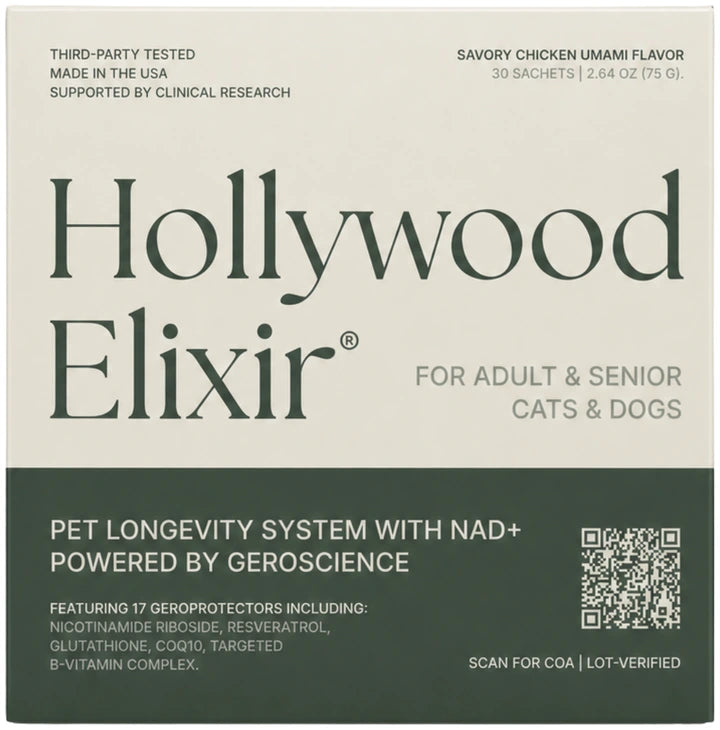
A useful filter is to prioritize support for resilience over promises of purification. Cats can accumulate prooxidant minerals in chronic kidney disease, contributing to oxidative stress, and that slow-burn biology is better met with steady antioxidant support than aggressive cycles. If you want a daily option, Hollywood Elixir is a food-mixed longevity formula built around exactly that lane — its antioxidant complex includes glutathione at a disclosed 50 mg per serving, the same molecule central to the body’s own detox systems — meant to support cellular steadiness in graceful aging, not to neutralize specific toxins.
Choosing Products with Restraint, Transparency, and Long-term Fit
If you’re comparing cellular detoxification products for cats, look past the loudest promises and focus on signals of seriousness: transparent labeling, sensible serving guidance, and a formulation that supports more than one bottleneck. “Detox” is often marketed as a one-lane road; in reality, cellular housekeeping depends on hydration status, protein tolerance, micronutrient sufficiency, and oxidative balance working together.
Also consider what the product does not do. A responsible cellular detoxification supplement for cats should not position itself as a substitute for veterinary care, nor should it imply it can neutralize specific toxins on demand. Cats can be uniquely sensitive to certain drugs and exposures; for example, cisplatin is notably toxic in cats and requires extreme caution in clinical contexts (Knapp DW, 1987). That reality should make any “miracle detox” language feel immediately out of place.
The best cellular detoxification supplements for cats tend to be the ones that respect biology’s pace: steady, daily support that complements good food, clean water, and a low-stress home. That’s the frame Hollywood Elixir is designed to fit—supporting the broader aging and resilience network rather than chasing a single, brittle claim.
“In cats, support should never feel like forcing. Resilience is the goal.”
DVM Voice: Clinical Vignette of a Common Pattern in Senior Cat Aging
Case provided by JoAnna Pendergrass, DVM
Sasha, a 12-year-old cat, was brought in after her owner noticed increased thirst and urination, lethargy, vomiting, and a generally unkempt appearance. Examination showed weight loss, elevated blood pressure, and reduced vitality.
Diagnostic testing revealed elevated kidney markers, poorly concentrated urine, and protein loss in the urine — findings consistent with chronic kidney disease, one of the most common chronic conditions in senior cats.
Her care required a kidney-focused diet, blood pressure management, targeted supplementation, medication support, and regular monitoring — a necessary plan, but one started after clinical signs were already visible.
Clinical takeaway: Sasha’s case reflects why senior-cat wellness should begin before obvious decline. Earlier monitoring, body-condition tracking, hydration awareness, antioxidant support, and daily cellular resilience may help support quality of life as cats age.
Single-case vignette. Not generalizable. Veterinary diagnosis and monitoring are essential for increased thirst, urination, vomiting, lethargy, weight loss, or suspected kidney disease.
Kidney-sensitive Cats: Support Without Pushing the System
A common worry is whether “detox support” is appropriate for cats with kidney concerns. The honest answer is that it depends on the cat, the formula, and the goal. Chronic kidney disease in cats is associated with oxidative stress and shifts in mineral handling, including accumulation of prooxidant elements (Alborough R, 2020). That doesn’t mean supplements are automatically helpful or harmful—it means the margin for error can be narrower.
For these cats, the most responsible version of natural cellular detoxification for cats is conservative: prioritize hydration, avoid abrupt diet changes, and ask your veterinarian to review any new product alongside current labs and medications. The aim is to support comfort and metabolic steadiness, not to “push” detoxification.
Owners often choose Hollywood Elixir in this context because it’s positioned as system support—helping the body maintain resilience over time—rather than as a harsh, single-pathway cleanser. That distinction matters most when kidneys are already doing careful work.
Diet, Trace Elements, and Why Balance Beats Megadosing
Diet is part of the cellular detoxification conversation, but it’s not the whole story. Even well-formulated foods can vary in trace element content, and some surveys have identified potentially toxic elements in certain dry cat diets (Bilgiç B, 2025). This is not a reason to panic; it’s a reminder that “background exposure” is real, and that long-term support can be rational even in a conscientious household.
At the same time, more is not always better. Over-supplementing individual amino acids or antioxidants can create its own imbalances. For instance, excess cystine intake has been shown to alter aspects of the feline immune system (Schuller-Levis GB, 1991). That’s why the best cellular detoxification for cats is rarely a single mega-dose idea—it’s a balanced, whole-cat approach.
Hollywood Elixir is best understood in that middle lane: not a replacement for a complete diet, and not a high-risk “stack,” but a way to support the broader metabolic network that helps cats stay steady as they age.
What Improvement Looks Like When It’s Real and Sustainable
Owners often ask what “cellular detoxification” looks like when it’s working. In real life, it’s subtle: a cat that maintains appetite consistency, recovers from minor stressors more smoothly, and keeps a more even energy rhythm. You’re not looking for a dramatic purge; you’re looking for fewer small derailments.
Because the concept is broad, it helps to anchor it to a few observable domains: coat and skin quality, stool regularity, hydration habits, and overall demeanor. If you change more than one variable at a time—new food, new litter, new supplement—you lose the ability to interpret what helped.
Effective cellular detoxification for cats is usually the result of accumulated small advantages: stable routines, low household chemical burden, and a supplement that supports resilience without overreaching. Hollywood Elixir is intended to be one of those quiet advantages—supporting healthy aging in a way that fits daily life.
Safety First: When to Pause, Monitor, or Ask Your Vet
Safety is where “detox” conversations should become more adult. Cats are not small dogs, and they can respond differently to compounds that seem benign in other species. Any cellular detoxification supplement for cats should be introduced thoughtfully, with attention to appetite, stool, and behavior changes—especially in seniors or cats with known medical conditions.
If your cat is undergoing cancer treatment or has a complex medication plan, do not assume a supplement is automatically compatible. Some drugs have narrow safety margins in cats; cisplatin, for example, is associated with significant toxicity and renal damage in this species (Knapp DW, 1987). While that’s a specific chemotherapy agent, it illustrates the broader point: feline physiology deserves respect, and your veterinarian should be part of the decision.
Hollywood Elixir is positioned as supportive care for the everyday—helping maintain cellular resilience over time—rather than as an aggressive intervention. That framing is often the safest place to start.
A Practical Framework for the Best Cellular Support Choices
If you’re trying to choose the best cellular detoxification for cats, it can help to separate three categories: exposure reduction, foundational health, and targeted support. Exposure reduction is unglamorous but powerful: ventilation, fragrance-free cleaning, careful pest control choices, and minimizing dust. Foundational health is the daily baseline: hydration, appropriate calories, and a diet your cat truly tolerates.
Targeted support is where supplements live, and where marketing can get noisy. The most defensible goal is not “removing toxins” as a one-time event, but supporting the body’s ongoing processing capacity. Persistent organic pollutants have been identified in cats, including in kidney tissue, which supports the idea that long-term, low-grade exposures can matter (Nomiyama, 2024).
Hollywood Elixir fits best as that third layer: a consistent, system-level addition for owners who already do the basics and want a measured way to support healthy aging and cellular steadiness.
Why Whole-system Biology Matters More Than One Ingredient
Some of the most important “detox” work happens in the background of ordinary biology: managing oxidative byproducts, recycling cellular components, and keeping redox balance from drifting. Heme biology is one example of a system that intersects with detox-related functions, and scientific reviews note that modulating heme-related processes can influence broader cellular handling of stressors (Immenschuh, 2017). You don’t need to memorize the biochemistry to appreciate the implication: the body runs on interconnected loops.
That interconnection is why single-ingredient “detox hacks” often disappoint. A cat can have adequate intake of a nutrient on paper and still benefit from broader support if aging, stress, or chronic inflammation is raising demand across multiple systems at once.
Hollywood Elixir is designed for that reality: supporting the network that helps cells stay composed over time, rather than betting everything on one narrow lever.
Making It Work Daily: Consistency, Palatability, and Tracking
A practical way to evaluate cellular detoxification supplements for cats is to ask: does this fit my cat’s life? The best plan is the one you can do consistently without turning daily care into a negotiation. Palatability, ease of serving, and a predictable routine matter as much as the label’s ambitions.
Consistency also makes outcomes easier to interpret. If you’re tracking changes, choose two or three markers—coat softness, stool quality, energy rhythm—and give them time. Because oxidative stress and mineral handling can shift in chronic conditions like feline CKD (Alborough R, 2020), it’s especially important not to layer multiple new products at once in medically complex cats.
Hollywood Elixir is typically chosen by owners who want a steady, low-drama addition: a daily ritual that supports healthy aging and the cellular systems that quietly keep a cat feeling like themselves.
The Long View: Stewardship, Aging, and Quiet Resilience
The most persuasive argument for cellular detoxification for cats is not fear; it’s stewardship. Cats are long-lived companions, and the exposures and metabolic wear of a decade add up. Studies documenting pollutant accumulation in feline tissues and the role of oxidative stress in chronic disease contexts support the idea that “cellular housekeeping” is not a marketing invention—it’s a real, ongoing biological need (Nomiyama, 2024).
A careful owner can hold two truths at once: you can’t supplement your way out of a poor environment, and you also don’t have to wait for a diagnosis to support resilience. The best cellular detoxification supplements for cats are the ones that respect that balance—supporting the whole network without making brittle promises.
Hollywood Elixir is for the owner who wants that quiet middle path: a premium, system-level approach to graceful aging that complements good nutrition, clean living, and veterinary care.
“A premium supplement earns relevance by supporting the whole network, not one isolated ingredient.”
Educational content only. This material is not a substitute for veterinary advice. Always consult your veterinarian about your dog’s specific needs. These statements have not been evaluated by the Food and Drug Administration. Products mentioned are not intended to diagnose, treat, cure, or prevent any disease.
Glossary
- Cellular Detoxification: The continuous cellular and organ-level processes that transform, neutralize, and eliminate normal metabolic byproducts and everyday exposures.
- Oxidative Stress: An imbalance where reactive molecules outpace antioxidant defenses, potentially affecting tissues over time.
- Antioxidant Defenses: The body’s protective compounds and enzymes that help keep oxidative byproducts in check.
- Biotransformation: The liver’s process of converting compounds into forms that are easier to excrete.
- Renal Clearance: The kidneys’ role in removing waste products and certain compounds through urine.
- Cumulative Exposure: The total burden of low-level exposures (food, dust, water, household chemicals) that can add up across years.
- Persistent Organic Pollutants (POPs): Long-lasting environmental chemicals that can accumulate in tissues over time.
- Trace Elements: Minerals present in small amounts; some are essential, while others may be undesirable depending on type and dose.
- System-Level Support: A supplement strategy that supports multiple connected functions (resilience, oxidative balance, energy metabolism) rather than targeting a single nutrient.
Related Reading
Aging & Senior Cat Guidance
• Cat Age Calculator: Cat Years to Human Years
• Lethargy in Cats
• Senior Cat Not Eating
• Cat Drinking A Lot
• Why Is My Senior Cat Withdrawn?
Healthy Aging Support
• NAD+ for Cats
• NMN for Cats
• Vitamins For Older Cats
• Senior Cat Food
References
Knapp DW. Cisplatin toxicity in cats. PubMed. 1987. https://pubmed.ncbi.nlm.nih.gov/3506619/
Alborough R. Renal accumulation of prooxidant mineral elements and CKD in domestic cats. PubMed. 2020. https://pubmed.ncbi.nlm.nih.gov/32081923/
Schuller-Levis GB. Alterations in the immune system in cats fed diets with excess cystine. PubMed. 1991. https://pubmed.ncbi.nlm.nih.gov/1990239/
Immenschuh. Heme as a Target for Therapeutic Interventions. Nature. 2017. https://www.nature.com/articles/s41598-021-87421-6
Nomiyama. Accumulation of persistent organic pollutants in the kidneys of pet cats (Felis silvestris catus) and the potential implications for their health. 2024. https://www.sciencedirect.com/science/article/abs/pii/S004896972403359X
Bilgiç B. The Values of Potentially Toxic Elements (PTEs) in Prescription and Non-prescription Dry Cat and Dog Diets in Turkey. PubMed. 2025. https://pubmed.ncbi.nlm.nih.gov/40442459/
Summers S. Evaluation of iron, copper and zinc concentrations in commercial foods formulated for healthy cats. PubMed Central. 2022. https://pmc.ncbi.nlm.nih.gov/articles/PMC10812249/
Bilgiç B. Investigation of Trace and Macro Element Contents in Commercial Cat Foods. PubMed Central. 2025. https://pmc.ncbi.nlm.nih.gov/articles/PMC11633335/
Ahmed. Bioaccumulation of heavy metals in some commercially important fishes from a tropical river estuary suggests higher potential health risk in children than adults. Nature. 2019. https://www.nature.com/articles/s41598-021-00467-4
FAQ
What does cellular detoxification mean for cats day to day?
In daily life, cellular detoxification for cats refers to the body’s ongoing work of processing normal metabolic byproducts and routine environmental exposures. It’s less about a dramatic cleanse and more about steady cellular housekeeping that supports comfort, appetite consistency, and resilience. A measured supplement can support that broader system without overpromising.
Why do owners focus on cellular detoxification for cats now?
Because cats live long lives in relatively fixed indoor environments, small exposures can add up. Researchers have documented persistent organic pollutants accumulating in pet cats’ kidneys, which supports the idea that long-horizon support is reasonable rather than trendy. Owners who already feed well often still want system-level support for aging resilience.
How is cellular detoxification for cats different from a cleanse?
A “cleanse” implies a short, intense push. Cellular detoxification for cats is the opposite: continuous, balanced processing through the liver, kidneys, gut, and cellular antioxidant systems. The goal is steadiness, not a purge. If you’re choosing support, look for conservative claims and a whole-system frame.
What makes a cellular detoxification supplement for cats feel credible?
Credible products avoid miracle language, provide clear serving directions, and emphasize support rather than “removing toxins.” They also acknowledge feline sensitivity and encourage veterinary review for cats with medical conditions or complex medication plans. A system-level formula that fits daily life is often the most realistic choice, which is why owners consider a disclosed aging-support formula for ongoing support.
Is cellular detoxification for cats safe for seniors?
Senior cats can benefit from gentle, consistent support, but they also have less tolerance for abrupt changes. Introduce any new supplement slowly, monitor appetite and stool, and involve your veterinarian if your cat has kidney, liver, or thyroid concerns.
When should I avoid detox supplements and call my veterinarian?
Skip new supplements and contact your veterinarian if your cat has persistent vomiting, marked lethargy, sudden appetite loss, yellowing of gums/eyes, or suspected toxin exposure. Also pause if your cat is on complex medications or undergoing cancer therapy, where safety margins can be narrow.
How long does it take to notice results from detox support?
With cellular support, timelines are usually measured in weeks, not days. Owners often watch for subtle shifts: steadier appetite, coat softness, and more even energy. Because these are gradual domains, consistency matters more than intensity.
Can cats detox naturally without supplements at all?
Yes. Cats have built-in detoxification capacity through the liver, kidneys, gut, and cellular antioxidant systems. “Natural cellular detoxification for cats” starts with hydration, a well-tolerated diet, and reducing household chemical burden. Supplements are best viewed as optional support for aging resilience, not as a replacement for basics.
Do cellular detoxification supplements for cats affect the kidneys?
They can, depending on ingredients and the cat’s health status. Cats with kidney concerns may have higher oxidative stress and altered mineral handling, so conservative choices and veterinary oversight are important. The goal should be support, not forcing elimination.
What side effects should I watch for with detox supplements?
The most common early signals are digestive: softer stool, gas, or reduced appetite. Behavior changes—hiding, restlessness, or unusual lethargy—also matter. If any sign is persistent or severe, stop the supplement and consult your veterinarian.
Can detox supplements interact with medications my cat takes?
Potentially, yes. Any supplement can alter absorption, appetite, or metabolism in ways that matter for prescription drugs. This is especially important in cats with complex treatment plans, where feline-specific toxicity concerns can be significant. Always ask your veterinarian to review the full list of products.
Are cats exposed to toxins through food and indoor dust?
They can be. Cats groom dust from their coats and eat the same foods for long periods, which can make low-grade exposure more relevant. Studies have identified persistent organic pollutants in pet cats, including kidney accumulation. Food surveys have also reported potentially toxic elements in some dry diets(Bilgiç B, 2025).
What does best cellular detoxification for cats usually include?
The best cellular detoxification for cats usually starts with basics: hydration, a consistent diet your cat tolerates, and a low-fragrance, low-chemical home. Supplement-wise, “best” often means balanced support for oxidative stress and cellular resilience rather than a single-ingredient megadose.
Is there a difference between cats and dogs for detox support?
Yes. Cats have distinct metabolic handling for certain compounds and can be more sensitive to some exposures and medications. That’s why cat-specific formulations and conservative serving guidance matter, and why “just use the dog version” is rarely a good idea.
How should I introduce a new detox supplement to my cat?
Introduce one change at a time and start slowly so you can spot sensitivity. Keep meals and treats consistent for the first couple of weeks, and monitor stool, appetite, and behavior. If your cat has a medical condition, ask your veterinarian before starting.
Can I use cellular detoxification support daily long term?
Daily use is often the most logical way to think about cellular support, because the underlying work is continuous. The key is choosing a product intended for long-term steadiness, and checking in with your veterinarian if your cat’s health status changes.
What quality signals matter when comparing detox products for cats?
Look for transparent ingredient lists, realistic claims, and serving guidance that doesn’t read like a dare. Avoid products that promise to “flush toxins” quickly or that rely on proprietary blends without clarity. For medically complex cats, vet compatibility is a quality signal too.
Does cellular detoxification for cats relate to oxidative stress?
Yes. A large part of cellular housekeeping involves managing oxidative byproducts created by normal metabolism. In cats with chronic kidney disease, oxidative stress has been linked with mineral accumulation that may contribute to prooxidant burden. Supporting oxidative balance is one reason “detox” is better framed as resilience support.
Can too many amino acids or antioxidants backfire in cats?
They can. More is not always better, especially with single-nutrient megadoses. For example, diets with excess cystine have been associated with alterations in the immune system of cats(Schuller-Levis GB, 1991). The safer pattern is balanced, moderate support that respects feline physiology.
What research exists on pollutants accumulating in cats over time?
Studies have reported that pet cats can accumulate persistent organic pollutants in their kidneys, which raises reasonable concerns about long-term health implications and cumulative exposure. This doesn’t mean every cat is “toxic,” but it supports the logic of steady, low-risk resilience support.
Discover LPL-01: How This Fits Into a Larger Feline Longevity System
Aging in cats unfolds quietly. It’s not driven by a single failure, but by gradual shifts across interconnected systems — cellular energy, oxidative balance, immune tone, and tissue integrity — each influencing the others over time.
This article explores one layer of that system. To understand what actually shapes long-term health, you need to step back and look at how these layers interact.
Start with the underlying science:
- Feline Geroscience Framework →
A structured view of how aging progresses across cellular energy, inflammation, and resilience systems. - Senior Biological Defense Coverage (BDC) Modeling →
A systems-level map of which biological pathways decline first, and how layered interventions can support them. - 2026 Market Research: Best Cat Longevity Supplements →
A feline-specific review of longevity supplements. 2026 Industry report created by LPL-01 Research. - LPL-01 Standard →
The formulation system that translates these models into real-world supplementation—covering multiple pathways in a coordinated way.
Essential Summary
Why is cellular detoxification for cats important?
Cellular detoxification for cats is less about dramatic cleansing and more about supporting the body’s everyday ability to handle normal metabolic byproducts and long-term environmental exposures. A thoughtful plan pairs exposure reduction, hydration, and a balanced diet with system-level support that respects feline sensitivity and aging physiology.
Hollywood Elixir is a premium, system-level option for owners seeking steady support for cellular resilience, oxidative balance, and graceful aging—without the harsh logic of “cleanse” culture. It’s designed to complement good nutrition and veterinary care while supporting the broader network that helps cats stay vibrant over time.
Hollywood Elixir®
Starting at $89/mo
Hollywood Elixir is amazing! She put back on 5 lbs to a healthy weight, her eyes are shiny, her coat is beautiful!
— Jessie
She hopped up onto the windowsill again for the first time in years.
— Charlie
Considering cellular detoxification for cats?
If you're searching to understand cellular detoxification in cats
If you’re choosing a cellular detoxification supplement for cats, prioritize a product that supports the broader resilience system rather than promising a fast “cleanse.” Look for transparent labeling, conservative claims, and a formula that fits daily life—because consistency is what makes support meaningful. Also consider your cat’s age, sensitivities, and medical history, and involve your veterinarian when conditions or medications are in play. For owners seeking the best cellular detoxification for cats in a premium, measured format, Hollywood Elixir is designed to support healthy aging and cellular steadiness as part of a long-term routine.
Learn about how our DVMs think about cat aging
Dr. JoAnna Pendergrass DVM
Hollywood Elixir®
Starting at $89/mo
Explore your cat’s changing needs over time
Related Reading
Cellular detoxification for cats is an easy phrase to misunderstand. It can sound like a weekend reset, a dramatic cleanse, or a promise that a single product can erase years of exposure.