5 Coat Warning Signs of Illness in Dogs & Cats
Read full insightSkin Barrier Restoration for Cats
By La Petite Labs Editorial 15 min read
If your cat's coat has turned itchy, dry, or fragile, skin barrier restoration means helping that protective "seal" work again. The barrier is a real structure: the stratum corneum, sealed by a lipid layer rich in ceramides, backed by a balanced surface microbiome. When those parts work together, skin holds hydration, blocks irritants, and stays calmer and less reactive, which shows up as softness, even sheen, and less flaking.
This hub explains what the feline skin barrier is, what restoration actually means, and why barrier strain surfaces as itch, dandruff, overgrooming, or excess shedding. It also points you to focused resources depending on what you're seeing: hydration support, itch patterns, allergy flares, hair loss, the role of fatty acids, and grooming habits that either help or stress the barrier. If you want a clear, owner-friendly overview before the next step, you're in the right place.
- Restoration shows up in visible signals: softer feel, even sheen, and less flaking on dark fabrics.
- A stressed barrier reads as rough texture, persistent dandruff, redness, and grooming that looks frantic rather than tidy.
- Nutrition is structural: feline skin relies on dietary building blocks, and amino acids are crucial for barrier integrity (Sun M, 2024).
- Targeted diets can improve skin signs in some cats, confirming the surface responds to what goes in (Mazzeranghi F, 2017).
- Topicals help small areas, but cats lick; choose cat-appropriate formulas and skip heavy fragrances.
- Intense or sudden symptoms mean a vet first; supportive care then maintains the well-kept finish.
What the Cat Skin Barrier Is (and What “Restoration” Actually Means)
The cat skin barrier is often described as a “brick-and-mortar” system. The “bricks” are flattened skin cells in the stratum corneum, and the “mortar” is the lipid matrix between them. That matrix is largely made from a trio of ceramides, cholesterol, and free fatty acids, arranged in layers that slow water loss and reduce penetration by irritants.
A key concept here is transepidermal water loss (TEWL): the passive escape of water through the skin. When the barrier is intact, TEWL stays relatively controlled. When the lipid matrix is disrupted—by dryness, inflammation, frequent licking, or environmental stress—TEWL can rise. The result is a surface that dehydrates more easily and becomes more permeable.
“Restoration” doesn’t mean changing your cat’s skin overnight or chasing a single fix. It means supporting the conditions that allow the stratum corneum and lipid matrix to re-stabilize, so micro-cracks are less likely to form and irritants have fewer entry points. Cats have their own twist on barrier biology: dense hair coverage and frequent self-grooming can both protect the surface and, when excessive, mechanically stress it—one reason barrier topics often overlap with itch, hydration, hair loss, fatty-acid discussions, and grooming guidance.
Barrier Stress: The 6 Most Common Owner-Visible Clues (and What They Suggest)
Barrier stress can look different from cat to cat, and multiple clues often appear together. These signs don’t diagnose a cause on their own, but they can suggest the barrier isn’t regulating moisture, oils, and microbial balance as well as it should.
1) Flakes/dandruff: Often points to a drier stratum corneum or faster-than-normal shedding of surface cells.
2) Greasy coat or waxy feel: Can suggest oil imbalance, buildup on the skin surface, or changes in how the microbiome is behaving.
3) Odor: A stronger “skin smell” may indicate microbial imbalance on the surface, especially when paired with redness or greasy texture.
4) Redness: Can reflect irritation and inflammation that commonly accompany increased permeability and higher TEWL.
5) Scabs or crusts: May occur when the surface is easily injured, scratched, or inflamed; they can also follow self-trauma from licking.
6) Overgrooming: Persistent licking or chewing can be both a response to discomfort and a driver of further barrier disruption.
Because these clues overlap, it’s important to consider the whole picture. Call a vet promptly if you see open sores, spreading redness, significant odor with discharge, lethargy, appetite changes, or rapid worsening—those can signal infection, pain, or a condition that needs medical treatment.
What the Skin Barrier Does for Shine, Softness, and Comfort
The skin barrier is often described as “bricks and mortar,” but for owners it’s simpler: it’s the difference between a coat that feels plush and one that feels brittle. When the barrier is balanced, the coat tends to lie flatter, grooming looks calmer, and the skin doesn’t broadcast irritation through constant scratching. When it’s off, you may see uneven texture, patchy shine, or a persistent “dry” look even after brushing.
Cats rely on specific nutritional building blocks to maintain skin integrity; amino acids are highlighted as crucial for barrier function in felids, and deficiencies can compromise that function (Sun M, 2024). This is one reason a “best skin barrier restoration for cats” approach usually includes both diet quality and targeted support—because the skin is continuously renewing and constantly on display.
If you’re comparing skin barrier restoration products for cats, prioritize options that fit daily life: easy to give, consistent, and designed to support the full skin-coat-nail presentation rather than chasing one symptom at a time.
Everyday Triggers That Can Dull the Coat’s Fresh Finish
Common triggers for a “tired-looking” barrier are surprisingly ordinary: heated indoor air, frequent wiping of paws, over-bathing, harsh shampoos, and seasonal shedding that leaves the coat in transition. Even stress grooming can change how the coat sits, making the skin look more exposed. None of this is a moral failing in care—it’s just the reality of living with a fastidious animal in a human home.
When food sensitivity is part of the picture, the skin can be especially reactive. A study on cats with cutaneous adverse food reactions found that a nutraceutical diet improved clinical signs, supporting the idea that dietary choices can influence barrier-related presentation (Mazzeranghi F, 2017). The takeaway for owners is practical: if the coat looks persistently rough despite good grooming, nutrition is a reasonable place to look—alongside parasite control and veterinary evaluation.
A skin barrier restoration supplement for cats can be a steady “baseline” when life is variable—travel, dry winters, or multi-cat homes where grooming and stress patterns shift.
Topicals and Licking: Choosing Cat-appropriate Surface Care
Topical care can be useful, but cats are not small dogs with different packaging. They lick. They groom. They sample whatever you apply. That makes ingredient selection and formulation quality especially important when considering a skin barrier restoration cream for cats. Products designed for humans may contain fragrances, essential oils, or preservatives that are simply not a good match for feline habits.
Even in veterinary pharmacotherapy, excipients (the “inactive” ingredients) can influence safety and overall performance, which is why careful evaluation and regulatory considerations matter (Thomazini VC, 2024). For owners, this translates into a simple rule: choose cat-appropriate formulations, use the smallest effective amount, and avoid applying anything to areas your cat will immediately lick unless your veterinarian has approved it.
Topicals can polish the surface, but the most reliable visible change often comes from pairing gentle external care with internal support—one reason skin barrier restoration supplements for cats remain a popular, low-fuss foundation.
“A restored barrier shows up as a coat that lies flatter, feels softer, and looks evenly cared-for.”
When Skin Problems Need Veterinary Care, Not Just Support
If your cat’s skin looks unsettled, it’s tempting to jump straight to “stronger” solutions. In veterinary dermatology, medications like cyclosporine may be used for certain skin disorders, but they are prescription-only and require veterinary oversight (Robson D, 2003). This is not the lane for DIY experimentation, especially because cats can experience adverse reactions such as gastrointestinal upset and potential changes in renal function (Robson D, 2003).
For everyday visible care—softness, reduced flaking, a coat that looks freshly groomed—most owners are looking for supportive options that fit routine life. That’s where “best skin barrier restoration supplement for cats” comparisons tend to land: palatability, consistency, and a formula designed for the whole integument (skin, coat, nails) rather than a single dramatic promise.
If signs are intense, sudden, or paired with hair loss, sores, or ear issues, treat that as a veterinary conversation first—then use supportive products to maintain the polished look once the underlying cause is addressed.
How to Evaluate Skin Barrier Restoration Products for Cats
The best skin barrier product for a cat usually isn't the loudest label; it's the one that quietly fits your cat's reality. Look for clear feline labeling, transparent ingredient intent, and a format your cat will accept without turning daily care into a negotiation.
Because cats groom so thoroughly, formulation matters. Excipients can affect safety and performance in veterinary products, which is why "inactive" doesn't mean irrelevant (Thomazini VC, 2024). For supplements, prioritize reputable manufacturing, consistent dosing, and whole-coat positioning that supports shine, softness, and comfortable skin rather than implying it replaces medical care. The practical test: will I actually give this daily, and will my cat accept it? Consistency is what turns support into a visible payoff.
What a Realistic Results Timeline Looks Like at Home
Timeline matters because owners are watching for reassurance. With supportive care, the earliest visible signals are often tactile: the coat feels less “static,” brushing pulls through more smoothly, and the skin looks less dusty along the spine. More noticeable shine typically follows as the coat cycle catches up with improved daily support.
If food sensitivity is contributing, dietary interventions have been associated with improvement in clinical skin signs in affected cats (Mazzeranghi F, 2017). That doesn’t guarantee a fast change for every cat, but it supports a realistic expectation: when the inputs improve, the surface often follows. Take photos in the same lighting once a week; subtle improvements are easier to trust when you can see them side by side.
If nothing looks better after several weeks of consistent care—or if things worsen—treat that as a signal to reassess triggers with your veterinarian rather than stacking more products.
Grooming as a Ritual: Brushing That Supports a Well-kept Look
Grooming is where barrier care becomes a relationship, not a regimen. A few minutes of calm brushing can distribute natural oils, lift loose coat, and reduce the “flake halo” that shows up on dark fabrics. It also helps you notice early changes—tiny scabs, new dandruff, or areas your cat avoids being touched.
Be cautious with frequent bathing unless your veterinarian recommends it. Cats generally maintain their coats well, and over-washing can strip the very surface feel you’re trying to restore. If you use wipes, choose cat-specific options and avoid heavily scented formulas, since cats live close to their own skin and will groom what you leave behind.
Pairing gentle grooming with a skin barrier restoration supplement for cats can make the visible results more consistent—less about “fixing” and more about maintaining that freshly cared-for look.
Nutrition as the Foundation for Consistent Skin and Coat Presentation
Nutrition isn't background to the skin barrier; it's part of what the barrier is made of. Amino acids are described as crucial for maintaining skin barrier integrity in cats, and deficiencies can compromise that function (Sun M, 2024). Even on a good commercial diet, real life adds variability: picky eating, multi-cat competition, stress, or a cat that just doesn't finish meals consistently.
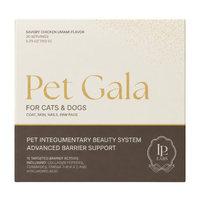
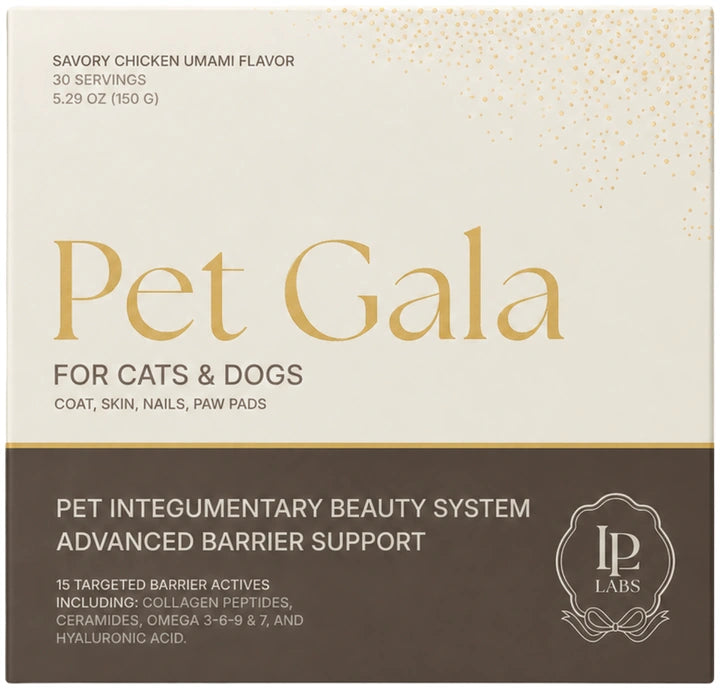
This is where a daily barrier formula fits as a visible-condition tool, not a deficiency fix. Pet Gala™ is built for exactly this lane, with marine collagen peptides at 500 mg, ceramides at 8 mg, and hyaluronic acid at 50 mg per sachet, plus zinc and omega lipids for keratin, hydration, and a smoother coat. The aim isn't to replace complete nutrition; it's to support how wellbeing shows up: a smoother coat, calmer-looking skin, and less brittle nails. Consistent intake is what makes those ingredients visible. Explore Pet Gala™ →
“In cats, what you apply must be safe for what they will inevitably lick.”
DVM Voice: Clinical Vignette of When Skin Changes Point Deeper Than the Surface
Case provided by Sarah Calvin, DVM
Maverick, a 4-year-old Siamese cat, was brought in for hair loss across his lower abdomen and red, flaky skin lesions that had progressed over the previous month. His owners were unsure whether he was itchy or overgrooming.
Examination showed broken hairs, abdominal alopecia, and lesions consistent with bacterial skin infection. Further testing ruled out fleas, FeLV/FIV, and common fungal causes. Because his grooming pattern suggested deeper discomfort, his veterinarian continued the workup.
Radiographs and urinalysis revealed bladder stones, crystalluria, and blood in the urine. Maverick’s overgrooming was linked to urinary pain — a case where skin changes were secondary to an internal problem.
His care required a staged plan: stabilizing the skin infection, surgically removing the bladder stones, managing pain, transitioning to a therapeutic diet, and supporting skin-barrier recovery with appropriate nutrition and fish oil.
Hair regrowth began by 8 weeks. By 6 months, his coat had fully recovered, with no recurrence after the urinary issue was resolved.
Clinical takeaway: Maverick’s case shows why feline coat loss and overgrooming deserve careful veterinary investigation. Skin and coat health can reflect pain, stress, nutrition, infection, barrier weakness, or internal disease — not just surface-level grooming behavior.
Single-case vignette. Not generalizable. Veterinary diagnosis and oversight are essential for overgrooming, hair loss, skin lesions, urinary signs, pain, or suspected infection.
Cream Versus Supplement: Matching the Tool to the Visible Goal
Owners often ask whether they need a topical, a supplement, or both. The honest answer: it depends on what you’re trying to see. A skin barrier restoration cream for cats can be helpful for small, localized areas that look dry or feel rough—especially when your veterinarian has ruled out infection or parasites. But creams are limited by licking and by how evenly they can be applied through fur.
Internal support tends to be more uniform. Dietary approaches have been associated with improvement in clinical signs in cats with food-related skin issues, suggesting the surface can respond to targeted inputs. Many owners find the best results come from a simple pairing: gentle grooming plus a consistent supplement, with topical use reserved for specific spots and short windows.
If you’re building a small “skin wardrobe,” keep it minimal: one reliable internal option and one cat-appropriate topical, used thoughtfully.
Safety and Tolerance: Keeping Support Gentle and Predictable
Safety is part of good aesthetics. A product that irritates, upsets the stomach, or triggers aversion doesn’t support a polished look—it disrupts it. Prescription medications used for certain feline skin disorders can have side effects and require veterinary monitoring; cyclosporine, for example, is associated with adverse reactions including gastrointestinal issues and potential renal changes in cats (Robson D, 2003).
For over-the-counter skin barrier restoration products for cats, the safety conversation is often about ingredients and formulation quality. Excipients can influence safety and efficacy in veterinary products, which is why “inactive” doesn’t mean “irrelevant” (Thomazini VC, 2024). Choose cat-specific products, avoid strong fragrances, and introduce any new supplement gradually so you can spot intolerance early.
If your cat has chronic disease, is on medication, or has a history of sensitivity, ask your veterinarian before adding new products—even supportive ones.
Allergies, Sensitivities, and the Role of Medical Management
When skin looks inflamed, it’s easy to assume the answer is always topical. But many cats with recurring skin issues are dealing with a broader sensitivity picture—food, fleas, environment, or a combination. In more severe hypersensitivity dermatitis, ciclosporin has been evaluated for effectiveness in reducing symptoms, reflecting that immune-driven skin problems can require medical management (Roberts ES, 2016).
Supportive care still matters alongside veterinary treatment because owners live with the day-to-day presentation. Once the big drivers are addressed, the “finish” becomes the focus: softness, reduced flaking, and a coat that looks even. That’s where the best skin barrier restoration for cats is often a combination of veterinary clarity and owner-consistent maintenance.
If your cat’s skin changes quickly, develops sores, or your cat seems uncomfortable, prioritize a vet visit—then use supportive products to maintain the visible gains.
Life Stage Considerations for Maintaining a Fresh, Cared-for Coat
Kittens, adults, and seniors can all benefit from thoughtful barrier care, but the “why” looks different. Kittens may have sensitive skin and frequent handling; adults may face seasonal shedding and indoor dryness; seniors may groom less thoroughly, leaving the coat looking unkempt even when health is stable. The goal stays the same: a comfortable, well-kept appearance that matches how you want your cat to feel at home.
Because amino acids are important for feline skin barrier integrity, consistent intake of quality nutrition is foundational. Supportive supplements can be a practical add-on when appetite is inconsistent or when you want a steadier “shine and softness” signal through life-stage transitions. For seniors on medications, confirm compatibility with your veterinarian before adding anything new.
Choose formats that match the cat in front of you: easy-to-administer, low-stress, and designed for daily consistency.
When “Dry Skin” Isn’t Simple: Sorting Look-alike Causes
Not all “dry skin” is the same. Flakes can come from low humidity, over-grooming, parasites, infection, or allergy. The visual overlap is why skin barrier restoration for cats should be framed as supportive care, not a diagnosis. If you see hair loss, open sores, ear debris, or a sudden change in behavior, treat that as a medical question first.
For cats with hypersensitivity dermatitis, ciclosporin has been shown to reduce symptoms in clinical evaluation, underscoring that some cases need prescription therapy rather than cosmetic-only approaches (Roberts ES, 2016). Once the underlying issue is controlled, supportive products can help maintain the visible calm: fewer flakes, smoother coat lay, and less “touch sensitivity” during petting.
A good decision framework is simple: rule out the big causes, then commit to a consistent, gentle routine that supports the look you want to keep.
Quality Signals That Separate the Best Options from the Noisy Ones
When you're shopping for [skin barrier restoration supplements for cats](https://lapetitelabs.com/pages/cat-skin-care-supplements), quality signals matter more than trendy claims. Look for clear labeling, realistic positioning (support, not cure), and a brand that treats formulation as part of safety, because excipients affect overall safety and efficacy even when they aren't glamorous.
Also weigh the human factors: will everyone in the household give it the same way, at the same time, without stress? The best options become invisible in the routine, your cat accepts them, and you keep going long enough to see the coat change. One more rule: don't stack several new products at once. Introduce one change, watch the coat and stool, then decide what's actually helping.
A Simple Maintenance Plan for Skin, Coat, and Nails Together
A polished coat is a visible summary of many small choices: parasite prevention, gentle grooming, steady nutrition, and low-drama routines. Skin barrier restoration products for cats work best when they’re part of that calm baseline, not a rotating cast of experiments. If you want a simple “signal check,” watch for three things: reduced flaking, smoother coat lay, and a more even sheen along the back and sides.
Because cats’ skin integrity depends on nutritional building blocks, including amino acids, it’s reasonable to support the barrier from the inside as well as the outside. This is also why a supplement can stay relevant even for owners feeding high-quality diets: it’s about consistent visible condition through everyday variability, not correcting a single deficiency.
When your cat looks comfortable and well-kept, it’s easier to trust your routine—and easier for your cat to enjoy the attention that comes with it.
Closing Thoughts on Keeping Your Cat Looking Comfortably Well-kept
Skin care for cats is ultimately about harmony: the coat you see, the comfort your cat shows, and the ease of the routine you can maintain. If you’re aiming for the best skin barrier restoration for cats, keep the approach balanced—rule out medical causes, avoid harsh topicals, and choose supportive options that your cat will accept daily.
When veterinary treatment is needed, follow that plan closely; medications used for feline skin disorders can be effective but require oversight and attention to side effects. For everyday maintenance, focus on consistent grooming and internal support that helps the skin-coat-nail system present well. That’s the difference between short-lived improvement and a look that stays fresh week after week.
“Consistency is the quiet advantage: the routine you can keep is the one that shows.”
Educational content only. This material is not a substitute for veterinary advice. Always consult your veterinarian about your dog’s specific needs. These statements have not been evaluated by the Food and Drug Administration. Products mentioned are not intended to diagnose, treat, cure, or prevent any disease.
Glossary
- Skin Barrier: The outer protective layer of skin that helps retain moisture and keep irritants out.
- Transepidermal Water Loss (TEWL): A measure of how much water escapes through the skin; higher TEWL often aligns with a “dry-looking” coat.
- Corneocytes: The flattened surface skin cells that form the visible “top layer” and influence smoothness.
- Sebum: Natural skin oils that contribute to coat sheen and a soft, conditioned feel.
- Dander: Tiny flakes of skin that can be visible on fur and fabrics; not the same as parasites.
- Over-Grooming: Excessive licking or chewing that can roughen coat texture and make skin look more exposed.
- Excipients: “Inactive” formulation ingredients (carriers, stabilizers, flavors) that can still affect tolerance and performance.
- Cutaneous Adverse Food Reaction: A food-related sensitivity that can show up as skin signs such as itching or coat changes.
- Hypersensitivity Dermatitis: An allergic-type skin condition that may require veterinary diagnosis and treatment.
Related Reading
Common Feline Integumentary Issues
• Cat Dandruff
• Why Is My Cat Shedding So Much
• Cat Hair Loss
Comfort & Recovery
• Skin & Coat Supplements for Cats
• Cat Nail Supplement
• Best Supplements for Cat Shedding
Ingredient-Level Articles
• Biotin for Cats
• Silica for Cats
• Hyaluronic Acid for Cats
• Ceramides for Cats
References
Sun M. Considerations on amino acid patterns in the natural felid diet: a review. PubMed Central. 2024. https://pmc.ncbi.nlm.nih.gov/articles/PMC11603590/
Mazzeranghi F. Clinical efficacy of nutraceutical diet for cats with clinical signs of cutaneus adverse food reaction (CAFR). PubMed. 2017. https://pubmed.ncbi.nlm.nih.gov/28865210/
Robson D. Review of the pharmacokinetics, interactions and adverse reactions of cyclosporine in people, dogs and cats. PubMed. 2003. https://pubmed.ncbi.nlm.nih.gov/12833934/
Thomazini VC. Impact of concerning excipients on animal safety: insights for veterinary pharmacotherapy and regulatory considerations. PubMed Central. 2024. https://pmc.ncbi.nlm.nih.gov/articles/PMC11087455/
Roberts ES. Confirmatory field study for the evaluation of ciclosporin at a target dose of 7.0 mg/kg (3.2 mg/lb) in the control of feline hypersensitivity dermatitis. PubMed Central. 2016. https://pmc.ncbi.nlm.nih.gov/articles/PMC11132215/
Finno CJ. Veterinary Pet Supplements and Nutraceuticals. PubMed Central. 2020. https://pmc.ncbi.nlm.nih.gov/articles/PMC7802882/
Tater KC. Dermatological topical products used in the US population and their toxicity to dogs and cats. PubMed. 2019. https://pubmed.ncbi.nlm.nih.gov/31608529/
Fahey. The art of establishing mineral tolerances of dogs and cats. PubMed Central. 2024. https://pmc.ncbi.nlm.nih.gov/articles/PMC11161897/
FAQ
What is skin barrier restoration for cats in plain terms?
It means supporting the skin’s surface so it looks and feels more comfortable: less flaking, smoother texture, and a coat that lies neatly. Owners usually notice it as a cleaner sheen and fewer “dry” patches during petting. Because cats groom constantly, restoration often blends gentle external care with consistent internal support that fits daily life.
Why does a strong skin barrier matter for coat appearance?
When the barrier is balanced, the coat tends to look more even, reflect light better, and feel softer rather than brittle. When it’s stressed, you may see dullness, flakes, or a rough “lifted” coat texture that brushing can’t fully smooth. Barrier support is also about comfort signals—less touch sensitivity and calmer grooming patterns.
How do supplements support skin barrier restoration for cats?
Supportive supplements provide consistent inputs that can help the skin-coat-nail system present well, especially when appetite, seasons, or indoor air make the coat look less polished. Feline skin integrity depends on nutritional building blocks, including amino acids. They’re not a replacement for a complete diet or veterinary care; they’re a way to keep visible condition steadier week to week.
Are skin barrier restoration supplements for cats safe for daily use?
Many are intended for daily use, but “safe” depends on your cat’s health history, other products, and how the formula is made. Even inactive ingredients can influence safety and performance, which is a known consideration in veterinary formulations. Introduce any new supplement gradually and stop if you see vomiting, diarrhea, or refusal to eat.
When should I call a vet about skin barrier issues?
Call your veterinarian if you see hair loss, open sores, scabs that spread, ear debris, strong odor, or sudden intense itching. Those signs can point to parasites, infection, or allergy that needs diagnosis, not just cosmetic support. Prescription options may be used for certain feline skin disorders and require monitoring for side effects.
Can I use a skin barrier restoration cream for cats?
Sometimes, yes—especially for small, localized dry areas—if the product is specifically made for cats and your veterinarian agrees it’s appropriate. Cats lick, so human creams and fragranced products are a poor fit and can create avoidable risk. Formulation details matter; excipients can affect safety and efficacy in veterinary products.
How fast will I see results from skin barrier restoration products?
Some changes are tactile first: the coat feels less static, brushing is smoother, and flaking may look reduced. A more noticeable sheen often follows as the coat cycle catches up with consistent care. If food sensitivity is part of the picture, targeted dietary approaches have been associated with improved skin signs in affected cats.
What is the best skin barrier restoration for cats overall?
“Best” usually means the simplest routine that you can keep consistent: parasite control, gentle grooming, a complete diet, and supportive add-ons that your cat accepts. The goal is a coat that looks even and a cat that seems comfortable during handling. Because feline skin relies on nutritional building blocks like amino acids, internal support can be a smart complement to grooming.
What should I look for in the best skin barrier restoration supplement for cats?
Look for cat-specific labeling, realistic claims (support, not cure), and a format your cat will take without stress. Consistency is the real differentiator—an excellent formula that sits unused won’t change what you see on the coat. Also consider formulation quality; even excipients can influence safety and performance in animal products.
Can skin barrier restoration for cats help with dandruff flakes?
It can support the look of flaking when the cause is dryness, grooming imbalance, or seasonal coat changes. But flakes can also come from parasites, infection, or allergy, so persistent dandruff deserves a veterinary check. Once major causes are ruled out, a steady routine—gentle brushing plus internal support—often improves visible flake load.
Is skin barrier restoration for cats different from dogs?
Yes. Cats groom more intensively, are more sensitive to certain ingredients, and will ingest whatever you apply to the coat. That changes how you evaluate topicals and why cat-specific products matter. It also means routine-friendly internal support can be especially appealing for feline care.
Can I combine a cream and supplements for better results?
Often, yes—if you keep it simple. A cat-appropriate topical can target a small area, while a supplement supports overall coat and skin presentation. The key is introducing one change at a time so you can tell what’s helping. If your cat has chronic illness or takes medication, confirm compatibility with your veterinarian first.
Do certain breeds need more skin barrier support than others?
Some cats are simply more “showy” about skin changes: hairless or short-coated cats can reveal dryness quickly, while long-coated cats may hide flakes until brushing. Individual history matters more than breed—especially prior allergies, grooming habits, and indoor environment. A consistent routine is usually the best equalizer across coat types.
What side effects should I watch for with supplements?
The most common concerns are digestive: softer stool, vomiting, or appetite changes. Any new supplement can also trigger refusal if the smell or texture is off for your cat. Stop the product and contact your veterinarian if signs persist or your cat seems unwell.
Can supplements interact with prescription skin medications in cats?
They can, depending on the ingredients and your cat’s health status. Prescription therapies used for feline skin disorders require veterinary oversight, and some have known adverse reactions that need monitoring. If your cat is on prescriptions, ask your veterinarian before adding any new supplement so the full plan stays coherent.
How do I give a skin barrier restoration supplement for cats?
Choose the method your cat accepts most calmly: mixed into a small portion of food, offered as a treat-format, or given at a consistent time tied to an existing routine. The goal is zero drama and steady intake. Avoid mixing into a full meal if your cat is picky; you don’t want them skipping dinner.
Is skin barrier restoration for cats useful during seasonal shedding?
Yes, because shedding seasons can make the coat look uneven and expose dry-looking skin underneath. Supportive care during this window is often about maintaining softness and reducing the “dusty” look that can appear along the back. Pair consistent brushing with internal support so the new coat comes in looking smoother.
What does research say about diet and feline skin signs?
Research in cats with cutaneous adverse food reactions suggests nutraceutical dietary approaches can improve clinical skin signs, supporting the idea that skin presentation can respond to targeted dietary inputs. That doesn’t mean every cat needs a special diet, but it does validate nutrition as part of the visible-care conversation.
How do I decide between the best skin barrier restoration supplements for cats?
Start with your goal: less flaking, better sheen, or overall “well-kept” texture. Then choose the product your cat will reliably take, with clear labeling and a brand that treats formulation quality seriously. Avoid changing multiple variables at once; consistency is what makes results interpretable.
Can skin barrier restoration for cats replace veterinary treatment?
No. Supportive care is for maintaining visible condition and comfort signals, not diagnosing or treating disease. Some cats with hypersensitivity dermatitis may require prescription therapy under veterinary direction; ciclosporin has been evaluated for effectiveness in reducing symptoms in cats(Roberts ES, 2016). Once medical causes are addressed, supportive routines help maintain the polished finish owners want to see.
Discover LPL-01: How This Fits Into a Complete Feline Integumentary Support System
Skin, coat, and nails in cats are not surface traits. They reflect deeper biological systems—barrier integrity, hydration dynamics, lipid balance, and structural protein turnover—working in coordination.
When these systems drift, the signs are subtle but telling: reduced coat softness, increased shedding, dryness, brittle claws, changes in grooming behavior.
This article explores one piece of that system. If you want to understand how true coat quality and skin resilience are built in cats—and what actually drives visible improvement—you need to zoom out.
Start with the underlying science:
- Feline Skin & Coat Framework →
A structured view of how skin, coat, and claw health are maintained across collagen synthesis, lipid nourishment, and barrier function. - Barrier Protection Coverage Modeling →
A systems-level map of which integumentary pathways are most vulnerable—and how layered nutritional inputs can support them. - 2026 Market Research: Best Cat Skin & Coat Supplements →
A feline-focused review of skin and coat formulas shaped by grooming behavior, barrier resilience, coat softness, ingredient quality, and daily usability. - LPL-01 Standard →
The formulation system that translates these models into real-world supplementation—covering multiple pathways in a coordinated way.
Essential Summary
Why is skin barrier restoration for cats important?
Skin barrier restoration for cats focuses on visible comfort: fewer flakes, smoother coat texture, and a more even sheen. Because feline skin integrity depends on nutritional building blocks like amino acids, supportive routines often combine gentle grooming with consistent internal care. The goal is a well-kept look that holds up to real life—seasonal shedding, indoor dryness, and everyday grooming.
Pet Gala is designed for owners who want skin, coat, and nails to look quietly polished every day—support that complements good food and good grooming, without turning care into a complicated project.
Pet Gala™
Starting at $79/mo
The scratching is completely gone, his coat looks healthy and shiny!
— Lena
He was struggling with itching, now he's glowing.
— Grace
Considering skin barrier restoration for cats?
If you're searching to understand skin barrier restoration in cats
If you’re choosing a routine for skin barrier restoration for cats, aim for support that’s easy to repeat: gentle brushing, cat-appropriate topicals only when truly needed, and a consistent internal option that supports skin, coat, and nails together. Cats’ skin integrity depends on nutritional building blocks like amino acids, and some cats’ skin signs respond to targeted dietary approaches. The most convincing results are the ones you can see—less flaking, smoother coat lay, and a more even sheen. For owners who want that polished, everyday presentation without overcomplicating care, Pet Gala fits naturally into the routine.
Learn about how our DVMs think about the feline barrier
Dr. Sarah Calvin DVM
Pet Gala™
Starting at $79/mo
Explore the visible signs of whole-body wellness
Related Reading
Skin barrier restoration for cats means helping the skin return to its normal “seal” function. That seal is built from the stratum corneum (the outermost layer of skin), a protective lipid layer rich in ceramides, and a balanced microbiome (the community of helpful microbes that live on the skin surface).