


The 12 Hallmarks of Aging in Dogs, Explained
Read full insightNAD+ Precursors for Dogs
From ordinary B3 nutrition to NR and NMN: what changes when you choose a precursor
By La Petite Labs Editorial 21 min read

The starting point is already in the diet

Four names, several entry points

Nicotinamide can have a particular clinical job

What NR contributes to the pathway

What NMN studies in dogs have found

The cognition result came from a combination

Safety findings depend on the exposure

DVM Voice: Clinical Vignette of a Common Pattern in Senior Dog Aging
Case provided by JoAnna Pendergrass, DVM
Rex, a 7-year-old Labrador Retriever, was brought in after his owner noticed he was slower to rise, hesitant on stairs, and less able to play as before. Examination showed stiffness and reduced hip mobility; radiographs confirmed degenerative joint changes.
His care required weight management, veterinary-guided pain control, nutritional support, and rehabilitation — a comprehensive plan, but one started only after visible decline appeared.
Clinical takeaway: Rex’s case reflects the value of proactive aging support: maintaining lean body condition, monitoring mobility early, and supporting cellular resilience, antioxidant defense, and healthy inflammatory balance before decline becomes obvious.
Single-case vignette. Not generalizable. Veterinary oversight is essential for pain, stiffness, or suspected joint disease.

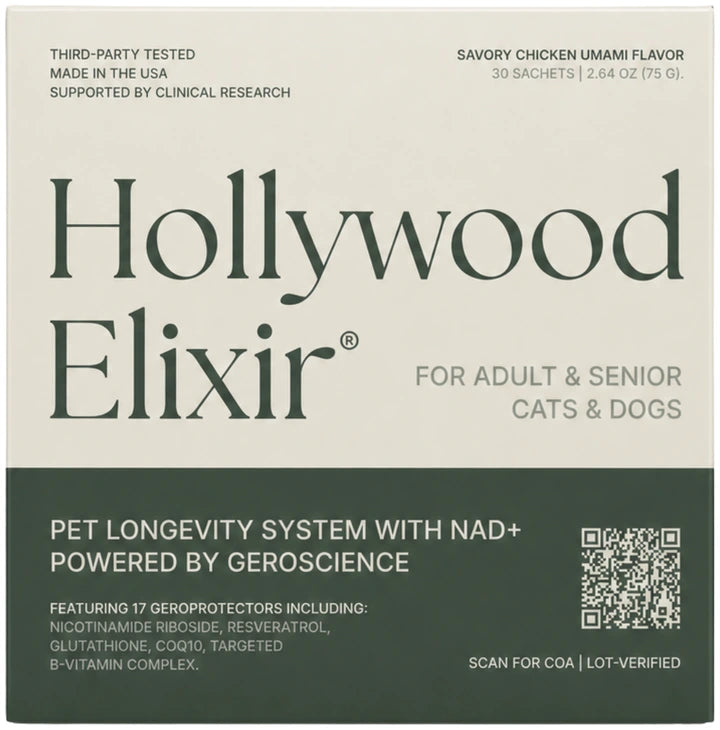
Reading Hollywood Elixir’s NR and niacin declaration

Why a combined formula can be a useful choice

Drops, powders and capsules: compare the amount eaten

Compare cost per directed day

Human labels and existing care need a whole-product check
References
Numbered references identify the sources used for specific claims. Read the study design, species and evidence boundaries alongside each finding.
-
Fletcher and colleagues. Nicotinamide riboside kinases display redundancy in mediating nicotinamide mononucleotide and nicotinamide riboside metabolism in skeletal muscle cells. Evidence boundary: Mouse muscle and cell experiments explain the NR-kinase step, related precursor pathways and the distinction between NAD cycling and replenishment.↩ 1 · ↩ 2 · ↩ 3 · ↩ 4 · ↩ 5 · ↩ 6 · ↩ 7 · ↩ 8 · ↩ 9 · ↩ 10 · ↩ 11 · ↩ 12 · ↩ 13
-
VCA Animal Hospitals; Kayla Hyland and Rania Gollakner. Niacinamide. Evidence boundary: Veterinary guidance on niacinamide used with other medicines for particular canine inflammatory skin conditions, including administration, adverse effects and when to contact the clinic.↩ 1 · ↩ 2 · ↩ 3
-
Cardoso and colleagues. Replenishing NAD+ content reduces aspects of striated muscle disease in a dog model of Duchenne muscular dystrophy. Evidence boundary: Three young dogs with muscular dystrophy received nicotinamide for one month. Muscle NAD and a respiratory-flow measure improved, while broader function and muscle restoration did not establish general recovery.↩ 1 · ↩ 2 · ↩ 3 · ↩ 4 · ↩ 5 · ↩ 6
-
Liu and colleagues. Quantitative Analysis of NAD Synthesis-Breakdown Fluxes. Evidence boundary: Isotope tracing in mice follows orally and intravenously administered NR and NMN. It shows substantial oral conversion to circulating nicotinamide and different tissue delivery by route.↩ 1 · ↩ 2
-
Zeng and colleagues. Transcriptomic and intervention evidence reveals domestic dogs as a promising model for anti-inflammatory investigation. Evidence boundary: A small intervention included five retired police dogs receiving NMN, with lower post-treatment IL-6 and TNF-alpha. The intervention lacked an untreated comparison group.↩ 1 · ↩ 2 · ↩ 3 · ↩ 4 · ↩ 5
-
Jiang, Mei and Huang. Exploring the therapeutic potential of β-nicotinamide mononucleotide in regulating canine NT-proBNP levels. Evidence boundary: An uncontrolled eight-dog clinical series reports mixed NT-proBNP changes during NMN use and concurrent care. Three deaths are described among dogs with substantial illness; the report cannot attribute survival outcomes to NMN.↩ 1 · ↩ 2 · ↩ 3 · ↩ 4 · ↩ 5
-
Simon and colleagues. A randomized, controlled clinical trial demonstrates improved owner-assessed cognitive function in senior dogs receiving a senolytic and NAD+ precursor combination. Evidence boundary: A six-month blinded trial of a proprietary combination found a favorable adjusted owner-rating result at three months. Several objective outcomes did not differ significantly, and the precursor identity and active dose were not disclosed.↩ 1 · ↩ 2 · ↩ 3 · ↩ 4 · ↩ 5 · ↩ 6 · ↩ 7
-
EFSA Panel on Nutrition, Novel Foods and Food Allergens. Safety of nicotinamide riboside chloride as a novel food and bioavailability of nicotinamide from this source. Evidence boundary: Official assessment describes unpublished NR chloride dog toxicology and kinetic reports. The 28-day dog NOAEL is an experimental finding, while the assessment’s regulatory conclusion concerns specified human uses.↩ 1 · ↩ 2 · ↩ 3
-
You and colleagues. Subacute Toxicity Study of Nicotinamide Mononucleotide via Oral Administration. Evidence boundary: Five treated beagles received 1,340 mg NMN per dog per day for 14 days. Visible condition remained good while serum nicotinamide, creatinine and uric acid rose. The paper also includes separate mouse tissue experiments.↩ 1 · ↩ 2
-
FEDIAF. Nutritional Guidelines for Complete and Complementary Pet Food for Cats and Dogs. Evidence boundary: Adult-dog niacin recommendations of 4.74 or 4.09 mg per 1,000 kilocalories reflect different assumed energy needs. These values describe complete-food nutrient density, rather than an extra precursor dose.↩ 1 · ↩ 2
-
La Petite Labs. Hollywood Elixir product panel and serving information. Evidence boundary: The panel declares 60 mg NR and 2 mg niacin per standard daily serving of one 2.5 g sachet. Product information provides the full formulation, serving guidance and recommended routine.↩ 1 · ↩ 2 · ↩ 3 · ↩ 4 · ↩ 5 · ↩ 6 · ↩ 7 · ↩ 8 · ↩ 9 · ↩ 10 · ↩ 11
-
Reactome. Complex I oxidises NADH to NAD+, reduces CoQ to CoQH2. Evidence boundary: Curated human biochemical reaction explains electron transfer from NADH through Complex I to CoQ, supporting the distinction between precursor supply and a downstream electron carrier.↩ 1 · ↩ 2
-
U.S. Food and Drug Administration. Paws Off Xylitol; It’s Dangerous for Dogs. Evidence boundary: Explains xylitol risks in human products, including supplements, and advises immediate veterinary or poison-service contact after suspected ingestion.↩

Discover LPL-01: How This Fits Into a Larger Canine Longevity System
Aging in dogs is not driven by a single pathway. It’s the result of interacting biological systems—energy metabolism, oxidative stress, immune signaling, and structural integrity—changing over time.
This article explores one piece of that puzzle. If you want to understand how these pieces connect—and what actually moves the needle—you need to zoom out.
Start with the underlying science:
- Canine Geroscience Framework →
A structured view of how aging progresses across cellular energy, inflammation, and resilience systems. - Senior Biological Defense Coverage (BDC) Modeling →
A systems-level map of which biological pathways decline first, and how layered interventions can support them. - 2026 Market Research: Best Dog Longevity Supplements →
A 2026 industry report and review of leading senior-dog and cellular-aging formulas. - LPL-01 Standard →
The formulation system that translates these models into real-world supplementation—covering multiple pathways in a coordinated way.
Keep exploring
What would you like to understand next?
Search practical guides about healthy aging, cellular energy, ingredients, and daily support for dogs.


