Rate of Aging in Dogs

Learn what makes dogs age faster and how to smooth daily function.

By La Petite Labs Editorial 15 min read

The rate of aging in dogs is best understood as a slope over time, not a number tied to birthdays—and the encouraging part is that the slope can be shaped. Some dogs hold a gentle pace for years; others get a steeper slope when everyday stressors start compounding. In practice, 'rate' means how quickly your dog's baseline changes—mobility, stamina, body condition, and comfort—across months, not days. Common accelerators include persistent pain that cuts movement, obesity that adds mechanical load and can amplify inflammatory signaling, and chronic low-grade inflammation from stressors like dental disease or recurring skin and gut irritation. The decelerators are unglamorous but powerful: a consistent mobility plan that preserves conditioning, proactive dental care, weight management, and routine check-ins that catch small changes early. Because the slope can move, monitoring matters. Simple, repeatable observations—how easily your dog rises, how long recovery takes after activity, whether appetite is stable, and whether sleep seems restorative—help you spot trendlines and discuss them with your veterinarian.

  • Aging rate is a slope you can shape: inflammation, pain, and oxidative stress steepen it; consistency flattens it.
  • Biological age reflects cellular wear and repair capacity, not just years lived.
  • Large and giant breeds often show faster biological aging, so their margin deserves earlier support (McCoy, 2024).
  • Owners usually notice narrower headroom first: slower recovery, more stiffness, less resilience to routine change.
  • Track a few markers—weight trend, gait, sleep, appetite, next-day soreness—to make vet visits productive.
  • Steady diet and daily low-impact movement matter more than any single 'anti-aging' hack.

Why the aging slope changes: feedback loops between pain, inactivity, weight gain, and inflammation

A dog’s aging slope often steepens through a behavior–physiology loop that is easy to miss in real time. Pain is a common starting point: discomfort leads to less voluntary movement, which reduces conditioning and joint range of motion. With less activity, weight gain becomes more likely, and extra weight increases strain on joints and soft tissues—often worsening pain and further reducing movement.

This loop can also intersect with inflammation. Reduced conditioning and increased body fat can be associated with higher inflammatory tone, and inflammation can make tissues more sensitive, reinforcing the cycle. The key takeaway is not that aging is “set,” but that the pace can shift when feedback loops run unchecked.

Practical levers focus on early intervention: address pain promptly with your veterinarian, keep activity consistent (even if it’s lower impact), and protect conditioning with regular, appropriate movement. Small, steady adjustments—maintaining a healthy body condition, keeping walks predictable, and avoiding long gaps of inactivity—can help keep the slope flatter over time rather than letting a short period of discomfort cascade into months of decline.

How to track aging rate at home: mobility, recovery time, appetite, sleep, and play drive

Tracking the rate of aging at home works best when you use the same simple measures repeatedly and look for trends. One approach is a basic mobility score you record weekly (for example, 1–5) based on how smoothly your dog rises, uses stairs, and settles down. Pair that with a short note on recovery time: after a normal walk or play session, does your dog return to baseline quickly, or do they seem “spent” for longer than usual?

Add two more anchors: appetite and sleep quality. Appetite is less about day-to-day preference and more about consistency—steady interest in meals and treats versus a gradual change over weeks. Sleep quality can be tracked by whether rest seems restorative (waking comfortable and ready to engage) versus increasingly fragmented or restless.

Finally, note play drive and willingness to initiate activity. A gradual shift in enthusiasm can be meaningful when it persists across multiple weeks.

Schedule a veterinary visit when your tracking shows a sustained change (for example, two to four weeks of worsening mobility score, longer recovery time, or a persistent appetite shift), or when comfort and daily function are clearly trending downward. Bringing your notes helps your veterinarian evaluate pace and prioritize next steps without guessing from memory.

Oxidative Stress and Mitochondrial Slowdown in Daily Life

Oxidative stress is not simply “bad molecules”; it is an imbalance between reactive oxygen species and the systems that neutralize them. Mitochondria—cells’ energy hubs—are both a source and a target of oxidative stress, and age-related mitochondrial decline can make energy production less consistent. When energy output becomes less reliable, tissues with high demand (muscle, brain, immune cells) may show earlier functional changes. In dogs, aging models highlight mitochondrial function and redox balance as central themes that connect cellular wear to visible decline (Ruple, 2022).

In a household, this can look like shorter play bursts, more frequent rest breaks, and a dog that “runs out of gas” sooner than expected. Some dogs begin hesitating at stairs or jumping into the car, not from fear but from reduced muscular follow-through. Owners often interpret this as laziness, yet it can be a sign that energy availability and recovery are less smooth. A steady routine with warm-ups and cooldowns can help keep activity within the dog’s current headroom.

Musculoskeletal Wear: the Fast Lane for Visible Aging

Joint cartilage, connective tissue, and muscle mass form the mechanical foundation of “young-looking” movement. As inflammation and oxidative stress rise, micro-injuries accumulate and repair becomes less efficient, making mobility a common early limiter of quality of life. When movement becomes guarded, dogs often reduce activity, which accelerates muscle loss and further destabilizes joints. A randomized study in shepherd dogs evaluated a combination of antioxidants, mitochondrial cofactors, and omega-3 fatty acids and reported changes in telomere length and joint mobility measures, illustrating how oxidative and mobility markers can move together (Lorke, 2020).

Owners can watch for “movement negotiations”: a pause before standing, a wider stance when turning, or a preference for softer surfaces. These small adaptations often appear weeks before obvious limping. Flooring traction, nail length, and a consistent low-impact exercise plan can make daily movement smoother. The goal is not maximal exercise; it is reliable, repeatable motion that preserves confidence and reduces flare-ups.

Breed Size and the Biology Behind Faster Decline
Large and giant breeds often show earlier aging-related changes, and modern datasets support measurable differences in biological aging signals by size. In the Dog Aging Project, epigenetic aging patterns were consistent with accelerated aging in larger breeds, helping explain why a “senior” phase can arrive sooner even when a dog seems outwardly healthy (McCoy, 2024). Bigger bodies place higher mechanical demand on joints and may carry a different inflammatory and oxidative burden over time. This does not mean large dogs are destined for rapid decline; it means their margin can be narrower and deserves earlier support. (see our Dog Life Stages →)

In practical terms, a Great Dane and a small terrier may need different expectations for workload, recovery time, and weight targets. Owners of giant breeds benefit from treating “middle age” as a preventive window rather than a waiting period. A consistent plan—lean body condition, controlled impact, and early mobility monitoring—often keeps day-to-day function more predictable. The most important comparison is the dog against its own baseline, not against another breed.

“Aging feels sudden when recovery stops being automatic.”

Biological Age Tools: What Epigenetic Clocks Can and Cannot Tell

Epigenetic clocks estimate biological age by reading DNA methylation patterns that shift with aging. Dog-specific methylation clocks have been developed and compared with humans, supporting the idea that aging rate can be quantified beyond calendar years (Horvath, 2022). Related work shows that methylation remodeling can translate dog-to-human aging relationships in a nonlinear way, reinforcing that “one dog year equals seven human years” is an oversimplification (Wang, 2020). These tools are mainly research instruments today, but they sharpen the concept that aging speed varies between individuals.

For owners, the takeaway is not to chase a lab number but to use the same mindset: measure change over time. A dog that is chronologically seven may behave biologically older if recovery, mobility, and appetite stability are slipping. Conversely, a dog with consistent energy and smooth movement may be aging more slowly than peers. Home tracking becomes a practical “clock” when it is consistent and tied to real function.

Case Vignette: When a Dog “Ages Overnight” After Minor Stress

A common pattern is an abrupt-looking shift after a small stressor: a long car ride, a weekend of extra play, or a short illness. A nine-year-old Labrador may seem normal on Saturday, then on Monday shows stiffness on rising, shorter walks, and a reluctance to jump into the car. This is often the moment owners first confront the Rate of Aging in Dogs as something that can accelerate. The biology behind it is usually cumulative—an inflammatory and oxidative load that finally exceeds the dog’s remaining headroom.

The most helpful response is to treat the week as information, not as a verdict. Note what changed (activity, diet, sleep, weather), then return to a calmer baseline for two weeks and observe recovery. If the dog does not bounce back, it suggests the baseline has shifted and needs a new plan. This is also the right time to schedule a mobility-focused exam rather than waiting for a severe limp.

Owner Checklist: Home Signs That Aging Rate May Be Accelerating

Owners often miss early acceleration because each change is small. A practical checklist focuses on function and recovery: (1) longer “start-up” time after rest, (2) next-day soreness after normal activity, (3) shorter play sessions with more frequent breaks, (4) new hesitation on stairs or slick floors, and (5) more digestive sensitivity to routine foods. These signals fit the inflammation-plus-oxidative-stress pattern because they reflect reduced resilience across multiple systems. The point is not to label a dog as old; it is to spot a narrowing margin while there is still room to adjust.

This checklist works best when paired with a simple weekly note. Record whether the dog warms up faster or slower than last month, and whether recovery is smoother after the same walk. If two or more items are trending worse for three to four weeks, it is reasonable to treat it as a meaningful shift rather than a temporary “off week.” That trend is often more actionable than a single dramatic day.

What to Track over Weeks: a Simple Aging-rate Rubric

Tracking should be specific enough to compare month to month. Useful markers include: body weight trend, body condition score estimate, resting respiratory rate during sleep, walk duration before slowing, “start-up” stiffness time, stool consistency, and next-day recovery after a standard activity. These markers map onto inflammation, oxidative stress, and musculoskeletal capacity without requiring special equipment. In senior dogs, metabolomic profiles vary with diet type, illustrating that measurable internal markers can shift alongside lifestyle inputs over time (Yamka, 2025).

Choose two “anchor routines” that stay consistent, such as a 20-minute neighborhood walk and a short play session. Then track how the dog looks during the first five minutes and how the dog behaves the next morning. Owners often focus on the fun moment and miss the recovery cost. A smoother recovery curve—less stiffness, more willingness to move—usually signals that the plan is matching the dog’s current headroom.

Can Being 'A Little Heavy' Speed Up My Dog's Aging?

A specific misconception is that a dog can be “a little heavy” without consequences as long as energy seems normal. In reality, excess body fat can amplify inflammatory signaling and mechanically overload joints, making the aging pace feel faster even before obvious disease appears. Owner misperception of canine body condition is common and can persist even when body condition score charts are provided (Eastland-Jones, 2014). That gap matters because a dog’s visible comfort may lag behind the biological cost of carrying extra weight.

At home, the most reliable check is trend plus touch: ribs should be easy to feel with light pressure, and the waist should be visible from above. Photos taken monthly from the side and above can reveal slow drift that daily familiarity hides. If weight is trending up while walks are trending down, the plan is moving in the wrong direction for long-term resilience. A veterinarian can confirm targets and rule out medical contributors to weight gain.

“Consistency is often the earliest sign that a plan is working.”

La Petite Labs

DVM Voice: Clinical Vignette of a Common Pattern in Senior Dog Aging

Case provided by JoAnna Pendergrass, DVM

Rex, a 7-year-old Labrador Retriever, was brought in after his owner noticed he was slower to rise, hesitant on stairs, and less able to play as before. Examination showed stiffness and reduced hip mobility; radiographs confirmed degenerative joint changes.

His care required weight management, veterinary-guided pain control, nutritional support, and rehabilitation — a comprehensive plan, but one started only after visible decline appeared.

Clinical takeaway: Rex’s case reflects the value of proactive aging support: maintaining lean body condition, monitoring mobility early, and supporting cellular resilience, antioxidant defense, and healthy inflammatory balance before decline becomes obvious.

Single-case vignette. Not generalizable. Veterinary oversight is essential for pain, stiffness, or suspected joint disease.

Explore Hollywood Elixir Research →
Epigenetic Aging-Rate Measurement In Dogs - 9

Does Diet Affect How Fast a Dog Ages?

Diet shapes aging rate through body composition, gut signaling, and the balance of pro-oxidant and antioxidant exposures. In senior dogs, different diet formats have been linked to different serum metabolomic profiles, which suggests food choices can shift measurable internal chemistry tied to aging physiology (Yamka, 2025). No single diet is universally 'best,' but the principle that matters is stability: sudden switches and frequent rich extras create inflammatory noise that masks what is truly helping. What owners often read as 'picky eating' is sometimes a dog reacting to variability. Give it a two-week run of consistent meals, measured portions, and limited add-ons, then watch whether stool quality, appetite, and energy become smoother. Keep treats predictable and modest so they do not dominate the diet. Consistency also makes it far easier to judge any new joint or aging-support strategy you add later.

Epigenetic Aging-Rate Measurement In Dogs - 10

Does NAD+ Help Slow Aging in Dogs?

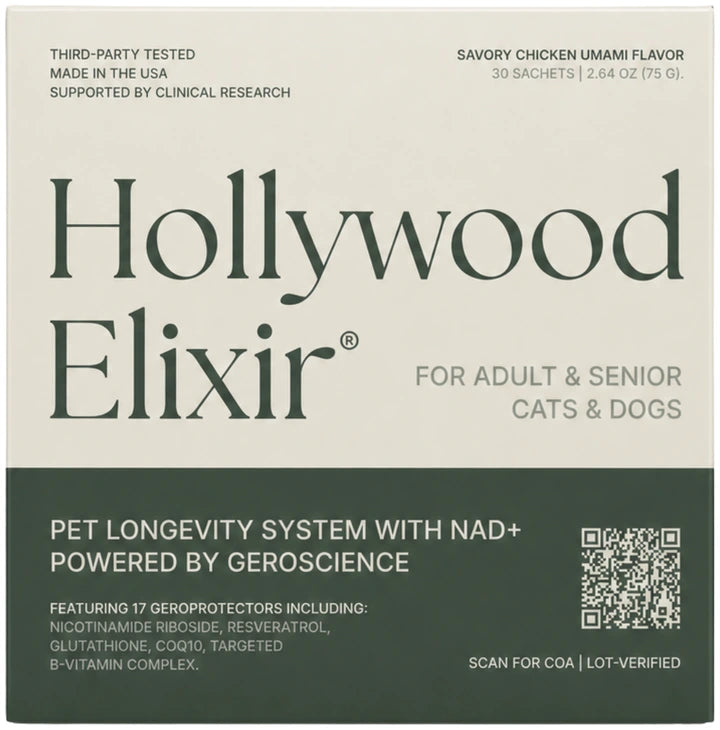
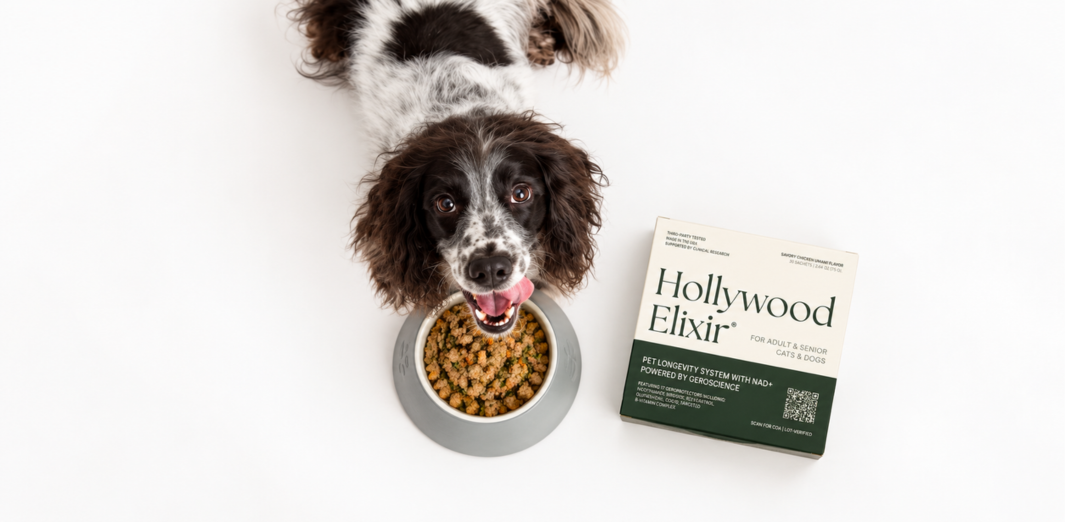
You have probably heard about NAD+ in the context of energy and longevity. Here is the practical relevance: NAD+ participates in cellular repair and stress-response pathways that help cells manage oxidative pressure, and those pathways tend to change with age. Dog-aging research emphasizes that coordinated shifts across repair, immune signaling, and metabolism shape how quickly function declines (Ruple, 2022). NAD+ is not a single switch that sets lifespan, but it fits the broader picture of how cells stay resilient under repeated stress. This is where the label matters. A formula like Hollywood Elixir supports that machinery with visible actives—nicotinamide riboside at a disclosed 60 mg per sachet for NAD+ support, plus antioxidants like resveratrol (15 mg) for the oxidative wear this page keeps returning to—mixed into food as a daily routine, not a rescue. Expect gradual shifts over weeks, not overnight change, and if a dog is declining fast, a veterinary exam matters more than any longevity trend.

Epigenetic Aging-Rate Measurement In Dogs - 11

What Not to Do When Trying to Slow Aging Rate

Common mistakes can unintentionally accelerate the Rate of Aging in Dogs by increasing inflammation or injury risk. Avoid (1) “weekend warrior” activity spikes followed by sedentary weekdays, (2) abrupt diet changes or frequent rich table scraps, (3) pushing through stiffness to “build strength,” and (4) stacking multiple new supplements at once, which makes reactions hard to interpret. These patterns create volatility—more flare-ups, less consistent stool quality, and unpredictable mobility. A slower, steadier approach usually preserves headroom better than aggressive interventions.

A safer household plan layers changes over weeks. Keep one variable stable while adjusting another, such as maintaining the same walk route while refining meal portions. If a new supplement is introduced, add only one at a time and track stool, appetite, and next-day movement. Owners should also avoid masking pain with unapproved human medications; the risk profile is not the same in dogs. When discomfort is persistent, the correct next step is a veterinary-guided pain and mobility plan.

Vet Visit Prep: Make the Mobility and Aging Conversation Concrete

A productive veterinary visit focuses on patterns, not impressions. Bring a short log and ask targeted questions: What joints look most affected on exam, and what range-of-motion limits are present? Is the dog’s body condition score appropriate for joint load, and what target range is realistic? Which signs suggest inflammation-driven pain versus neurologic weakness? These questions align the owner’s observations with a clinical plan and reduce guesswork about why decline feels faster.

Also bring two short videos: one of the dog rising from rest and one walking away and back on a flat surface. Mention whether stiffness is worse in the morning, after exercise, or in cold weather, and whether recovery takes hours or days. Ask what to notice over the next month so response to the plan can be evaluated. This level of detail helps the veterinarian adjust pain control, physical therapy, and activity recommendations with more precision.

Interventions That Tend to Create Smoother Weeks

Slowing visible aging is mostly about reducing inflammatory load while protecting mobility. The most reliable levers are a lean body condition, daily low-impact movement, and a plan that avoids repeated flare-ups. Supportive nutrition usually focuses on maintaining muscle, supporting normal joint function, and providing components linked to healthier inflammatory balance. In a controlled study in shepherd dogs, a combination including omega-3s and mitochondrial cofactors was evaluated alongside mobility measures, a reminder that multi-ingredient approaches are typically studied as coordinated support rather than single 'magic' nutrients (Lorke, 2020). The intervention most owners underestimate is pacing. Two shorter walks are often easier on joints than one long outing, and a few warm-up minutes reduce stiffness. Add traction rugs where slipping happens, keep nails trimmed for better footing, and use ramps when jumping turns hesitant. These changes do not feel like 'anti-aging,' yet they make daily function more consistent—and consistency is the signal that the plan is working.

How to Judge Progress Without Chasing a Perfect Dog

Progress should be defined as smoother function and better bounce-back, not as a return to puppy behavior. A dog aging at a healthier pace often shows fewer “bad mornings,” a shorter warm-up period, and more willingness to move after rest. Because aging is nonlinear, plateaus are normal; the goal is to prevent repeated downward steps. Research tools like methylation clocks reinforce that aging rate can differ between individuals, but day-to-day function remains the most meaningful outcome for owners (Horvath, 2022).

Owners can set a simple monthly review: compare videos, check weight trend, and rate recovery after the same anchor routine. If the dog’s week is more consistent, the plan is likely supporting resilience even if the dog still has limitations. If volatility is increasing, it is a signal to revisit pain control, activity dose, or diet consistency. This approach keeps expectations realistic while still acting early enough to matter.

When Faster Aging Signals Need Medical Attention

Not every change is “just aging,” and some patterns warrant prompt evaluation. Sudden inability to rise, rapid weight loss, persistent appetite decline, repeated vomiting or diarrhea, or a new cough can indicate problems beyond normal aging pace. A key distinction is trajectory: gradual change over months often fits aging, while sharp change over days suggests illness, injury, or pain escalation. Dog aging models emphasize that multiple organ systems shift with age, so new symptoms deserve a structured assessment rather than assumptions.

Owners should call a veterinarian sooner if a dog’s recovery window stretches from “next morning” to “several days,” or if mobility changes are paired with behavior shifts like hiding or irritability. Bring the tracking rubric and videos to reduce reliance on memory. If the dog is on any medications, report changes in thirst, urination, stool, and appetite, since these can alter dosing decisions. Early evaluation often preserves more options and reduces the chance of a prolonged flare.

Putting It Together: a Daily Plan That Protects Headroom

A practical approach to the Rate of Aging in Dogs treats inflammation and oxidative stress as pressures that can be shaped by routine. The most effective plan is coordinated: maintain lean mass, keep joints moving without overload, and reduce avoidable inflammatory triggers from diet variability and activity spikes. The science of biological age—whether measured by methylation patterns or functional markers—supports the idea that aging pace differs and can be tracked over time (Wang, 2020). Owners do not need perfect control; they need a plan that keeps weeks smoother and setbacks less frequent.

Daily execution is simple: consistent meals, measured portions, predictable low-impact movement, and a short weekly check-in on recovery and stiffness. Add environmental supports like ramps and traction where needed, and adjust expectations by season and workload. When changes are introduced, layer them slowly and track the response for several weeks. This keeps decisions grounded in observation signals rather than hope, and it supports clearer conversations with a veterinarian.

“Track recovery, not just activity, to protect long-term headroom.”

Educational content only. This material is not a substitute for veterinary advice. Always consult your veterinarian about your dog’s specific needs. These statements have not been evaluated by the Food and Drug Administration. Products mentioned are not intended to diagnose, treat, cure, or prevent any disease.

Glossary

  • Biological age - Functional age estimated from biomarkers and performance, not birthdays.
  • Inflammaging - Age-associated, low-grade inflammation that can narrow resilience.
  • Oxidative stress - Imbalance between reactive molecules and antioxidant defenses.
  • Redox balance - The body’s management of oxidation and antioxidant capacity.
  • Mitochondrial decline - Reduced efficiency of cellular energy production with age.
  • Epigenetic clock - DNA methylation-based model estimating biological age.
  • DNA methylation - Chemical tagging of DNA that influences gene activity over time.
  • Body condition score (BCS) - Visual and hands-on estimate of fatness and leanness.
  • Recovery window - Time needed to return to baseline after routine activity.

Related Reading

References

Eastland-Jones. Owner misperception of canine body condition persists despite use of a body condition score chart. 2014. https://www.sciencedirect.com/science/article/pii/S0168159124000121

Yamka. Serum Metabolomics of Senior Dogs Fed a Fresh, Human-Grade Food or an Extruded Kibble Diet. 2025. https://www.mdpi.com/2218-1989/15/10/676

Horvath. DNA methylation clocks for dogs and humans. PubMed. 2022. https://pubmed.ncbi.nlm.nih.gov/35580182/

Wang. Quantitative Translation of Dog-to-Human Aging by Conserved Remodeling of the DNA Methylome. PubMed. 2020. https://pubmed.ncbi.nlm.nih.gov/32619550/

Ruple. Dog Models of Aging. 2022. https://www.mdpi.com/2073-4409/13/24/2101

Kim. Genome-Wide Integrative Transcriptional Profiling Identifies Age-Associated Signatures in Dogs. 2023. https://www.mdpi.com/2073-4425/14/6/1131

Lorke. Effect of antioxidants, mitochondrial cofactors and omega-3 fatty acids on telomere length and kinematic joint mobility in young and old shepherd dogs – A randomized, blinded and placebo-controlled study. 2020. https://www.sciencedirect.com/science/article/abs/pii/S0034528819304254

McCoy. Aging at scale: Younger dogs and larger breeds from the Dog Aging Project show accelerated epigenetic aging. PubMed. 2024. https://pubmed.ncbi.nlm.nih.gov/39553930/

FAQ

What does Rate of Aging in Dogs actually mean?

Rate of Aging in Dogs refers to how quickly a dog’s body shifts from resilient function to reduced bounce-back. It is influenced by inflammation, oxidative stress, and how well tissues repair after everyday wear.

Chronological age counts years; aging rate describes pace. Two dogs the same age can show very different recovery, mobility, and stamina because their biological “load” and repair capacity differ.

Why do some dogs seem to decline so fast?

Fast-looking decline often happens when multiple pressures stack: joint discomfort reduces movement, reduced movement accelerates muscle loss, and inflammation rises as activity becomes more guarded. Oxidative stress can compound this by making recovery less consistent.

Owners typically notice it after a trigger such as a long hike or a minor illness. The trigger is rarely the true cause; it often reveals that headroom was already narrow.

Is biological age different from a dog’s actual age?

Yes. Biological age describes how “aged” tissues behave based on biomarkers and function, while chronological age is time since birth. Epigenetic clocks use DNA methylation patterns to estimate biological age in dogs.

For owners, the practical version is functional age: recovery time, mobility confidence, appetite stability, and how quickly a dog returns to baseline after routine activity.

Do large breeds have a faster aging rate?

Often, yes. Large and giant breeds tend to show earlier aging-related changes, and large datasets have found accelerated epigenetic aging patterns in larger dogs(McCoy, 2024).

That does not mean rapid decline is inevitable. It means weight targets, joint protection, and recovery-aware exercise matter earlier to preserve resilience.

How does inflammation change the Rate of Aging in Dogs?

Inflammation can become self-reinforcing: it alters tissue function, increases cellular stress, and can keep immune signaling activated. Over time, this narrows a dog’s margin for bounce-back and makes flare-ups more likely.

Owners often see this as more “off days,” slower warm-ups, and digestive sensitivity. A steadier routine and lean body condition can help keep inflammatory load from becoming more volatile.

What is oxidative stress in aging dogs?

Oxidative stress is an imbalance between reactive oxygen species and the body’s antioxidant defenses. It can affect mitochondria and other cellular components, making energy production and recovery less consistent.

In daily life, it may show up as shorter play bursts, more rest breaks, and next-day soreness after normal activity. These patterns are especially meaningful when they trend worse over weeks.

What are the earliest signs aging is accelerating?

Early acceleration is usually about recovery, not dramatic symptoms. Common signs include longer start-up stiffness, reluctance with stairs or jumping, and needing more time to return to baseline after routine exercise.

Digestive volatility and subtle behavior changes (less interest in play, more sleeping) can also signal reduced resilience. Tracking patterns for three to four weeks helps separate trends from one-off days.

How can owners track aging rate at home?

Pick a few markers that are easy to repeat: weight trend, a simple body condition estimate, walk duration before slowing, start-up stiffness time, stool consistency, and next-day recovery after a standard activity.

Use short videos monthly (rising from rest and walking) to reduce memory bias. The goal is to notice whether weeks are becoming smoother or more volatile.

Is the “seven human years per dog year” accurate?

It is a rough cultural shortcut, not a biological rule. DNA methylation research supports a nonlinear relationship between dog age and human-equivalent aging, meaning early-life changes are not proportional to later-life changes(Wang, 2020).

A better approach is to compare a dog to its own baseline: recovery time, mobility confidence, and stamina over months. That is where actionable change shows up.

Can diet influence the Rate of Aging in Dogs?

Diet can influence aging pace through body composition, gut signaling, and inflammatory balance. In senior dogs, different diet types have been associated with different serum metabolomic profiles, showing that internal markers can shift with feeding patterns(Yamka, 2025).

The most practical principle is consistency: measured portions, stable meals, and fewer rich extras. This makes energy, stool quality, and mobility easier to interpret over time.

Why does extra weight speed up visible aging?

Extra weight increases mechanical load on joints and is associated with higher inflammatory signaling. That combination can make stiffness and reduced activity appear earlier, which then accelerates muscle loss.

Many owners underestimate body fat even when using charts(Eastland-Jones, 2014). Regular weigh-ins and monthly photos help catch slow drift before it changes a dog’s daily comfort.

What not to do when trying to slow aging?

Avoid activity spikes that create flare-ups, abrupt diet changes, and pushing through stiffness to “toughen up.” Also avoid starting multiple supplements at once, which makes side effects and benefits hard to interpret.

A better approach layers changes over weeks and tracks recovery. If discomfort is persistent or worsening, veterinary evaluation is safer than experimenting at home.

When should a dog be seen by a veterinarian urgently?

Seek prompt care for sudden inability to rise, severe pain, rapid weight loss, repeated vomiting or diarrhea, collapse, or breathing changes. These patterns are not typical “normal aging” and can indicate injury or illness.

Also schedule a visit if recovery stretches from “next morning” to “several days.” Bring videos of gait and rising to help the exam reflect what happens at home.

What questions help most at an aging and mobility vet visit?

Ask which joints or muscle groups appear most limited, what body condition target best protects joints, and how to distinguish pain from weakness. Ask what “response markers” should improve over the next month if the plan is working.

Bring a short log: start-up stiffness time, next-day soreness, and walk duration before slowing. Concrete observations make treatment adjustments more precise.

How long does it take to see changes from routine adjustments?

Most meaningful changes show up over weeks, not days. Mobility confidence and next-day recovery often shift first, while body composition and endurance typically take longer.

Use a two- to four-week window for each change so the signal is clearer. If volatility increases, the plan may be exceeding the dog’s current headroom.

How should Hollywood Elixir™ fit into an aging plan?

a disclosed aging-support formula fits best as a consistent, daily layer that supports whole-body coordination as dogs age. It should sit on top of fundamentals: lean body condition, predictable low-impact movement, and stable meals. Introduce it gradually and track stool quality, appetite, and next-day mobility for several weeks.

Is Hollywood Elixir™ safe for senior dogs?

Senior dogs often have less headroom for digestive upset or medication interactions, so any supplement should be discussed with a veterinarian—especially if the dog has chronic conditions or takes prescriptions. Stop and call the veterinarian if vomiting, diarrhea, or marked behavior change occurs.

Can Hollywood Elixir™ be used with prescription medications?

Some supplements can interact with medications by affecting absorption or bleeding risk, or by overlapping with similar ingredients. A veterinarian or pharmacist should review the full medication list before adding any new product. This keeps the plan safer and more consistent.

What side effects should owners watch for with supplements?

The most common early issues are digestive: softer stool, gas, reduced appetite, or occasional vomiting. Less commonly, a dog may seem more restless or more sleepy depending on ingredients and timing.

Add only one new supplement at a time and keep meals consistent so changes are easier to interpret. If signs persist beyond a few days or are severe, stop the product and contact a veterinarian.

How do owners choose a quality aging-support supplement?

Look for clear ingredient lists, transparent sourcing, and manufacturing quality signals such as batch testing or third-party verification when available. Avoid products that promise dramatic results or claim to treat disease.

A good product fits into a plan that supports normal function: mobility comfort, cellular stress response, and a smoother recovery pattern. Owners should still track outcomes rather than relying on marketing language.

Is Rate of Aging in Dogs the same as arthritis?

No. Rate of Aging in Dogs is broader than any single diagnosis. Arthritis is one common pathway that makes aging visible because it affects movement, activity, and muscle maintenance.

Aging rate also reflects inflammation, oxidative stress, and recovery capacity across multiple systems. A dog can have accelerated aging signals without obvious arthritis, and a dog with arthritis can still maintain a smoother baseline with good management.

Can cats use the same aging-rate strategies as dogs?

Some principles overlap—stable routines, lean body condition, and early detection—but cats and dogs differ in metabolism, behavior, and common aging patterns. Strategies should be species-specific, especially for supplements and pain management.

For a dog-focused plan, tracking mobility, recovery, and appetite stability remains central. Cat plans should be built with a veterinarian using feline-specific guidance rather than adapting dog routines.

What is a practical decision framework for slowing aging rate?

Start with the highest-leverage basics: lean body condition, consistent meals, and low-impact movement that does not trigger next-day soreness. Then add environmental supports like traction and ramps to reduce flare-ups. If additional support is desired, consider a single supplement layer and track outcomes for two to four weeks.

La Petite Labs

Discover LPL-01: How This Fits Into a Larger Canine Longevity System

Aging in dogs is not driven by a single pathway. It’s the result of interacting biological systems—energy metabolism, oxidative stress, immune signaling, and structural integrity—changing over time.

This article explores one piece of that puzzle. If you want to understand how these pieces connect—and what actually moves the needle—you need to zoom out.

Start with the underlying science: