Epigenetics and Aging for Dogs

Understand Epigenetic Drift and the Daily Inputs That Accelerate or Slow Aging

Essential Summary

Why are epigenetics and aging important for dogs?

Epigenetics and aging for dogs focuses on how everyday inputs shape gene activity over time. Age-related patterns can shift with diet, environment, and stress, helping explain why longevity varies even within the same breed. A thoughtful routine pairs strong basics with system-level support that stays consistent as your dog grows older.

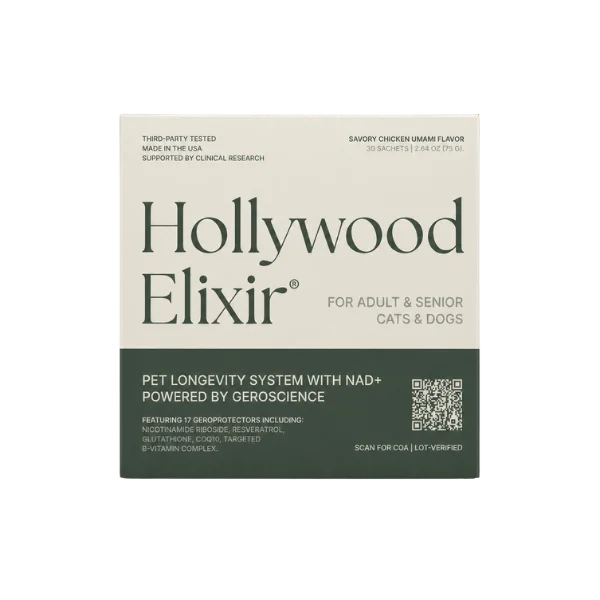
Hollywood Elixir™ is designed as system-level support for graceful aging—helping reinforce the broader network behind energy, recovery, and everyday resilience, rather than chasing a single “anti-aging” ingredient. It fits best alongside good nutrition, healthy weight, and calm routines, especially when you want consistency that is easy to maintain.

Epigenetics and aging for dogs describes how gene expression shifts over time without changing the DNA sequence itself. Instead of altering genes, cells use chemical tags and structural changes to influence which instructions are read strongly, weakly, or not at all. One of the best-studied tags is methylation, a small chemical mark that can help regulate when genes are active. These epigenetic patterns respond to environmental signals—such as stress physiology, activity patterns, sleep disruption, inflammation, and other exposures—because cells continuously adjust to what the body experiences. In aging research, that matters because many age-related changes look less like “new genes” and more like altered regulation of existing ones. In dogs, scientists are investigating whether age-associated methylation patterns track biological aging rates, and how those patterns relate to downstream processes like mitochondrial function, redox balance, and inflammatory signaling. The goal is a clearer map of how time and experience become biology, and where the strongest evidence is emerging.

By La Petite Labs Editorial, ~15 min read

Featured Product:

  • Epigenetics and aging for dogs is about gene activity, not changing DNA, and it responds to daily life.
  • Age-related patterns can be influenced by diet quality and consistency, making nutrition a long-game lever. (Stockman J, 2024)
  • Breed, size, and body weight shape how dogs age, so “best” always depends on the individual.
  • Environmental exposures are part of the picture; reducing avoidable toxins supports the body’s repair capacity. (Choi BY, 2025)
  • Sleep, stress, and enrichment quietly influence resilience, especially as dogs enter their senior years.
  • Epigenetics and aging supplements for dogs work best as system support, not as a replacement for good food.
  • A science-minded reason to supplement is consistency: reinforcing the metabolic network when life is imperfect.

How Epigenetics Works: Marks, Readers, Writers, and Erasers

Epigenetic regulation is often explained as a toolkit of “marks” plus the proteins that place, interpret, or remove them. DNA methylation is a core mark: methyl groups are added to DNA (often at CpG sites) and can change how accessible a gene is to the transcription machinery. Histone modification is another major layer. DNA is wrapped around histone proteins, and chemical changes to histone tails (for example, acetylation or methylation) can loosen or tighten chromatin structure, shifting how easily genes are transcribed.

Researchers study these mechanisms with methods such as bisulfite sequencing or array-based methylation profiling for DNA methylation, and ChIP-seq for histone modification patterns. In aging studies, these data can be combined into “epigenetic clocks,” statistical models that estimate biological age from methylation signatures. In dogs, epigenetic clocks are being explored to compare chronological age to methylation-derived age and to test whether specific exposures correlate with faster or slower epigenetic aging trajectories. (Park JH, 2017)

Cellular powerhouse illustration symbolizing metabolic support via best epigenetics and aging supplements for dogs.

What Epigenetics Can (and Can’t) Tell Owners Today

Epigenetic findings are informative, but they are not deterministic. A methylation pattern associated with age does not mean a dog is “destined” for a specific outcome, and it does not identify a single cause. Most epigenetic signals reflect many inputs at once—genetics, developmental history, immune activity, and cumulative exposures—so interpretation requires caution.

For owners, the key limitation is that epigenetic testing is largely still in the research stage. While epigenetic clocks can estimate biological age in study settings, they are not yet a routine diagnostic tool for most dogs, and they do not replace veterinary evaluation. Lifestyle factors are frequently studied because they are measurable exposures that may correlate with methylation shifts (for example, chronic stress markers, activity patterns, sleep disruption, or inflammatory burden), but correlation is not the same as proof of causation. The most responsible takeaway today is that epigenetics offers a framework for understanding how experience can influence gene regulation across time—without overinterpreting early signals as individualized predictions.

DNA strand visualization representing cellular protection supported by best epigenetics and aging for dogs.

Food as a Signal: Diet’s Role in Long-term Regulation

Diet is one of the most direct ways owners influence the signals a dog’s body receives. In canine studies, both age and diet have been shown to significantly influence gene expression patterns, suggesting that nutrition can modulate some aging-associated changes.(Kil DY, 2010)

This does not mean a single “longevity diet” exists for every dog. It means that consistency, quality, and appropriateness matter: adequate protein, balanced fats, and micronutrients that match life stage and health status. If you are exploring epigenetics and aging supplements for dogs, the best results tend to come when supplements reinforce an already-sound dietary foundation rather than trying to compensate for a chaotic one.

Molecular ribbon graphic highlighting formulation science reflected in best epigenetics and aging for dogs.

Aging Is a Whole-body Story, Not a Single Symptom

Aging is not only about joints and gray hair. It is also about how efficiently the body manages energy, repairs everyday cellular wear, and maintains stable brain function. Dietary changes can influence the aging process in dogs by affecting metabolism and overall health, which is one reason nutrition is often the first lever veterinarians discuss.(Stockman J, 2024)

The epigenetic perspective adds a useful layer: it suggests that repeated, small inputs can accumulate into a different long-term trajectory. That is why many owners look for the best epigenetics and aging for dogs as a category—not to chase a miracle, but to support daily resilience in a way that feels gentle and sustainable.

Black pug portrait showing gentle expression and daily vitality with best epigenetics and aging for dogs.

Movement and Enrichment That Age with Your Dog

Exercise and enrichment are often described as “good for health,” but their value is more specific than that. Movement improves circulation, supports healthy body composition, and helps regulate stress. Enrichment—sniff walks, training games, novel routes—keeps the brain engaged without overstimulation. Together, they shape the internal signals that influence how the body allocates resources across a life.

Because methylation patterns are influenced by age and other individual factors, there is no single perfect routine for every dog. The best plan is the one your dog can do consistently: moderate, enjoyable, and adapted as stamina changes. Supplements can complement this by supporting recovery and steadier energy, especially in older dogs.

Hollywood Elixir™ is amazing and makes my 13 y/o young again!

— Jessie

We go on runs. Lately he's been keeping up with no problem!

— Cami

“Genes set the stage; daily life shapes the performance.”

Sleep and Repair: the Overlooked Rhythm of Resilience

Sleep is one of the least glamorous longevity tools, and one of the most revealing. When sleep becomes fragmented, owners often notice it first as pacing, nighttime waking, or a dog who seems “on edge.” While epigenetics is not a sleep manual, it does offer a helpful reminder: the body’s repair work depends on predictable cycles, and chronic disruption can change the signals that guide long-term maintenance.

Simple supports—consistent bedtime, a quiet sleeping area, daytime activity that matches age—often matter more than dramatic interventions. If sleep changes are sudden, painful, or paired with confusion, involve your veterinarian. A well-chosen epigenetics and aging supplement for dogs may fit best as part of a broader routine that prioritizes calm and regularity.

Dog portrait tied to trust and long-term care supported by epigenetics and aging supplement for dogs.

Stress, Routine, and the Biology of Staying Steady

Stress is not only emotional; it is physiological. A dog who is frequently startled, under-stimulated, over-stimulated, or socially strained can live in a subtly heightened state that affects appetite, digestion, and sleep. Over time, those patterns become part of the dog’s biological “weather,” influencing how resources are spent and replenished.

Because epigenetic modifications are linked to aging and respond to environmental inputs, reducing chronic stressors is a meaningful longevity practice. Think in terms of steadiness: predictable routines, gentle training, and environments that feel safe. Supplements can be supportive here when they are positioned as part of whole-dog care, not a substitute for behavior and lifestyle work.

Profile shot of a dog showing attentive expression supported by epigenetics and aging research for dogs.

Breed, Size, and Why One Dog’s Aging Is Not Another’s

Breed and size shape aging in ways owners can feel but not always explain. Larger dogs often show age-related changes earlier, while some breeds have distinctive health vulnerabilities. Epigenetic data adds texture: methylation patterns differ by breed and other traits, which may contribute to differences in health and longevity.

This is one reason “best epigenetics and aging supplement for dogs” is not a universal label. The better question is whether a formula supports broad resilience without overpromising, and whether it fits your dog’s life stage. For some dogs, that means focusing on weight and mobility; for others, it means supporting calm, sleep, and cognitive steadiness.

Product overview visual highlighting formulation integrity aligned with epigenetics and aging research for dogs.

Testing, Trends, and What’s Actually Useful at Home

Owners sometimes encounter epigenetic “age clocks” in headlines and wonder if they should test their dog. The science is intriguing, but most families do not need a lab report to make good decisions. The practical value of epigenetics and aging research for dogs is that it validates what careful owners already sense: small, repeated inputs matter, and aging is responsive to context.

If you do pursue testing, treat it as a conversation starter with your veterinarian, not a verdict. The best outcomes still come from fundamentals—diet, movement, weight, stress reduction—supported by a consistent supplement strategy when it aligns with your dog’s needs and tolerances.

Do Supplements Still Matter When Diet Is Already Strong

Owners often ask whether the best epigenetics and aging supplements for dogs are “worth it” if a dog already eats well. A thoughtful answer is that good food is necessary, but it is not always sufficient for the realities of modern life: variable appetites, picky phases, travel, stress, and the simple fact that aging bodies process nutrients differently. Research in dogs suggests diet can influence age-associated gene expression patterns, which is one reason nutrition remains central to longevity conversations.(Kil DY, 2010)

A well-designed epigenetics and aging supplement for dogs should be viewed as system support rather than a single-nutrient “fix.” The most credible products aim to reinforce the broader metabolic network—energy handling, antioxidant capacity, and cellular maintenance—so the dog’s day-to-day inputs are more consistently supportive, even when life is not perfectly controlled.

“Longevity support works best when it feels boring, steady, and repeatable.”

Lab coat visual symbolizing disciplined formulation supporting epigenetics and aging effects for dogs.

How to Judge “Best” Without Falling for Big Promises

If you are comparing options, “best epigenetics and aging for dogs” is less about a buzzword and more about fit: your dog’s age, size, sensitivities, and what you are trying to preserve (mobility, curiosity, steadier energy, or a calmer nervous system). Epigenetic change is not a single switch; it is a pattern that reflects many inputs at once.(Park JH, 2017)

Look for products that are transparent about sourcing, consistent manufacturing, and clear daily-use instructions. Avoid anything that promises to reverse aging or makes disease claims. The best epigenetics and aging supplement for dogs should feel like a quiet addition to a strong baseline: good veterinary care, appropriate exercise, and a diet your dog thrives on.

Shop Now
Hollywood Elixir in food tableau emphasizing purity aligned with epigenetics and aging supplement for dogs.

What Epigenetics and Aging Research for Dogs Is Suggesting

Epigenetics and aging research for dogs is especially interesting because dogs share our homes, our schedules, and many of our environmental exposures. That makes them both vulnerable to modern stressors and uniquely informative as a species. Studies of canine methylation patterns show that age is a major driver, but so are factors like breed and body weight—variables owners can sometimes influence indirectly through lifestyle.(Rubbi L, 2022)

For owners, the takeaway is practical: the “inputs” you can control—food quality, weight management, enrichment, and exposure reduction—are not cosmetic. They are part of the long arc of how a dog’s body allocates resources to repair, immunity, and brain function as the years accumulate.

Shop Now
Owner and dog moment highlighting wellness rituals supported by epigenetics and aging for dogs.

The Home Environment as a Hidden Part of Longevity

Environmental exposures are an under-discussed part of epigenetics and aging effects for dogs. While most owners focus on diet and exercise, the home environment also sends biological “messages.” Certain toxins have been associated with accelerated epigenetic aging in human populations, and the concept raises reasonable concern for companion animals who share the same spaces.(Choi BY, 2025)

This does not mean living in fear. It means choosing the calmer, lower-exposure option when it is easy: good ventilation, careful storage of chemicals, and attention to what a dog might lick, chew, or inhale. Reducing avoidable exposures complements nutrition and supplementation by lowering the background “noise” the body must continually manage.

Shop Now

Why Heavy Metals Belong in a Modern Aging Conversation

Heavy metals are another reason the environment belongs in longevity conversations. Lead exposure, for example, has been described as an epigenetic modifier with potential relevance to brain aging, which is one reason prevention and awareness matter even when exposure seems unlikely.(Eid A, 2016)

For dogs, risk can come from older homes, contaminated soil, certain imported products, or hobbies that bring residues indoors. If you suspect exposure, the right move is veterinary guidance and testing—not self-treatment. In the broader picture, lifestyle plus targeted support can help keep the dog’s internal “maintenance budget” focused on normal wear-and-tear rather than constant cleanup.

Cognitive Aging, Daily Inputs, and Long-term Support

Cognitive aging is often where owners feel time most sharply: a dog who seems less curious, more restless at night, or slower to respond. Nutrition is one of the few levers that can be adjusted without adding stress, and dietary interventions have been associated with supporting cognitive function in aging dogs.(Stockman J, 2024)

The epigenetic lens adds nuance. It suggests that consistent, supportive inputs may influence how the brain and body allocate resources over time, even if you never measure a biomarker. If you are considering epigenetics and aging supplements for dogs, prioritize steadiness: daily use, realistic expectations, and a plan your veterinarian is comfortable with.

Side-by-side supplement comparison designed around epigenetics and aging supplement for dogs expectations.

Body Condition, Metabolic Strain, and Aging Trajectory

Weight and body composition are not just aesthetic concerns; they are part of the biological context in which aging unfolds. Canine methylation patterns vary with weight, and that association is a reminder that long-term metabolic strain can echo in deeper regulatory layers.(Rubbi L, 2022)

For many dogs, the most meaningful “anti-aging” move is simply returning to a healthier body condition through measured portions, appropriate treats, and enjoyable movement. Supplements can complement that work by supporting the systems that make consistency easier—energy, recovery, and stress tolerance—especially in older dogs who cannot exercise the way they once did.

Shop Now
Unboxing scene highlighting careful delivery and experience aligned with best epigenetics and aging supplements for dogs.

What Epigenetics Can and Cannot Tell You

A common misconception is that epigenetics is only about inheritance. In practice, much of what owners care about is the day-to-day: how quickly a dog bounces back, how steady their appetite feels, how well they sleep, and how comfortably they move. Epigenetic modifications influence gene expression and are linked to aging across organisms, which is why the topic has become a serious area of interest rather than a trend.(Park JH, 2017)

That said, the best epigenetics and aging supplements for dogs should be framed as supportive, not deterministic. They cannot guarantee outcomes. What they can do is help you deliver consistent, body-friendly inputs—especially when life is busy and perfection is not the goal.

Shop Now

A Science-minded Reason to Choose System-level Support

Choosing an epigenetics and aging supplement for dogs is ultimately a values decision: you are investing in the quieter parts of health that are hard to see in the short term. The most science-minded reason to consider a product is not because food “fails,” but because aging is multi-factorial. Diet can influence aging-related gene expression in dogs, yet real-world consistency is difficult, and older bodies can be less flexible.(Kil DY, 2010)

A system-level formula earns its place when it supports the broader network—energy handling, oxidative balance, and cellular upkeep—without asking you to micromanage individual nutrients. That is the practical bridge between epigenetics and aging research for dogs and a daily routine that feels sustainable.

“The most credible supplements reinforce systems, not slogans.”

Educational content only. This material is not a substitute for veterinary advice. Always consult your veterinarian about your dog’s specific needs. These statements have not been evaluated by the Food and Drug Administration. Products mentioned are not intended to diagnose, treat, cure, or prevent any disease.

Glossary

  • Epigenetics: Biological regulation that changes gene activity without changing DNA sequence.
  • Gene Expression: The process by which genes are “read” to make functional products in cells.
  • DNA Methylation: A chemical tagging pattern on DNA associated with turning gene activity up or down.
  • Methylome: The full set of methylation marks across the genome in a cell or tissue.
  • Biological Aging: Functional aging of tissues and systems, which may differ from calendar age.
  • Longevity: The length of life, often discussed alongside quality-of-life and resilience.
  • Resilience: The ability to recover from stressors such as exercise, illness, or routine disruption.
  • Oxidative Stress: An imbalance between reactive molecules and antioxidant defenses, relevant to aging.
  • Environmental Exposure: Contact with substances in air, water, dust, soil, or products that can affect health.

Related Reading

References

Kil DY. Age and diet affect gene expression profiles in canine liver tissue.. PubMed. 2010. https://pubmed.ncbi.nlm.nih.gov/20967283/

Stockman J. Nutrition and Aging in Dogs and Cats.. PubMed. 2024. https://pubmed.ncbi.nlm.nih.gov/38625530/

Park JH. Epigenetics: Linking Nutrition to Molecular Mechanisms in Aging.. PubMed. 2017. https://pubmed.ncbi.nlm.nih.gov/28702424/

Rubbi L. The effects of age, sex, weight, and breed on canid methylomes.. PubMed. 2022. https://pubmed.ncbi.nlm.nih.gov/35502722/

Choi BY. Epigenetics-Based Age Acceleration Associated with 2,3,7,8 TCDD Exposure in Older Americans.. PubMed. 2025. https://pubmed.ncbi.nlm.nih.gov/40003942/

Eid A. Consequences of lead exposure, and it's emerging role as an epigenetic modifier in the aging brain.. PubMed. 2016. https://pubmed.ncbi.nlm.nih.gov/27066759/

LeBaron MJ. Epigenetics and chemical safety assessment.. PubMed. 2010. https://pubmed.ncbi.nlm.nih.gov/20399890/

Benbrook. Trends in glyphosate herbicide use in the United States and globally.. Nature. 2016. https://www.nature.com/articles/s41598-019-42860-0

Guelfi. Dog Aging: A Comprehensive Review of Molecular, Cellular, and Physiological Processes. 2024. https://www.mdpi.com/2073-4409/13/24/2101

Martínez-Iglesias. Natural Bioactive Products as Epigenetic Modulators for Treating Neurodegenerative Disorders. 2023. https://www.mdpi.com/1424-8247/16/2/216

Muršec. Antioxidant Strategies for Age-Related Oxidative Damage in Dogs. 2025. https://www.mdpi.com/2306-7381/12/10/962

Ruden. Editorial: Long-term toxicity and epigenetic effects of environmental exposures. 2022. https://www.frontiersin.org/articles/10.3389/fgene.2022.1044589/full

Thompson MJ. An epigenetic aging clock for dogs and wolves.. PubMed. 2017. https://pubmed.ncbi.nlm.nih.gov/28373601/

Kutzsche. Oral treatment with the all-d-peptide RD2 enhances cognition in aged beagle dogs – A model of sporadic Alzheimer’s disease. 2023. https://www.sciencedirect.com/science/article/pii/S2405844023056517

Ruiz-Cano. Beneficial Effects of Nutraceuticals, Especially Polyphenols on Canine Health. 2024. https://www.mdpi.com/2813-9372/1/3/17

Finno CJ. Veterinary Pet Supplements and Nutraceuticals.. PubMed Central. 2020. https://pmc.ncbi.nlm.nih.gov/articles/PMC7802882/

Kim HT. Evaluation of Arsenic, Cadmium, Lead and Mercury Contamination in Over-the-Counter Available Dry Dog Foods With Different Animal Ingredients (Red Meat, Poultry, and Fish).. PubMed Central. 2018. https://pmc.ncbi.nlm.nih.gov/articles/PMC6209665/

Geary EL. Effects of a mildly cooked human-grade dog diet on gene expression, skin and coat health measures, and fecal microbiota of healthy adult dogs.. PubMed Central. 2022. https://pmc.ncbi.nlm.nih.gov/articles/PMC9527297/

Unknown. Senate hearing examines safety, recall of pet food. 2007. https://www.avma.org/javma-news/2007-05-15/senate-hearing-examines-safety-recall-pet-food

FAQ

What does epigenetics mean in the context of dog aging?

In dogs, epigenetics describes how cells adjust gene activity without changing the DNA sequence. These adjustments can shift with age and with everyday inputs like diet, stress, and environment, shaping how the body maintains itself over time.

It is a helpful framework for thinking about long-term resilience, not a promise of “rewriting” genetics. Many owners pair lifestyle consistency with system-level support such as Hollywood Elixir™

Why does epigenetics and aging for dogs matter to owners?

It matters because it connects daily choices to the long arc of aging. Epigenetic patterns change with age, and they also vary with traits like breed and body weight, helping explain why two dogs can age differently even with similar care.

For owners, the value is practical: focus on consistent routines that support resilience, then consider a supplement that reinforces the broader network behind healthy aging, such as Hollywood Elixir™

Can diet really influence epigenetics and aging in dogs?

Diet is one of the most direct, repeatable inputs a dog receives. Research in dogs suggests age and diet can significantly influence gene expression patterns, and that dietary factors may modulate some aging-related changes.

A strong diet is the foundation, but many owners still choose system-level support for consistency across busy weeks and changing appetites, including Hollywood Elixir™

What are common epigenetics and aging effects for dogs?

Owners usually notice aging as changes in stamina, recovery, sleep quality, curiosity, and comfort. Epigenetics is not a symptom list, but it helps explain why these shifts can reflect deeper changes in how the body regulates repair and energy use over time.

The most useful approach is to support the whole system—diet, movement, stress reduction—then add a daily formula that fits that philosophy, such as Hollywood Elixir™

Is an epigenetics and aging supplement for dogs safe daily?

Daily use can be appropriate, but safety depends on the individual dog, the full ingredient list, and any medical conditions or medications. Because supplements vary widely, it is wise to review options with your veterinarian, especially for seniors or dogs with chronic disease.

Choose products designed for consistent, long-term support rather than aggressive short-term “results,” including Hollywood Elixir™

When should I avoid epigenetics and aging supplements for dogs?

Avoid starting any new supplement if your dog is vomiting, has sudden appetite loss, seems painful, or is being evaluated for a new medical issue. Also pause and ask your veterinarian if your dog is pregnant, nursing, scheduled for surgery, or has a complex medication regimen.

Once your vet agrees supplementation fits your dog’s situation, a steady, system-level option can be considered, such as Hollywood Elixir™

How quickly do epigenetics and aging supplements for dogs show results?

With longevity-focused support, timelines are usually measured in weeks to months, not days. Some owners notice steadier energy or easier recovery first, while other changes are subtle and best tracked through routines: sleep, appetite consistency, and willingness to engage.

Because diet can influence aging-related biology in dogs, consistency matters more than intensity. Many owners choose a daily option built for that long view, such as Hollywood Elixir™

Do supplements replace a high-quality senior dog diet?

No. A complete, appropriate diet remains the foundation for healthy aging. Research suggests nutrition can influence aging-related gene expression and overall health in dogs, which is exactly why food quality matters.

A supplement is best viewed as system reinforcement—helping support resilience and consistency when life is imperfect—such as Hollywood Elixir™

What should I look for in the best epigenetics and aging supplements for dogs?

Prioritize transparency and practicality: clear ingredient disclosure, sensible daily directions, and manufacturing standards you can verify. Be cautious with products that promise to reverse aging or make disease claims. The best epigenetics and aging supplements for dogs fit into a routine without creating stress.

Many owners prefer formulas positioned as network support—energy, recovery, and resilience—rather than single-ingredient hype, including Hollywood Elixir™

Are there side effects with an epigenetics and aging supplement for dogs?

Side effects depend on the formula and the dog. The most common issues owners report with supplements in general are mild digestive upset or changes in stool. If you see persistent vomiting, diarrhea, itching, or behavior changes, stop the product and contact your veterinarian.

To reduce surprises, introduce new support gradually and choose a product designed for steady daily use, such as Hollywood Elixir™

Can epigenetics and aging supplements for dogs interact with medications?

They can. Any supplement with bioactive ingredients may affect absorption, sedation, bleeding risk, or how the liver processes certain drugs. This is especially relevant for seniors who may take pain medications, thyroid medication, seizure control drugs, or heart medications.

Bring the full ingredient panel to your veterinarian before starting, and choose a product intended for long-term, supportive use, such as Hollywood Elixir™

At what age should dogs start longevity-focused supplements?

There is no single right age. Many owners begin when a dog enters midlife, while others wait until early senior years. The better cue is a shift in resilience: slower recovery after activity, changes in sleep, or less enthusiasm for long walks.

Because aging is influenced by many inputs, earlier consistency can be reasonable when your veterinarian agrees. A system-level option that fits daily life is Hollywood Elixir™

Do breed and size change epigenetics and aging for dogs?

Yes, they can shape the baseline. Studies of canine methylation patterns show influences from age and breed-related factors, and differences may contribute to variation in health and longevity among breeds.

That is why “best” is often about fit: a formula that supports broad resilience without overpromising. Many owners choose daily system support such as Hollywood Elixir™

Is epigenetics and aging research for dogs settled science?

It is an active, evolving area. We have strong evidence that epigenetic modifications relate to aging and that nutritional factors can influence epigenetic change, but translating that into precise, individual predictions is still developing.

For owners, the practical takeaway is to focus on consistent inputs that are low-risk and sustainable, supported by a daily product designed for graceful aging like Hollywood Elixir™

Can environmental toxins affect epigenetics and aging in dogs?

Potentially, yes. Some environmental toxins have been linked to accelerated epigenetic aging in older populations, and the concept is relevant to dogs because they share indoor air, dust, and surfaces with us.(Choi BY, 2025)

The best approach is exposure reduction where practical and veterinary guidance if you suspect a problem. Many owners also support overall resilience with daily system care such asHollywood Elixir™

How does weight relate to epigenetics and aging effects for dogs?

Weight is part of the biological context of aging. Canine methylomes are influenced by factors including weight, which is one reason maintaining a healthy body condition can be a meaningful longevity strategy.

Portion control and enjoyable movement are the foundation, and some owners add system-level support to help keep routines steady over time, including Hollywood Elixir™

Can cats use the same epigenetics and aging supplement for dogs?

Not automatically. Cats and dogs differ in metabolism and nutrient tolerances, and some ingredients that are fine for dogs may not be appropriate for cats. Always use species-specific products unless your veterinarian explicitly advises otherwise.

If your goal is canine longevity support, choose a dog-formulated option and confirm fit with your vet, such as Hollywood Elixir™

How do I give an epigenetics and aging supplement for dogs?

Administration should be simple enough to repeat daily. Most owners mix supplements into food or offer them as a treat-like addition, ideally at the same time each day to build a routine. If your dog has a sensitive stomach, introducing gradually can help.

If your dog refuses it, do not force the issue; ask your veterinarian about alternatives. Many owners prefer an easy daily option like Hollywood Elixir™

What is a reasonable decision framework for choosing supplements?

Start with the baseline: diet quality, weight, dental care, and movement. Then define the goal you can observe—steadier energy, calmer evenings, easier recovery—rather than chasing abstract promises. Finally, check for compatibility with your dog’s conditions and medications with your veterinarian.

When you want a system-level approach that supports the broader aging network, many owners consider Hollywood Elixir™

When should I call my vet about aging changes?

Call your veterinarian if changes are sudden, severe, or paired with red flags: collapse, labored breathing, persistent vomiting or diarrhea, marked confusion, pain, or rapid weight loss. For slower changes, schedule a senior checkup to review mobility, cognition, and nutrition.

Once medical issues are addressed, supportive daily routines and a longevity-focused formula can be discussed, including Hollywood Elixir™

Is there a best epigenetics and aging supplement for dogs?

“Best” depends on the dog. Age, breed, weight, sensitivities, and your goals all matter, and biology varies across individuals. Research suggests aging is influenced by nutrition and other inputs, but no supplement can guarantee a specific outcome.

A sensible choice is a product designed for system-level support and daily consistency, aligned with veterinary guidance, such as Hollywood Elixir™

5K+ Happy Pet Parents

Excellent 4.8

Epigenetics and Aging for Dogs | Why Thousands of Pup Parents Trust Hollywood Elixir™

"He seems more happy overall. I've also noticed he has more energy which makes our walks and playtime so much more fun."

Olga & Jordan

"He's got way more energy now! We go on runs pretty often; he use to get tired halfway through, but lately, he's been keeping up without any problem."

Cami & Clifford

"I want her to live forever. She hasn't had an ear infection since!"

Madison & Azula

"It helps with her calmness, her immune system. I really like the clean ingredients. Highly recommend La Petite Labs!"

Maple & Cassidy

"He seems more happy overall. I've also noticed he has more energy which makes our walks and playtime so much more fun."

Olga & Jordan

"He's got way more energy now! We go on runs pretty often; he use to get tired halfway through, but lately, he's been keeping up without any problem."

Cami & Clifford

"I want her to live forever. She hasn't had an ear infection since!"

Madison & Azula

"It helps with her calmness, her immune system. I really like the clean ingredients. Highly recommend La Petite Labs!"

Maple & Cassidy

"He seems more happy overall. I've also noticed he has more energy which makes our walks and playtime so much more fun."

Olga & Jordan

"He's got way more energy now! We go on runs pretty often; he use to get tired halfway through, but lately, he's been keeping up without any problem."

Cami & Clifford

"I want her to live forever. She hasn't had an ear infection since!"

Madison & Azula

"It helps with her calmness, her immune system. I really like the clean ingredients. Highly recommend La Petite Labs!"

Maple & Cassidy

"He seems more happy overall. I've also noticed he has more energy which makes our walks and playtime so much more fun."

Olga & Jordan

"He's got way more energy now! We go on runs pretty often; he use to get tired halfway through, but lately, he's been keeping up without any problem."

Cami & Clifford

"I want her to live forever. She hasn't had an ear infection since!"

Madison & Azula

"It helps with her calmness, her immune system. I really like the clean ingredients. Highly recommend La Petite Labs!"

Maple & Cassidy

SHOP NOW