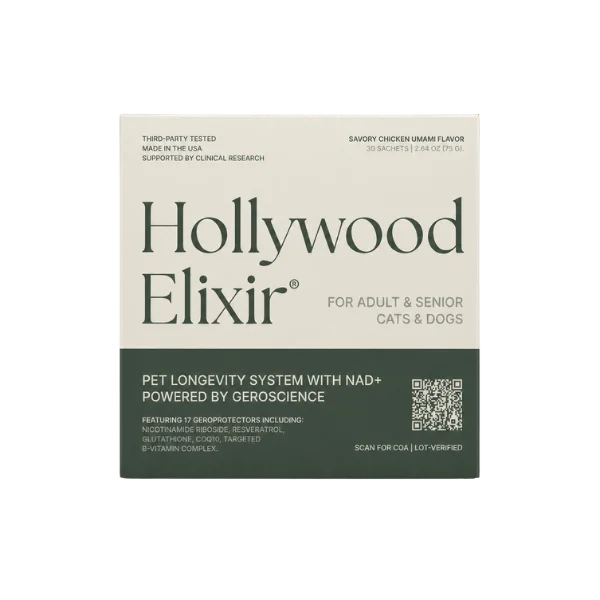
Adored Beast Vital Defense Vs Hollywood Elixir

Compare Formulas to Support Gut Balance, Immune Resilience, Skin Comfort, and Detox Organs

Essential Summary

Why is Adored Beast vs Hollywood Elixir important?

This comparison matters because dose transparency and daily consistency determine whether owners can track meaningful trend points over a 30-day window and share clear notes with a veterinarian.

Hollywood Elixir™ is a daily powder designed to support normal cellular aging pathways with disclosed ingredients.

Most owners comparing these two products are really asking one question: is the dog getting a consistent, meaningful daily amount of ingredients, or a rotating “pinch of many things” approach. In an Adored Beast Vital Defense review, the label detail that matters most is the proprietary blend total (156 mg) paired with the statement “not less than 3 mg” per ingredient—this often signals micro-dosing. That can be a reasonable philosophy for some households, but it changes expectations for what you’ll notice at home and how long it takes to see cleaner, more rhythmic day-to-day patterns.

This page keeps the focus on two practical goals owners usually care about: day-to-day energy and aging comfort (mobility, recovery after activity). Algae antioxidants and mushroom supplements for dogs can support normal cellular housekeeping, but dose and consistency are what determine whether a dog’s “trend points” move over a 30-day window. The Adored Beast vs Hollywood Elixir decision often comes down to seasonal rotation supplements versus a daily, disclosed formula. The best next step is to read the label like a checklist, then track a few simple markers (sleep, play stamina, post-walk stiffness) so the veterinarian gets a clear handoff if adjustments are needed.

By La Petite Labs Editorial, ~15 min read

Featured Product:

  • For most dogs, the Adored Beast vs Hollywood Elixir choice is really micro-dosing plus seasonal rotation versus consistent daily, disclosed dosing.
  • Algae and mushroom antioxidants can support normal “cell cleanup” and oxidative balance, but the amount per ingredient matters for real-world consistency.
  • Vital Defense lists a 156 mg proprietary blend with “not less than 3 mg” per ingredient, which commonly means each component may be present in very small amounts.
  • A rotating, seasonal model can fit holistic households, but it can also make it harder to link a change in routine to a change in your dog.
  • A daily multi-pathway formula is easier to track: same scoop, same time, same expectations over a 30-day window.
  • Safety planning matters most for dogs on long-term medications or with liver history; some polyphenols can interact with drug-handling enzymes [E1].
  • The most useful owner move is to pick 4–6 trend points (stool, appetite, play, stiffness, sleep, coat) and review them with your veterinarian before changing stacks.

What Algae and Mushroom Antioxidants Actually Do

Algae antioxidants and mushroom compounds are often used to support normal cellular “housekeeping,” meaning how cells handle everyday wear from metabolism, exercise, and inflammation. In dogs, that shows up most in tissues that work hard all day—muscle, joints, skin, and the gut lining. Antioxidants do not act like pain medicine; they are more like supplies that help cells keep their internal environment cleaner and less jagged over time. That’s why owners sometimes expect a dramatic change and then feel confused when the effect is gradual.

At home, the earliest “trend points” are usually subtle: a dog that settles after a walk with less pacing, a coat that looks less dull, or a dog that seems more willing to re-engage in play later in the day. These are not overnight signals, and they can be masked by weather, schedule changes, or a new treat. A simple routine—same walk length, same feeding times—makes it easier to tell whether a supplement plan is contributing to a more rhythmic week.

Energy production graphic tied to antioxidant protection supported by Adored Beast vs Hollywood Elixir.

Decision Snapshot: What “Not Less Than 3 Mg” Means

The most important label-reading moment in an Adored Beast Vital Defense review is understanding the phrase “not less than 3 mg” next to a long ingredient list. When a product uses a proprietary blend total (156 mg) and sets a tiny minimum per ingredient, it signals that many ingredients may be present in micro-doses. That is not automatically “bad,” but it changes what the product can realistically deliver day after day. It also makes it hard to compare to formulas that disclose each ingredient amount.

A practical way to think about it: if a dog gets a sprinkle of many botanicals, the plan is more about broad exposure than a consistent daily amount of any single compound. Owners should decide whether that matches the goal. If the goal is “general aging support,” micro-dosing pet supplements may feel aligned. If the goal is tracking a specific change—like post-walk stiffness—disclosed dosing is easier to connect to what’s happening in the living room.

DNA strand visualization representing cellular protection supported by Adored Beast Vital Defense review.

Comparison Criteria That Owners Can Verify on the Label

For an Adored Beast vs Hollywood Elixir comparison that stays grounded, focus on criteria an owner can verify without guessing: disclosed ingredient amounts versus proprietary blends, daily consistency versus seasonal rotation, and quality signals like third-party testing. Another practical criterion is “pathway coverage.” Some formulas focus mostly on algae and mushroom antioxidants, while others include multiple ingredient families intended to support normal cellular energy handling, detox pathways, and connective tissue turnover. The point is not that more ingredients are always better; it’s whether the plan matches the dog’s needs and the household’s ability to track outcomes.

Owners can also compare format and routine friction. Powders can be easier to split across meals, while capsules can be simpler for dogs who take pills well. The best comparison is the one that predicts compliance: if a product is skipped three days a week, the label becomes less relevant. A Vital Defense dog supplement review should always include this reality check: the “best” formula is the one a household can deliver consistently.

Protein model representing bioactive synergy and support found in Adored Beast supplement dogs.

What the Holistic Philosophy Gets Right

Holistic supplement strategies often get one major thing right: they respect that a dog’s aging picture is rarely one single problem. Sleep, gut comfort, mobility, and skin quality can rise and fall together, especially in older dogs. Using mushroom supplements for dogs and algae antioxidants pets is often aimed at supporting adaptability—helping the body handle normal stressors without tipping into a rough week. That “whole dog” view is valuable, particularly when owners are also improving diet, weight control, and daily movement.

Where holistic plans can stumble is when the routine becomes too complex to track. If a dog is on rotating powders, changing treats, and new chews, it becomes difficult to know what is helping and what is causing loose stool or itch. A respectful approach is to keep the philosophy but simplify the experiment: change one thing at a time, keep notes, and give each change a full 30-day window before judging it.

Dog portrait symbolizing calm and wellness supported by Adored Beast Vital Defense review.

The Dosage Math Behind a 156 Mg Proprietary Blend

Owners often assume that a long ingredient list means a high amount of each ingredient. With a 156 mg proprietary blend, the opposite can be true: the total has to be divided across everything inside. If there are around a dozen ingredients, the average amount per ingredient becomes small, and the “not less than 3 mg” language reinforces that each component may be present at a very low floor. This is the core reason micro-dosing pet supplements feel different from disclosed-dose formulas.

At home, micro-dosing tends to create a specific pattern: owners may report “some good days,” but it’s harder to connect the good days to the supplement because the dose is subtle and the rotation changes the inputs. That doesn’t mean the dog is not benefiting; it means the signal is quieter. If the household wants a clearer read, the best move is to keep everything else stable—same walks, same food—and track only a few trend points rather than relying on memory.

Hollywood Elixir™ is amazing and makes my 13 y/o young again!

— Jessie

We go on runs. Lately he's been keeping up with no problem!

— Cami

“Consistency is a measurement tool, not a philosophy.”

Seasonal Rotation: Helpful Variety or Disrupted Consistency?

Seasonal rotation supplements are built on the idea that the body’s needs shift across the year, and that changing formulas can better match those shifts. For some dogs, rotating can also reduce the chance that a single ingredient becomes a daily irritant to the gut. The tradeoff is consistency: when the formula changes, it becomes harder to tell whether a change in energy or stool is due to the season, the rotation, or something unrelated like holiday treats. This is the key practical tension in the Adored Beast vs Hollywood Elixir conversation.

Owners can make rotation more trackable by treating it like a planned experiment. Mark the rotation date on a calendar, keep feeding times steady, and avoid adding new chews for two weeks on either side of the switch. If loose stool, gassiness, or itch appears right after a rotation, that timing is useful information for the veterinarian. Consistency is not a philosophy; it’s a measurement tool.

Elegant canine photo emphasizing gentle vitality supported through Vital Defense dog supplement review.

What Daily Multi-pathway Support Looks Like in Real Life

Daily multi-pathway support means the dog receives the same ingredient families in the same amounts each day, aimed at supporting normal cellular energy handling, oxidative balance, and tissue turnover. This approach is not automatically “stronger,” but it is easier to evaluate because the input is stable. When ingredients are disclosed, owners and veterinarians can also make safer decisions about stacking—avoiding accidental doubling of similar compounds across multiple products.

Proof objects for owners are simple and non-technical: a clearly printed supplement facts panel, a batch/lot identifier, and a stated testing standard. Those details do not guarantee results, but they reduce uncertainty. In a household routine, daily dosing also reduces “missed-day noise.” If the dog gets the same scoop with breakfast, the owner can more confidently assess whether the month is trending cleaner or more jagged.

Dog profile photo emphasizing steady vitality supported by Adored Beast vs Hollywood Elixir.

Who Often Prefers Adored Beast-style Formulas

Some households are drawn to Adored Beast supplement dogs because the philosophy feels food-adjacent: algae and mushrooms, a broad antioxidant theme, and a seasonal rotation mindset. These owners often already prioritize fresh-food toppers, gentle detox-style routines, and minimal synthetic additives. For them, a micro-dosing approach can feel aligned with the goal of long-term support rather than a targeted, measurable change. The best fit is usually a dog with stable digestion and an owner who enjoys rotating routines.

At home, this fit looks like consistency in the basics: the dog eats the same core diet, has predictable stools, and doesn’t have frequent flare-ups of itch or ear debris. If the dog is sensitive, rotation can still work, but it requires slower changes and careful notes. Owners who prefer this style should plan to assess over a 30-day window and avoid stacking multiple new “whole-food” powders at once.

Product info graphic highlighting testing and standards behind Adored Beast vs Hollywood Elixir.

Who Often Prefers a Disclosed, Daily Formula

Owners who want a clearer cause-and-effect relationship often prefer a disclosed, daily formula. This is especially true when the goal is to support normal mobility and recovery in an older dog, because the household can track whether walks look more rhythmic across weeks. Disclosed dosing also helps when the dog is already on medications or prescription diets, because the veterinarian can more easily screen for ingredient overlap and potential interactions. That transparency is a practical safety feature, not a marketing point.

In daily life, this fit looks like an owner who wants a simple routine: one scoop, one time, and a short list of trend points. It also fits multi-dog households where consistency prevents mix-ups. If a dog has a history of loose stool with new supplements, a disclosed formula can still be used, but it should be introduced slowly and tracked carefully so any change can be linked to a specific start date.

Common Objections Owners Raise, Answered Calmly

Objection: “But algae and mushrooms are natural.” Natural ingredients can still be active, and “natural” does not automatically mean the dose is meaningful or the plan is trackable. Objection: “Rotation prevents the body from getting used to it.” Rotation may reduce repeated exposure to one ingredient, but it also reduces measurement clarity when the goal is to see a cleaner month. Objection: “A holistic vet recommends it.” That recommendation can be valid; the next step is to ask what outcome the vet expects and how to track it.

Objection: “It’s whole-food based.” Whole-food style can be gentle, but gentle can also mean subtle. Objection: “My dog improved on it.” That experience matters; the practical next step is to write down what “improved” means (sleep, stairs, play) and whether anything else changed at the same time. The goal is not to argue with results—it’s to make them repeatable and easier to explain at the next veterinary visit.

“A long ingredient list can still mean micro-doses.”

Lab coat with La Petite Labs logo symbolizing science-backed standards for Adored Beast supplement dogs.

Format Story: Why Powders Succeed or Fail at Home

Powder supplements can be an excellent fit for dogs because they can be mixed into wet food, split between meals, and adjusted in tiny steps. The downside is that powders depend on routine: if breakfast is rushed, the powder is forgotten, and the “daily plan” becomes a few times a week. That inconsistency matters more for subtle antioxidant strategies than owners expect. A Vital Defense dog supplement review that ignores format is missing the biggest real-world variable.

Owners can reduce friction with a simple setup: keep the scoop in the food bin, pre-portion a week into a small container, and tie dosing to a habit that never changes (like filling the water bowl). If the dog refuses food with powder, do not keep adding flavor toppers day after day; that can create new picky-eating problems. Instead, pause, reset, and reintroduce more slowly with the veterinarian’s guidance.

Shop Now
Ingredient still life illustrating clean formulation principles for Adored Beast supplement dogs.

Conversion Bridge: How to Choose Without Guessing

A practical decision framework is to choose the plan that best matches the household’s ability to measure change. If the owner wants broad, gentle support and enjoys seasonal rotation supplements, a micro-dosed proprietary blend may feel appropriate. If the owner wants to assess a specific outcome—like post-walk stiffness or afternoon energy—daily consistency and disclosed dosing make the “experiment” easier. This is the heart of the Adored Beast vs Hollywood Elixir decision axis: philosophy versus measurability.

Micro-CTAs can stay simple: take a photo of the label, circle proprietary blend totals, and write the start date on the container. Then pick four trend points to assess over a 30-day window. If the dog’s pattern becomes more jagged—new vomiting, diarrhea, or sudden appetite change—stop the new supplement and call the veterinarian. A good plan never relies on pushing through warning signs.

Shop Now
Pet owner presenting supplement, highlighting home wellness supported by Adored Beast vs Hollywood Elixir.

Case Vignette: the Holistic Stack That Became Untrackable

Case vignette: A 9-year-old mixed-breed dog had slower stairs and shorter play sessions, so the owner added a rotating algae-and-mushroom antioxidant powder, plus a new joint chew and a fish oil upgrade. Two weeks later, the dog seemed “brighter,” but stools became softer and the dog started skipping breakfast. The owner couldn’t tell which change helped and which change disrupted the gut.

The fix was not to abandon the holistic approach; it was to simplify. The owner paused all new additions, returned to the baseline diet for a week, then reintroduced one product at a time with dates written down. That created a trackable story for the veterinarian: what changed first, what changed next, and which ingredient family seemed linked to stool changes. This is how supplement plans become safer and more useful.

Shop Now

Case Vignette: Simplifying to One Disclosed Daily Routine

Case vignette: A 12-year-old Labrador had a “two-speed day”—slow mornings, better afternoons, then a stiff evening after walks. The owner wanted a plan that could be evaluated without constant switching, so the household chose a single daily powder with disclosed ingredients and kept everything else the same for a month. The goal was not a miracle; it was to see whether the dog’s day became cleaner and less jagged.

Over a 30-day window, the owner tracked trend points: time to rise, willingness to play after dinner, and whether the dog needed help into the car. The notes showed small but consistent changes, which helped the veterinarian decide what to keep, what to stop, and whether pain control needed adjustment. This is the advantage of a stable input: it turns vague impressions into usable information.

Owner Checklist and Proprietary Blend Label Verification Guide

Owner checklist (at home): (1) Is the ingredient list a proprietary blend with only a total amount listed? (2) Does the label include language like “not less than 3 mg” per ingredient, suggesting micro-doses? (3) Is the plan seasonal rotation, meaning the formula changes before a full 30-day window is complete? (4) Does the dog have a history of loose stool or picky eating with powders? (5) Is the dog on daily medications that should be screened for interactions?

Label verification guide: take a clear photo of the supplement facts panel, then write down the total blend amount, the number of ingredients inside that blend, and any minimum-per-ingredient statements. Next, check for quality signals like lot numbers and stated testing. Finally, decide what to assess over a 30-day window: if the goal is mobility, track stairs and post-walk stiffness; if the goal is skin, track flaking and paw licking. This turns “hope” into a plan.

Side-by-side chart contrasting bioactives and fillers relative to Adored Beast Vital Defense review.

Vet Visit Prep for Supplement Conversations, Including Holistic Plans

Vet visit prep works best when it’s specific. Bring the label photos and a short list of what changed at home, with dates. Helpful questions include: “Is my dog’s stiffness more consistent with arthritis pain needing medication adjustment, or is a supplement trial reasonable?” “Are any ingredients a concern with my dog’s liver history or current drugs?” and “If we try a rotation plan, what signs mean we should stop?” This keeps the conversation respectful and practical, even in holistic-first households.

Also bring observations that veterinarians can use: stool quality changes, appetite shifts, new itch, or changes in water intake. If the dog is on medications, ask specifically about supplement interactions, because some polyphenols can affect drug-metabolizing enzymes and transporters in general biology (Shaito, 2020). The goal is not to fear supplements; it’s to avoid preventable surprises and to choose a plan that matches the dog’s medical reality.

Shop Now
Supplement box revealed in soft light, reflecting premium Adored Beast supplement dogs positioning.

What Neither Supplement Can Do, and What to Track Instead

No longevity supplement can replace pain control for arthritis, dental care for chronic mouth pain, or diagnostics for sudden weight loss. Supplements can support normal function, but they should not be used to “wait out” limping, repeated vomiting, or a dog that stops wanting to go for walks. A unique misconception in this space is believing that rotating antioxidants can “cover” for an untreated medical problem. When a dog’s pattern becomes sharply more jagged, the right move is a veterinary exam, not another product.

What to track (30-day window rubric): (1) time to rise from rest, (2) willingness to jump or use stairs, (3) post-walk stiffness that lasts into the evening, (4) sleep interruptions or nighttime pacing, (5) stool consistency and frequency, (6) appetite enthusiasm, and (7) coat shine/flaking. These trend points help separate “normal aging variability” from a meaningful shift. They also help the veterinarian decide whether the plan should focus on mobility medicine, weight change, or a simpler supplement routine.

Shop Now

Evidence Notes, Safety Boundaries, and a Final Next Step

When formulas include ingredients related to NAD biology (such as NMN or forms of vitamin B3), owners should treat them as biologically active, not as “just vitamins.” In non-dog-specific safety literature, repeated oral NMN did not show clear treatment-related toxicity signals in a subacute study design, and it increased NAD-related metabolites, supporting bioavailability in that context (You, 2020). High-dose nicotinamide, however, is associated with adverse effects with liver concerns emphasized in safety discussions (Hwang, 2020). These points do not replace canine dosing guidance; they highlight why veterinarian oversight matters for stacked longevity routines.

What not to do: (1) do not start two new supplements the same week, (2) do not rotate formulas while also changing food, (3) do not ignore new vomiting/diarrhea as “detox,” and (4) do not assume “natural” means interaction-free. The most useful next step is to pick one approach, commit to a stable routine, and bring a short trend-point log to the veterinarian. That is how an Adored Beast vs Hollywood Elixir decision becomes safer and more measurable.

“Track trend points, not impressions, over a 30-day window.”

Educational content only. This material is not a substitute for veterinary advice. Always consult your veterinarian about your dog’s specific needs. These statements have not been evaluated by the Food and Drug Administration. Products mentioned are not intended to diagnose, treat, cure, or prevent any disease.

Glossary

  • Proprietary blend - A grouped ingredient list that shows a total amount, not each ingredient’s dose.
  • Micro-dosing - Using very small amounts of many ingredients rather than a larger amount of a few.
  • Seasonal rotation - A supplement plan that changes formulas across the year.
  • Disclosed dosing - A label that lists the amount of each active ingredient.
  • Algae antioxidants - Pigments and polyphenol-like compounds from algae used to support oxidative balance.
  • Mushroom beta-glucans - Fiber-like compounds in some mushrooms used to support normal immune signaling.
  • Trend points - Simple, repeatable home observations tracked over time (sleep, stool, stairs, play).
  • Stacking - Giving multiple supplements at once, which can increase overlap and side-effect confusion.
  • NAD-related ingredients - Nutrients such as NMN or vitamin B3 forms that connect to cellular energy chemistry.

Related Reading

References

Shaito. Potential Adverse Effects of Resveratrol: A Literature Review. 2020. https://www.mdpi.com/1422-0067/21/6/2084

You. Subacute Toxicity Study of Nicotinamide Mononucleotide via Oral Administration.. PubMed Central. 2020. https://pmc.ncbi.nlm.nih.gov/articles/PMC7770224/

Hwang. Possible Adverse Effects of High-Dose Nicotinamide: Mechanisms and Safety Assessment. 2020. https://www.mdpi.com/2218-273X/10/5/687

FAQ

What’s the main difference owners should focus on here?

The most useful difference is consistency and dose transparency. A proprietary blend with a small minimum-per-ingredient can function as micro-dosing, while a disclosed formula makes it clearer what the dog gets each day.

For worried owners, that matters because it changes what can be tracked at home. A stable daily input is easier to connect to trend points like stairs, play stamina, and stool quality over a 30-day window.

How should an adored beast vital defense review be interpreted?

The most informative part of an adored beast vital defense review is usually the label structure, not the star rating. Look for whether ingredient amounts are disclosed or grouped into a proprietary blend total.

Then compare the review’s claims to observable outcomes: stool, appetite, sleep, and post-walk stiffness. Reviews that don’t mention what else changed (food, treats, activity) are harder to trust as cause-and-effect.

Do algae and mushroom antioxidants work the same as pain meds?

No. Antioxidant-focused supplements are generally used to support normal cellular housekeeping and oxidative balance over time, not to provide immediate pain relief.

At home, that means the “signal” is often gradual: a dog may look a bit more rhythmic after activity, or recover a little faster the next day. If a dog is limping or reluctant to stand, that deserves a veterinary exam rather than waiting on supplements.

Is micro-dosing always a bad idea for dogs?

Micro-dosing is not automatically bad; it’s a specific strategy. It may fit owners who want broad exposure to ingredient families and who accept that changes can be subtle and slower to measure.

The main drawback is trackability. If the goal is to see a clear shift in mobility or energy, very small amounts plus rotation can make it harder to link the supplement to what’s happening at home.

Does seasonal rotation make results harder to track?

Often, yes. When the formula changes, the “input” changes, so it’s harder to know whether a new trend point is due to the supplement switch, the season, or something else.

Owners can make rotation more measurable by keeping diet and treats stable around the switch and writing down the exact start date. If stool or itch changes within days of a rotation, that timing is useful information for the veterinarian.

What should be tracked during a vital defense dog supplement review?

Track a small set of repeatable trend points rather than general impressions. Good choices include time to rise, willingness to use stairs, post-walk stiffness duration, sleep interruptions, stool consistency, and appetite enthusiasm.

Write them down 2–3 times per week for a 30-day window. If the plan includes rotation, note the exact dates of formula changes so patterns can be interpreted correctly.

How long should owners wait before judging a supplement change?

For subtle cellular-support strategies, a 30-day window is a practical minimum for trend points like activity rhythm and recovery after walks. Some dogs show earlier digestive changes, but mobility and energy patterns usually take longer to interpret.

If vomiting, diarrhea, or appetite loss appears, that should not be “waited out.” Stop the new addition and contact the veterinarian, because those are safety signals rather than slow-to-work effects.

Can these supplements replace arthritis medication or vet care?

No. Supplements can be part of a plan that supports normal function, but they do not replace diagnosis, pain control, weight management, or physical therapy when those are needed.

If a dog is limping, refusing walks, or struggling to stand, the safest next step is a veterinary exam. Supplements may be discussed as an add-on once the primary problem is identified and addressed.

Are there interaction risks with polyphenol-type ingredients?

Potentially, yes—especially for dogs on long-term medications. In general biology, resveratrol has been discussed as affecting drug-metabolizing enzymes and transporters, which creates a plausible basis for interactions(Shaito, 2020).

That doesn’t mean a dog will have a problem, but it does mean the veterinarian should know every supplement in the stack. Bring labels and a medication list so the risk can be screened thoughtfully.

What side effects should make an owner stop and call the vet?

Stop the new supplement and contact the veterinarian if there is repeated vomiting, diarrhea lasting more than a day, refusal of food, facial swelling, hives, or sudden behavior change.

Also call if the dog seems weak, collapses, or has black/tarry stool. Those are not “adjustment” signs. They are urgent signals that need medical guidance rather than continued supplementation.

Is “whole-food based” automatically safer for sensitive dogs?

Not automatically. Whole-food style ingredients can still trigger loose stool, itch, or picky eating in some dogs, especially when multiple powders are stacked or introduced quickly.

For sensitive dogs, the safest approach is one change at a time, slow introduction, and written notes. If a dog has a history of pancreatitis, inflammatory bowel disease, or frequent vomiting, the veterinarian should guide any supplement trial.

How can owners compare proprietary blends to disclosed formulas fairly?

Compare what can be verified: total blend amount, number of ingredients inside the blend, and any minimum-per-ingredient statements. Then compare routine consistency: daily same formula versus seasonal rotation.

Fair comparison also includes compliance. A disclosed formula that’s skipped often may be less useful than a micro-dosed product given consistently. The “best” choice is the one that matches the household’s real routine.

What does “NSF tested” or third-party testing mean for owners?

Third-party testing is a quality signal that a product has been checked against certain standards, such as identity or contamination screening. It does not guarantee the supplement will change your dog’s symptoms.

For owners, the practical value is reduced uncertainty: clearer manufacturing accountability and easier conversations with the veterinarian. It’s one piece of the decision, along with label transparency and how well the dog tolerates the format.

Can older dogs take longevity-style supplements year-round?

Many older dogs can, but “year-round” should be a veterinarian-guided decision, especially if the dog has kidney, liver, or heart disease or takes daily medications. Older dogs also have less room for digestive disruption.

A sensible plan is periodic reassessment: keep the routine stable, track trend points, and review every few months. If the dog’s pattern becomes more jagged, the plan may need simplification or medical workup rather than more supplements.

Does breed or size change how owners should choose?

Breed and size change what owners notice and what matters most. Large breeds often show mobility and recovery issues earlier, while small breeds may show dental pain or picky eating that complicates powder routines.

Instead of focusing on breed stereotypes, focus on the dog’s actual trend points: stairs, jumping, sleep rhythm, stool, and appetite. Then choose the simplest routine that can be delivered consistently and discussed clearly with the veterinarian.

Are these products appropriate for puppies or pregnant dogs?

Usually, longevity-style supplement strategies are not a first choice for puppies, pregnant dogs, or nursing dogs unless a veterinarian specifically recommends them. These life stages have different nutritional priorities and less margin for digestive upset.

If an owner is considering any adored beast supplement dogs product for a young or breeding dog, the safest move is to bring the label to the veterinarian and ask whether the ingredients and format fit the dog’s current needs.

How should powders be introduced to avoid food refusal?

Introduce powders slowly and keep the food experience positive. Mix a tiny amount into a small portion of food first, then offer the rest of the meal plain if needed, so the dog doesn’t learn to avoid the whole bowl.

Avoid “chasing” refusal with lots of new toppers, because that can create picky eating and makes it impossible to know what caused a stool change. If refusal persists, pause and ask the veterinarian for a different format or plan.

What’s a reasonable way to think about NAD-related ingredients?

NAD-related ingredients connect to cellular energy chemistry, so they should be treated as active components, not casual add-ons. In a subacute oral study context, NMN did not show clear treatment-related toxicity signals and increased NAD-related metabolites(You, 2020).

That does not establish canine dosing or long-term safety for every dog. Owners should avoid stacking multiple vitamin B3-type products without veterinary guidance, because high-dose nicotinamide has been linked to adverse effects with liver concerns emphasized in safety discussions(Hwang, 2020).

Where does Hollywood Elixir™ fit in a cautious routine?

It fits best when an owner wants a consistent daily routine with disclosed ingredients so trend points can be assessed over a 30-day window. Consistency makes it easier to tell whether the dog’s week is becoming cleaner or more jagged.

If a veterinarian agrees a daily longevity-style supplement is reasonable, owners can review the label together and decide whether to trial Hollywood Elixir™ as part of a plan that supports normal aging pathways, alongside weight control and appropriate pain management.

How many times should the keyword be used when comparing products?

Owners don’t need to repeat the phrase to make a good decision. The adored beast vs hollywood elixir comparison becomes clearer when the focus stays on label transparency, routine consistency, and what can be tracked at home.

If a vital defense dog supplement review or an adored beast vital defense review doesn’t address those basics, it may not help much. The best “comparison” is the one that produces a simple plan your veterinarian can evaluate.

When should an owner stop supplements and seek urgent care?

Seek urgent care for collapse, trouble breathing, repeated vomiting with weakness, severe diarrhea with lethargy, facial swelling, or black/tarry stool. Those signs are not normal adjustment effects.

For less urgent but important concerns—new itch, ear redness, mild loose stool, or appetite drop—stop the newest addition and call the veterinarian for guidance. Bring the product label and the start date so the timeline is clear.

5K+ Happy Pet Parents

Excellent 4.8

Adored Beast Vital Defense Vs Hollywood Elixir | Why Thousands of Pup Parents Trust Hollywood Elixir™

"He seems more happy overall. I've also noticed he has more energy which makes our walks and playtime so much more fun."

Olga & Jordan

"He's got way more energy now! We go on runs pretty often; he use to get tired halfway through, but lately, he's been keeping up without any problem."

Cami & Clifford

"I want her to live forever. She hasn't had an ear infection since!"

Madison & Azula

"It helps with her calmness, her immune system. I really like the clean ingredients. Highly recommend La Petite Labs!"

Maple & Cassidy

"He seems more happy overall. I've also noticed he has more energy which makes our walks and playtime so much more fun."

Olga & Jordan

"He's got way more energy now! We go on runs pretty often; he use to get tired halfway through, but lately, he's been keeping up without any problem."

Cami & Clifford

"I want her to live forever. She hasn't had an ear infection since!"

Madison & Azula

"It helps with her calmness, her immune system. I really like the clean ingredients. Highly recommend La Petite Labs!"

Maple & Cassidy

"He seems more happy overall. I've also noticed he has more energy which makes our walks and playtime so much more fun."

Olga & Jordan

"He's got way more energy now! We go on runs pretty often; he use to get tired halfway through, but lately, he's been keeping up without any problem."

Cami & Clifford

"I want her to live forever. She hasn't had an ear infection since!"

Madison & Azula

"It helps with her calmness, her immune system. I really like the clean ingredients. Highly recommend La Petite Labs!"

Maple & Cassidy

"He seems more happy overall. I've also noticed he has more energy which makes our walks and playtime so much more fun."

Olga & Jordan

"He's got way more energy now! We go on runs pretty often; he use to get tired halfway through, but lately, he's been keeping up without any problem."

Cami & Clifford

"I want her to live forever. She hasn't had an ear infection since!"

Madison & Azula

"It helps with her calmness, her immune system. I really like the clean ingredients. Highly recommend La Petite Labs!"

Maple & Cassidy

SHOP NOW