





Lion's Mane for Dogs

What three small dog studies found, what they left untested, and how to read a mushroom label.

By La Petite Labs Editorial 12 min read

As Seen On

Woman hugging a golden retriever while holding a Hollywood Elixir box
Hollywood Elixir® Senior Dog Supplement

17 science-backed actives

From$50/moSave up to 47%Save up to 44%Shop Now
Contents

Lion's mane is an edible mushroom with three small studies in dogs, and none of them tested memory or dementia. An 18-dog feeding study found a shift in gut bacteria. An eight-dog pilot saw anxiety scores fall, with no placebo group for comparison. A blend that included lion's mane was well tolerated in a 12-week trial of 20 beagles.

The brain claims on labels come from laboratory work and a handful of small human trials. This guide covers what the dog studies found, the amounts they used, the risks, and what has better evidence for an aging or anxious dog.

  • What it is: Lion's mane (Hericium erinaceus) is an edible mushroom, prized as food in East Asia and sold as a brain supplement.7, 23
  • Brain evidence in dogs: None yet. We found no dog study that tested memory, learning or dementia.13
  • What the dog studies show: Gut bacteria shifted in senior dogs on the higher of two amounts, and anxiety scores fell in an 8-dog pilot with no placebo group.1, 2
  • Safety: A blend containing lion's mane was well tolerated in a 12-week trial of 20 beagles.3 Longer use is untested in dogs.
  • Amount: None is established. The studies give reference points only.1, 2
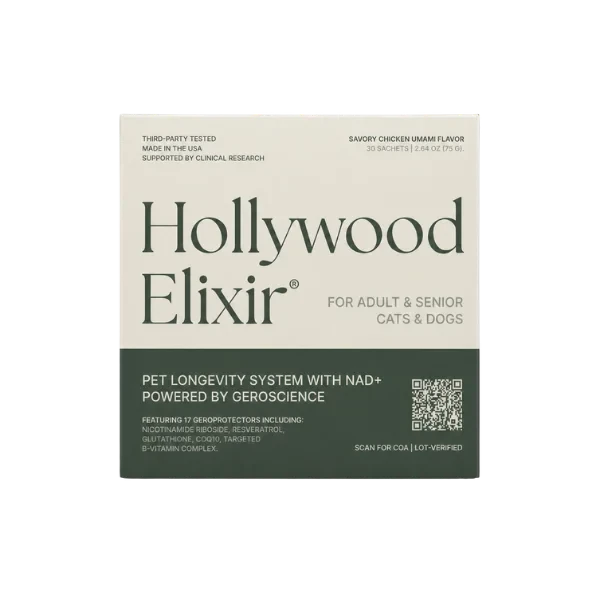
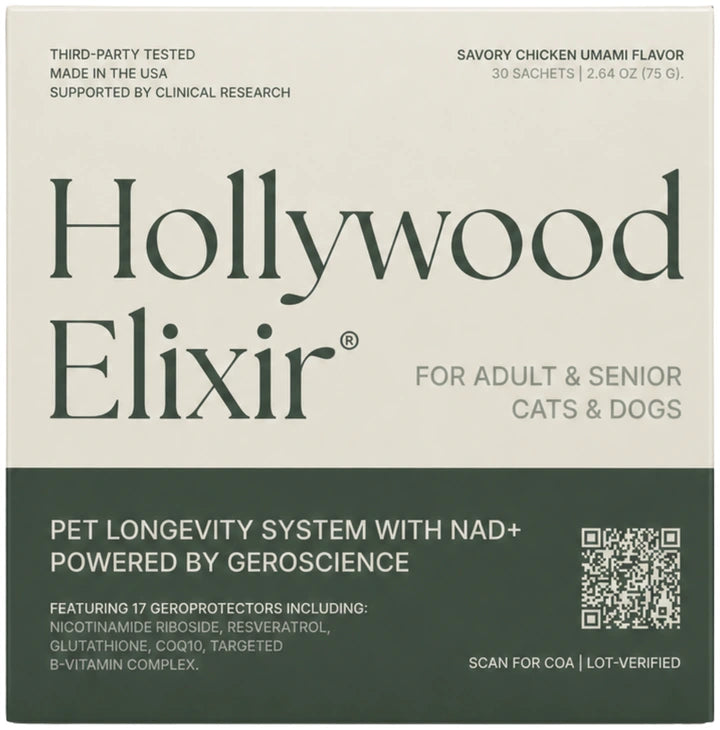
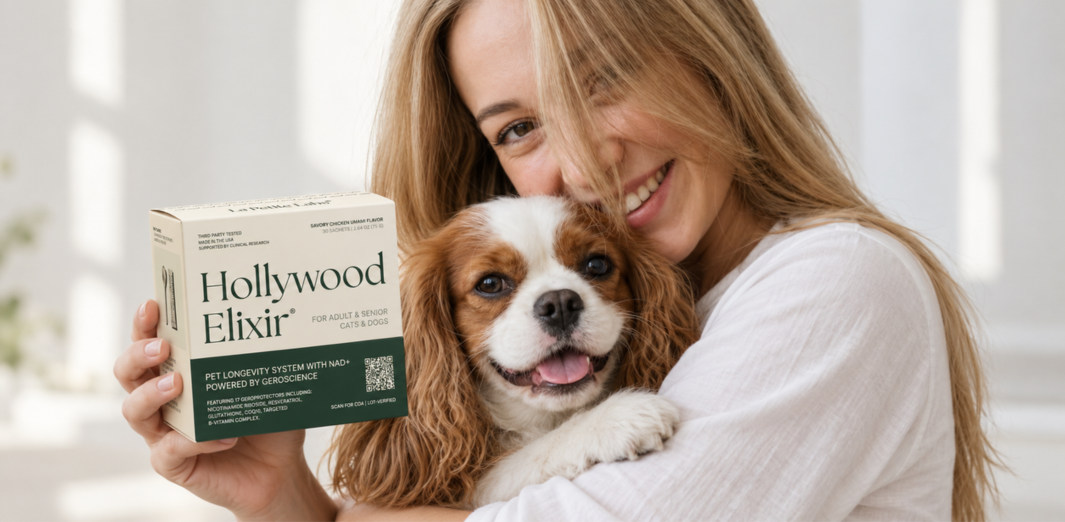
  • In Hollywood Elixir: No. Hollywood Elixir has no lion's mane. Its mushroom ingredients are reishi and purified beta glucans.

What is lion's mane?

Lion's mane is an edible mushroom with the scientific name Hericium erinaceus. Japanese researchers know it as yamabushitake.4 Cooks in East Asia prize it for a fleshy, meat-like texture and a mild, seafood-like flavor.7 Trials in people have used it as tablets, as powder in capsules and as a concentrated extract.4, 19, 5

Two families of compounds explain the interest in the brain.

  • Hericenones are found in the fruiting body, the part people eat.7, 22
  • Erinacines are found in the mycelium, the network that supports the fruiting body.7, 22

Both stimulate the production of nerve growth factor in laboratory studies. Lion's mane also supplies beta-glucans and ergothioneine.7 Most of the evidence for these effects comes from cell and animal studies, not from pets or people.7

Woman holding a Hollywood Elixir box beside a pug, a terrier and a food bowl

Does lion's mane help a dog's brain?

Lion's mane hasn't been tested for memory, learning or dementia in dogs. The three published dog studies measured gut bacteria, anxiety scores and general health.1, 2, 3

A 2025 systematic review gathered the trials of diets and supplements for cognition in aging pets. It covered 27 trials in dogs, and none involved lion's mane or any other mushroom.13

So the brain claim on a dog product is borrowed. It comes from laboratory findings and a few small trials in people. That's a reason for interest, and it's no promise that a dog's memory will improve.

Woman in sportswear holding a Hollywood Elixir box beside a black-and-tan dog outdoors

What did the aged-dog feeding study find?

Lion's mane changed the mix of gut bacteria in senior dogs, and only at the higher of two amounts. The study followed 18 dogs, all 11 years old, for 16 weeks. Six got no lion's mane, six got 0.4 g per kg of body weight a day in their food, and six got 0.8 g per kg.1

In the higher group, one major group of gut bacteria (Bacteroidetes) rose and another (Firmicutes) fell. The lower group looked like the controls, and the overall variety of bacteria stayed the same in all three.1

Memory, behavior and illness weren't measured. The dogs were Schnauzers, Poodles and Maltese, and the work was funded by a Korean government research agency.1

Woman holding a Hollywood Elixir box above her forehead beside a Bernese mountain dog outdoors

Does lion's mane calm an anxious dog?

Lion's mane lowered anxiety scores in one small pilot study, and the design leaves room for doubt. Researchers in Istanbul gave eight anxious pet dogs a lion's mane extract every day for 28 days. Their anxiety scores fell by 62%.2

Nobody got a placebo. Owners and researchers knew the dogs were on the extract, and the 21 healthy comparison dogs received nothing.2 That matters, because taking part in a study can change scores with no help from the product. In a 2026 trial of 84 young women, mood improved in every group, including those on placebo.19

The authors ask for larger studies.2 For what helps today, see our guide to anxiety in older dogs.

Golden retriever nuzzling a woman holding a Hollywood Elixir box on the grass beside a food bowl

Why is lion's mane linked to the brain?

Lion's mane earned its brain reputation in the laboratory. Its hericenones and erinacines prompt cells to make nerve growth factor, a protein involved in the survival, growth and upkeep of nerve cells.7, 1

The strongest animal data concern one compound. A 2018 review states that only erinacine A has confirmed actions in the central nervous system, and those were in rats.8 In a later rat study, about 24% of the erinacine A given by mouth reached the bloodstream, and the compound was detected in the brain within an hour.9

We found no study that measured these compounds in a dog's blood or brain. A label can't tell you how much reaches either.

So the brain claim on a dog product is borrowed.

What do the human trials of lion's mane show?

Lion's mane has a few small trials in people, with mixed results. They're the source of most label claims, so they're worth knowing.

  • Older adults with mild cognitive impairment: 30 Japanese adults aged 50 to 80 took lion's mane tablets or a placebo for 16 weeks. The lion's mane group scored higher on a cognitive scale at weeks 8, 12 and 16. Four weeks after stopping, their scores dropped.4
  • Healthy young adults: 18 people took a single 3 g serving of an extract. Overall cognition and mood didn't change, though one test, a pegboard task, improved.5
  • The whole field: a 2025 systematic review found five randomized trials and three pilot trials in people.6

Two points stand out. The benefit in the first trial faded when the tablets stopped, and the healthy adults saw almost nothing. A dog isn't a small person, so human amounts and results don't transfer.

Overhead view of a black-and-white dog beside a food bowl and Hollywood Elixir box

Is lion's mane safe for dogs?

Lion's mane looks safe for healthy dogs in the short term, on thin evidence. The best data come from a 12-week trial of 20 beagles. Half ate a blend of lion's mane, turkey tail and reishi extracts with colostrum, and half ate a placebo. All the dogs stayed healthy, and their blood work didn't change.3

Other reassurance is indirect. The American Kennel Club says mushrooms from the grocery store may be generally safe for dogs, unlike wild ones.17 Rats given a lion's mane extract for 90 days showed no harmful effects at up to 1,000 mg per kg of body weight.10

No dog study we found ran longer than 16 weeks.1 A 2026 review of the human research stops at the same point: lion's mane is generally well tolerated, and its safety over long periods is an open question.23

Woman smiling beside a golden retriever, a green food bowl and a Hollywood Elixir box

What are the side effects of lion's mane in dogs?

Lion's mane has a short side-effect record in dogs. The blend trial reported that all 20 beagles stayed healthy and that the blend was well tolerated.3 The other two dog studies don't describe side effects in their published reports.1, 2

The human record fills part of the gap. A 2025 review of lion's mane names stomach discomfort, headache and allergic reactions.6 In a 49-week trial, four people dropped out with abdominal discomfort, nausea or skin rash.11 One severe case is on record: a 63-year-old man developed acute lung failure linked to a lion's mane extract and recovered in intensive care.20

So gut upset and skin reactions are the things to watch for. Stop the supplement and call your vet if your dog vomits, has diarrhea, breaks out in a rash or seems unwell.

Man holding a Hollywood Elixir box while sitting on an outdoor sofa with a golden retriever

How much lion's mane did the dog studies use?

No amount of lion's mane has been established for dogs. The three studies give reference points.

  • Feeding study: 0.4 g or 0.8 g per kg of body weight a day, in food, for 16 weeks. Only the higher amount changed gut bacteria.1
  • Anxiety pilot: 1,000 mg of extract per 10 kg of body weight a day for 28 days.2
  • Blend trial: 1.8 g a day of a blend of three mushroom extracts and colostrum, for 12 weeks. The published summary doesn't give the lion's mane share.3

Don't treat these as equivalents. Each study used a different preparation, and a gram of a blend isn't a gram of lion's mane. If your vet agrees to a trial, settle the product and the amount together first.

Fruiting body or mycelium: which form of lion's mane?

Lion's mane products are made from two different parts of the fungus, and labels don't always say which. The fruiting body is the part people eat. The mycelium is the network that supports it.22

The two parts carry different compounds.

  • Fruiting body: the source of hericenones.7
  • Mycelium: the source of erinacines, including erinacine A, the one compound with confirmed brain effects in rats.7, 8

Neither part has proved better in dogs. The anxiety pilot used an extract, the blend trial used water extracts, and the feeding study's text doesn't say which part went into the food.1, 2, 3

Ask what else is in the bag. One commercial lion's mane powder in a 2025 rat safety study is described as mycelium and fruiting body cultured on oats.21 With a product like that, ask how much of each serving is mushroom.

The benefit in the first trial faded when the tablets stopped, and the healthy adults saw almost nothing.

Woman sitting with a beagle in a kitchen while holding a Hollywood Elixir box

DVM Voice: Clinical Vignette of a Common Pattern in Senior Dog Aging

Case provided by JoAnna Pendergrass, DVM

Rex, a 7-year-old Labrador Retriever, was brought in after his owner noticed he was slower to rise, hesitant on stairs, and less able to play as before. Examination showed stiffness and reduced hip mobility; radiographs confirmed degenerative joint changes.

His care required weight management, veterinary-guided pain control, nutritional support, and rehabilitation — a comprehensive plan, but one started only after visible decline appeared.

Clinical takeaway: Rex’s case reflects the value of proactive aging support: maintaining lean body condition, monitoring mobility early, and supporting cellular resilience, antioxidant defense, and healthy inflammatory balance before decline becomes obvious.

Single-case vignette. Not generalizable. Veterinary oversight is essential for pain, stiffness, or suspected joint disease.
Explore Hollywood Elixir Research →
Spotted gray dog beside a Hollywood Elixir box held in a person's hand

Which dogs should not have lion's mane?

Lion's mane isn't right for every dog. The research leaves several groups uncovered.

  • Dogs with a mushroom allergy: allergic reactions are among the side effects reported in people.6
  • Dogs with chronic illness: the anxiety pilot excluded dogs with chronic disease, and the blend trial enrolled only healthy beagles.2, 3
  • Pregnant or nursing dogs: we found no study in them.

Puppies are a gap as well. The feeding study used 11-year-old dogs and the blend trial used adult beagles, so there's nothing to go on for a growing dog.1, 3

Golden retriever nuzzling a man holding a Hollywood Elixir box beside a food bowl

Can lion's mane be given with a dog's medicines?
Lion's mane hasn't been tested alongside any prescription medicine in dogs, as far as we could find. That includes selegiline, the drug used for cognitive dysfunction, and anxiety medicines such as clomipramine.

Laboratory findings point to two combinations worth raising with your vet. One lion's mane compound, hericenone B, blocked platelet clumping in rabbit and human blood cells, which matters for a dog on a blood thinner.24 A lion's mane extract also lowered blood glucose in diabetic rats over 28 days, which matters for a dog on insulin.25

Bring the product, or a photo of its label, to your dog's next appointment. A supplement that seems to help is never a reason to cut back a prescribed medicine on your own.

Golden spaniel eating from a green bowl beside a Hollywood Elixir box

Is lion's mane worth trying for a senior dog?

Lion's mane is a fair thing to ask about for a senior dog, because brain aging is common. Cornell's canine health center says cognitive dysfunction syndrome can begin at around nine years of age, and that it's often missed because the changes come on slowly.12 One systematic review cites estimates of 14% to 35% of dogs by age 8.13

The first step is a diagnosis. Pain, arthritis, seizure disorders, other illnesses and fading sight or hearing can all look like a failing mind.12 Our guide to cognitive dysfunction in dogs explains the signs.

If your vet confirms it, lion's mane sits well down the list. Diet, enrichment and medication have more behind them.12

How do you choose a lion's mane product for a dog?

A lion's mane product for a dog should tell you exactly what's in it. A 2026 review of the human research describes a market where formulations vary, fruiting-body and mycelium products differ, and active compounds aren't standardized.23

Check for:

  • the scientific name, Hericium erinaceus;
  • the part used: fruiting body, mycelium or both;
  • the amount of lion's mane per serving, in milligrams;
  • a product made for dogs, with a feeding guide by weight.

Blends need the closest reading. The 20-beagle trial tested three mushrooms and colostrum together, so its results can't be credited to lion's mane.3 Look for the amount of each ingredient, not a combined total. It's the test we apply to our own label: Hollywood Elixir prints all 17 amounts, and lion's mane isn't among them.

Is lion's mane different for dogs and cats?

Lion's mane has more research in dogs than in cats, and the one cat trial raised questions the dog trial didn't.

  • Dogs: three studies. A feeding study in 18 senior dogs, an anxiety pilot in 8 dogs, and a 20-beagle trial of a mushroom blend.1, 2, 3
  • Cats: one study, a 12-week trial of the same type of blend in 20 healthy adult cats. We found no study of lion's mane alone in cats.18

The blend behaved differently in the two species. In dogs, blood chemistry and antibody levels were unchanged.3 In cats, a blood antibody called IgA fell over time, and blood urea nitrogen tended to climb higher than on placebo.18

A supplement bought for the dog shouldn't be shared with the cat. Our guide to lion's mane for cats covers the feline trial.

Woman holding a Hollywood Elixir box beside a dapple dachshund and green food bowl on a sofa

When should you see the vet instead of trying lion's mane?
Lion's mane shouldn't be the first response to a dog whose behavior is changing. Book a visit if your dog:

  • gets lost in familiar places, gets stuck in corners or stares into space;
  • wanders the house at night and sleeps more by day;
  • has accidents indoors after being house-trained;
  • shows new anxiety, irritability or aggression.

These are common signs of cognitive dysfunction, and they overlap with pain, illness and loss of sight or hearing, which need their own treatment.12 Our guide to a dog that seems confused walks through the causes. A seizure, sudden weakness or a sudden change in awareness is an emergency.

Woman cuddling a brown-and-white spaniel while holding a Hollywood Elixir box

What works better than lion's mane for an aging dog's brain?

Several options have more evidence than lion's mane for a dog's aging brain.

  • Selegiline: a medication approved for cognitive dysfunction in North America.12 In an open-label study of 641 dogs with no comparison group, 77.2% had improved by day 60.14
  • MCT-enriched food: aged beagles on a diet with 5.5% medium-chain triglycerides for 8 months beat controls on most cognitive tests.15
  • SAMe: in a placebo-controlled trial of 36 dogs, scores for mental decline fell by more than half in 41.2% of dogs on SAMe and 15.8% on placebo.16
  • Enrichment: regular play, varied toys and exercise.12

Our guide to cognitive supplements for dogs compares the options.

Is lion's mane in Hollywood Elixir?

No. Hollywood Elixir doesn't contain lion's mane, and it isn't a treatment for dementia or anxiety.

Lion's mane is the mushroom studied for the brain. Hollywood Elixir uses different mushroom ingredients: each sachet supplies 25 mg of reishi mushroom and 50 mg of purified beta glucans, the compounds mushrooms are valued for, next to 60 mg of nicotinamide riboside (an NAD+ precursor) and 14 more actives. All 17 amounts are printed on the label, so there's no blend to decode.

It's a daily supplement for adult and senior dogs, a powder you stir into food: half a sachet under 7 lb, one sachet from 7 to 30 lb, two sachets above 30 lb. Hollywood Elixir hasn't been tested for cognitive dysfunction, anxiety or lifespan, and it's no substitute for a diagnosis.

If mushrooms are what drew you here, our guides to reishi mushroom for dogs and beta glucans for dogs cover the two in the formula. See the full Hollywood Elixir formula and serving guide.

A supplement bought for the dog shouldn't be shared with the cat.

Educational content only. This material is not a substitute for veterinary advice. Always consult your veterinarian about your dog’s specific needs. These statements have not been evaluated by the Food and Drug Administration. Products mentioned are not intended to diagnose, treat, cure, or prevent any disease.

Glossary

Hericium erinaceus: The scientific name of lion's mane, an edible mushroom.

Fruiting body: The visible mushroom, the part that is eaten as food.

Mycelium: The network that supports the fruiting body. For supplements it is grown in culture.

Erinacines: Compounds from lion's mane mycelium that are studied for their effect on nerve growth factor.

Nerve growth factor: A protein involved in the survival, growth and upkeep of nerve cells.

Open-label study: A study in which owners and researchers know which animals are getting the product.

Related Reading

References

Numbered references identify the sources used for specific claims. Read the study design, species and evidence boundaries alongside each finding.

FAQ

Can dogs eat lion's mane mushrooms?

Lion's mane is an edible mushroom, and the American Kennel Club says mushrooms sold in grocery stores may be generally safe for dogs. Serve any mushroom plain, because butter, garlic and onions can harm dogs. Never let a dog eat a wild mushroom.

Does lion's mane cure dog dementia?

No. Lion's mane hasn't been tested in dogs with cognitive dysfunction. The dog research covers gut bacteria, anxiety scores and general health, and the brain claims come from laboratory work and small human trials.

How long does lion's mane take to work in dogs?

Nobody knows for brain aging. The dog anxiety pilot measured scores after 28 days. In the main human memory trial, lion's mane beat placebo from week 8, and the gain faded within four weeks of stopping.

Does Hollywood Elixir contain lion's mane?

No. Hollywood Elixir has no lion's mane. Its mushroom ingredients are 25 mg of reishi and 50 mg of purified beta glucans per sachet, each printed on the label, and it isn't a dementia or anxiety treatment.

Can I give my dog my own lion's mane capsules?

It's a poor idea. Human capsules are sized for an adult person, and no amount of lion's mane is established for dogs. If your vet agrees to a trial, use a product made for dogs with a feeding guide by weight.

Is lion's mane good for a dog's gut?

Possibly. In 18 senior dogs, the higher of two amounts of lion's mane shifted the balance of gut bacteria over 16 weeks. A blend containing it raised short-chain fatty acids in beagles' stools. Neither study tested whether the dogs were healthier for it.

Can puppies have lion's mane?

Lion's mane hasn't been studied in puppies. The published dog studies used adult and senior dogs, so there's no basis for giving it to a growing dog.

Does lion's mane help dogs with nerve damage or degenerative myelopathy?

We found no dog study of lion's mane for nerve injury, degenerative myelopathy or any spinal condition. The nerve growth findings come from laboratory research, which can't tell you what happens in a dog with nerve disease.

Is lion's mane or reishi better for dogs?

We found no study that compares the two in dogs. Lion's mane research in dogs covers gut bacteria and anxiety scores. Our guide to reishi mushroom for dogs covers that mushroom's own studies.

Dalmatian looking toward a Hollywood Elixir box held in a person's hand

Discover LPL-01: How This Fits Into a Larger Canine Longevity System

Aging in dogs is not driven by a single pathway. It’s the result of interacting biological systems—energy metabolism, oxidative stress, immune signaling, and structural integrity—changing over time.

This article explores one piece of that puzzle. If you want to understand how these pieces connect—and what actually moves the needle—you need to zoom out.

Start with the underlying science:

Keep exploring

What would you like to understand next?

Search practical guides about healthy aging, cellular energy, ingredients, and daily support for dogs.