








Lion's Mane for Cats

What the only cat trial of a lion's mane blend found, why night calling needs a vet first, and what has more evidence.

By La Petite Labs Editorial 11 min read

As Seen On

Woman cuddling an orange-and-white cat and a silver tabby while holding a Hollywood Elixir box
Hollywood Elixir® Senior Cat Supplement

17 science-backed actives

From$50/moSave up to 47%Save up to 44%Shop Now
Contents
No study has tested lion's mane on its own in cats, so nobody knows whether it helps a cat's brain. The one feline trial gave healthy adult cats a blend of three mushroom extracts, lion's mane among them, plus colostrum for 12 weeks. Stools stayed normal and blood fats fell. Two other blood results moved in ways worth raising with a vet, and memory and behavior weren't measured at all.

This guide covers what that trial found, where the brain claims come from, the risks, and what to do first for a senior cat that seems confused or cries at night.

  • What it is: Lion's mane is an edible mushroom with a long history as food and traditional medicine in East Asia, now sold as a brain supplement.11, 18
  • Cat evidence: One trial, in 20 healthy adult cats, of a mushroom blend that included lion's mane.1 We found none of lion's mane alone.
  • What it found: Normal stools and lower triglycerides. An antibody called IgA fell, and blood urea rose more than on placebo.1
  • Brain claims: They come from laboratory work and small human trials, not from cats.12, 9
  • Amount: None is established for cats. The trial gave 900 mg a day of the whole blend.1 Ask your vet before starting any mushroom product.
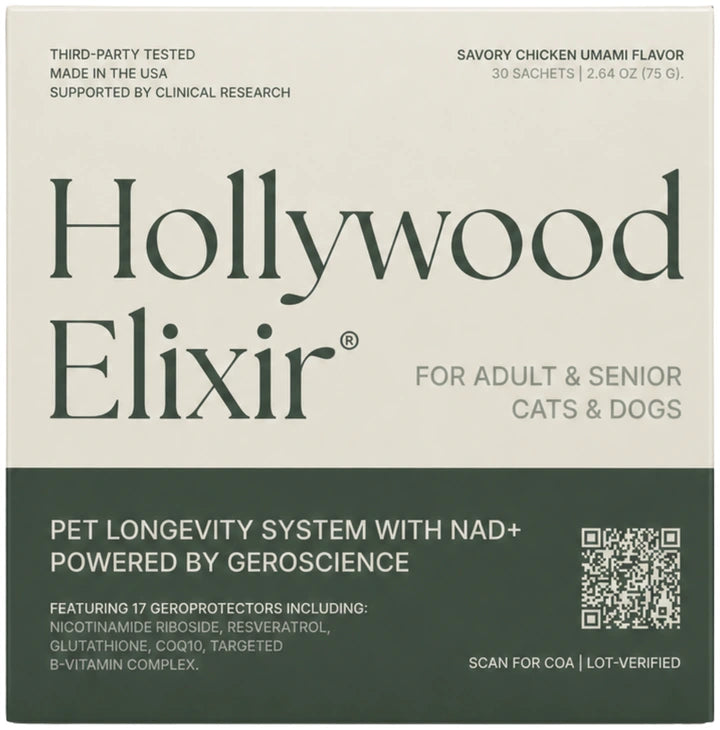
  • In Hollywood Elixir: No. Hollywood Elixir has no lion's mane. It lists reishi mushroom and purified beta glucans instead, each with an amount.

What is lion's mane, and why give it to a cat?

Lion's mane is an edible mushroom, Hericium erinaceus, valued for centuries in traditional Chinese medicine and served as a delicacy across East Asia.11 Its modern fame rests on the brain. In laboratory studies, two groups of its compounds, hericenones and erinacines, stimulate the production of nerve growth factor, which supports nerve cells.11

That's why it turns up in products for senior cats. Aging cats often change in ways that worry their owners. One study cited by feline specialists found that 28% of pet cats aged 11 to 14 develop at least one behavior problem tied to old age, rising to more than 50% of cats aged 15 and over.3

A mushroom that might protect nerve cells sounds like an answer. The rest of this page asks whether anyone has shown that in a cat.

Woman kneeling with two long-haired tabby cats while holding a Hollywood Elixir box beside a food bowl

Has lion's mane been studied in cats?
Lion's mane has been studied in cats once, and only as one part of a blend.1 We searched for trials of lion's mane given alone to cats, and for any cat study of memory or behavior. We found none.

The wider field is thin too. A 2025 systematic review of diet and supplement trials for cognition in aging pets found 27 trials in dogs and two in cats, one with 8 cats and one with 16. Neither tested a mushroom.6

So every claim about lion's mane and a cat's mind is borrowed from laboratory work, from dogs or from people.

Woman exercising beside a tabby cat, with a Hollywood Elixir box and food bowl on a small table

What did the cat mushroom-blend trial find?

Lion's mane reached the cats in this trial inside a blend: water extracts of turkey tail, red reishi and lion's mane, plus bovine colostrum. Twenty healthy adult cats, about seven years old on average, were split into two groups of ten. One group got 900 mg of the blend on their food each day for 12 weeks, and the other got a placebo.1

  • Unchanged: stool quality and frequency.
  • Lower: blood triglycerides.
  • Shifted: gut bacteria and some fermentation products in the stool.

The authors' own summary is modest: the blend slightly changed gut bacteria and lowered triglycerides without affecting stools.1 With four ingredients given together, no result can be traced to lion's mane.

Orange-and-white cat reaching toward a woman holding a Hollywood Elixir box while sitting in a chair

Is lion's mane safe for cats?

Lion's mane, as part of that blend, didn't upset healthy cats' digestion over 12 weeks.1 Two blood results deserve attention, though.

  • IgA: this antibody rose over time in the placebo cats and fell in the cats on the blend.1
  • Blood urea nitrogen: a waste product normally filtered by the kidneys. It tended to rise in all the cats and climbed higher on the blend.1, 22

The published summary doesn't say whether either change matters for health. A raised urea value can also come from dehydration, so it takes a vet to read it.22

Beyond 12 weeks, and in kittens or sick cats, lion's mane is untested. Wild mushrooms are a separate danger: Pet Poison Helpline advises treating any mushroom a pet eats as toxic unless a specialist identifies it as safe.14

Gray-haired man holding a Hollywood Elixir box while two cats rest beside him in an armchair

What are the side effects of lion's mane in cats?

Lion's mane has no side-effect record of its own in cats. The only trial was small, used a blend, and reported normal stools.1

The human record is the nearest guide. A 2025 review of lion's mane lists stomach discomfort, headache and allergic reactions as possible side effects.13 In a 49-week trial of lion's mane capsules, four people dropped out with abdominal discomfort, nausea or skin rash.10

So watch a cat for vomiting, loose stools, itching or a drop in appetite, and stop the product if you see them. A cat that stops eating needs prompt care whatever the cause.

So every claim about lion's mane and a cat's mind is borrowed from laboratory work, from dogs or from people.

Can lion's mane help a cat with dementia or night calling?

Lion's mane hasn't been tested in cats with cognitive dysfunction, so there's no evidence that it eases confusion or night-time crying.

The condition itself is real. Cats with cognitive dysfunction syndrome may call out more, seek more attention, sleep at odd hours, miss the litter box, lose their bearings, or seem anxious or forgetful.4 In a Colorado survey, the most common sign was inappropriate vocalization, reported in 40% of affected cats.5

Night calling has other causes that a mushroom won't touch. Cornell's Feline Health Center notes that it's relatively common in cats with an overactive thyroid or high blood pressure. High blood pressure can also cause blindness, which brings anxiety and confusion of its own.2

That's why a vet visit comes before any brain supplement. Our guides to night vocalization in senior cats and feline cognitive dysfunction explain what to expect.

Tabby cat looking up at a Hollywood Elixir sachet held above it, with the product box on a small table

Where do the brain claims for lion's mane come from?

Lion's mane's brain claims start in the laboratory. A 2018 review concluded that, among its active compounds, only erinacine A has confirmed actions in the central nervous system, and those were shown in rats.12 The same review concedes that animal results have been hard to carry over to patients.12

Erinacines come from the mycelium of the mushroom and hericenones from the fruiting body, so two products with the same name can deliver different compounds.11

From there the claims jump to people, in a few small trials covered below. No step in that chain involved a cat.

Hand gently petting an orange-and-white cat beside a food bowl and Hollywood Elixir box

How much lion's mane did the cat trial use?

No amount of lion's mane has been established for cats. The single reference point is the blend trial: 900 mg of the whole blend a day, sprinkled on food, for 12 weeks, in cats weighing a little over 4 kg on average.1 The published summary doesn't say how much of that was lion's mane.

Amounts from other species don't transfer. Dog studies gave lion's mane by body weight, and the main human trial used 3 g of tablets a day in adults.15, 9

If your vet supports a trial, pick a product with a feeding guide for cats and agree on the amount first.

Man holding a Hollywood Elixir box beside a black cat, an orange tabby and a food bowl

Which form of lion's mane is sold for cats?

Lion's mane reaches the market in several forms, and research has used most of them: tablets and capsules in human trials, and extracts sprinkled on food in the cat trial.9, 10, 1 The format tells you less than the contents.

  • Fruiting body: the mushroom itself, the source of hericenones.11
  • Mycelium: the thread-like growth the mushroom springs from, the source of erinacines.11
  • Extract: a concentrate. The cat trial used water extracts.1

If a label quotes a beta-glucan percentage, one laboratory analysis offers a comparison: 17.4% beta-glucan in a lion's mane sample.20 That figure describes one group of compounds and says nothing about hericenones or erinacines.

Powders suit cats that eat well. For a picky or unwell cat, check that a new powder doesn't put the cat off its food.

Do the human trials of lion's mane apply to cats?

Lion's mane has been tested in a handful of small human trials, and they're the source of most label claims. A 2025 systematic review counted five randomized trials and three pilot trials.13

  • Mild cognitive impairment: 30 adults aged 50 to 80 took four 250 mg tablets three times a day for 16 weeks. Their cognitive scores beat placebo from week 8 and fell after the tablets stopped.9
  • Mild Alzheimer's disease: patients took three 350 mg capsules of lion's mane mycelium a day for 49 weeks. Scores on a mental-state test improved in that group.10

A 2026 review sums up the field: results differ from study to study, the trials are small and short, and the products aren't standardized.18

These trials tell you nothing about amounts for a cat. They show that lion's mane is an open question even in the species where it has been tested most.

Night calling has other causes that a mushroom won't touch.

Silver tabby sitting beside a food bowl and a Hollywood Elixir box held in a person's hand

DVM Voice: Clinical Vignette of a Common Pattern in Senior Cat Aging

Case provided by JoAnna Pendergrass, DVM

Sasha, a 12-year-old cat, was brought in after her owner noticed increased thirst and urination, lethargy, vomiting, and a generally unkempt appearance. Examination showed weight loss, elevated blood pressure, and reduced vitality.

Diagnostic testing revealed elevated kidney markers, poorly concentrated urine, and protein loss in the urine — findings consistent with chronic kidney disease, one of the most common chronic conditions in senior cats.

Her care required a kidney-focused diet, blood pressure management, targeted supplementation, medication support, and regular monitoring — a necessary plan, but one started after clinical signs were already visible.

Clinical takeaway: Sasha’s case reflects why senior-cat wellness should begin before obvious decline. Earlier monitoring, body-condition tracking, hydration awareness, antioxidant support, and daily cellular resilience may help support quality of life as cats age.

Single-case vignette. Not generalizable. Veterinary diagnosis and monitoring are essential for increased thirst, urination, vomiting, lethargy, weight loss, or suspected kidney disease.

Explore Hollywood Elixir Research →
Woman holding a Hollywood Elixir box toward a brown cat perched on the back of a sofa

Which cats should not have lion's mane?

Lion's mane is a poor fit for some cats, and untested in most of the groups that matter.

  • Cats with kidney disease: blood urea nitrogen rose more on the blend than on placebo in healthy cats, and nobody has tested cats whose kidneys are already failing.1
  • Diabetic cats: a lion's mane extract lowered blood glucose in diabetic rats.19
  • Cats with a known mushroom allergy: allergic reactions are among the side effects reported in people.13
  • Kittens and pregnant or nursing cats: the only cat trial enrolled healthy adults.1

Senior cats often have more than one of these conditions, which is one more reason to start with blood tests.

Woman leaning toward a fluffy orange cat beside a Hollywood Elixir box and green food bowl

Can lion's mane be given with a cat's medicines?

Lion's mane hasn't been tested alongside any prescription medicine in cats, as far as we could find. Laboratory work flags two combinations to raise with your vet.

  • Insulin: a lion's mane extract lowered blood glucose in diabetic rats over 28 days.19 In a diabetic cat on insulin, a further drop is the risk to ask about.
  • Blood thinners: hericenone B, a lion's mane compound, blocked platelet clumping in laboratory tests on rabbit and human blood cells.21

Fluoxetine, which vets sometimes prescribe for the signs of cognitive dysfunction, hasn't been studied with lion's mane either.2 Show your vet the full ingredient list before you start, and again before any anesthetic.

Tabby cat licking its nose beside a food bowl and Hollywood Elixir box

Is lion's mane worth trying for a senior cat?

Lion's mane is a fair question for a senior cat and a weak first choice. Signs of cognitive dysfunction tend to become noticeable from about 10 years of age.2, 8 A 2010 review noted that no diet or drug was approved for the condition in cats, and Cornell says the drug that helps dogs, L-deprenyl, hasn't been approved for them.8, 2

That gap is what makes supplements tempting. Lion's mane doesn't fill it, because nobody has tested it for this purpose in cats.

Start with a diagnosis, then the home and diet changes covered below. If you still want to try lion's mane, treat it as an add-on that your vet knows about.

How do you choose a lion's mane product for a cat?

A lion's mane product for a cat should be simple, measured and made for cats. A 2026 review of the human research warns that formulations vary and that active compounds aren't standardized, so the label carries the weight.18

Check for:

  • the scientific name, Hericium erinaceus, and the part used;
  • lion's mane as the only active ingredient, so a reaction can be traced;
  • the amount per serving in milligrams, with a feeding guide for cats;
  • a form your cat will accept without eating less.

Be wary of a mushroom complex with no amounts. The cat trial shows the problem: with three mushrooms and colostrum in one scoop, nobody can say which ingredient moved the blood results.1 We hold our own label to that standard: Hollywood Elixir lists each of its 17 actives with an amount, and lion's mane isn't one of them.

Is lion's mane different for cats and dogs?

Lion's mane has a slightly longer research record in dogs, and the two species didn't respond the same way to the same type of blend.

  • Dog studies of lion's mane: in 18 senior dogs, the higher of two amounts shifted gut bacteria over 16 weeks.15 In an 8-dog pilot, anxiety scores fell by 62% in 28 days, with no placebo group.16
  • The blend in dogs: in a trial of 20 beagles, blood chemistry and antibody levels didn't change.17
  • The blend in cats: IgA fell, and blood urea rose more than on placebo.1

Body size doesn't explain the gap. The beagles averaged about 9.5 kg and got 1.8 g a day, and the cats averaged about 4.25 kg and got 900 mg.17, 1

A cat isn't a small dog, and a product or amount chosen for one shouldn't be handed to the other. Our guide to lion's mane for dogs covers the canine studies.

Tabby cat sitting at a table with a food bowl and Hollywood Elixir box

When should you see the vet instead of trying lion's mane?

Lion's mane shouldn't be the first response to a senior cat that's acting differently. Book a visit if your cat:

  • cries at night or wanders as if lost;
  • misses the litter box, or urinates more than before;
  • stares at walls, or stops responding to you;
  • eats less or loses interest in the food bowl.

Each of these can come from a treatable illness. Kidney failure changes litter box habits, arthritis makes the box hard to reach, and dental pain keeps a cat from its bowl.2 A seizure, sudden weakness, circling or sudden blindness needs a vet the same day. Our guide to confusion episodes in senior cats goes deeper.

Woman cuddling a silver tabby and a cream-colored cat while holding a Hollywood Elixir box

What works better than lion's mane for an aging cat's brain?

Several steps have more behind them than lion's mane for a cat's aging brain.

  • Diet: in one trial, cats aged 5.5 to 8.7 years ate a food enriched with fish oil, B vitamins, antioxidants and arginine. They did better on three of four cognitive tests than cats on the plain food.7
  • Home setup: easy access to food, water, resting places and litter boxes, with low-sided boxes and ramps where stairs are a struggle.4, 2
  • Medication: vets sometimes prescribe an anti-anxiety drug such as fluoxetine once other illnesses are ruled out.2

Supplements such as SAMe are on specialists' lists as well.4 Our guide to cognitive supplements for cats compares them, and the guide to selegiline for cats covers the drug option.

Is lion's mane in Hollywood Elixir?

No. Hollywood Elixir has no lion's mane in it, and it isn't a treatment for feline dementia.

What it does have, from the mushroom world, is 25 mg of reishi mushroom and 50 mg of purified beta glucans in every sachet. They sit beside 60 mg of nicotinamide riboside, an NAD+ precursor, and 14 other actives, and the label gives an amount for each one.

Hollywood Elixir is daily nutrition for adult and senior cats in powder form. You mix it into food: half a sachet for cats under 7 lb, a whole sachet from 7 to 30 lb. It hasn't been tested for cognitive dysfunction, night calling or lifespan, and it doesn't replace a vet's diagnosis.

Our guides to reishi for cats and beta glucans for cats explain those two ingredients, and the best supplements for senior cats guide compares the wider field. View the Hollywood Elixir label and serving guide.

A cat isn't a small dog, and a product or amount chosen for one shouldn't be handed to the other.

Educational content only. This material is not a substitute for veterinary advice. Always consult your veterinarian about your cat’s specific needs. These statements have not been evaluated by the Food and Drug Administration. Products mentioned are not intended to diagnose, treat, cure, or prevent any disease.

Glossary

Hericium erinaceus: The scientific name of lion's mane, an edible mushroom.

Mycelium: The thread-like growth a mushroom springs from, and the source of erinacines in lion's mane.

IgA: An antibody that can be measured in blood and stool.

Blood urea nitrogen (BUN): A waste product normally filtered by the kidneys and measured on a blood test.

Cognitive dysfunction syndrome: Age-related decline in brain function, with signs such as night calling and disorientation.

Colostrum: The first milk a cow produces after calving, used in the blend that was tested in cats.

Related Reading

References

Numbered references identify the sources used for specific claims. Read the study design, species and evidence boundaries alongside each finding.

FAQ

Can cats eat lion's mane mushrooms?

We found no study of cats eating the fresh mushroom. Lion's mane is an edible species for people, and a blend containing its extract didn't upset healthy cats' stools over 12 weeks. Never let a cat eat a mushroom found outdoors.

Does lion's mane help cats with dementia?

Nobody has tested it. No published trial has given lion's mane to cats with cognitive dysfunction. The only cat study used a mushroom blend in healthy adults and measured digestion and blood values, not memory or behavior.

Does Hollywood Elixir contain lion's mane?

No. Hollywood Elixir has no lion's mane. It supplies 25 mg of reishi mushroom and 50 mg of purified beta glucans per sachet, with every amount on the label, and it isn't a treatment for cognitive dysfunction.

Can I give my cat my own lion's mane capsules?

Better not. Human trials used about 1 to 3 g of lion's mane a day in adults, and no amount is established for a cat of 4 or 5 kg. Ask your vet about a product made for cats.

Can kittens have lion's mane?

Lion's mane hasn't been studied in kittens. The one cat trial enrolled healthy adults of about seven years, so there's nothing to guide use in a growing cat.

How long does lion's mane take to work in cats?

Nobody knows. The cat trial of a lion's mane blend ran 12 weeks and tracked digestion and blood values only. In the main human memory trial, differences appeared from week 8 and faded within four weeks of stopping.

Can lion's mane repair a cat's damaged nerves?

No one has shown that. The nerve growth findings for lion's mane come from laboratory studies, and we found no trial in cats with nerve or spinal disease. A cat with sudden weakness or trouble walking needs a vet promptly.

Is lion's mane good for cats with kidney disease?

We found no study of lion's mane in cats with kidney disease. In healthy cats, a blend containing it pushed blood urea nitrogen higher than placebo did. Ask the vet who manages your cat's kidneys before you try it.

Does lion's mane calm anxious cats?

We found no cat study of lion's mane for anxiety. An 8-dog pilot reported lower anxiety scores after 28 days without a placebo group, which is too little to guide cat care. New anxiety in an older cat can signal illness.

Orange-and-white cat beside a Hollywood Elixir box held in a person's hand

Discover LPL-01: How This Fits Into a Larger Feline Longevity System

Aging in cats unfolds quietly. It’s not driven by a single failure, but by gradual shifts across interconnected systems — cellular energy, oxidative balance, immune tone, and tissue integrity — each influencing the others over time.

This article explores one layer of that system. To understand what actually shapes long-term health, you need to step back and look at how these layers interact.

Start with the underlying science:

Keep exploring

What would you like to understand next?

Search practical guides about healthy aging, cellular energy, ingredients, and daily support for cats.