

The 12 Hallmarks of Aging in Dogs, Explained
Read full insightGABA for Dogs
By La Petite Labs Editorial 11 min read
As Seen On

17 science-backed actives
Contents +
GABA is a calming supplement with only two small studies in dogs, and it is not gabapentin. GABA (gamma-aminobutyric acid) is the brain's main calming messenger. In one study, four Shih Tzus moved around less after a single serving. In the other, owners of aged dogs reported better behavior over two weeks. Both studies were small, and gabapentin, the prescription drug with the similar name, works in a different way.
This guide covers what the dog studies found, the amounts they used, the safety gaps, and what to ask your vet.
- What it is: GABA (gamma-aminobutyric acid) is the main calming messenger in the brain. It's also sold as a supplement.4, 3
- Not gabapentin: Gabapentin is a prescription drug built to resemble GABA. It doesn't bind to GABA receptors.6
- Dog evidence: Two small studies. Four Shih Tzus were less active after one serving, and owners of aged dogs reported better behavior over two weeks.1, 2
- Safety: The aged-dog study saw no adverse effects over two weeks, and a safety review reports no toxicity in dogs given large amounts long term.2, 3
- Amount: None is established. The dog studies gave 1 to 4 mg per kg once, or 30 mg per kg a day.1, 2
- Watch for: Human supplements can be sweetened with xylitol. Xylitol is dangerous for dogs.9
- In Hollywood Elixir: No. Hollywood Elixir contains no GABA. It's daily nutrition.
What is GABA?
GABA is short for gamma-aminobutyric acid, the main inhibitory neurotransmitter in the mammalian brain.4 A neurotransmitter is a chemical messenger between nerve cells. "Inhibitory" means GABA quiets the cells it reaches, which is why it turns up in calming chews.
Your dog already makes GABA. The body builds it from glutamate, another amino acid, with an enzyme that needs vitamin B6 as its helper.3
GABA also exists outside the body.
- In food: tea, tomatoes, soybeans, germinated rice and some fermented foods contain it naturally.4
- In supplements: commercial GABA is mostly made by fermentation, often with lactic acid bacteria.3
The GABA in a chew and the GABA in your dog's brain are the same molecule. The open question is whether the one your dog swallows ever reaches the brain.
One name causes real confusion. GABA is not gabapentin, the prescription medicine that vets use in dogs for seizures, nerve pain and anxiety.7
Is GABA the same as gabapentin?
GABA and gabapentin are two different things. GABA is a natural messenger sold as a supplement. Gabapentin is a prescription drug that chemists built to resemble GABA, and it doesn't bind to either type of GABA receptor.6
Gabapentin has its own evidence. In a placebo-controlled trial of 18 dogs with storm phobia, it lowered fear responses.14 A GABA chew is not a weaker or more natural version of that medicine, and it can't stand in for a prescription.
If a clinic note or a friend says "gaba", ask for the full name. Our guide to gabapentin for dogs covers the drug.
Does GABA help calm an anxious dog?
GABA might take the edge off for some dogs, but the proof is thin. Two small studies exist in dogs. One watched four adult Shih Tzus for 90 minutes after a single serving.1 The other asked owners of aged dogs to rate behavior after two weeks.2
Going by the published summaries, neither study enrolled dogs diagnosed with noise fears or separation anxiety. We searched for GABA trials in dogs with those problems and found none.
The human research points the same way. A systematic review of 14 placebo-controlled trials found limited evidence that swallowed GABA eases stress, and very limited evidence that it helps sleep.4
What did the Shih Tzu study of GABA find?
GABA made four adult Shih Tzus less active for a short while. Researchers gave each dog three amounts by mouth, 1, 2 and 4 mg per kg of body weight, and compared those sessions with ones where the dogs got nothing.1
For 90 minutes after GABA, the dogs spent less time sitting and walking. Cortisol, a stress hormone measured in urine, was lower seven hours later.1
The limits are plain. Four dogs is a tiny group, and the comparison was no treatment, not a placebo. A dog that moves less isn't always a calmer dog.
What did the GABA study in aged dogs find?
GABA was linked to better behavior in a group of very old dogs, according to their owners. The dogs averaged 15.3 years of age and had recently visited a vet clinic. Each got 30 mg of GABA per kg once a day, mixed into food, for two weeks.2
Owners then judged signs that often come with aging. Some signs improved, notably the dogs' emotional state, and no adverse effects were seen. Signs of cognitive dysfunction, the age-related decline in memory and awareness, didn't always improve.2, 12
The published summary mentions no placebo group and no blinding, so owners likely knew what they were giving. Ratings like that are easy to sway.
A dog that's quiet because it feels dull or dizzy isn't calmer.
Does GABA from a chew reach a dog's brain?
GABA from a chew probably reaches a dog's brain only in very small amounts, if at all. The brain sits behind the blood-brain barrier, a tight lining in its blood vessels that keeps many substances out.
A safety review by the United States Pharmacopeia concluded that very little GABA crosses from the blood into the brain, whether it's swallowed or injected.3 The same review notes that the liver is the main site that breaks GABA down outside the brain. In some animal studies, swallowed GABA barely raised blood levels at all.3
So how could a chew calm anything? Researchers offer two guesses. A little GABA may get through the barrier, or it may act on the nerves of the gut.5
The authors of that paper called the mechanism "far from clear". They also noted that most of the positive findings came from researchers with a potential conflict of interest.5
We found no study that measured GABA in the blood or brain of dogs after a supplement. Until someone does, the two dog results are a pattern without an explanation.
Is GABA safe for dogs?
GABA has a reassuring safety record at the amounts studied, with gaps. In the aged-dog study, two weeks of GABA at 30 mg per kg a day produced no observable adverse effects.2 A safety review by the United States Pharmacopeia reports that long-term studies in rats and dogs, at up to 1 g per kg a day, showed no signs of toxicity.3
In people, the same review found no serious adverse events in clinical studies.3
The gaps matter more than the totals. We found no safety data for pet dogs that take GABA for months alongside other medicines, or for puppies and pregnant dogs.
What are the side effects of GABA in dogs?
GABA caused no observable side effects in the one dog study that reported on them.2 The fuller list comes from people.
- Mild and passing: stomach discomfort, headache, drowsiness and a brief burning feeling in the throat.3
- Blood pressure: some studies saw a short, moderate drop of less than 10%.3
By inference, the signs to watch for in a dog are unusual sleepiness, wobbliness, vomiting or loose stools. Stop the supplement and call your vet if you see any of them.
A dog that's quiet because it feels dull or dizzy isn't calmer. Check whether your dog still eats, plays and greets you as usual.
How much GABA did the dog studies use?
No amount of GABA has been established for dogs. The studies give reference points, not a feeding guide.
- Shih Tzu study: 1, 2 and 4 mg per kg of body weight, given once.1
- Aged-dog study: 30 mg per kg once a day, mixed with food, for two weeks.2
- Human stress trials of fermentation-made GABA: 20 to 100 mg per person.4
The aged-dog amount was more than seven times the highest Shih Tzu amount. The Shih Tzu results were also reported for all three amounts together, and the summary doesn't say which one worked best.1
If your vet supports a trial, agree on the amount, a goal you can observe and a date to review it.
Which dogs should skip GABA?
GABA isn't a fit for every dog. Check with your vet first if your dog:
- takes blood pressure medicine, because GABA lowered blood pressure slightly in some human studies and the two effects could add up;3
- takes seizure medicine, because the same review flags a possible interaction with drugs for epilepsy;3
- is pregnant or nursing, because there are no studies and GABA can shift hormone levels;3
- has liver disease, because the liver does most of the work of clearing GABA and we found no study in dogs with liver disease;3
- is a puppy, because the two dog studies used adult and aged dogs.1, 2
Sedating medicines deserve a mention too. We found no study of GABA given with trazodone, gabapentin or other calming prescriptions in dogs, so the combined effect is unknown. Tell your vet about every supplement before an anesthetic or a new prescription.
Skipping GABA costs a healthy dog nothing. The body makes its own supply.3
A GABA chew is not a weaker or more natural version of that medicine, and it can't stand in for a prescription.
DVM Voice: Clinical Vignette of a Common Pattern in Senior Dog Aging
Case provided by JoAnna Pendergrass, DVM
Rex, a 7-year-old Labrador Retriever, was brought in after his owner noticed he was slower to rise, hesitant on stairs, and less able to play as before. Examination showed stiffness and reduced hip mobility; radiographs confirmed degenerative joint changes.
His care required weight management, veterinary-guided pain control, nutritional support, and rehabilitation — a comprehensive plan, but one started only after visible decline appeared.
Clinical takeaway: Rex’s case reflects the value of proactive aging support: maintaining lean body condition, monitoring mobility early, and supporting cellular resilience, antioxidant defense, and healthy inflammatory balance before decline becomes obvious.
Single-case vignette. Not generalizable. Veterinary oversight is essential for pain, stiffness, or suspected joint disease.
Can GABA help a dog with seizures?
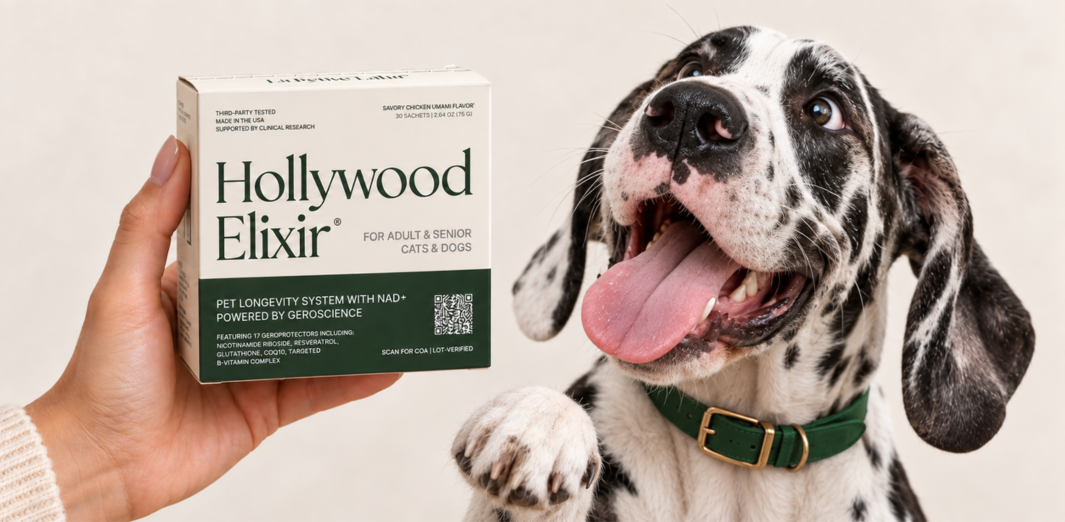
GABA supplements have not been tested for seizures in dogs, as far as we could find. The idea has a real root. In one study, 19 dogs with epilepsy had less GABA in the fluid around the brain than 34 healthy dogs.8
A low level in that fluid is a finding about the brain. Whether a chew can raise it is another matter, because very little swallowed GABA crosses into the brain.3
Seizures are a job for your vet and for prescription medicine. Never cut back or stop a prescribed anticonvulsant to try a supplement.
Can GABA help an old dog that paces at night?
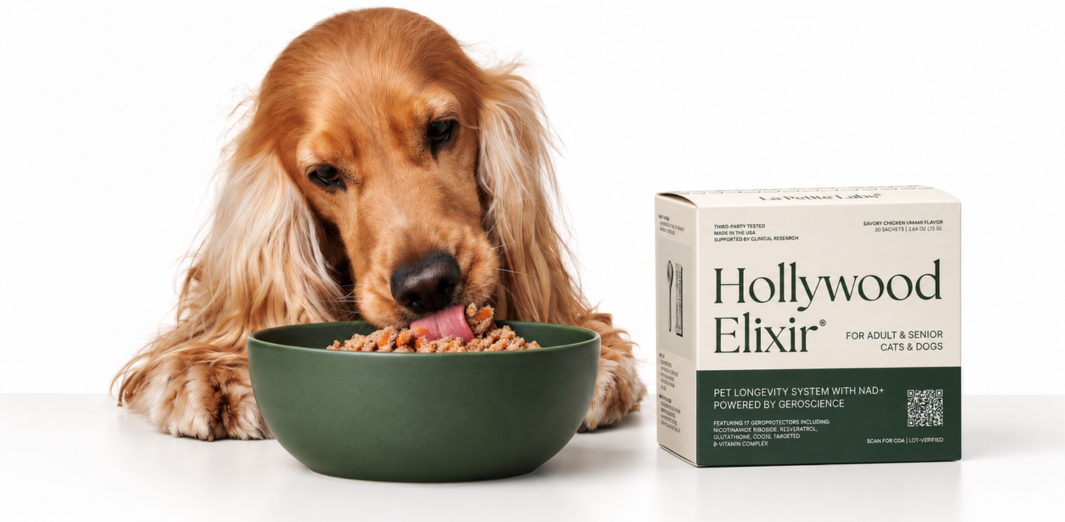
GABA has one small study behind it for old-dog behavior, and the result was mixed. Owners of dogs averaging 15.3 years old reported that mood-related signs improved over two weeks, while signs of cognitive dysfunction didn't always change.2
Night pacing fits the sleep and activity changes that vets group under canine cognitive dysfunction, where anxiety and agitation are often reported too.12 A new pattern deserves a checkup before a supplement. One medicine, selegiline, is approved in North America for cognitive dysfunction in dogs.12
Our guides to old dog anxiety and canine cognitive dysfunction walk through the signs.
Are human GABA supplements safe for dogs?
Human GABA products are a poor choice for a dog, for three reasons.
- Sweeteners: chewable vitamins and other supplements made for people can contain xylitol, which can cause a rapid, life-threatening drop in a dog's blood sugar.9
- Size: capsules are made for adults, and no amount is established for dogs.
- Look-alikes: phenibut, also labeled phenyl-GABA, is a different compound, and the FDA says it isn't a lawful supplement ingredient.11 A Weimaraner that swallowed a large amount was found unresponsive, needed intensive hospital care and went on to recover fully.10
Read the full ingredient list, and keep your own supplements out of reach.
How do you choose a GABA product for a dog?
A GABA product for a dog should tell you exactly what's in each chew. If GABA comes in a blend with other calming ingredients, the two dog studies no longer apply, because they tested GABA and not a mix.1, 2
Check the label for:
- the amount of GABA per chew or scoop, in milligrams;
- the amount of every other active, not one combined "blend" total;
- no xylitol, which is dangerous for dogs;9
- a product made for dogs, with a feeding guide by weight.
Then compare the label with the research. The Shih Tzu study used 1 to 4 mg per kg, and the aged-dog study used 30 mg per kg.1, 2 A chew far outside that range has no dog study behind it at all.
Printed amounts are the test we apply to our own label. Hollywood Elixir lists all 17 of its actives with an amount for each, and GABA isn't one of them.
Whatever you choose, tell your vet, and set a clear goal before you start. The aged-dog study ran for two weeks, which is a fair first checkpoint.2
Is GABA different for dogs and cats?
GABA has been studied a little in dogs and, as far as we could find, not at all in cats as a calming supplement.
- Evidence: dogs have two small studies.1, 2 We found no trial of a GABA supplement in cats.
- Clearance: a safety review reports that swallowed GABA was cleared fast in cats, rabbits and rats, with a half-life of about 20 minutes.3 The review gives no such figure for dogs.
- Xylitol: the sweetener is a serious danger to dogs. The FDA notes that it doesn't seem to be as dangerous for cats.9
- The name mix-up: vets use gabapentin in both species, so "gaba" in a clinic note most likely means the drug either way.7
A chew bought for the dog shouldn't be shared with the cat on the strength of dog studies. Our guide to GABA for cats covers what is and isn't known there.
When should you see the vet instead of trying GABA?
GABA shouldn't be the first response to a dog whose behavior has changed. Book a visit if your dog:
- starts pacing, panting or whining at night;
- panics badly enough to hurt itself or break out of a crate;
- has a seizure, a collapse or a spell of staring;
- suddenly hides, snaps or stops eating.
These can be signs of pain, illness or a fear problem that needs a proper plan. Our guide to the signs of a stressed dog can help you describe what you're seeing. A supplement tried first can delay the answer.
What works better than GABA for an anxious dog?
Several options have stronger evidence than GABA for an anxious dog.
- Approved medicines: fluoxetine and clomipramine are FDA approved for separation anxiety in dogs, used with behavior training. A dexmedetomidine gel is approved for noise aversion.12
- A drug that does act on GABA receptors: imepitoin lowered owner-rated fear scores against placebo in a trial of 238 dogs during New Year's Eve fireworks.13, 15
- Other calming supplements: the Merck Veterinary Manual notes a calming effect for alpha-casozepine and L-theanine. GABA isn't on its list.12
Medicines and supplements work best alongside behavior training.12 Our guide to L-theanine for dogs covers one of those supplements.
Is GABA in Hollywood Elixir?
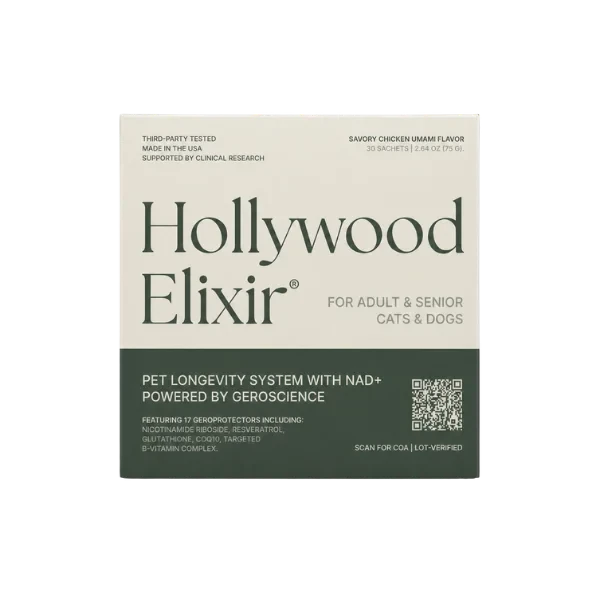
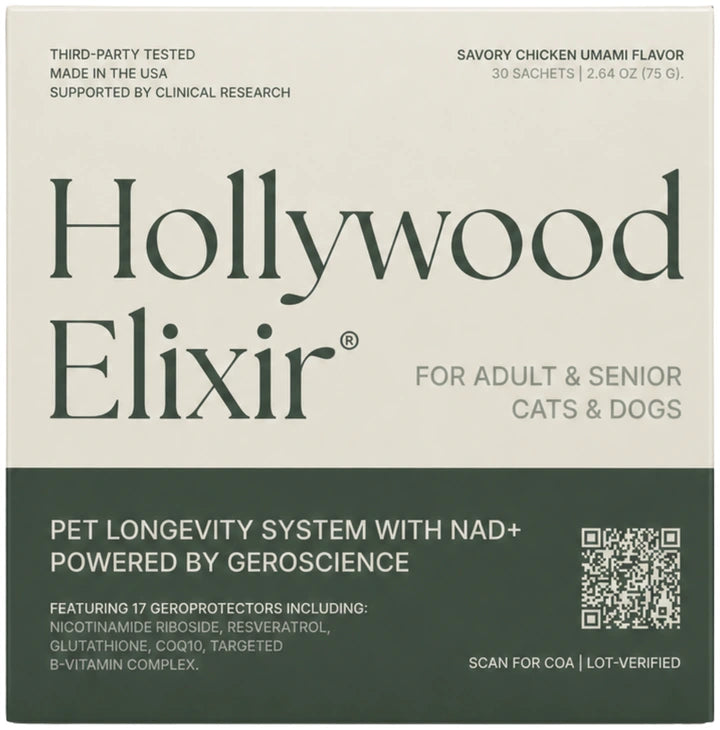
No. Hollywood Elixir doesn't contain GABA, and it isn't a calming product.
Here is the one real connection. A dog's body makes its own GABA, and the enzyme that builds it needs vitamin B6 as a helper.3 That is a point about nutrition, not a calming claim.
Each sachet supplies 1 mg of vitamin B6 and 25 mg of reishi mushroom, next to 60 mg of nicotinamide riboside (an NAD+ precursor) and 14 more actives. All 17 amounts are printed on the label.
Hollywood Elixir is daily nutrition for adult and senior dogs, a powder stirred into food: half a sachet under 7 lb, one sachet from 7 to 30 lb, two sachets over 30 lb. It hasn't been tested for anxiety, sleep or seizures.
Our guides to vitamin B6 for dogs and the best all-in-one supplements for dogs explain more. See the full Hollywood Elixir formula and serving guide.
Skipping GABA costs a healthy dog nothing.
Educational content only. This material is not a substitute for veterinary advice. Always consult your veterinarian about your dog’s specific needs. These statements have not been evaluated by the Food and Drug Administration. Products mentioned are not intended to diagnose, treat, cure, or prevent any disease.
Glossary
GABA: Gamma-aminobutyric acid, the main calming chemical messenger in the brain, also sold as a supplement.
Gabapentin: A prescription drug built to resemble GABA that works in a different way.
Neurotransmitter: A chemical that carries signals between nerve cells.
Blood-brain barrier: The lining of the brain's blood vessels, which keeps many substances in the blood from reaching the brain.
Cortisol: A stress hormone that can be measured in blood, saliva or urine.
Xylitol: A sugar substitute in some human products that is dangerous for dogs.
Related Reading
Aging & Senior Dog Guidance
• Dog Age Calculator
• Dog Lifespan by Breed
• Dog Dementia
• Lethargy in Dogs
• My Dog Won't Eat
• Dog Pacing At Night
• Dog Licking Paws
• Can Dogs Dehydrate
Healthy Aging Support
• NAD+ for Dogs
• NMN for Dogs
• Antioxidants Supplements for Dogs
• Best Senior Dog Supplements & Vitamins
• Dog Longevity Drugs
• Rapamycin for Dogs
References
Numbered references identify the sources used for specific claims. Read the study design, species and evidence boundaries alongside each finding.
- [1]
- [2]
- [3]
- [4]
- [5]
- [6]
- [7]
- [8]
- [9]
- [10]
- [11]
- [12]
- [13]
- [14]
- [15]
FAQ
Is GABA a natural version of gabapentin?
No. GABA is a messenger the body makes, and gabapentin is a prescription drug built to resemble it. Gabapentin doesn't bind to GABA receptors, so a GABA chew can't replace it.
Does Hollywood Elixir contain GABA?
No. Hollywood Elixir has no GABA and isn't a calming product. It's daily nutrition with 17 actives, among them 1 mg of vitamin B6, which the body uses to make its own GABA, and 25 mg of reishi mushroom.
Which foods contain GABA?
Tea, tomatoes, soybeans, germinated rice and some fermented foods contain GABA naturally. Those are human foods, and there's no reason to add them to a dog's bowl for the GABA. A dog makes its own.
How long does GABA take to work in dogs?
In the Shih Tzu study, activity dropped within the 90 minutes after one serving of GABA, and urinary cortisol was lower at seven hours. In the aged-dog study, owners judged the effect after two weeks of daily use.
Can I give my dog GABA with gabapentin or trazodone?
Ask your vet first. We found no study of GABA combined with either medicine in dogs. Drowsiness has been reported with GABA in people, so adding it to a sedating prescription is your vet's call.
Can puppies have GABA?
GABA hasn't been studied in puppies. One dog study used adult Shih Tzus and the other used dogs averaging 15.3 years old, so there's no basis for giving it to a growing dog.
Is phenibut the same as GABA?
No. Phenibut is a different compound, sometimes labeled phenyl-GABA. The FDA says it doesn't meet the legal definition of a dietary ingredient, and one dog needed intensive hospital care after swallowing a large amount.
Can GABA help a dog with fireworks or thunderstorms?
We found no study of GABA for noise fears in dogs. A dexmedetomidine gel is FDA approved for noise aversion, and gabapentin lowered storm fear in a trial of 18 dogs. Talk to your vet well before the next loud night.
Does GABA lower a dog's blood pressure?
We found no study that measured it in dogs. In people, some studies saw a brief, moderate drop of less than 10% with GABA. That's why a dog on blood pressure medicine needs a vet's go-ahead first.
Will GABA make my dog sleepy?
It might. Drowsiness is among the mild effects reported in people taking GABA, and the four Shih Tzus spent less time walking and sitting after a serving. A dog that seems dull, wobbly or hard to rouse needs a call to the vet.
Discover LPL-01: How This Fits Into a Larger Canine Longevity System
Aging in dogs is not driven by a single pathway. It’s the result of interacting biological systems—energy metabolism, oxidative stress, immune signaling, and structural integrity—changing over time.
This article explores one piece of that puzzle. If you want to understand how these pieces connect—and what actually moves the needle—you need to zoom out.
Start with the underlying science:
- Canine Geroscience Framework →
A structured view of how aging progresses across cellular energy, inflammation, and resilience systems. - Senior Biological Defense Coverage (BDC) Modeling →
A systems-level map of which biological pathways decline first, and how layered interventions can support them. - 2026 Market Research: Best Dog Longevity Supplements →
A 2026 industry report and review of leading senior-dog and cellular-aging formulas. - LPL-01 Standard →
The formulation system that translates these models into real-world supplementation—covering multiple pathways in a coordinated way.
Keep exploring
What would you like to understand next?
Search practical guides about healthy aging, cellular energy, ingredients, and daily support for dogs.
Hollywood Elixir®Senior Dog SupplementSenior dog energy, mobility & cognitionFrom$50/moSave up to 47%Save up to 44%Shop Now
Limited time offerEnds Nov 30
Hollywood Elixir®Senior Dog SupplementSenior dog energy, mobility & cognitionFrom$50/moSave up to 47%Save up to 44%Shop Now
Essential Summary
What should dog owners know about GABA?
GABA is a calming messenger the body makes on its own. It is not gabapentin, and a chew can't replace a prescription.
The dog evidence is two small studies: four Shih Tzus after one serving, and owner ratings of aged dogs over two weeks.
No amount is established. Ask your vet first if your dog takes blood pressure or seizure medicine, and keep xylitol-sweetened human products away.
“The most impressive results in our real-world testing.”
Jessica Kim, Dogster. Three months with her 16-year-old Dalmatian mix, now “once again bouncing around like her 7-year-old self.”

Hollywood Elixir® Senior Dog Supplement
17 science-backed actives in every sachet
Supports senior energy, mobility & cognition
60-day first-box guarantee
Hollywood Elixir is amazing! She put back on 5 lbs to a healthy weight, her eyes are shiny, her coat is beautiful!
— Jessie
We go on runs. Lately he's been keeping up with no problem!
— Cami
Caring for an older dog day to day?
Daily nutrition, every amount printed.
Hollywood Elixir gives adult and senior dogs 17 actives in each sachet, including 1 mg of vitamin B6 and 25 mg of reishi mushroom. It has no GABA and isn't a calming aid.

Hollywood Elixir® Senior Dog Supplement
17 science-backed actives in every sachet
Supports senior energy, mobility & cognition
60-day first-box guarantee
Learn about how our DVMs think about dog aging
Dr. JoAnna Pendergrass DVM

Hollywood Elixir® Senior Dog Supplement
17 science-backed actives in every sachet
Supports senior energy, mobility & cognition
60-day first-box guarantee
Explore your dog’s changing needs over time
Related Reading
GABA is a calming supplement, not gabapentin. Two small dog studies tested it, one in 4 Shih Tzus. See what they found, the amounts used and the risks.