






The 12 Hallmarks of Aging in Dogs, Explained
Read full insightCordyceps for Cats
By La Petite Labs Editorial 11 min read
As Seen On

17 science-backed actives
Contents +
Cordyceps is a fungus sold for kidney and immune support, and the research in cats comes down to one small feeding study. In a 20-cat trial, five healthy cats ate a cordyceps species in their food for 42 days. Their weight gain and stools matched the cats on plain food, and the study's immune gains went to a different mushroom. We found no trial in cats with kidney disease or feline immunodeficiency virus (FIV).
This guide covers what that study and the laboratory work show, what's known about safety and amounts, and how to protect a kidney cat's appetite and care plan.
- What it is: A fungus that grows on insects. Several species are sold under the one name.11
- Cat evidence: One 42-day feeding study, in which five of 20 healthy cats ate cordyceps. The benefits it reported belonged to a different mushroom.1
- Kidneys: We found no trial in cats with kidney disease. The claim comes from low-quality human trials and one dog experiment.5, 6
- FIV: A cordyceps extract slowed a virus enzyme in a laboratory test. No infected cat was treated.2
- Safety: We found no formal safety study in cats. For a cat with kidney disease, protect appetite first.4
- Amount: None is established for cats. The feeding study gives a single reference point.1
- In Hollywood Elixir: No. Hollywood Elixir has no cordyceps. It's daily nutrition.
What is cordyceps?
Cordyceps is the shared name for a large group of insect-killing fungi, and more than one of them ends up in supplements.16
The famous one is the Chinese caterpillar fungus. It grows out of moth caterpillars and is used in traditional Chinese medicine for fatigue and coughs.7 Scientists renamed it Ophiocordyceps sinensis in 2007, though the older name Cordyceps sinensis is still common.7 Wild supplies are very limited, the price is high, and adulteration with other fungi is a common problem.17
Three other materials also go by the name:
- Fermented mycelium: the fungus grown by fermentation, as in the dog kidney experiment.6
- Cordyceps militaris: a related species from a different fungal family.16
- Cordyceps sobolifera: the species fed in the only cat study.1
Cordyceps is also a source of polysaccharides, the compound family that beta glucans belong to.6 Our guide to beta glucans for cats has more on those.
People take cordyceps for immunity, kidney health, strength and stamina.7 The chapters below ask what has been tested in cats for each.
Can cats have cordyceps?
Cats can have cordyceps in small amounts, going by the one study that fed it to them, but nothing so far shows they gain from it. In that study, five healthy adult cats ate food containing cordyceps for 42 days. Their weight gain and stool scores were no different from cats on the plain diet.1
Healthy adults are the easy case. Cats with kidney disease, FIV or a poor appetite are a harder one, and we found no study of cordyceps in any of them. For those cats, the decision belongs with the vet who knows the case.
What did the cat feeding study find?
The cat feeding study found no difference in weight gain or stool quality between cats that ate cordyceps and cats that didn't.1
Researchers split 20 healthy adult cats into four groups of five. One group ate a basic diet. Each of the others had one extra: a polysaccharide from the mushroom Agaricus bisporus, the fruiting body of Cordyceps sobolifera, or loquat flower extract. After a seven-day lead-in, the test ran for 42 days.1
The Agaricus group stood out, with higher antibody and immune cell readings, and the authors' conclusion names that ingredient only. The summary lists no such gains for the cordyceps group.1
Three limits apply: only five cats ate cordyceps, all were healthy, and the species differs from the Cordyceps sinensis used in dog and human studies.
Does cordyceps help cats with kidney disease?
Cordyceps hasn't been tested in cats with kidney disease, as far as we could find. That gap matters, because the disease is so common: it affects up to 40% of cats over age 10 and 80% of cats over 15.4
The kidney claim rests on people. A Cochrane review of 22 trials and 1,746 participants found that cordyceps taken with conventional treatment lowered creatinine and cut protein loss in urine. The reviewers flagged a high or unclear risk of bias in every trial and declined to draw a definite conclusion.5
A single blood value is also a shaky yardstick in cats. Creatinine moves with hydration and muscle mass, and no one test gives the full picture of kidney function.4 Our guide to chronic kidney disease in cats explains how vets stage and track it.
Can cordyceps help a cat with FIV?
Cordyceps has been tested against feline immunodeficiency virus (FIV) only in the laboratory, never in an infected cat that we could find.
In 2020, researchers tested extracts of 17 mushrooms against reverse transcriptase, an enzyme FIV needs to copy itself. An alcohol extract of fresh Cordyceps sinensis showed moderate activity. Another mushroom, Inonotus obliquus, was far stronger: it halved the enzyme's activity at 0.80 micrograms per mL, against 29.73 for cordyceps.2
A 2022 paper lowered the viral load in infected cells with a commercial plant-based product. Its summary names cordyceps as a much-studied candidate but doesn't say what the product contains.3
An extract touching an enzyme in a tube is a long way from a powder eaten by a cat. A cat with FIV needs a vet's care plan first.
An extract touching an enzyme in a tube is a long way from a powder eaten by a cat.
Is cordyceps safe for cats?
Cordyceps hasn't had a formal safety study in cats that we could find. The evidence is thin and mostly borrowed.
- Cats: in the 42-day feeding study, weight gain and stool scores matched the control group.1
- Rats: a Cordyceps militaris powder grown on oats showed no toxicity at up to 2,000 mg per kg of body weight a day, the highest amount tested.9
- People: a hospital reference reports no major side effects.7
Two cautions carry more weight for cats than those reassurances do.
The first is contamination. Two people developed lead poisoning from a cordyceps powder that held up to 20,000 ppm of lead.10
The second is appetite. Cats with kidney disease that go without food for even fairly short periods can develop significant health problems.4 A powder that puts a cat off its dinner does harm before it can do any good.
What are the side effects of cordyceps in cats?
Cordyceps side effects are unrecorded in cats, because we found no study that set out to track them. The feeding study followed weight and stool scores and saw no difference from plain food.1
Human references add two effects to know about. Cordyceps may lower blood sugar, and it may raise the risk of bleeding.7 One person who took it daily had prolonged bleeding after a tooth extraction.15
In a cat, the first thing to watch is the food bowl. Stop the supplement and call your vet if your cat eats less, vomits, has loose stools or seems dull.
How much cordyceps can a cat have?
No amount of cordyceps has been established for cats. The research offers one cat figure and little a vet could build a serving on.
- Cat feeding study: 300 micrograms of Cordyceps sobolifera fruiting body per gram of food, for 42 days.1
- Beagle kidney experiment: six 0.5 g capsules of fermented cordyceps, three times a day, for one week.6
- Human exercise trial: 333 mg of a cordyceps product called Cs-4, three times a day, for 12 weeks.14
None of these converts into a serving for your cat, because the species, the preparation and the animal all differ. If your vet agrees to a trial, choose a product made for cats, follow its feeding guide and set a date to review it.
Which type of cordyceps is in cat supplements?
Cordyceps in a cat supplement could be any of several fungi, so the label has to say which.
- Ophiocordyceps sinensis: the Chinese caterpillar fungus, also written Cordyceps sinensis.7
- Fermented mycelium: that fungus grown by fermentation. The dog kidney experiment used it.6
- Cordyceps militaris: a separate cultured species.9
- Cordyceps sobolifera: the species in the cat feeding study. In rats, an extract of it improved kidney blood flow and filtration after a toxin injury.1, 8
Swapping one species for another is a known problem, and they're very hard to tell apart once processed.11
Supplements come as capsules, powders and liquid extracts.7 For most cats, something that stirs into wet food is easier than a daily pill.
Why can't cats borrow the dog kidney study?
Cordyceps has one kidney study in pets, and it was run in dogs under conditions unlike a cat's kidney disease.
Twenty beagles had their kidneys injured with a drug. Half then took fermented cordyceps for a week before a heart scan that used contrast dye. In dogs that had cordyceps and a reduced amount of dye, kidney blood markers and MRI readings improved. In dogs that had cordyceps and the usual amount of dye, nothing changed significantly.6
Now picture a typical cat with kidney disease. The condition is a slow, progressive loss of function with no cure, and age is its only known risk factor.4 The beagle model was a sudden injury, a one-week course and a single scan, with five dogs per group and no follow-up afterward.6
So the dog result is a reason for researchers to test cats. It isn't yet a reason to change a cat's care. Our explainer on creatinine, BUN and SDMA covers the kidney blood tests vets rely on.
In a cat, the first thing to watch is the food bowl.
DVM Voice: Clinical Vignette of a Common Pattern in Senior Cat Aging
Case provided by JoAnna Pendergrass, DVM
Sasha, a 12-year-old cat, was brought in after her owner noticed increased thirst and urination, lethargy, vomiting, and a generally unkempt appearance. Examination showed weight loss, elevated blood pressure, and reduced vitality.
Diagnostic testing revealed elevated kidney markers, poorly concentrated urine, and protein loss in the urine — findings consistent with chronic kidney disease, one of the most common chronic conditions in senior cats.
Her care required a kidney-focused diet, blood pressure management, targeted supplementation, medication support, and regular monitoring — a necessary plan, but one started after clinical signs were already visible.
Clinical takeaway: Sasha’s case reflects why senior-cat wellness should begin before obvious decline. Earlier monitoring, body-condition tracking, hydration awareness, antioxidant support, and daily cellular resilience may help support quality of life as cats age.
Single-case vignette. Not generalizable. Veterinary diagnosis and monitoring are essential for increased thirst, urination, vomiting, lethargy, weight loss, or suspected kidney disease.
Which cats should not have cordyceps?
Cordyceps is a poor fit for some cats. Talk to your vet before giving it to a cat that:
- has diabetes or is on insulin, because cordyceps may push blood sugar lower;7
- takes a blood thinner, or is booked for surgery or dental work;7, 15
- has kidney disease, where diet, fluids and medicines come first;4
- is eating poorly or losing weight;
- is a kitten, pregnant or nursing. The one cat study used healthy adults.1
Can cordyceps be given with a cat's kidney diet or medicines?
Cordyceps hasn't been studied alongside feline kidney diets or prescriptions, as far as we could find. The human kidney review judged it as an add-on to conventional treatment, not a replacement.5
Three habits keep a trial safer. Bring the full label to your vet, because a kidney formula can bundle other herbs, vitamins and minerals. Change one thing at a time, so a shift in bloodwork can be traced. And recheck on your vet's schedule.
Kidney values are best read from at least two blood and urine samples taken within two weeks of each other, from a stable, well-hydrated cat.4
Is cordyceps worth trying for a senior cat?
Cordyceps sits low on the list for a senior cat. Age is the one known risk factor for chronic kidney disease, and early disease often shows no obvious signs, so regular screening does more for an older cat than any mushroom.4
If the bloodwork is clean and you still want to try it, keep the test practical. Your cat has to eat the food it's mixed into, every day, with no drop in appetite. Pick one thing to watch, set a time limit, and stop if nothing changes.
A cat that sleeps more or plays less deserves a closer look first. Our guides to low energy in older cats and mitochondrial support for cats cover the usual causes and the nutrition side.
How do you choose a cordyceps product for a cat?
A cordyceps product for a cat should name its species, state its amount and show its testing. Check for:
- the full scientific name, since several fungi share the word cordyceps;11
- the part used: fruiting body or mycelium;
- the amount of cordyceps in each serving, in milligrams;
- test results for lead and other heavy metals;10
- a short ingredient list made for cats, with a feeding guide by weight.
Read the claims as closely as the label. The kidney evidence is human trials and one dog experiment, and the antiviral evidence is an enzyme test.5, 6, 2
Kidney blends deserve extra care, since each added ingredient is one more thing your vet has to clear. Ask for the amount of every ingredient, not a combined total. Our own Hollywood Elixir label prints each of its 17 amounts, and you won't find cordyceps on it.
Our guide to kidney health for cats covers the daily care that matters most.
Is cordyceps different for cats and dogs?
Cordyceps has been studied a little more in dogs than in cats, and the two sets of studies barely overlap.
- Cats: one 20-cat feeding study in which five healthy cats ate Cordyceps sobolifera, plus laboratory work on FIV.1, 2
- Dogs: a kidney experiment in 20 beagles and a 90-day study of a mixed supplement in 12 dogs with a parasitic disease, both with Cordyceps sinensis.6, 13
We found no study of how either species absorbs cordyceps, so an amount can't simply be scaled by body weight. A jar bought for the dog should stay with the dog.
Our guide to cordyceps for dogs goes through the canine studies.
When should you see the vet instead of trying cordyceps?
Cordyceps shouldn't hold up a vet visit for a cat with signs of kidney trouble. Book one if your cat:
- drinks more, or leaves bigger wet patches in the litter box;
- eats less or loses weight;
- looks unkempt or grooms less;
- seems tired or withdrawn;
- has pale gums, sudden vision changes or weakness.
Thirst, weight loss and a scruffy coat are how kidney disease tends to show itself as it advances. Pale gums can mean anemia, and sudden vision changes can mean high blood pressure, which develops in about 60% of cats with chronic kidney disease.4 Any cat that stops eating should be seen, whatever the cause.
What works better than cordyceps for a cat's kidneys?
Cordyceps has no kidney data in cats, while the basics of standard care do.
- Kidney diets: Cornell's Feline Health Center calls diet change a proven part of treatment. In some studies, cats with kidney disease on a prescription kidney diet lived two to three times longer than cats on regular food.4 The Merck Veterinary Manual recommends these diets from stage 2 onward.12
- Hydration: wet food, several clean water bowls or a fountain, and fluids under the skin when your vet advises them.4
- Early diagnosis: in many studies, cats diagnosed at stage 2 survived two to three years on average, against less than 6 months at stage 4.4
A supplement belongs after those basics, if at all, and only with your vet's agreement.
Is cordyceps in Hollywood Elixir?
No. There's no cordyceps of any species in Hollywood Elixir.
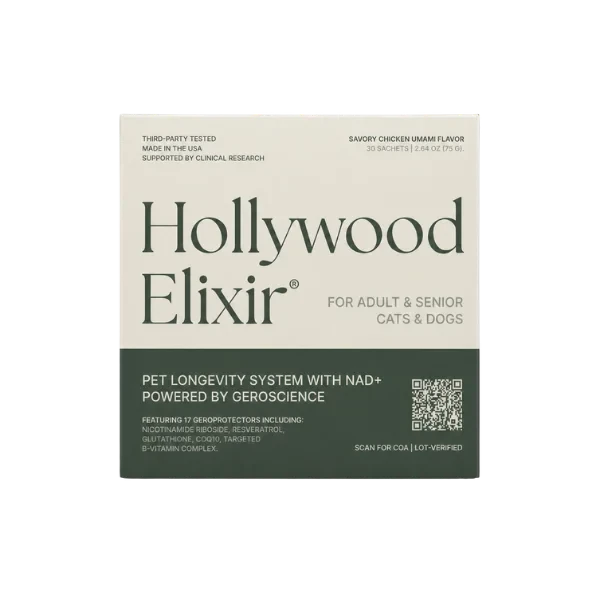
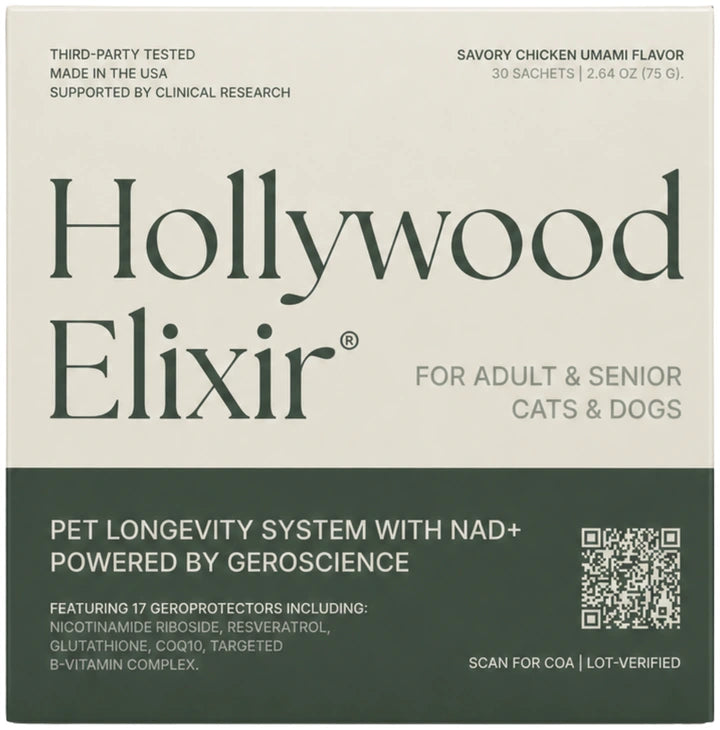
Cordyceps is the mushroom marketed for stamina. The formula's mushroom is reishi, at 25 mg per sachet, and its cell-energy support comes from 40 mg of CoQ10 and 60 mg of nicotinamide riboside, an NAD+ precursor. The label prints those three amounts and the other 14, so you can show your vet exactly what a sachet holds.
Hollywood Elixir is a daily supplement for adult and senior cats. It's a powder mixed into food: half a sachet for cats under 7 lb, one sachet from 7 to 30 lb. It hasn't been tested in cats with kidney disease or FIV, or for lifespan, and it doesn't replace a kidney diet or a diagnosis.
Our guides to reishi for cats, CoQ10 for cats and the best supplements for senior cats put it in context. Read the full Hollywood Elixir ingredient list and serving guide.
So the dog result is a reason for researchers to test cats.
Educational content only. This material is not a substitute for veterinary advice. Always consult your veterinarian about your cat’s specific needs. These statements have not been evaluated by the Food and Drug Administration. Products mentioned are not intended to diagnose, treat, cure, or prevent any disease.
Glossary
Cordyceps: A group of fungi that grow on insects; several species are sold under the one name.
Cordyceps sobolifera: The cordyceps species used in the only cat feeding study.
Fruiting body: The spore-making part of a fungus, as opposed to its thread-like mycelium.
Mycelium: The thread-like body of a fungus, which can be grown by fermentation.
Creatinine: A waste product in blood that vets use to judge kidney function.
Reverse transcriptase: An enzyme that FIV uses to copy itself inside cells.
Related Reading
Aging & Senior Cat Guidance
• Cat Age Calculator: Cat Years to Human Years
• Cat Lifespan by Breed
• Lethargy in Cats
• Senior Cat Not Eating
• Cat Drinking A Lot
• Why Is My Senior Cat Withdrawn?
Healthy Aging Support
• NAD+ for Cats
• NMN for Cats
• Vitamins For Older Cats
• Senior Cat Food
• Longevity Drugs for Cats
References
Numbered references identify the sources used for specific claims. Read the study design, species and evidence boundaries alongside each finding.
- [1]
- [2]
- [3]
- [4]
- [5]
- [6]
- [7]
- [8]
- [9]
- [10]
- [11]
- [12]
- [13]
- [14]
- [15]
- [16]
- [17]
FAQ
Does a dog kidney study prove cordyceps helps my cat?
No. The beagle experiment used a drug-induced injury, one week of cordyceps and a contrast scan, with five dogs per group. A cat with slow, age-related kidney disease is a different patient, and we found no kidney trial of cordyceps in cats.
Can I give my cat a human cordyceps kidney supplement?
It's a poor idea. Human capsules are sized for adults, and no cordyceps amount has been worked out for cats. A kidney formula made for people can also carry herbs and minerals that clash with a cat's kidney diet. Ask your vet before opening the bottle.
Is cordyceps toxic to cats?
We found no report of cordyceps poisoning in cats, and no formal safety study either. In the one feeding study, five healthy cats ate it for 42 days, and their weight gain and stools matched the control cats. Contaminated powder is the clearer risk, since lead poisoning from cordyceps has been reported in people.
Can cordyceps lower a cat's creatinine?
We found no study that measured it in cats with kidney disease. Human trials reported lower creatinine when cordyceps was added to standard care, and reviewers rated that evidence as low quality. A cat's creatinine also moves with hydration and muscle mass, so read any change with your vet.
Does Hollywood Elixir contain cordyceps?
No. Hollywood Elixir has no cordyceps of any kind. Its mushroom ingredient is 25 mg of reishi per sachet, next to 40 mg of CoQ10 and 60 mg of nicotinamide riboside, and it hasn't been tested in cats with kidney disease.
Is a kidney blend with cordyceps better than cordyceps on its own?
Nobody has compared them in cats that we could find. More ingredients mean more things that can upset a cat's stomach or clash with its treatment, and more for your vet to check. A blend earns its place only when every ingredient and amount is on the label.
How long should I try cordyceps before deciding it isn't working?
There's no cat data to set a clock by. The cat feeding study ran 42 days, and one human exercise trial ran 12 weeks. Agree on a review date with your vet, tie it to the next bloodwork, and stop at once if appetite drops.
Can kittens have cordyceps?
We found no study of cordyceps in kittens. The only cat study used healthy adults, so there's no basis for giving it to a growing kitten.
Is cordyceps good for a cat's immune system?
The only cat study measured immune markers, and it reported no gains for the cats eating cordyceps. The improvements went to cats eating a polysaccharide from a different mushroom. We found no study of cordyceps in cats with immune problems.
Will cordyceps give my older cat more energy?
We found no study of cordyceps and energy or activity in cats. A senior cat that's slowing down needs an exam first, since kidney disease alone affects up to 40% of cats over 10.
Discover LPL-01: How This Fits Into a Larger Feline Longevity System
Aging in cats unfolds quietly. It’s not driven by a single failure, but by gradual shifts across interconnected systems — cellular energy, oxidative balance, immune tone, and tissue integrity — each influencing the others over time.
This article explores one layer of that system. To understand what actually shapes long-term health, you need to step back and look at how these layers interact.
Start with the underlying science:
- Feline Geroscience Framework →
A structured view of how aging progresses across cellular energy, inflammation, and resilience systems. - Senior Biological Defense Coverage (BDC) Modeling →
A systems-level map of which biological pathways decline first, and how layered interventions can support them. - 2026 Market Research: Best Cat Longevity Supplements →
A feline-specific review of longevity supplements. 2026 Industry report created by LPL-01 Research. - LPL-01 Standard →
The formulation system that translates these models into real-world supplementation—covering multiple pathways in a coordinated way.
Keep exploring
What would you like to understand next?
Search practical guides about healthy aging, cellular energy, ingredients, and daily support for cats.
Hollywood Elixir®Senior Cat SupplementSenior cat energy, mobility & cognitionFrom$50/moSave up to 47%Save up to 44%Shop Now
Limited time offerEnds Nov 30
Hollywood Elixir®Senior Cat SupplementSenior cat energy, mobility & cognitionFrom$50/moSave up to 47%Save up to 44%Shop Now
Essential Summary
What should cat owners know about cordyceps?
Only one study has fed cordyceps to cats: five healthy adults ate it for 42 days, and no benefit was credited to it.
We found no trial in cats with kidney disease or FIV. The kidney claim comes from human trials and one dog experiment.
Protect appetite and the kidney diet first, and clear any cordyceps product with your vet.

Hollywood Elixir® Senior Cat Supplement
17 science-backed actives in every sachet
Supports senior energy, mobility & cognition
60-day first-box guarantee
Hollywood Elixir is amazing! She put back on 5 lbs to a healthy weight, her eyes are shiny, her coat is beautiful!
— Jessie
She hopped up onto the windowsill again for the first time in years.
— Charlie
Want cell-energy support you can show your vet?
No cordyceps, every amount printed.
Hollywood Elixir gives adult and senior cats 25 mg of reishi mushroom, 40 mg of CoQ10, 60 mg of nicotinamide riboside and 14 more actives per sachet. It hasn't been tested in cats with kidney disease.

Hollywood Elixir® Senior Cat Supplement
17 science-backed actives in every sachet
Supports senior energy, mobility & cognition
60-day first-box guarantee
Learn about how our DVMs think about cat aging
Dr. JoAnna Pendergrass DVM

Hollywood Elixir® Senior Cat Supplement
17 science-backed actives in every sachet
Supports senior energy, mobility & cognition
60-day first-box guarantee
Explore your cat’s changing needs over time
Related Reading
Only 1 study has fed cordyceps to cats: 5 of 20 healthy cats got it for 42 days. See what it found, what the kidney and FIV claims rest on, and the risks.