
The 12 Hallmarks of Aging in Dogs
Read full insightCoQ10 for Dogs
See How CoQ10 Affects Energy Metabolism, Heart Output, and Oxidative Stress
By La Petite Labs Editorial 15 min read

Most owners don’t start searching CoQ10 for dogs because they love supplements. They start because something has shifted: a little less spring on the stairs, a longer pause before the walk, a new murmur noted at a routine visit. CoQ10 enters the conversation as a quiet, plausible support—something the body already uses, now considered in a more intentional way as dogs age. CoQ10 plays a role in cellular energy production, and it’s often discussed for cardiovascular support in older dogs.
A careful approach keeps two truths in view. First, no supplement replaces diagnostics, weight management, dental health, movement, or prescribed medications. Second, aging is rarely a single-ingredient problem. Even when diet provides some CoQ10, the broader system that manages energy and oxidative balance can still benefit from support over time. That’s why some owners look beyond a standalone CoQ10 supplement for dogs and choose a system-level product they can keep consistent—one that supports the wider metabolic network rather than chasing one nutrient in isolation.
- CoQ10 for dogs is most relevant when you’re supporting aging, stamina, or a heart-aware care plan.
- CoQ10 helps cells produce usable energy, which is why changes—if any—tend to be subtle and gradual.
- Diet can contribute CoQ10, but absorption, consistency, and individual needs are why some owners consider supplements.
- In dogs with mitral valve disease, supplementation has been shown to raise plasma CoQ10 levels in a controlled trial (Druzhaeva N, 2021).
- The best CoQ10 for dogs is usually the product your dog will take consistently, in a form designed for absorption.
- CoQ10 is generally well-tolerated, but dosing and fit should be decided with your veterinarian, especially with other medications.
- A system-level aging formula can still make sense because longevity is shaped by networks, not single nutrients.
Why CoQ10 Belongs in the Quiet Conversation About Canine Aging
CoQ10 for dogs sits at an interesting intersection: it’s both familiar (a naturally occurring compound) and, for many owners, newly relevant as dogs live longer. CoQ10 helps cells make usable energy and also plays a role in antioxidant balance, which is why it’s often discussed in the context of aging and cardiac support (German K, 2025). A CoQ10 supplement for dogs is not a shortcut to vitality, but it can be a thoughtful addition when your veterinarian is already watching energy, stamina, or heart-related changes.
Still, the most careful question isn’t “Does CoQ10 exist?” It’s “Will this form, routine, and overall plan fit my dog?” Different CoQ10 supplements for dogs vary in formulation and absorption, and research in dogs has specifically examined how formulations behave in the body (Kommuru TR, 1999). The best CoQ10 for dogs is the one that matches your dog’s needs, tolerability, and your vet’s broader strategy—especially when you’re supporting an aging system rather than chasing a single ingredient.

What CoQ10 Is, and Why Cells Keep It Close
Coenzyme Q10 is present in the body and is involved in cellular energy production, which is why it’s often framed as a “mitochondrial” support nutrient. In plain terms, it helps cells convert fuel into energy the body can use. That matters most in tissues that work hard all day—like the heart and skeletal muscle—especially as dogs get older and recovery becomes less effortless.
Diet can contribute to CoQ10 intake. Foods such as meat and fish are among the dietary sources that may influence levels in a dog’s overall diet. But food intake, absorption, and individual needs don’t always line up neatly, which is why some owners explore a CoQ10 supplement for dogs as part of a vet-guided aging plan rather than as a replacement for nutrition.

CoQ10 Benefits for Dogs: the Heart-focused Context
The most discussed CoQ10 benefits for dogs relate to the heart. CoQ10 supplementation may support cardiovascular health in dogs, particularly in older animals. That wording matters: “support” is not the same as treating disease, and it’s not a substitute for diagnostics, medications, or monitoring. It’s better understood as one tool that may help the body maintain function under the ordinary pressures of aging.
Research in dogs with myxomatous mitral valve disease has evaluated CoQ10 supplementation in a randomized, double-blinded, controlled design and found that supplementation can increase plasma CoQ10 levels (Druzhaeva N, 2021). For owners, the takeaway is modest but useful: CoQ10 can be absorbed and measurably change circulating levels, which supports the logic of choosing a well-formulated product when your veterinarian recommends it.

Energy and Stamina: the Everyday Reasons Owners Notice
Energy is the least glamorous reason CoQ10 matters—and often the most relatable. CoQ10 participates in the electron transport chain, a core step in how cells produce energy (Unknown, 2024). When owners talk about “pep,” they’re often noticing the downstream effects of energy availability: willingness to climb stairs, interest in play, and how quickly a dog rebounds after activity.
This is also why expectations should stay measured. If your dog is tired because of pain, anemia, thyroid disease, or heart failure, CoQ10 won’t paper over that. But when fatigue is part of normal aging—or when your vet is building a broader support plan—CoQ10 can be a reasonable component to discuss.

Oxidative Balance: a Subtle Lever in Long-term Resilience
Oxidative stress is a phrase that gets overused, but the underlying idea is simple: normal metabolism creates reactive byproducts, and the body needs systems to keep them in balance. Supplementation with Coenzyme Q10 may reduce oxidative stress in dogs, alongside potential support for heart function. In an aging dog, that “balance” question tends to show up as slower recovery, less tolerance for heat, or a general sense that the body is working harder to do the same things.
This is where product positioning should be honest: a single nutrient rarely changes the whole story. Owners who do best with supplements treat them as part of a network—nutrition, movement, sleep, and veterinary care—rather than as a lone hero ingredient.
“The best supplement plan is the one that stays calm, consistent, and easy to evaluate.”
Who Might Consider CoQ10 for Dogs, and Who Might Not
Not every dog needs CoQ10. The dogs most commonly considered for supplementation are seniors, dogs with veterinarian-identified heart concerns, and dogs whose stamina has changed in a way that can’t be explained by weight, arthritis, or lifestyle. CoQ10 supplementation is often discussed for cardiovascular support, particularly in older dogs.
If you’re deciding whether CoQ10 for dogs belongs in your routine, start with a simple question: what are you hoping to support, and how will you know if it’s helping? A good answer is specific and observable. A vague answer (“I just want more energy”) is still valid emotionally, but it’s harder to evaluate responsibly.

Form Matters: Absorption, Consistency, and Real-world Use
Formulation is where many supplements quietly succeed or fail. Studies in beagle dogs have examined the pharmacokinetics of different CoQ10 formulations, highlighting that absorption and distribution can vary by product design. For owners, this translates into a practical point: the “best CoQ10 for dogs” is rarely about hype; it’s about a form your dog can absorb and you can administer consistently.
If your dog refuses capsules, a soft chew or liquid may be more realistic. If your dog has a sensitive stomach, taking it with food may matter. These details aren’t trivial—they’re the difference between a supplement that lives in a cabinet and one that becomes part of a stable routine.

What Research in Dogs Can Tell Us, Without Overpromising
One reason CoQ10 appears in heart-focused conversations is that it’s been studied in dogs with specific cardiac conditions. In dogs with myxomatous mitral valve disease, CoQ10 supplementation has been shown to increase plasma CoQ10 levels in a controlled trial (Druzhaeva N, 2021). That doesn’t mean it replaces standard care; it means it can be part of a monitored, layered approach.
If your dog has a murmur or is on a cardiology plan, ask your veterinarian (or cardiologist) how they would define success. Sometimes success is as simple as supporting comfort and maintaining routine—quiet goals that matter a great deal in real life.

Quality Signals: What “Best CoQ10 for Dogs” Usually Means
Owners often want a clean ranking: the best CoQ10 supplements for dogs, in order. But quality is more about signals than superlatives. Look for transparent sourcing, third-party testing when available, and a company that can answer basic questions about stability and shelf life. CoQ10 formulations have been evaluated for stability and bioequivalence in dogs, underscoring that product design matters.
Also consider whether the supplement fits into a broader plan. If you’re already supporting joints, cognition, or metabolic aging, you may prefer a system-level product that reduces “pill burden.” The best CoQ10 supplement for dogs is often the one that integrates cleanly with everything else you’re doing.
How to Choose the Best CoQ10 Supplement for Dogs
If you’re comparing the best CoQ10 supplement for dogs, think like a label reader, not a headline reader. Look for clear ingredient disclosure, consistent dosing per serving, and a form designed for absorption. In dogs, different formulations have been evaluated for pharmacokinetics and bioequivalence, which matters because “more on the label” doesn’t always mean “more available to the body”(Kommuru TR, 1999).
Also consider the practical details that determine whether a supplement actually gets used: palatability, ease of splitting for small dogs, and a routine you can keep steady. The best CoQ10 supplements for dogs are often the ones that disappear into daily life—no drama, no bargaining, no missed days—because consistency is what lets you notice whether anything is changing over time.
“CoQ10 is most useful when it supports a broader plan, not when it tries to replace one.”

DVM Voice: Clinical Vignette of a Common Pattern in Senior Dog Aging
Case provided by JoAnna Pendergrass, DVM
Rex, a 7-year-old Labrador Retriever, was brought in after his owner noticed he was slower to rise, hesitant on stairs, and less able to play as before. Examination showed stiffness and reduced hip mobility; radiographs confirmed degenerative joint changes.
His care required weight management, veterinary-guided pain control, nutritional support, and rehabilitation — a comprehensive plan, but one started only after visible decline appeared.
Clinical takeaway: Rex’s case reflects the value of proactive aging support: maintaining lean body condition, monitoring mobility early, and supporting cellular resilience, antioxidant defense, and healthy inflammatory balance before decline becomes obvious.
Single-case vignette. Not generalizable. Veterinary oversight is essential for pain, stiffness, or suspected joint disease.

CoQ10 Dosage for Dogs: Vet-led Decisions That Stay Sensible
CoQ10 dosage for dogs is a conversation, not a number pulled from a forum. Your veterinarian will weigh the reason you’re using it (general aging support versus a heart-focused plan), your dog’s size, diet, and other products, and whether there are medical conditions that change the risk-benefit balance. CoQ10 is generally considered safe for dogs, with few reported side effects when used appropriately (Unknown, 2024).
In practice, “appropriate” also means choosing a product you can administer consistently and monitoring for small signals: appetite shifts, loose stool, or changes in energy that might be coincidence—or might be your dog telling you the routine needs adjusting. If your dog is on heart medications or has a complex history, treat dosing decisions as part of the full care plan rather than an add-on (Brittany Sood, 2024).

Side Effects and Tolerance: What to Watch Without Worrying
Side effects from a CoQ10 supplement for dogs tend to be uncommon, but “uncommon” isn’t “impossible.” The most typical issues owners report are mild gastrointestinal upset—soft stool, occasional vomiting, or a dog who suddenly finds dinner less appealing. Overall, CoQ10 is generally considered safe for dogs, with few reported side effects (Brittany Sood, 2024).
The more important safety point is context. If your dog has a heart condition, liver disease, is pregnant, or is taking multiple medications, your vet should be the one to decide whether CoQ10 belongs in the stack and how to monitor it. When owners treat supplements as “low stakes,” they sometimes miss the chance to make them genuinely useful.

Medication and Supplement Interactions: Keeping the Full Picture Clear
Interactions are less about CoQ10 being inherently risky and more about your dog’s overall medication picture. If your dog is taking cardiac drugs, seizure medications, or anything that affects appetite and digestion, adding a new supplement can complicate interpretation: is the new cough worse, or is the stomach just unsettled? CoQ10 is widely described as well-tolerated, but it should still be introduced with intention and oversight (Unknown, 2024).
A practical approach is to add only one new variable at a time, keep notes for two to four weeks, and share those notes at recheck appointments. That’s how a supplement becomes part of a thoughtful plan rather than a hopeful pile-on.
Puppies, Adults, Seniors: When CoQ10 Usually Matters Most
Owners often ask whether puppies need CoQ10. Usually, the question is really about future-proofing. In healthy young dogs, the priority is still fundamentals: complete nutrition, parasite prevention, dental habits, and appropriate exercise. CoQ10 is present in the body and is also found in foods like meat and fish, which can influence dietary intake (German K, 2025).
Where CoQ10 becomes more relevant is later—when aging, chronic inflammation, or heart changes make “cellular energy” feel less abstract and more like your dog’s day-to-day. If you’re considering early supplementation, ask your vet what you’re trying to change now, and what you’re simply trying to support over time.
Size, Breed, and Lifestyle: Matching Support to the Dog You Have
Small dogs and large dogs can respond differently to the same routine—not because CoQ10 is different, but because their diets, metabolisms, and health risks differ. Toy breeds may be more sensitive to changes in appetite and stool quality, while large breeds may have different cardiovascular considerations as they age. CoQ10 supplementation is often discussed for cardiovascular support in older dogs (German K, 2025).
Rather than chasing a universal “best CoQ10 for dogs,” focus on fit: a form your dog will take, a schedule you can keep, and a reason that’s tied to real observations—slower recovery after walks, reduced play drive, or a vet-identified heart murmur that’s being monitored.

Dogs Versus Cats: Why Species-specific Choices Reduce Risk
Cats and dogs aren’t interchangeable when it comes to supplements. Even when an ingredient is the same, the product base, flavoring, and dosing logic may not be. If you’re in a multi-pet household, don’t assume a human or feline product is appropriate for your dog. CoQ10 has been studied in dogs with attention to absorption and formulation behavior, which is one reason dog-specific products can be easier to use responsibly (Kommuru TR, 1999).
If your veterinarian approves CoQ10 for both species, treat them as separate decisions: separate products, separate routines, separate monitoring notes. It’s a small discipline that prevents big confusion.

How Long It Takes: Setting Expectations You Can Actually Keep
Timeline matters because it shapes expectations. CoQ10 isn’t a stimulant; it’s part of how cells handle energy and oxidative stress, so changes—if they happen—tend to be subtle and gradual (Brittany Sood, 2024). Many owners who feel satisfied with a routine describe small, quiet wins: steadier interest in walks, less “lag” after activity, or a more consistent mood.
If you want to evaluate whether a CoQ10 supplement for dogs is worth continuing, decide in advance what you’ll track. Pick two or three measures you can actually observe (walk duration, recovery time, appetite consistency) and review them with your vet at a set interval. That’s how you avoid both placebo optimism and premature dismissal.
Why System-level Aging Support Still Makes Sense Beyond CoQ10
A science-minded owner eventually asks a fair question: if CoQ10 is one nutrient, why choose a broader aging formula at all? Because aging rarely moves in a single line. Even when diet provides some CoQ10, the larger challenge is supporting the network that keeps energy production resilient and oxidative stress in check over time. That’s where system-level formulations can make sense—especially when you want consistency, simplicity, and a plan you can sustain.
If your goal is graceful aging rather than chasing one lab value, consider CoQ10 as one piece of a wider picture: movement, dental care, weight stability, and targeted support that respects your dog’s medical history. The best decisions are the ones that remain calm and workable six months from now.
“Aging is a network problem; the most satisfying solutions tend to be network-minded.”
Educational content only. This material is not a substitute for veterinary advice. Always consult your veterinarian about your dog’s specific needs. These statements have not been evaluated by the Food and Drug Administration. Products mentioned are not intended to diagnose, treat, cure, or prevent any disease.
Glossary
- CoQ10 (Coenzyme Q10): A naturally occurring compound involved in cellular energy production and antioxidant balance.
- Ubiquinone: The oxidized form of CoQ10 commonly used in supplements.
- Ubiquinol: The reduced form of CoQ10; some products use it to support absorption or tolerability.
- Electron Transport Chain: A cellular process that helps convert nutrients into usable energy; CoQ10 participates in this process.
- Mitochondria: Cell structures often described as “energy factories,” where much of energy production occurs.
- Oxidative Stress: An imbalance between reactive byproducts of metabolism and the body’s ability to manage them.
- Bioavailability: How much of a supplement is absorbed and becomes available for the body to use.
- Pharmacokinetics: How a compound is absorbed, distributed, and processed in the body over time.
- Myxomatous Mitral Valve Disease (MMVD): A common heart condition in dogs involving degeneration of the mitral valve.
Related Reading
Aging & Senior Dog Guidance
• Dog Age Calculator
• Dog Dementia
• Lethargy in Dogs
• My Dog Won't Eat
• Dog Pacing At Night
• Dog Licking Paws
• Can Dogs Dehydrate
Healthy Aging Support
• NAD+ for Dogs
• NMN for Dogs
• Antioxidants Supplements for Dogs
• Best Senior Dog Supplements & Vitamins
• Rapamycin for Dogs
References
Mansilla WD. Adult dogs of different breed sizes have similar threonine requirements as determined by the indicator amino acid oxidation technique. PubMed Central. 2020. https://pmc.ncbi.nlm.nih.gov/articles/PMC7085255/
German K. Exploratory analysis of nutrient composition of adult and senior dog diets. PubMed Central. 2025. https://pmc.ncbi.nlm.nih.gov/articles/PMC12757753/
Brittany Sood. Coenzyme Q10. 2024. https://www.ncbi.nlm.nih.gov/books/NBK531491
Druzhaeva N. Randomized, double-blinded, controlled trial of the effects of coenzyme Q(10) supplementation on plasma coenzyme Q(10) concentration in dogs with myxomatous mitral valve disease. PubMed. 2021. https://pubmed.ncbi.nlm.nih.gov/33764833/
Kommuru TR. Stability and bioequivalence studies of two marketed formulations of coenzyme Q10 in beagle dogs. PubMed. 1999. https://pubmed.ncbi.nlm.nih.gov/10434405/
Martin SB. Coenzyme Q10 and cognition in atorvastatin treated dogs. PubMed. 2011. https://pubmed.ncbi.nlm.nih.gov/21763754/
Kitano M. Subchronic oral toxicity of ubiquinol in rats and dogs. PubMed. 2008. https://pubmed.ncbi.nlm.nih.gov/18404543/
Harker-Murray AK. The role of coenzyme Q10 in the pathophysiology and therapy of experimental congestive heart failure in the dog. PubMed. 2000. https://pubmed.ncbi.nlm.nih.gov/10997750/
Kobayashi. Effect of supplementation with the reduced form of coenzyme Q10 on semen quality and antioxidant status in dogs with poor semen quality: Three case studies. PubMed Central. 2021. https://pmc.ncbi.nlm.nih.gov/articles/PMC8349810/
Hidaka. Safety assessment of coenzyme Q<sub>10</sub> (CoQ<sub>10</sub>). PubMed. 2008. https://pubmed.ncbi.nlm.nih.gov/19096117/
Yerramilli-Rao P. Oral repeated-dose toxicity studies of coenzyme Q10 in beagle dogs. PubMed. 2012. https://pubmed.ncbi.nlm.nih.gov/22267890/
Druzhaeva N. Effects of Coenzyme Q(10) Supplementation on Oxidative Stress Markers, Inflammatory Markers, Lymphocyte Subpopulations, and Clinical Status in Dogs with Myxomatous Mitral Valve Disease. PubMed. 2022. https://pubmed.ncbi.nlm.nih.gov/35892628/
Kim HT. Evaluation of selected ultra-trace minerals in commercially available dry dog foods. PubMed Central. 2018. https://pmc.ncbi.nlm.nih.gov/articles/PMC6042527/
FAQ
What is CoQ10, and why do dogs naturally have it?
CoQ10 is a compound found in the body that helps cells produce usable energy and also contributes to antioxidant balance. Dogs make and use it every day, especially in tissues with high energy demand.
When owners consider coq10 for dogs, it’s usually to support normal aging or a vet-supervised heart plan rather than to replace basic care. For broader, system-level aging support beyond a single ingredient, consider Hollywood Elixir™.
Which CoQ10 benefits for dogs matter most in daily life?
The most practical benefits owners look for are steadier stamina, smoother recovery after activity, and support for heart-focused wellness as dogs get older. These changes, when they happen, are often quiet rather than dramatic.
It helps to define what you’ll track—walk duration, interest in play, or comfort at rest—so you can review the pattern with your veterinarian. For a broader approach to graceful aging support, many owners pair that mindset with Hollywood Elixir™.
How does CoQ10 work inside a dog’s body?
CoQ10 participates in the electron transport chain, a key step in how cells convert fuel into energy the body can use. It also plays a role in managing oxidative stress, which becomes more relevant as dogs age.
That’s why coq10 for dogs is usually framed as support for resilience over time, not a quick fix. If you prefer a system-level option that supports aging beyond one nutrient, consider Hollywood Elixir™.
Is CoQ10 safe for dogs to take long term?
CoQ10 is generally considered safe for dogs, with few reported side effects when used appropriately. Long-term use should still be guided by your veterinarian, especially if your dog has chronic disease or takes multiple medications.
The goal is a routine that’s both tolerable and easy to monitor, so you can tell what’s helping and what’s noise. For owners who want consistent, broader aging support alongside vet guidance, Hollywood Elixir™.
What side effects might a CoQ10 supplement for dogs cause?
Side effects are typically uncommon, but mild digestive upset can occur—soft stool, occasional vomiting, or reduced appetite. Overall, CoQ10 is described as well-tolerated in dogs.
If anything changes, pause and check in with your veterinarian so you can adjust timing, form, or the broader supplement plan. For a system-level aging routine designed to be easy to keep consistent, consider Hollywood Elixir™.
Are there dogs who should avoid CoQ10 supplements?
Dogs with complex medical histories—especially those on multiple prescriptions, with liver disease, or with active gastrointestinal sensitivity—should only use CoQ10 under veterinary direction. While it’s generally considered safe, “safe” still depends on context and monitoring.
If you’re unsure, bring your full medication and supplement list to your vet and decide together whether CoQ10 fits the plan. For broader aging support that’s designed to complement, not replace, veterinary care, consider Hollywood Elixir™.
What is a reasonable CoQ10 dosage for dogs to discuss?
CoQ10 dosage for dogs should be set by your veterinarian based on your dog’s size, diet, and the reason for use. It’s also influenced by product formulation and how your dog tolerates it.
Because CoQ10 is generally well-tolerated when used appropriately, the key is choosing a plan you can keep steady and monitor for subtle changes. For owners who prefer system-level aging support beyond a single nutrient, consider Hollywood Elixir™.
Can CoQ10 interact with my dog’s heart medications?
Any supplement can complicate a medication plan if it changes appetite, digestion, or how you interpret symptoms. CoQ10 is generally considered safe, but dogs on cardiac medications should add it only with veterinary oversight.
A simple safeguard is to introduce one change at a time and keep notes for your next recheck. If you want a broader aging-support approach that fits alongside a vet-led plan, consider Hollywood Elixir™.
Does CoQ10 help dogs with mitral valve disease?
In dogs with myxomatous mitral valve disease, a randomized, double-blinded, controlled trial found that CoQ10 supplementation can increase plasma CoQ10 levels. That supports the idea that dogs can absorb it in a measurable way.
Whether it belongs in your dog’s plan depends on staging, medications, and your cardiologist’s goals, since it’s not a replacement for standard care. For system-level aging support that complements a careful plan, consider Hollywood Elixir™.
How quickly might I notice changes after starting CoQ10?
If you notice anything, it’s usually gradual—think weeks, not days—because CoQ10 supports cellular energy and oxidative balance rather than acting like a stimulant. Many owners track recovery after walks or steadiness of daily energy.
Pick two observable markers and review them with your veterinarian so you’re not guessing. If you prefer a broader, consistent aging-support routine alongside that tracking, consider Hollywood Elixir™.
What makes the best coq10 for dogs different from others?
The best coq10 for dogs is usually defined by formulation quality, consistency, and how well it’s absorbed. In dogs, different CoQ10 formulations have been studied for pharmacokinetics and bioequivalence, showing that product design can matter.
Beyond the label, the “best” option is the one your dog will take reliably and your vet feels fits the broader plan. For system-level aging support that’s designed to be easy to maintain, consider Hollywood Elixir™.
Should I choose ubiquinone or ubiquinol for my dog?
This is a good question for your veterinarian because the “best” form depends on your dog’s age, digestion, and the specific product’s formulation. What matters most is that the form you choose is stable and absorbed consistently.
Research in dogs has examined formulation behavior and pharmacokinetics, reinforcing that not all products perform the same way. For owners who prefer broader aging support beyond a single form choice, consider Hollywood Elixir™.
Can puppies take CoQ10, or is it only for seniors?
Most healthy puppies don’t need CoQ10 supplementation; their priorities are complete nutrition, growth-appropriate exercise, and preventive care. CoQ10 is naturally present in the body and can also come from dietary sources like meat and fish.
CoQ10 becomes more relevant when aging or a vet-identified concern changes the support picture. If you want a long-term, system-level approach to aging well, consider Hollywood Elixir™.
Is coq10 for dogs helpful for picky eaters or low appetite?
CoQ10 isn’t an appetite stimulant, and a sudden appetite change should be evaluated medically first. Some dogs may experience mild digestive sensitivity with new supplements, so introducing anything new should be done thoughtfully.
If your vet approves CoQ10, choose a form your dog accepts easily and monitor stool and appetite for a couple of weeks. For broader aging support that’s designed to fit into daily routines, consider Hollywood Elixir™.
Can I give my dog human CoQ10 capsules instead?
It’s best not to improvise. Human products may have doses, excipients, or capsule sizes that don’t suit dogs, and it’s harder to keep dosing consistent. In dogs, formulation differences can affect absorption, which is one reason product design matters.
If your veterinarian recommends CoQ10, ask for a dog-appropriate option and a monitoring plan. For system-level aging support that’s built specifically for pets, consider Hollywood Elixir™.
Should CoQ10 be given with food or on an empty stomach?
Many owners find giving CoQ10 with a meal improves tolerance and makes the routine easier to maintain. The best timing is the one that avoids stomach upset and stays consistent day to day.
If your dog has a sensitive stomach or takes other medications, confirm timing with your veterinarian so you can separate variables. For a broader, easy-to-keep aging routine that fits alongside daily feeding, consider Hollywood Elixir™.
How do I evaluate whether a CoQ10 supplement is high quality?
Look for transparent labeling, clear dosing per serving, and quality controls like third-party testing when available. In dogs, studies comparing formulations highlight that stability and absorption can vary, so “more mg” isn’t the only quality signal.
Also consider whether the company can answer basic questions about sourcing and shelf life. For owners who prefer system-level aging support without juggling multiple single-ingredient bottles, consider Hollywood Elixir™.
Do coq10 supplements for dogs replace prescription heart treatment?
No. CoQ10 is best viewed as supportive, not as a substitute for diagnostics, prescription medications, or cardiology monitoring. Research has evaluated CoQ10 in dogs with heart disease, but that doesn’t change the role of standard care.
If your dog has a murmur or heart diagnosis, ask your vet how (or whether) CoQ10 fits into the overall plan and what you’ll monitor. For broader aging support that complements careful care, consider Hollywood Elixir™.
When should I call my vet after starting CoQ10?
Call your vet if you see repeated vomiting, persistent diarrhea, marked appetite loss, new lethargy, or any worsening of existing symptoms. Even though CoQ10 is generally well-tolerated, your dog’s individual context matters.
It’s also worth checking in if you can’t tell whether the routine is doing anything after a reasonable trial, so you can refine the plan. For system-level aging support designed to fit into a vet-guided approach, consider Hollywood Elixir™.
How do I decide between the best coq10 supplements for dogs?
Start with your goal: general aging support, stamina, or a heart-aware plan. Then choose a product form your dog will take consistently, with transparent labeling and a formulation designed for absorption.
Finally, decide how you’ll evaluate it—two or three observable markers reviewed with your veterinarian. If you want a broader approach that supports aging as a network rather than a single nutrient, consider Hollywood Elixir™.

Discover LPL-01: How This Fits Into a Larger Canine Longevity System
Aging in dogs is not driven by a single pathway. It’s the result of interacting biological systems—energy metabolism, oxidative stress, immune signaling, and structural integrity—changing over time.
This article explores one piece of that puzzle. If you want to understand how these pieces connect—and what actually moves the needle—you need to zoom out.
Start with the underlying science:
- Canine Geroscience Framework →
A structured view of how aging progresses across cellular energy, inflammation, and resilience systems. - Senior Biological Defense Coverage (BDC) Modeling →
A systems-level map of which biological pathways decline first, and how layered interventions can support them. - Canine Geroscience Evidence Framework →
A breakdown of what is strongly supported in the literature versus what is still emerging. - LPL-01 Standard →
The formulation system that translates these models into real-world supplementation—covering multiple pathways in a coordinated way.
Essential Summary
Why is CoQ10 for dogs important?
CoQ10 for dogs is best viewed as quiet support for energy and resilience over time. It plays a role in cellular energy production and is often discussed for older dogs and heart-focused care plans. The right choice depends on formulation, tolerability, and veterinary context—not hype or one-size dosing.
If you’re drawn to CoQ10 benefits for dogs but don’t want to chase single-ingredient fixes, Hollywood Elixir is designed for system-level aging support—helping you back the broader metabolic network that shapes energy, recovery, and everyday comfort, even when one nutrient alone isn’t the whole story.
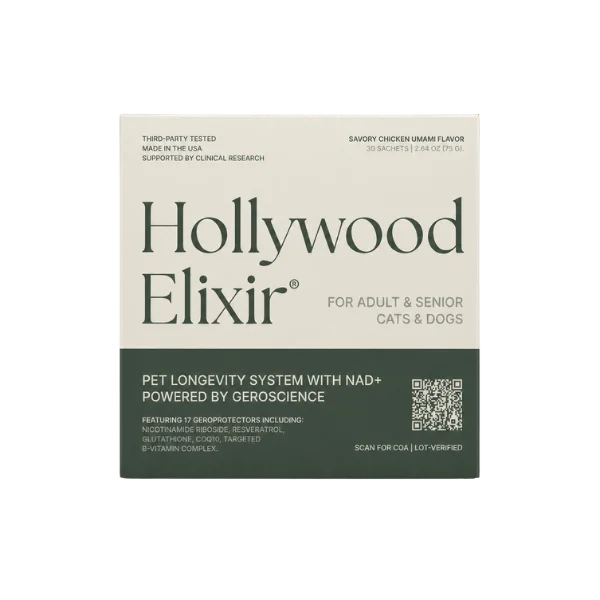
Longevity Core
Hollywood Elixir®
★★★★★(313)
More good years, starting now — steady energy, engagement, and a pet who keeps showing up fully, every day.
Starting at $89/mo
Hollywood Elixir is amazing! She put back on 5 lbs to a healthy weight, her eyes are shiny, her coat is beautiful!
— Jessie
We go on runs. Lately he's been keeping up with no problem!
— Cami
Considering CoQ10 for dogs?
If you're looking for CoQ10 for dogs
If you’re considering CoQ10 for Dogs, start by deciding what you’re supporting and how you’ll measure it. For many families, the goal isn’t a dramatic change—it’s steadier stamina, smoother recovery, and a routine that feels sustainable. Because CoQ10 supports cellular energy and is generally well-tolerated when used appropriately, it can fit well inside a vet-guided aging plan. If you’d rather avoid juggling multiple bottles, a system-level formula can be the more coherent choice: it supports the broader network that shapes energy, resilience, and comfort over time, even when one nutrient isn’t the whole story. That’s the practical reason many owners choose Hollywood Elixir as their daily foundation.
Veterinary Insights

Learn about how our DVMs think about dog aging
Dr. JoAnna Pendergrass DVM


Longevity Core
Hollywood Elixir®
★★★★★(313)
More good years, starting now — steady energy, engagement, and a pet who keeps showing up fully, every day.
Starting at $89/mo
Wellness Tools
Explore your dog’s changing needs over time


Related Reading
Most owners don’t start searching CoQ10 for dogs because they love supplements. They start because something has shifted: a little less spring on the stairs, a longer pause before the walk, a new murmur noted at a routine visit.
