
The 12 Hallmarks of Aging in Dogs, Explained
Read full insightThermoregulation in Dogs
Track panting, circulation, and recovery to prevent heat stress
By La Petite Labs Editorial 15 min read

Dogs cool themselves mainly by panting — evaporative cooling from the mouth and airway — plus shifting blood flow to the tongue and nose; they do not sweat through the skin to lose heat. That’s the heart of canine thermoregulation, and it’s why an older dog panting harder on an ordinary walk is a practical medical question, not trivia.
Senior dogs often overheat faster because those cooling tools — panting, blood-flow shifts, and post-exercise recovery — become less adaptable with age. What looks like “slowing down” can be early heat stress that deserves a call before it escalates. This page follows a vet-visit-prep flow: what triggers concern, what to watch at home, what to record over a 30-day window, and which questions help a clinic triage risk. The main focus is heat stress and heat stroke, with brief context on the opposite problem — hypothermia — because older dogs can swing both ways.
- How do dogs regulate body temperature? Mainly by panting (evaporative cooling) and blood-flow shifts to the mouth and nose — not by sweating to cool; seniors lose adaptability, so heat builds faster.
- Aging, body size, and coat change how dogs handle exercise heat, which is why “same walk, same route” can suddenly feel too hard.
- Early heat stress shows up as jagged recovery: prolonged panting, restlessness, seeking cool surfaces, or refusing to continue — before any collapse.
- Track trend points: panting duration after activity, water intake, nighttime pacing, gum moisture/color, and how fast the dog returns to normal.
- Don’t rely on fans alone, hot-car “just a minute” stops, or ice-cold baths; these can delay real cooling or complicate a crisis.
- Vet-visit prep matters: bring a short log, note medications, and ask which temperatures or breathing patterns mean emergency care.
The Moment Panting Stops Feeling Normal
Thermoregulation in dogs is the balance between heat made inside the body and heat released to the environment — and dogs shed most of that heat through panting and shifts in blood flow, not through sweat glands across the skin. They generate heat through movement and digestion, then off-load it by evaporative cooling at the mouth and airway. When that balance slips, body temperature can climb faster than owners expect, especially on humid days when evaporation works poorly. Seniors have a smaller margin because recovery after exertion slows.
A common trigger is realizing a familiar walk now ends with loud panting that lasts long after the leash comes off. The dog may pace, seek tile floors, or refuse food until breathing settles. Those are decision points: move to a cooler space, offer small amounts of water, and call the veterinarian if recovery feels unusually jagged. Act while the dog is still responsive.
How Do Dogs Regulate Body Temperature? Panting and Heat Exchange
Panting is not just fast breathing; it is a cooling behavior coordinated by the brain’s temperature centers. During panting, blood flow increases to the tongue and oral tissues so evaporation can pull heat from circulating blood (Krönert, 1976). Under heat load, dogs also widen blood vessels in the tongue and nasal region, increasing perfusion to surfaces that can release heat (Thomson, 1980). This design works well in dry air, but it becomes less efficient when humidity is high or airflow is limited.
At home, this explains why a dog may pant harder in a still room than on a breezy porch at the same temperature. It also explains why a closed car, even in mild weather, can overwhelm cooling quickly. Owners can support heat exchange by improving airflow, moving activity to cooler hours, and avoiding muzzles or gear that restricts mouth opening. If panting becomes noisy or strained, airway shape and age-related changes should be discussed with a veterinarian.

Why Senior Dogs Overheat Faster Than They Used To
Aging can make Thermoregulation in Dogs less adaptable because multiple links in the chain change at once: cardiovascular response, respiratory mechanics, muscle efficiency, and recovery timing. Research examining dogs before and after exercise shows thermoregulatory responses vary with age, body mass, and coat characteristics, and those differences matter across seasons (Jimenez, 2023). In practical terms, an older dog may produce similar heat during activity but shed it more slowly afterward. That slower cooldown is often the earliest sign owners can see.
In a household routine, “slowing down” can be misread as stubbornness or arthritis alone. A senior dog that stops in the shade, lies down mid-walk, or pants for a long time after climbing stairs may be signaling heat load rather than attitude. Shorter loops with planned cool-down breaks can keep the day cleaner and more rhythmic. If exercise intolerance appears suddenly, it is also a reason to ask the veterinarian about heart, airway, and endocrine contributors. (see our Dog Life Stages →)
Case Vignette: the Warm-day Walk That Turned Risky
A 12-year-old Labrador finishes a short afternoon walk and keeps panting hard for 25 minutes, then vomits foam and seems disoriented. The owner notices the dog’s tongue looks wider and darker than usual and that the dog cannot settle, even on a cool floor. This is a realistic early heat-stress pattern: prolonged recovery, gastrointestinal upset, and behavior change before any collapse. Heat-related illness can progress quickly once thermoregulation fails (Caldas, 2022).
In that moment, the safest move is to stop activity, move to shade or air conditioning, and begin gentle cooling with cool (not ice-cold) water on the body while arranging veterinary advice. Owners should avoid forcing large volumes of water or resuming the walk “to get home faster.” If the dog shows weakness, persistent vomiting, confusion, or worsening breathing, emergency care is warranted. A short description of timing and signs helps the clinic triage urgency.

Owner Checklist: Early Heat Stress Signs to Check Today
Early heat stress is often visible before a thermometer is ever used. Owners can check: (1) panting that stays heavy beyond 10–15 minutes after rest, (2) bright red or unusually dark gums or tongue, (3) drooling that becomes thick and ropey, (4) restlessness or inability to lie comfortably, and (5) sudden refusal to continue walking despite normal motivation. These signs reflect a dog struggling to shed heat through panting and circulation shifts. When they cluster, risk rises quickly.
This checklist works best when compared to the dog’s normal baseline. A senior dog that always pants lightly after play is different from a senior dog whose breathing becomes loud, frantic, or oddly quiet. Owners can also note environmental context: humidity, sun exposure, and whether the dog had access to water. If any sign is paired with wobbliness, collapse, or confusion, the decision should lean toward urgent veterinary evaluation rather than “watching overnight.”
“Heat risk often shows up as prolonged recovery, not dramatic collapse.”
What to Track over a 30-Day Window
For Thermoregulation in Dogs, trend points are more useful than a single “good day” or “bad day.” Track 3–7 markers: panting duration after walks, time to return to normal behavior, willingness to drink, nighttime pacing on warm evenings, appetite after activity, and any vomiting or diarrhea after heat exposure. Add context for each entry: temperature, humidity, and whether the dog was in sun, shade, or a car. This creates a clearer picture of whether heat handling is becoming more jagged.
A simple phone note can capture this without turning life into a protocol. Owners can use consistent language such as “panting mild/moderate/severe” and “recovered in 10/20/40 minutes.” If the dog takes longer to recover week over week, that pattern is actionable for a veterinarian. It also helps separate heat vulnerability from other causes of exercise intolerance, such as pain, anxiety, or cardiopulmonary disease.

Unique Misconception: “My Dog Pants, so Cooling Is Working”
A common misunderstanding is that panting automatically means a dog is successfully cooling. Panting is the attempt; it is not proof of success. When humidity is high, airflow is poor, or the dog’s airway is compromised, panting can become inefficient and may even add fatigue. Studies of dogs after athletic activity show body temperature regulation varies with season and individual factors, meaning the same panting effort can lead to different outcomes on different days (Russel, 2025).
In the home, this misconception shows up when owners keep playing fetch because the dog “is still panting, so it’s fine.” A safer rule is to watch recovery: if panting stays intense, the dog cannot settle, or behavior changes, the cooling attempt is not keeping up. Seniors deserve earlier breaks, shorter bursts, and more shade than they did at five years old. This mindset shift prevents heat stress from becoming a surprise emergency.

High-risk Dogs: Brachycephalic, Heavy-coated, Large, or Deconditioned
Risk is not evenly distributed across dogs. Body mass, coat type, and age influence thermoregulatory response around exercise and seasonal heat (Jimenez, 2023). Brachycephalic breeds face added challenges because upper-airway anatomy can limit airflow, making evaporative cooling less effective even when the dog tries hard. Heavy coats can trap heat near the skin, and large dogs may carry more heat after exertion simply due to size. Deconditioning matters too: an older dog returning to activity may generate heat quickly without the same adaptability.
Owners can use risk categories to plan routines rather than to label a dog as “fragile.” For high-risk dogs, shift walks to early morning, keep routes close to home, and build in cool-down stops before panting becomes intense. Grooming should focus on mat removal and coat maintenance rather than shaving double coats to the skin, which can change insulation and sun exposure. If a brachycephalic senior shows noisy breathing at rest, that baseline should be shared with the veterinarian before summer arrives.

What Not to Do During Suspected Overheating
When owners suspect overheating, a few common mistakes can waste critical time. Do not keep walking “to get home,” do not leave the dog in a parked car with windows cracked, and do not assume a fan alone will fix the problem in humid air. Avoid forcing a large bowl of water quickly, which can trigger vomiting or aspiration in a distressed dog. Also avoid ice-cold immersion unless a veterinarian specifically directs it, because overly aggressive cooling can complicate monitoring and comfort.
Instead, stop activity immediately, move to shade or air conditioning, and begin gentle cooling with cool water applied to the body while offering small sips if the dog is alert. Owners should call a veterinary clinic for next steps, especially if there is weakness, vomiting, diarrhea, confusion, or collapse. Heat stroke is a life-threatening failure of thermoregulation with systemic complications, so delays matter (Caldas, 2022). The safest plan is to treat concerning signs as time-sensitive.
Calling the Vet: What to Say in the First Minute
A clinic can triage faster when the first description is structured. Start with: the dog’s age, breed, and weight range; what triggered the episode (walk, car, yard play); and how long signs have been present. Then describe the most concerning sign: collapse, confusion, vomiting, diarrhea, or breathing that seems strained. Heat-related illness is associated with hyperthermia and can progress into multi-organ injury, so clinics often prioritize these calls (Romanucci, 2013). Clear timing helps determine whether emergency transport is needed.
Owners should also mention medications and any known heart, airway, or neurologic conditions. If a temperature was taken, share the method and the number, but do not delay transport to obtain it. If the dog is improving with cooling, that is still worth reporting because rebound worsening can occur. The goal of the call is not a diagnosis at home; it is a safe decision about monitoring versus immediate evaluation.
“A senior dog’s cooling span can shrink without obvious warning.”

DVM Voice: Clinical Vignette of a Common Pattern in Senior Dog Aging
Case provided by JoAnna Pendergrass, DVM
Rex, a 7-year-old Labrador Retriever, was brought in after his owner noticed he was slower to rise, hesitant on stairs, and less able to play as before. Examination showed stiffness and reduced hip mobility; radiographs confirmed degenerative joint changes.
His care required weight management, veterinary-guided pain control, nutritional support, and rehabilitation — a comprehensive plan, but one started only after visible decline appeared.
Clinical takeaway: Rex’s case reflects the value of proactive aging support: maintaining lean body condition, monitoring mobility early, and supporting cellular resilience, antioxidant defense, and healthy inflammatory balance before decline becomes obvious.
Single-case vignette. Not generalizable. Veterinary oversight is essential for pain, stiffness, or suspected joint disease.

Vet Visit Prep: Bring These Observations and Questions
For Thermoregulation in Dogs, the best appointment prep is specific and recent. Bring: a 30-day log of panting duration and recovery time, notes on heat exposure (time of day, humidity, car rides), and any videos of breathing at rest and after activity. Add appetite changes, vomiting/diarrhea episodes after warm days, and whether the dog seeks cool surfaces at night. These details help a veterinarian separate heat vulnerability from other causes of exercise intolerance.
Questions to ask: (1) “Which signs mean emergency care rather than home cooling?” (2) “Could airway shape, laryngeal function, or heart disease be limiting cooling?” (3) “What activity level is safe during warm months?” and (4) “Should any medications be adjusted on hot days?” Owners can also ask what a normal recovery window should look like for that dog’s age and body type. This keeps the plan practical and individualized.

What the Vet May Check and What Results Mean
In suspected heat-related illness, veterinarians look beyond temperature because heat can injure organs even after cooling begins. Heat stroke is associated with systemic complications, so a clinic may assess hydration status, cardiovascular stability, and neurologic function, then run bloodwork to check kidney and liver markers, electrolytes, and clotting tendencies (Caldas, 2022). Depending on the history, they may also evaluate airway function, chest imaging, or cardiac testing to understand why cooling capacity is limited. The goal is to identify vulnerabilities that make future episodes more likely.
Owners can use results to shape a follow-up plan rather than to chase a single number. Mild cases may lead to strict heat avoidance and recheck labs, while more severe cases may require hospitalization and monitoring for delayed effects. If tests suggest heart or airway contributors, the plan often shifts toward shorter activity bursts and earlier cooling breaks. Asking the veterinarian how quickly the dog should return to baseline behavior helps owners judge recovery at home.

Heat Stroke Versus Malignant Hyperthermia: Know the Difference
Not every dangerous temperature rise is classic environmental heat stroke. Malignant hyperthermia is a separate, life-threatening hypermetabolic crisis often triggered by certain anesthetics and tied to abnormal skeletal-muscle calcium handling (Rosenberg, 2007). It can look like sudden severe overheating with muscle rigidity and rapid deterioration, typically in a peri-anesthetic setting rather than after a warm walk. This distinction matters because the prevention plan is different: it is about anesthetic history and surgical planning, not summer routines.
Owners should tell the veterinarian if any relative dogs had anesthetic complications or unexplained overheating during procedures. For day-to-day life, most senior-dog episodes are still driven by environmental heat, exertion, humidity, and individual risk factors. Keeping these categories separate prevents false reassurance (“it only happens under anesthesia”) and prevents panic when a dog simply pants after normal play. The clinic can help place the episode in the correct bucket.
Secondary Context: Hypothermia Risk in Older Dogs
Although this page centers on overheating, older dogs can also struggle with cold. Thermoregulation in Dogs is a two-way job: conserving heat in winter and shedding it in summer. Seniors with low body fat, thin coats, or chronic disease may lose heat faster, and some medications can change how a dog responds to temperature extremes. Cold stress can look like shivering, stiffness, reluctance to go outside, and slower movement that is easy to misread as “just aging.”
Household routines can reduce cold strain without turning life upside down. Use coats for thin-coated seniors, shorten winter outings, and provide warm, dry bedding away from drafts. Owners should still watch breathing and recovery after activity, because a dog can be cold-stressed outside and then overheat indoors near heaters. If shivering is persistent or paired with weakness, a veterinary check is appropriate to rule out pain, endocrine disease, or other contributors.
Nutrition and Hydration: Foundations for Cleaner Recovery
Hydration and diet consistency influence how a dog handles heat load, especially during recovery. Commercial adult and senior diets vary substantially in nutrient composition, which can affect how predictable a dog’s daily intake is across brands and formulas (German, 2025). For seniors, abrupt food changes can also create gastrointestinal upset that complicates hot-day management. While nutrition alone cannot “solve” heat vulnerability, it contributes to the broader foundation that supports normal circulation, muscle function, and recovery timing.
Owners can keep routines less jagged by choosing a complete diet the dog tolerates well, avoiding sudden switches before warm seasons, and ensuring water access in every resting area. On hot days, offer small, frequent drinks rather than encouraging a single large gulp after exertion. If a dog is on a prescription diet or has kidney or heart disease, hydration strategies should be discussed with the veterinarian. The goal is predictable intake that supports a predictable cooldown.

Where Hollywood Elixir™ Fits in a Heat-safety Plan
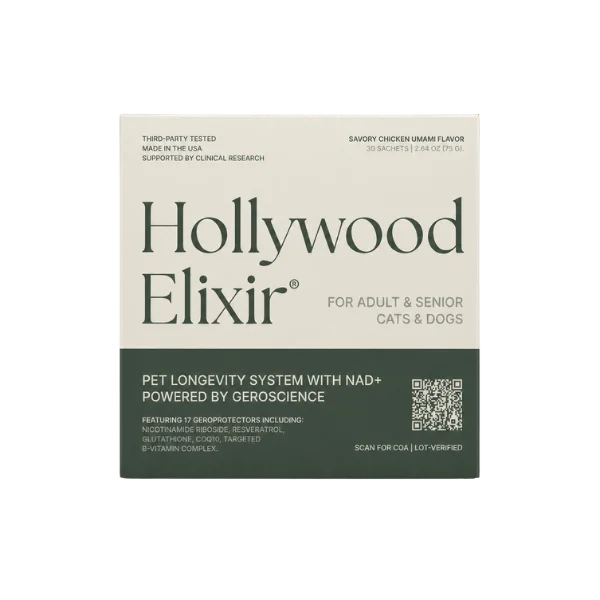
Heat safety is built on environment and timing first — shade, airflow, cooler walk hours, and shorter activity bursts — and no supplement substitutes for those. Supplements sit upstream of symptoms, supporting normal cellular function and everyday aging resilience rather than acting like emergency cooling tools. For owners building a broader senior-care plan that also touches mobility, recovery, and preventive care, Hollywood Elixir can support that daily foundation as part of a daily routine — a food-mixed longevity sachet with readable actives, paired with veterinary guidance for dogs with heart, airway, or endocrine disease. It supports general resilience, not heat tolerance specifically.
To judge fit, track trend points for 30 days: recovery time after walks, nighttime settling on warm evenings, and willingness to move during safe temperatures. Meaningful changes in daily rhythm take weeks to surface. If heat episodes continue, the next step is not more products — it’s rechecking risk factors and adjusting environment and activity with the veterinarian.

Follow-up Plan After an Episode: Prevent the Next One
After a heat-stress scare, the follow-up plan should be written like a household routine, not a one-time warning. Start with thresholds: which signs trigger immediate cooling and a call, and which signs trigger emergency transport. Then adjust exposure: walk timing, route shade, car rules, and play structure. Because heat stroke can involve systemic injury, veterinarians may recommend rechecks even if the dog seems normal at home (Romanucci, 2013). Follow-up protects the dog’s future span for safe activity.
Owners can also plan “recovery architecture”: a cool resting spot, a fan plus open airflow when humidity allows, and a calm post-walk routine that avoids excitement. Conditioning can be rebuilt with shorter, more frequent sessions during safe temperatures rather than weekend bursts. If the dog is brachycephalic or has noisy breathing, follow-up may include airway evaluation before the next warm season. The goal is fewer surprises and a more rhythmic recovery pattern.
Decision Framework: When It’s Safe to Monitor at Home
Home monitoring is only appropriate when the dog is alert, improving steadily with cooling, and able to drink small amounts without vomiting. If Thermoregulation in Dogs is failing, signs tend to escalate: worsening panting, weakness, confusion, persistent vomiting/diarrhea, or collapse. Those signs should be treated as urgent because heat-related illness can progress quickly and involve multiple organs. Owners should choose safety over certainty when the pattern feels abnormal for that dog.
If monitoring is advised by a veterinarian, keep the environment cool and quiet and document trend points: breathing effort, gum moisture/color, ability to settle, and any gastrointestinal signs. Avoid restarting activity the same day, even if the dog seems eager. The next 48 hours should be treated as a recovery window, with conservative routines and close observation. If signs return or become more jagged, re-contact the clinic promptly.
“Better notes at home create faster, safer decisions at the clinic.”
Educational content only. This material is not a substitute for veterinary advice. Always consult your veterinarian about your dog’s specific needs. These statements have not been evaluated by the Food and Drug Administration. Products mentioned are not intended to diagnose, treat, cure, or prevent any disease.
Glossary
- Panting - Rapid, shallow breathing pattern used for evaporative cooling.
- Evaporative Heat Loss - Cooling that occurs when moisture turns to vapor and carries heat away.
- Vasodilation - Widening of blood vessels to increase blood flow to heat-exchange surfaces.
- Heat Stress - Early stage of overheating where cooling is strained but not yet failing completely.
- Heat Stroke - Life-threatening failure of thermoregulation with systemic injury risk.
- Brachycephalic - Short-nosed breed type that may have restricted upper-airway airflow.
- Exercise Intolerance - Reduced ability to sustain activity, often shown by stopping, lagging, or prolonged recovery.
- Humidity - Water vapor in the air that can limit evaporative cooling efficiency.
- Trend Points - Repeatable markers tracked over time to reveal patterns in recovery and heat handling.
Related Reading
Aging & Senior Dog Guidance
• Dog Age Calculator
• Dog Dementia
• Lethargy in Dogs
• My Dog Won't Eat
• Dog Pacing At Night
• Dog Licking Paws
• Can Dogs Dehydrate
Healthy Aging Support
• NAD+ for Dogs
• NMN for Dogs
• Antioxidants Supplements for Dogs
• Best Senior Dog Supplements & Vitamins
• Rapamycin for Dogs
References
Russel. Body Temperature Regulation in Domestic Dogs After Agility Trials: The Effects of Season, Training, Body Characteristics, Age, and Genetics. PubMed. 2025. https://pubmed.ncbi.nlm.nih.gov/39817687/
Jimenez. Effect of different masses, ages, and coats on the thermoregulation of dogs before and after exercise across different seasons. PubMed. 2023. https://pubmed.ncbi.nlm.nih.gov/36449118/
Caldas. Heat stroke in dogs: Literature review. PubMed Central. 2022. https://pmc.ncbi.nlm.nih.gov/articles/PMC11295878/
Krönert. Lingual blood flow and its hypothalamic control in the dog during panting. PubMed. 1976. https://pubmed.ncbi.nlm.nih.gov/1034283/
Thomson. Vasodilatory mechanisms in the tongue and nose of the dog under heat load. PubMed. 1980. https://pubmed.ncbi.nlm.nih.gov/7191979/
Rosenberg. Malignant hyperthermia. PubMed Central. 2007. https://pmc.ncbi.nlm.nih.gov/articles/PMC1867813/
German. Exploratory analysis of nutrient composition of adult and senior dog diets. PubMed Central. 2025. https://pmc.ncbi.nlm.nih.gov/articles/PMC12757753/
Romanucci. Pathophysiology and pathological findings of heatstroke in dogs. PubMed Central. 2013. https://pmc.ncbi.nlm.nih.gov/articles/PMC7337213/
FAQ
What does Thermoregulation in Dogs mean in plain terms?
Thermoregulation in Dogs is the body’s ability to keep temperature in a safe range as weather and activity change. Dogs make heat through movement and normal metabolism, then release heat mainly through panting and shifting blood flow to heat-exchange surfaces.
When this balance becomes less adaptable—common in seniors—dogs can overheat faster and recover more slowly. Owners usually notice it as prolonged panting, restlessness, or refusing to continue a walk.
Why do senior dogs overheat faster on normal walks?
Older dogs often have a smaller span for heat handling because recovery timing changes. Cooling depends on coordinated breathing, circulation, and post-exercise cooldown, and those links can become less adaptable with age.
That is why the same route can suddenly feel “too much.” A useful home marker is how long heavy panting lasts after rest; a longer recovery window is often more meaningful than distance walked.
Is panting always a sign my dog is cooling successfully?
No. Panting is the attempt to cool, not proof that cooling is working. In humid air or still spaces, evaporation is less effective, so panting can stay intense while body heat continues to build.
Watch recovery instead: if panting remains heavy beyond 10–15 minutes, the dog cannot settle, or behavior changes, the cooling attempt may be falling behind. Seniors should get earlier breaks than they did in midlife.
What are early signs of heat stress at home?
Early heat stress often looks like prolonged heavy panting, thick drool, restlessness, and seeking cool surfaces. Some dogs slow down abruptly, refuse to continue walking, or seem unusually anxious after coming inside.
Vomiting or diarrhea after heat exposure is also concerning. If weakness, confusion, collapse, or worsening breathing appears, the safest choice is urgent veterinary evaluation rather than continued home monitoring.
When should a dog go to the emergency vet for overheating?
Emergency care is appropriate if there is collapse, confusion, persistent vomiting/diarrhea, inability to stand, or breathing that seems strained or rapidly worsening. Those signs suggest heat illness may be progressing beyond simple fatigue.
If a dog is not steadily improving within minutes of moving to a cooler space and beginning gentle cooling, a clinic should be contacted immediately. It is safer to be evaluated early than to wait for a dramatic crash.
How can owners cool a dog safely while traveling to the vet?
Move the dog into air conditioning, improve airflow, and apply cool (not ice-cold) water to the body, especially areas with less fur. Offer small sips of water only if the dog is alert and able to swallow normally.
Avoid forcing large volumes of water, and avoid ice baths unless a veterinarian directs it. The goal is steady cooling and rapid transport, not perfect temperature control at home.
What should be tracked for Thermoregulation in Dogs over time?
Useful trend points include panting duration after activity, time to return to normal behavior, nighttime pacing on warm evenings, appetite after walks, and any heat-linked vomiting or diarrhea. Add context: temperature, humidity, sun exposure, and car time.
A 30-day window helps reveal whether recovery is becoming more jagged. This record also improves the veterinary handoff by showing patterns rather than isolated episodes.
Which dogs are at highest risk for heat-related illness?
Senior dogs, brachycephalic breeds, heavy-coated dogs, large dogs, and dogs that are deconditioned tend to be higher risk. Airway anatomy can limit airflow, and coat and body mass can change how quickly heat accumulates and dissipates.
Risk also rises with humidity, direct sun, and exertion. A dog can be “fit” and still be vulnerable if recovery time is long or breathing is noisy at baseline.
Does shaving a double coat help prevent overheating?
Shaving is not a universal solution and can create new problems, including sun exposure and altered insulation. Coat maintenance that removes mats and allows airflow is often more helpful than shaving to the skin.
A veterinarian or groomer can advise based on coat type and skin health. Regardless of haircut, the most reliable prevention is cooler timing, shade, and stopping activity before panting becomes intense.
Can fans prevent heat stroke in a humid home?
Fans can help when they improve airflow across moist surfaces, but humidity limits evaporation. In a humid home, a fan may make owners feel cooler without meaningfully lowering a dog’s heat load.
Air conditioning, dehumidification, shade, and reduced activity are more dependable. If a senior dog pants heavily indoors despite a fan, that is a sign the environment still needs adjustment.
How should owners prepare for a vet visit after overheating?
Bring a short log: when the episode started, how long panting lasted, any vomiting/diarrhea, and how quickly the dog returned to normal behavior. Videos of breathing at rest and after activity can be especially useful.
Also bring a medication list and note any baseline noisy breathing or exercise intolerance. Ask which signs should trigger emergency care and what a normal recovery window should look like for that dog.
What tests might a vet run after suspected heat stroke?
Clinics often assess hydration, cardiovascular stability, and neurologic status, then run bloodwork to check organ markers, electrolytes, and clotting tendencies. These tests help identify complications that may not be obvious once the dog appears calmer.
Depending on history, a veterinarian may also evaluate airway function or heart health to understand why cooling capacity is limited. Follow-up recommendations are based on severity and how cleanly recovery progresses.
Is Thermoregulation in Dogs the same as fever?
No. Fever is a regulated rise in temperature driven by immune signaling, while overheating from heat stress is a failure to shed heat fast enough. The outward signs can overlap—panting, lethargy, poor appetite—so context matters.
If a dog seems hot without clear heat exposure, a veterinarian should evaluate for infection, inflammation, or other causes. Owners should not assume every warm dog is “just overheated,” especially in seniors.
How does brachycephalic anatomy affect cooling and panting?
Brachycephalic dogs may have restricted airflow, which can limit evaporative cooling even when panting is intense. That makes their heat-handling span smaller, especially during humidity, excitement, or exertion.
Owners should treat noisy breathing at rest as a meaningful baseline to share with a veterinarian. Heat planning for these dogs often requires earlier breaks, cooler walk timing, and strict avoidance of hot cars.
Can older dogs also get too cold, and why?
Yes. Thermoregulation in Dogs includes conserving heat in cold weather, and seniors may lose heat faster due to lower body fat, thinner coats, or chronic disease. Some medications can also change how dogs respond to temperature extremes.
Persistent shivering, weakness, or reluctance to move deserves veterinary attention. Winter routines should include warm bedding, shorter outings, and protective coats for thin-coated seniors.
How long should panting last after exercise in a senior dog?
There is no single number that fits every dog, but recovery should trend cleaner with rest in a cool environment. If heavy panting persists beyond 10–15 minutes or the dog cannot settle, that is a useful signal to shorten activity and reassess conditions.
Owners should compare to the dog’s baseline and track changes over a 30-day window. A veterinarian can help define a safe recovery expectation based on breed, body size, coat, and health history.
Can Hollywood Elixir™ replace heat-safety habits or vet care?
No. Hollywood Elixir™ is not an emergency tool and does not replace cooling routines, environmental control, or veterinary evaluation. Heat risk is managed first by timing, shade, airflow, and stopping activity early.
As part of a broader senior plan, it may help support normal cellular function and recovery routines. Any dog with heart disease, airway concerns, or repeated heat episodes should have a veterinarian-guided plan.
How soon might owners notice changes after starting Hollywood Elixir™?
Meaningful changes in daily rhythm typically take weeks, not days, because the goal is upstream support rather than symptom chasing. Owners should keep other variables consistent—diet, walk timing, and activity bursts—while watching trend points.
If using Hollywood Elixir™, track panting duration after safe-temperature walks and time to settle on warm evenings across a 30-day window. Worsening signs should prompt veterinary reassessment rather than waiting for a supplement timeline.
What should owners look for in a quality senior supplement?
Quality signals include clear labeling, consistent manufacturing standards, and a purpose that fits a whole-body aging plan rather than a single dramatic promise. Supplements should be framed as supporting normal function, not as crisis control.
Owners should also consider how the product fits with diet consistency and any prescription foods. A veterinarian can help check for ingredient overlap and decide whether the plan stays cleaner and more rhythmic over time.
Are there medication interactions owners should mention to the vet?
Yes. Owners should share all prescriptions, preventives, and supplements because some medications can affect hydration, heart rate, or heat handling. This context helps a veterinarian interpret panting, weakness, or exercise intolerance more accurately.
If adding Hollywood Elixir™, it should be included on that list. The goal is not to avoid support, but to keep the full plan coherent and safe for a senior dog’s health history.
How is Thermoregulation in Dogs different from cats’ cooling?
Dogs rely heavily on panting and upper-airway evaporation for cooling, while cats tend to pant less and use different behavioral strategies more often. That means dog heat-safety advice cannot be copied directly to cats, and vice versa.
For dogs, the practical focus is airflow, humidity awareness, and recovery timing after exertion. Owners with both species should ask a veterinarian for species-specific guidance rather than assuming the same warning signs apply.

Discover LPL-01: How This Fits Into a Larger Canine Longevity System
Aging in dogs is not driven by a single pathway. It’s the result of interacting biological systems—energy metabolism, oxidative stress, immune signaling, and structural integrity—changing over time.
This article explores one piece of that puzzle. If you want to understand how these pieces connect—and what actually moves the needle—you need to zoom out.
Start with the underlying science:
- Canine Geroscience Framework →
A structured view of how aging progresses across cellular energy, inflammation, and resilience systems. - Senior Biological Defense Coverage (BDC) Modeling →
A systems-level map of which biological pathways decline first, and how layered interventions can support them. - 2026 Market Research: Best Dog Longevity Supplements →
A 2026 industry report and review of leading senior-dog and cellular-aging formulas. - LPL-01 Standard →
The formulation system that translates these models into real-world supplementation—covering multiple pathways in a coordinated way.
Essential Summary
Why Is Thermoregulation in Dogs Important?
Thermoregulation in Dogs determines whether a warm day stays normal or turns into heat stress. Because dogs cool mainly through panting and blood-flow shifts in the mouth and nose, small changes in age, airway shape, or recovery time can meaningfully change risk. Planning ahead keeps daily activity safer.
Hollywood Elixir can be part of a daily plan that supports whole-body aging needs, including cellular health and recovery routines that contribute to a cleaner, more rhythmic response to everyday stressors. It is not a substitute for heat-safety habits or veterinary care, but it may help support the broader foundation senior dogs rely on.
Longevity Core
Hollywood Elixir®
★★★★★(313)
More good years, starting now — steady energy, engagement, and a pet who keeps showing up fully, every day.
Starting at $89/mo
Hollywood Elixir is amazing! She put back on 5 lbs to a healthy weight, her eyes are shiny, her coat is beautiful!
— Jessie
We go on runs. Lately he's been keeping up with no problem!
— Cami
Considering Heat Safety For Seniors?
If You're Researching Heat Stress, Here's What Matters Most
For senior dogs, the most useful plan is the one that owners can repeat: cooler walk timing, shaded rest stops, hydration access, and a simple log of panting and recovery. A supplement should fit upstream of symptoms by supporting normal cellular function and daily regeneration rate, not by promising crisis control. If adding support, discuss how it fits alongside diet consistency, medications, and any heart or airway concerns with the veterinarian.
Veterinary Insights

Learn about how our DVMs think about dog aging
Dr. JoAnna Pendergrass DVM


Longevity Core
Hollywood Elixir®
★★★★★(313)
More good years, starting now — steady energy, engagement, and a pet who keeps showing up fully, every day.
Starting at $89/mo
Wellness Tools
Explore your dog’s changing needs over time


Related Reading
When an older dog starts panting harder on ordinary walks, Thermoregulation in Dogs becomes a practical medical question, not trivia. Senior dogs often overheat faster because their cooling tools—panting, blood-flow shifts to the mouth and nose, and post-exercise recovery—can become less adaptable with age.
