

Phosphatidylserine for Dogs

What six dog trials of PS blends found, the amounts the studies gave, and when an older dog's confusion needs a vet first.

By La Petite Labs Editorial 12 min read

As Seen On

  • AVMA, American Veterinary Medical Association
  • Today’s Veterinary Business
  • Petfood Industry
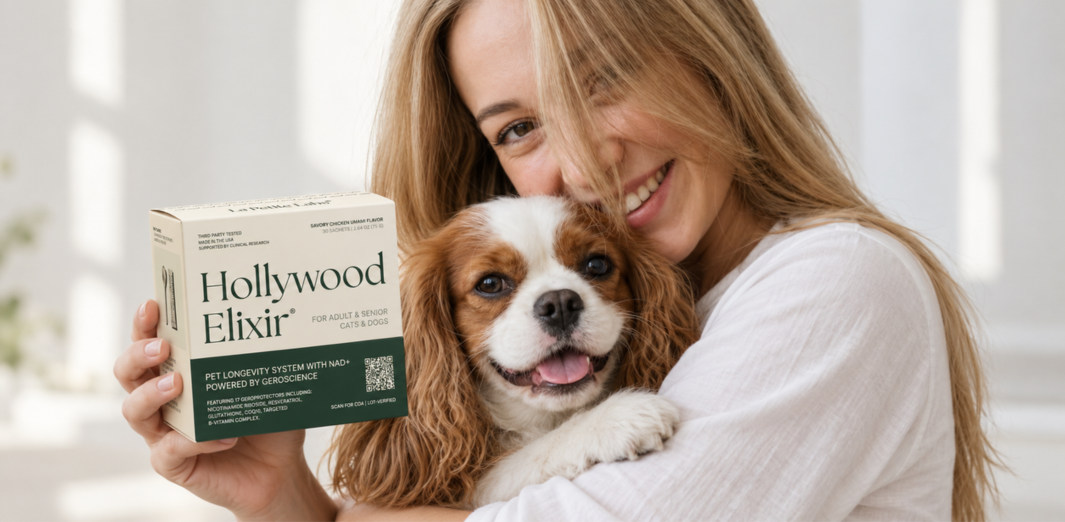
Woman hugging a golden retriever while holding a Hollywood Elixir box
Hollywood Elixir® Senior Dog Supplement

17 science-backed actives

From$50/moSave up to 47%Save up to 44%Shop Now
Contents
Phosphatidylserine (PS) is a membrane fat sold for aging dogs' brains, and we found no trial that tested it on its own in dogs. PS appears in six dog trials, always inside a blend or an enriched food. One blend lifted memory scores in nine aged beagles. A year-long PS-enriched diet made no measurable difference in pet dogs. Reported side effects are few, but we found no formal safety study in dogs.

This guide covers what each trial found, the amounts used, the gaps in the safety record, and when an older dog's confusion needs a vet before a supplement.

  • What it is: Phosphatidylserine (PS) is a fat that sits in cell membranes and is concentrated in nerve tissue.10 Supplement PS is made from soy lecithin.14
  • Dog evidence: Six trials used PS, always in a blend or an enriched food.2 Nine aged beagles scored better on a memory task than at their own baseline.1
  • The catch: A year-long PS-enriched diet made no difference in pet dogs.3, 4 The blend in the beagle study didn't beat the control overall.1
  • Safety: We found no formal safety study in dogs. In people, up to 600 mg a day for 12 weeks caused no more side effects than placebo.15
  • Amount: None is established. The beagle study gave 25 mg of PS per 5 kg of body weight a day.1
  • Vet first: New confusion, night pacing or house soiling in an older dog can come from pain or illness.7 Get those checked before you try a supplement.
  • In Hollywood Elixir: No. Hollywood Elixir has no phosphatidylserine. It's daily nutrition for adult and senior dogs.

What is phosphatidylserine?

Phosphatidylserine, or PS, is a phospholipid: one of the fats that form the membrane around every cell. PS is the main negatively charged phospholipid, and it is especially concentrated in the inner layer of the membrane in nerve tissue.10

The body makes its own. Cells build PS from two other membrane fats by swapping in serine, an amino acid.10 In a survey of grains, vegetables and fruits, PS turned up only in mushrooms.22

Supplement PS has come from two places.

  • Cow brain: the PS in the early human trials was taken from brain cortex.15 Researchers moved away from it because of the possible transfer of infectious disease.17
  • Plant lecithin: PS is now made from soy lecithin with an enzyme and serine.14 The same method works on sunflower and egg lecithin.18

The PS in the main dog study came from non-GM soy.1 Whether extra PS changes how an old dog thinks is what the rest of this page looks at.

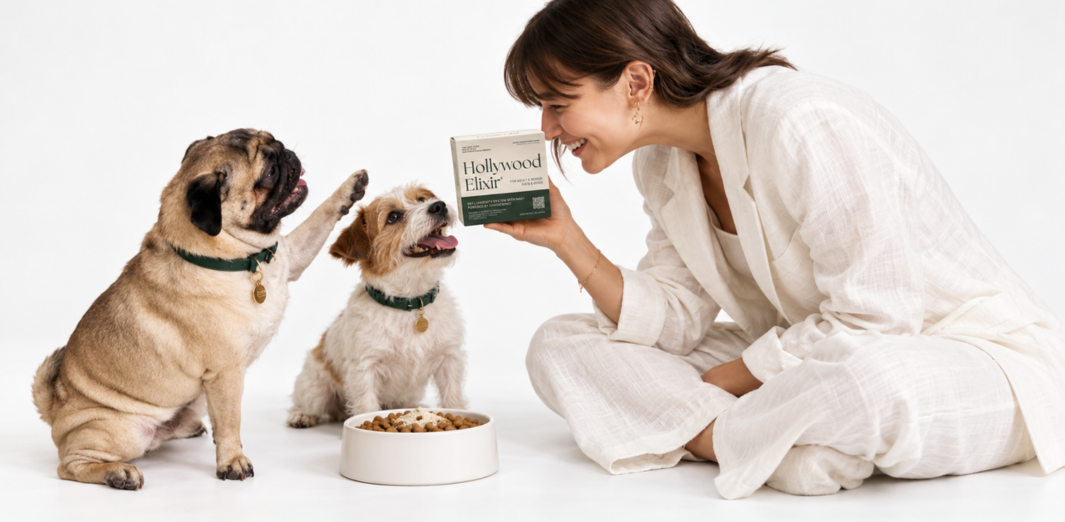
Woman holding a Hollywood Elixir box beside a pug, a terrier and a food bowl

What does phosphatidylserine do in a dog's brain?

Phosphatidylserine sits in the membrane where nerve cells pass signals to one another. PS in that membrane influences the release of chemical messengers and the receptors that receive them.10

That is the logic behind PS supplements. The authors of the main dog study cite laboratory work in which PS stimulated the release of acetylcholine, a messenger involved in memory, in old animals.1 Weaker acetylcholine signaling is one of the changes linked to mental decline in aging dogs.1

A job in the membrane is one thing. Whether a capsule adds to it is another. We found no study that tracked PS in a dog's blood or brain after it was swallowed.

Woman in sportswear holding a Hollywood Elixir box beside a black-and-tan dog outdoors

What did the aged-beagle memory study find?

Phosphatidylserine's best-known dog study tested a commercial blend, Senilife, in nine beagles aged 7 to nearly 13.1 Each capsule held 25 mg of PS with ginkgo biloba extract, vitamin E and vitamin B6.1

Every dog spent 70 days on the blend and 70 days on a plain meatball, with a memory test at the end of each stretch.1

  • Against baseline: dogs were more accurate on the blend than before the study. On the plain meatball they were not.
  • Blend against control: overall, the two periods didn't differ.
  • Order mattered: dogs given the blend second improved on it. Dogs given it first kept their gains after it stopped.

The maker funded the study and supplied the product.1 With four actives in the capsule, PS's own share is unknown.

Woman holding a Hollywood Elixir box above her forehead beside a Bernese mountain dog outdoors

Does phosphatidylserine help dogs with dementia?

Phosphatidylserine blends have been tried in pet dogs with cognitive dysfunction, the condition often called dog dementia. A 2025 systematic review lists three such trials.2

  • 8 dogs, 90 days, no control group: on the beagle-study blend, questionnaire scores improved for orientation, sleep and house training.2
  • 27 dogs, 42 days, control group: an 11-ingredient supplement with PS, omega-3 fats and lipoic acid beat the control on disorientation, interaction, sleep and house soiling.2
  • 10 dogs, 60 days, no control group: scores improved 41% on a mix of herbs and nutrients that included PS.2, 5

Only one trial had a control group, and it tested 11 actives at once. Merck's veterinary manual still lists two PS blends among supplements with demonstrated effects on cognition.6 Our guide to canine cognitive dysfunction covers diagnosis and care.

Golden retriever nuzzling a woman holding a Hollywood Elixir box on the grass beside a food bowl

What did the year-long trial in pet dogs find?

Phosphatidylserine's largest dog trial found no effect. Researchers at the Clever Dog Lab in Vienna enrolled 115 pet dogs older than six and fed them a control food or one enriched with PS, antioxidants, DHA and tryptophan for a year.3 Neither owners nor testers knew which food was which.

After 12 months, the 79 dogs tested learned a touchscreen picture task no faster on the enriched food.3 A second report from the same project, with 119 dogs and 11 tests, found no difference on any of six measures of behavior and thinking.4

Two limits apply. The recipe is confidential, so the PS level is unknown. And family dogs lead stimulating lives, which the authors say may hide a diet effect.3

With four actives in the capsule, PS's own share is unknown.

Is phosphatidylserine safe for dogs?

Phosphatidylserine has raised no safety alarm in dogs, but the safety record is thin. We found no published toxicity or tolerance study of PS in dogs. The evidence is indirect.

  • The beagle study: nine dogs took a PS blend for 70 days and stayed healthy throughout.1
  • The pet-dog trials: these were built to measure behavior, and they report little about side effects.4, 5
  • People: 120 older adults took 300 or 600 mg of soy PS a day, or a placebo, for 12 weeks. Blood tests, blood pressure, heart rate and side effects didn't differ between the groups.15

The gaps are long-term use, puppies, pregnant or nursing dogs, and dogs on several medicines. We found no study of PS in any of them. If your dog has a diagnosed soy allergy, ask the maker where its PS comes from.

Overhead view of a black-and-white dog beside a food bowl and Hollywood Elixir box

What are the side effects of phosphatidylserine in dogs?

Phosphatidylserine's side effects in dogs are barely documented. The clearest report comes from an open-label trial of a multi-ingredient PS supplement: one of 13 dogs recruited went off its food, and the supplement was stopped.5

Human trials are the fuller guide. In a six-month trial, 78 older adults took 100 or 300 mg of soy PS a day or a placebo, and no side effect was traced to PS.14

Whatever the product, watch your dog's appetite, stools and energy for the first two weeks. Stop and call your vet if your dog vomits, has diarrhea, refuses food, or seems more restless or more confused than before.

Woman smiling beside a golden retriever, a green food bowl and a Hollywood Elixir box

How much phosphatidylserine did the dog studies use?

No amount of phosphatidylserine is established for dogs, and we found no authority that sets one. The studies give reference points only.

  • Beagle study: one capsule with 25 mg of PS per 5 kg (11 lb) of body weight, once a day.1
  • All dog trials: a systematic review worked out PS amounts of 0.2 to 6.3 mg per kg of body weight.2
  • Human trials: 100 to 600 mg a day.13, 14

These figures describe what researchers gave. They aren't a serving guide for your dog. If your vet supports a trial, follow the product's own label and agree on the amount before you start.

Man holding a Hollywood Elixir box while sitting on an outdoor sofa with a golden retriever

How long does phosphatidylserine take to work in dogs?

Phosphatidylserine trials in dogs mostly checked for change after one to three months. The beagles were tested after 60 days on the blend.1 In the pet-dog trials, questionnaire scores had improved at 30, 42 and 90 days.2, 5

Two cautions go with those numbers. Questionnaires without a control group pick up hope as well as change. And the one trial that ran a full year found nothing.3

A fair test is to choose two or three specific problems, such as getting stuck behind furniture or waking at night, and count them each week. If nothing has changed after three months, PS isn't helping your dog.

What does the human research on phosphatidylserine show?

Phosphatidylserine has a longer record in people than in dogs, and the results depend on where the PS came from.

  • Cow-brain PS, 149 adults: 300 mg a day for 12 weeks improved learning and memory tests compared with placebo in people with age-related memory loss.11
  • Cow-brain PS, 494 patients: six months of 300 mg a day improved behavior and memory measures compared with placebo in older patients with cognitive decline.12
  • Soy PS, 120 adults: 300 or 600 mg a day for 12 weeks did no better than placebo on any test.13
  • Soy PS, 78 adults: over six months, scores rose as much on placebo as on PS. Only people who started with low scores improved on PS and not on placebo.14

So the best human results belong to a form of PS that is no longer used. The soy form now sold has a mixed record, though it matched cow-brain PS on one learning test in rats.17 None of this was done in dogs.

So the first step is a diagnosis, not a product.

Woman sitting with a beagle in a kitchen while holding a Hollywood Elixir box

DVM Voice: Clinical Vignette of a Common Pattern in Senior Dog Aging

Case provided by JoAnna Pendergrass, DVM

Rex, a 7-year-old Labrador Retriever, was brought in after his owner noticed he was slower to rise, hesitant on stairs, and less able to play as before. Examination showed stiffness and reduced hip mobility; radiographs confirmed degenerative joint changes.

His care required weight management, veterinary-guided pain control, nutritional support, and rehabilitation — a comprehensive plan, but one started only after visible decline appeared.

Clinical takeaway: Rex’s case reflects the value of proactive aging support: maintaining lean body condition, monitoring mobility early, and supporting cellular resilience, antioxidant defense, and healthy inflammatory balance before decline becomes obvious.

Single-case vignette. Not generalizable. Veterinary oversight is essential for pain, stiffness, or suspected joint disease.
Explore Hollywood Elixir Research →
Spotted gray dog beside a Hollywood Elixir box held in a person's hand

Which dogs should not have phosphatidylserine?

Phosphatidylserine hasn't been studied in several kinds of dog. For these, skip it unless your vet says otherwise.

  • Puppies and young adults. The dog trials we found enrolled dogs older than six.1, 2, 3
  • Pregnant or nursing dogs. We found no data.
  • Dogs on prescription medicine for the brain or behavior, such as selegiline. We found no study of the combinations.
  • Dogs whose behavior has changed suddenly or quickly. They need a diagnosis first.

A healthy young dog has no known use for PS. The beagle authors suggested starting before signs appear, but we found no trial of that idea.1

Golden retriever nuzzling a man holding a Hollywood Elixir box beside a food bowl

Does phosphatidylserine lower cortisol or calm an anxious dog?
Phosphatidylserine's link to cortisol comes from human research. Cortisol is the hormone whose long-term excess causes most signs of Cushing's disease in dogs.23 In one study of nine healthy men, 800 mg of brain-derived PS a day for 10 days blunted the rise in cortisol after exercise.16

Dogs have nothing comparable. We found no study of PS for anxiety, noise fears or cortisol in dogs, with or without Cushing's disease.

Cushing's disease needs a diagnosis and treatment from your vet. Tell them about every supplement your dog takes, and don't use PS in place of a prescribed medicine.

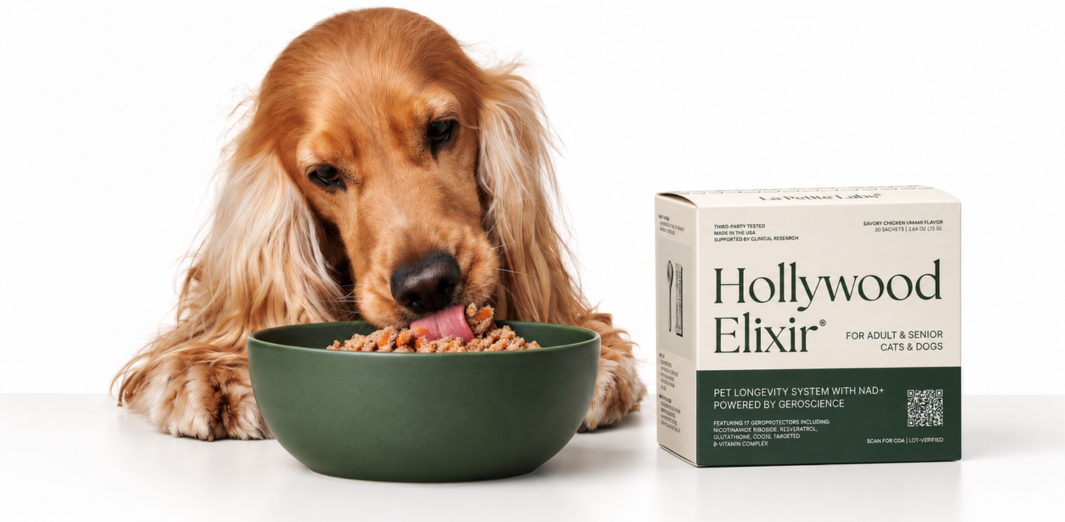
Golden spaniel eating from a green bowl beside a Hollywood Elixir box

Is phosphatidylserine worth trying for a senior dog?

Phosphatidylserine is a fair thing to ask about, because the problem it targets is common. In a survey of owners of 180 dogs, 28% of dogs aged 11 to 12 and 68% of dogs aged 15 to 16 were impaired in at least one area of behavior.8 In another survey, an estimated 14.2% of older dogs had cognitive dysfunction, yet only 1.9% had a vet's diagnosis.9

So the first step is a diagnosis, not a product. If your vet confirms cognitive dysfunction, PS is a low-priority extra: its trials are small, mixed or negative, and other options have firmer support. If you try it, change one thing at a time so you can tell what helped.

How do you choose a phosphatidylserine product for a dog?

A phosphatidylserine product for a dog should state how much PS is in each serving. That matters because PS is usually one part of a blend, as it was in every dog trial.2

Look for:

  • the PS amount per serving in milligrams, not only the weight of a proprietary blend;
  • the source, such as soy or sunflower lecithin;
  • each other active with its own amount;
  • a feeding guide by body weight, written for dogs.

Then compare the product with what was tested. The beagle blend supplied 25 mg of PS per 5 kg of body weight a day, with ginkgo, vitamin E and vitamin B6.1 Our Senilife comparison for dogs looks at that blend in detail.

Human PS capsules are sized for adults: the human trials used 100 to 600 mg a day.13, 14 Don't cut one down by guesswork.

Printed amounts are the test we hold our own label to. Hollywood Elixir lists all 17 actives with their amounts, and PS isn't one of them. Our guide to cognitive supplements for dogs compares the wider field.

Is phosphatidylserine different for dogs and cats?

Phosphatidylserine has thin evidence in dogs and none in cats.

  • Trials: dogs have six trials of PS blends and enriched foods. The same review found only two cat trials of any brain-support nutrition, and neither included PS.2
  • Products: PS blends are labeled for cats too, but a feline review noted that no efficacy studies in cats had been published.19
  • Blend partners: one PS supplement tested in dogs contains alpha-lipoic acid.2 In a tolerance study, lipoic acid damaged liver cells in cats, and the most they could tolerate was under 30 mg per kg.20 A separate cat version leaves it out.19

A dog blend shouldn't be shared with a cat in the same house, even in a smaller serving. Our guide to phosphatidylserine for cats covers the feline side.

Woman holding a Hollywood Elixir box beside a dapple dachshund and green food bowl on a sofa

When should you see the vet instead of trying phosphatidylserine?
Phosphatidylserine shouldn't be the first response to a dog that seems confused. Cornell's veterinary college lists the usual signs of cognitive dysfunction: getting lost in familiar places, staring into space, wandering at night, house soiling, new anxiety and forgetting known commands.7

Each of those signs has other causes. Vets check for pain, arthritis, seizure disorders, body-wide illness, and loss of sight or hearing before they settle on a diagnosis.7

Book a visit when you first notice a change. Go the same day if your dog suddenly circles, tilts its head, can't stand, has a seizure or stops eating. Our guides to a dog pacing at night and a dog that seems confused cover those two signs in more depth.

Woman cuddling a brown-and-white spaniel while holding a Hollywood Elixir box

What works better than phosphatidylserine for an aging dog's brain?

Several options have firmer support than phosphatidylserine for an aging dog's brain.

  • Selegiline: a prescription medicine approved in North America for cognitive dysfunction in dogs.6 See our selegiline guide.
  • MCT-enriched food: in an 87-dog trial, a diet with 6.5% MCT oil and a nutrient blend improved all six groups of signs over 90 days. The control food improved four.21 Our MCT oil guide has the details.
  • Omega-3s: a systematic review found benefits for thinking in aging pets, especially at higher intakes.2
  • Enrichment: Cornell's vets recommend regular play, varied toys and exercise to stimulate the brain.7

PS can sit beside any of these if your vet agrees. It shouldn't replace them.

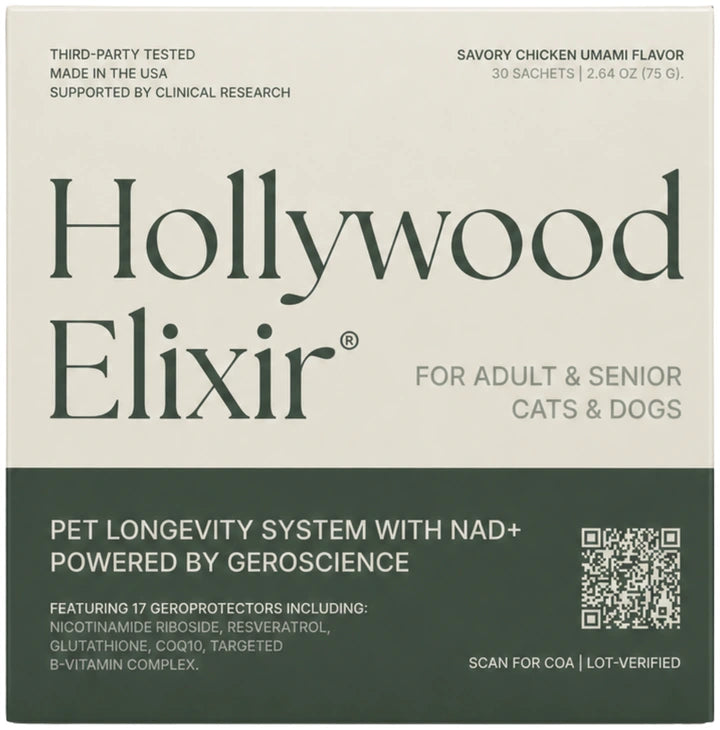
Is phosphatidylserine in Hollywood Elixir?

No. Hollywood Elixir doesn't contain phosphatidylserine, and it isn't a treatment for cognitive dysfunction.

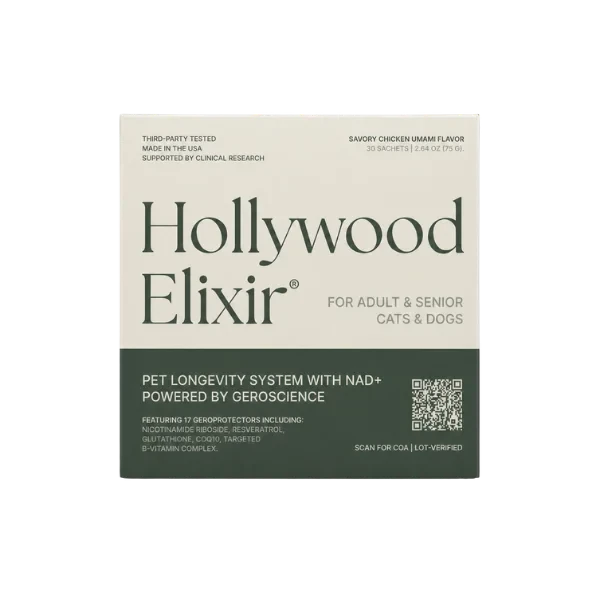
PS is a membrane fat. Hollywood Elixir takes a different route and supports cell energy. Each sachet has 60 mg of nicotinamide riboside, an NAD+ precursor, and 40 mg of CoQ10, plus 50 mg of blueberry powder. The other 14 actives are listed on the label with their amounts.

It's a daily nutrition powder for adult and senior dogs. You stir it into food: half a sachet for dogs under 7 lb, one sachet from 7 to 30 lb, two sachets over 30 lb. Hollywood Elixir is a supplement, not a medicine, and it hasn't been tested for memory, cognitive dysfunction or lifespan.

If PS caught your eye because your dog is slowing down, the label is a good place to start. See the full Hollywood Elixir formula and serving guide.

Questionnaires without a control group pick up hope as well as change.

Educational content only. This material is not a substitute for veterinary advice. Always consult your veterinarian about your dog’s specific needs. These statements have not been evaluated by the Food and Drug Administration. Products mentioned are not intended to diagnose, treat, cure, or prevent any disease.

Glossary

Phosphatidylserine (PS): A fat molecule found in cell membranes and concentrated in nerve tissue.

Phospholipid: The family of fats that forms cell membranes. PS is one member.

Lecithin: A mix of phospholipids from soy, sunflower or egg, and the starting material for supplement PS.

Cognitive dysfunction: Age-related brain decline in dogs, with confusion, sleep changes and house soiling.

Crossover study: A trial in which each animal gets both the test product and the control, one after the other.

Acetylcholine: A chemical messenger that nerve cells use in memory and learning.

Related Reading

References

Numbered references identify the sources used for specific claims. Read the study design, species and evidence boundaries alongside each finding.

FAQ

Is phosphatidylserine toxic to dogs?

We found no report of PS poisoning in dogs, and no formal toxicity study either. Nine beagles stayed healthy through 70 days on a PS blend. If your dog eats a whole container of any supplement, call your vet or an animal poison line.

Can I give my dog human phosphatidylserine capsules?

It's a poor idea. Human trials used 100 to 600 mg of PS a day, while the beagle study gave 25 mg per 5 kg of body weight. Use a dog product your vet has seen.

Does Hollywood Elixir contain phosphatidylserine?

No. Hollywood Elixir has no phosphatidylserine. It supplies 60 mg of nicotinamide riboside, 40 mg of CoQ10 and 50 mg of blueberry powder per sachet, and it isn't a treatment for cognitive dysfunction.

Can phosphatidylserine reverse dementia in dogs?

We found no evidence that it can. The beagle study measured a short-term memory task in healthy aged dogs, and the trials in pet dogs with cognitive dysfunction were small, short and used blends.

Can phosphatidylserine be given with selegiline?

We found no study of PS combined with selegiline in dogs. Selegiline is a prescription medicine, so ask the vet who prescribed it before you add any supplement, and never swap one for the other.

Does phosphatidylserine help dogs with Cushing's disease?

We found no dog study. The nearest evidence is a study of nine healthy men whose cortisol rise after exercise was blunted by 800 mg of PS a day. Cushing's disease needs a vet's diagnosis and treatment.

Should a young, healthy dog take phosphatidylserine to protect the brain?

We found no evidence for it. The dog trials enrolled dogs older than six, and a year-long PS-enriched diet made no measurable difference even in that age group.

Which foods contain phosphatidylserine?

The body makes its own PS, so food isn't the only supply. In a survey of grains, vegetables and fruits, PS turned up only in mushrooms. Supplement PS is made from soy lecithin, and the same method works on sunflower lecithin.

Is sunflower or soy phosphatidylserine better for dogs?

We found no dog study that compared sources. The main dog study used soy PS. In rats, soy PS performed like cow-brain PS on a learning test, while egg PS did not.

Does a quieter dog mean phosphatidylserine is working?

Not always. A dog that paces less may be calmer, or may be sleeping more or feeling unwell. Track specific things, such as getting stuck in corners or waking at night, and tell your vet about any drop in appetite.

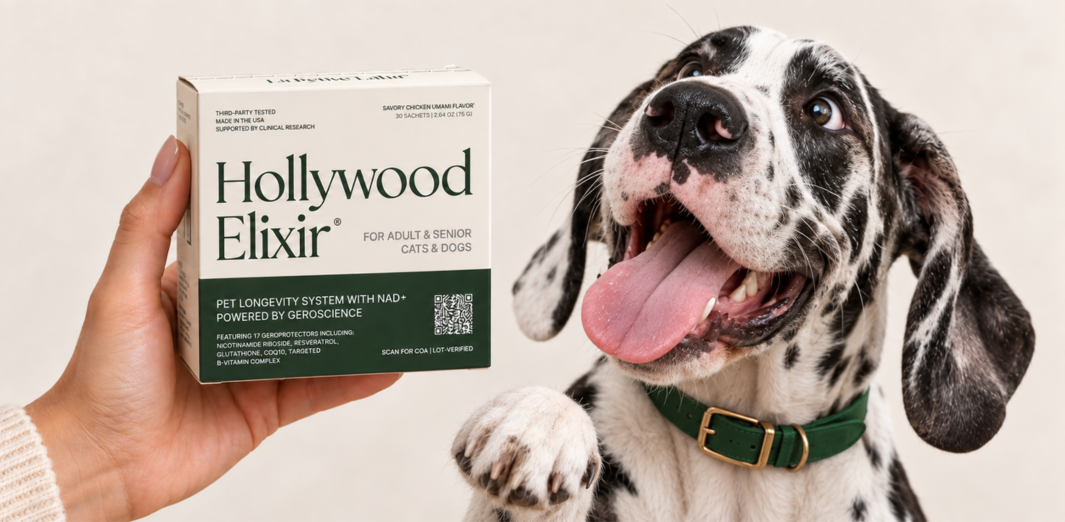
Dalmatian looking toward a Hollywood Elixir box held in a person's hand

Discover LPL-01: How This Fits Into a Larger Canine Longevity System

Aging in dogs is not driven by a single pathway. It’s the result of interacting biological systems—energy metabolism, oxidative stress, immune signaling, and structural integrity—changing over time.

This article explores one piece of that puzzle. If you want to understand how these pieces connect—and what actually moves the needle—you need to zoom out.

Start with the underlying science:

Keep exploring

What would you like to understand next?

Search practical guides about healthy aging, cellular energy, ingredients, and daily support for dogs.